Low Poly Art Style
Explore low poly art: crisp flat-shaded facets, geometric landscapes, and crystalline 3D forms shaped by digital modeling and minimalist design.
Instantly rendered in Low Poly — or transform a photo


Low Poly Gallery
Tap any artwork to explore it


What is Low Poly Art Style?
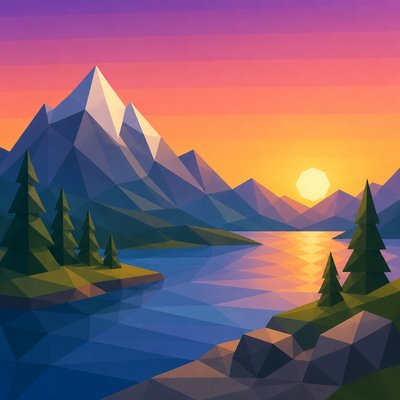
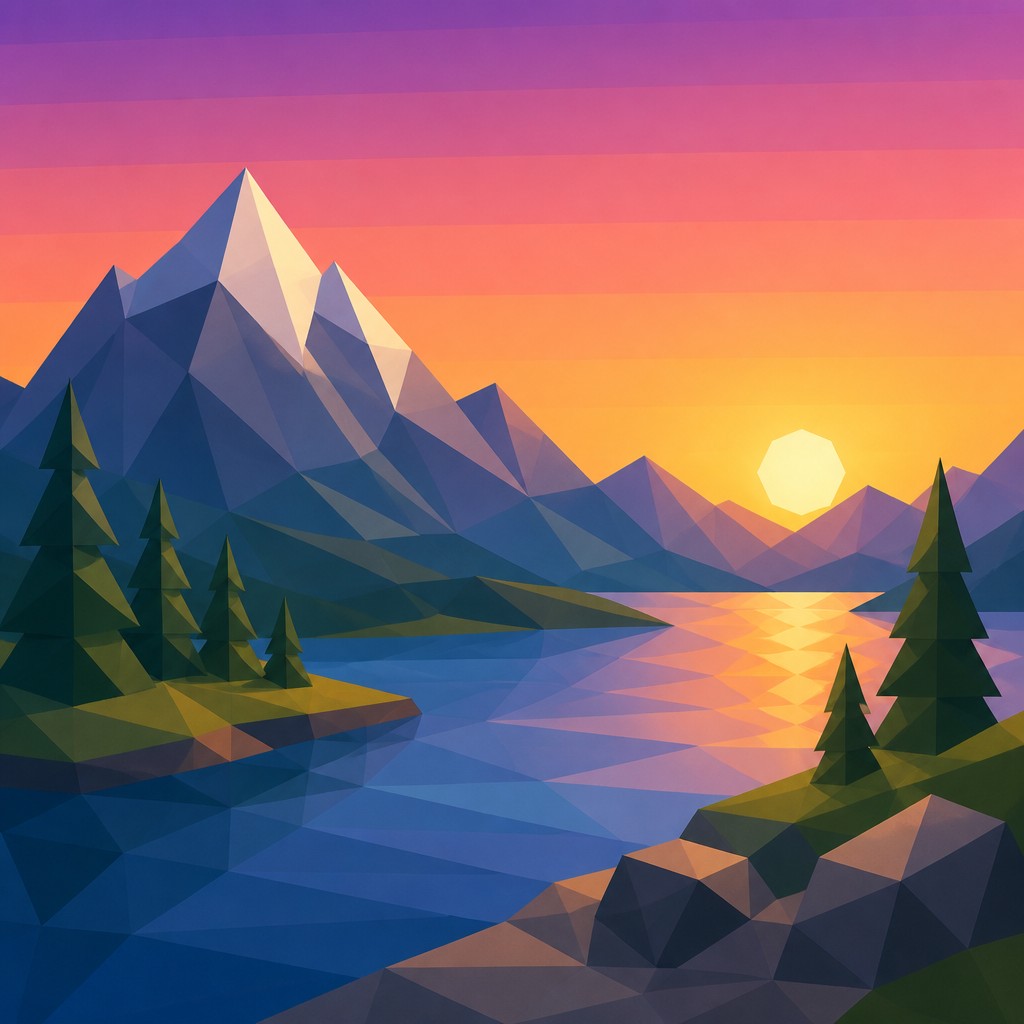
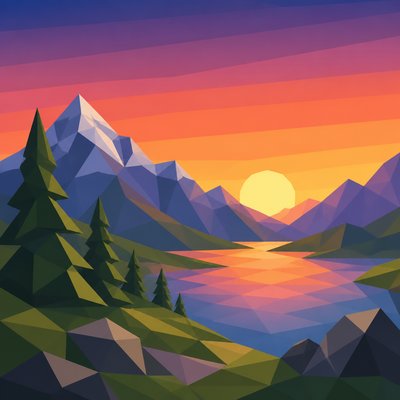
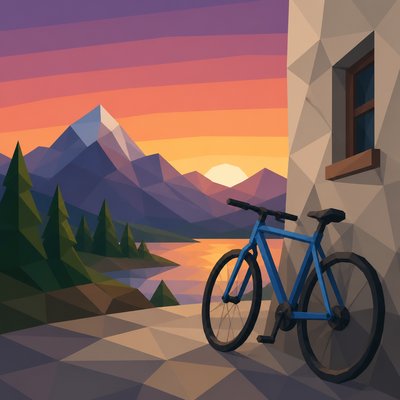
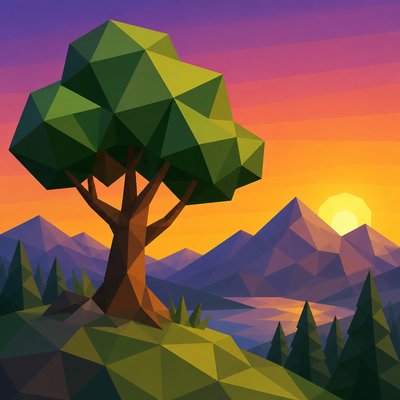
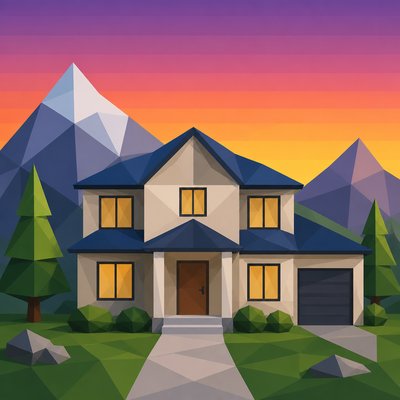
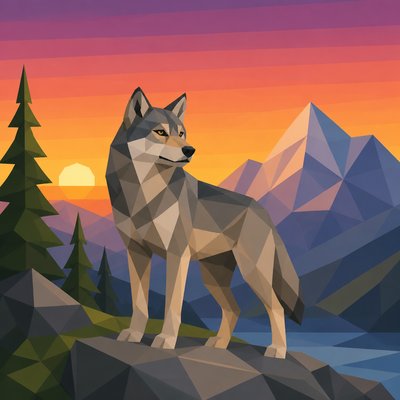
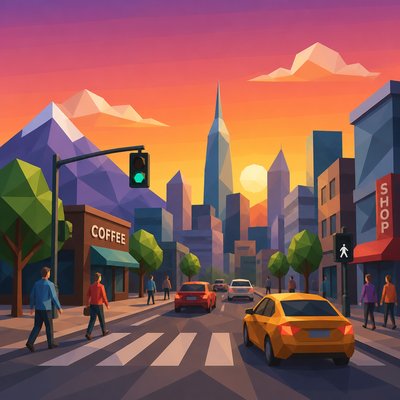
Low poly art is a geometric visual style built from a deliberately limited number of polygonal faces. Objects, landscapes, characters, and environments are reduced to angular planes, most often triangles, with each face assigned a single flat color or tone. The result is a crystalline image with sharp silhouettes, visible construction, and little or no surface texture.
The style looks the way it does because it treats form as a collection of simplified planes rather than as a continuous, smoothly modeled surface. Faceted geometry produces clear changes in light and color across an object, while restrained detail keeps the composition readable. Low poly scenes often combine hard-edged foreground forms with simplified atmospheric elements such as banded skies, geometric mountains, and sparsely arranged trees.

Try It On Your Photos
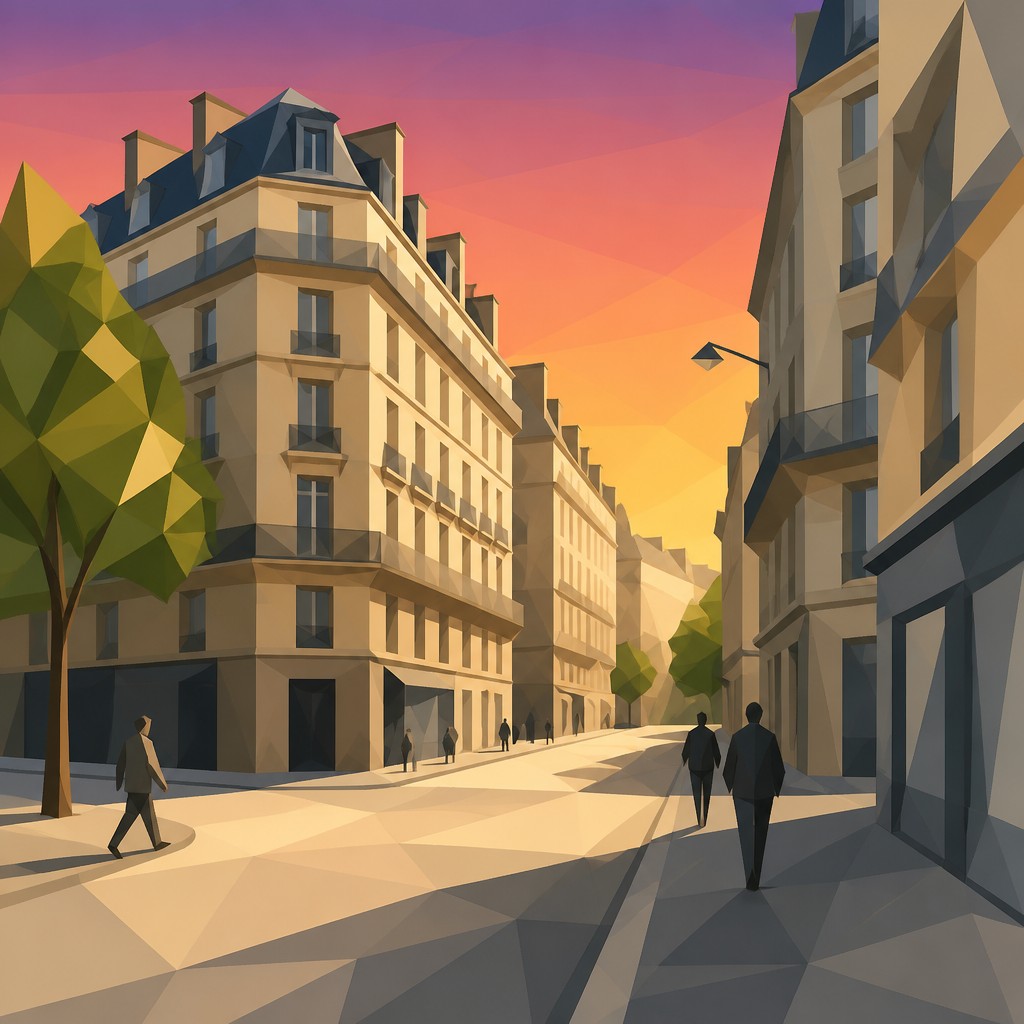
Upload any photo and convert it into Low Poly Art Style — drag the sliders to compare before and after.



What Defines Low Poly Art Style
The signature details, up close
Visible polygonal facets
Forms are divided into crisp triangular or polygonal planes whose boundaries remain visually legible. The mesh functions as part of the image rather than remaining hidden beneath a smooth surface.
Flat shading
Each polygon typically carries a uniform color or value instead of a smoothly interpolated gradient. Lighting therefore appears as distinct tonal steps across the object.
Simplified geometry
Complex subjects are reduced to a small number of carefully placed planes. Curves, foliage, anatomy, and architecture become angular approximations that preserve the subject's essential silhouette.
Crisp silhouettes
Hard edges and clearly separated shapes give the work a clean, constructed appearance. Unnecessary contours, texture noise, and fine surface detail are usually removed.
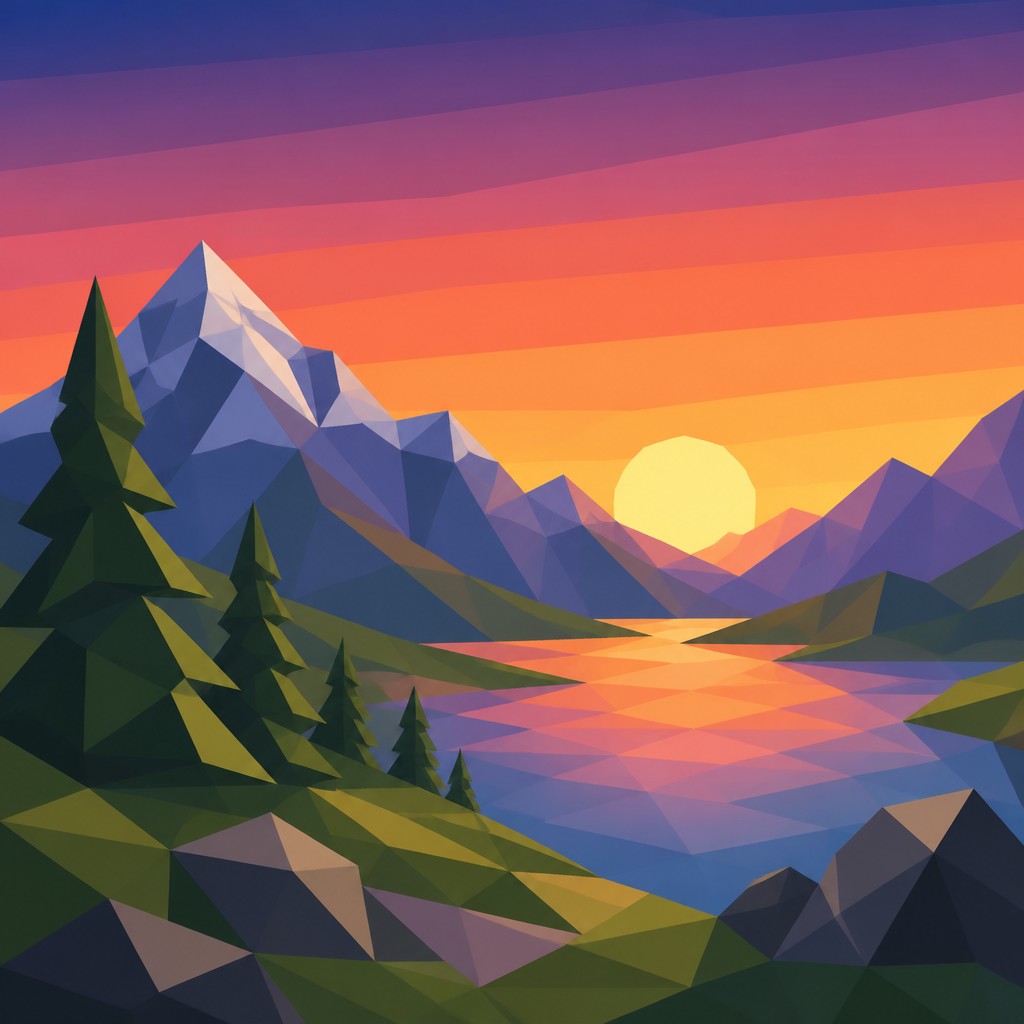
Controlled color planes
Color is organized into discrete regions that describe light, shadow, depth, or material. Sunset skies may use smooth horizontal bands, while landforms and objects use faceted shifts in hue and value.

Limited visual detail
Low polygon counts create open areas and strong visual hierarchy. Sparse vegetation, simple props, and uncluttered backgrounds help the principal forms remain immediately recognizable.
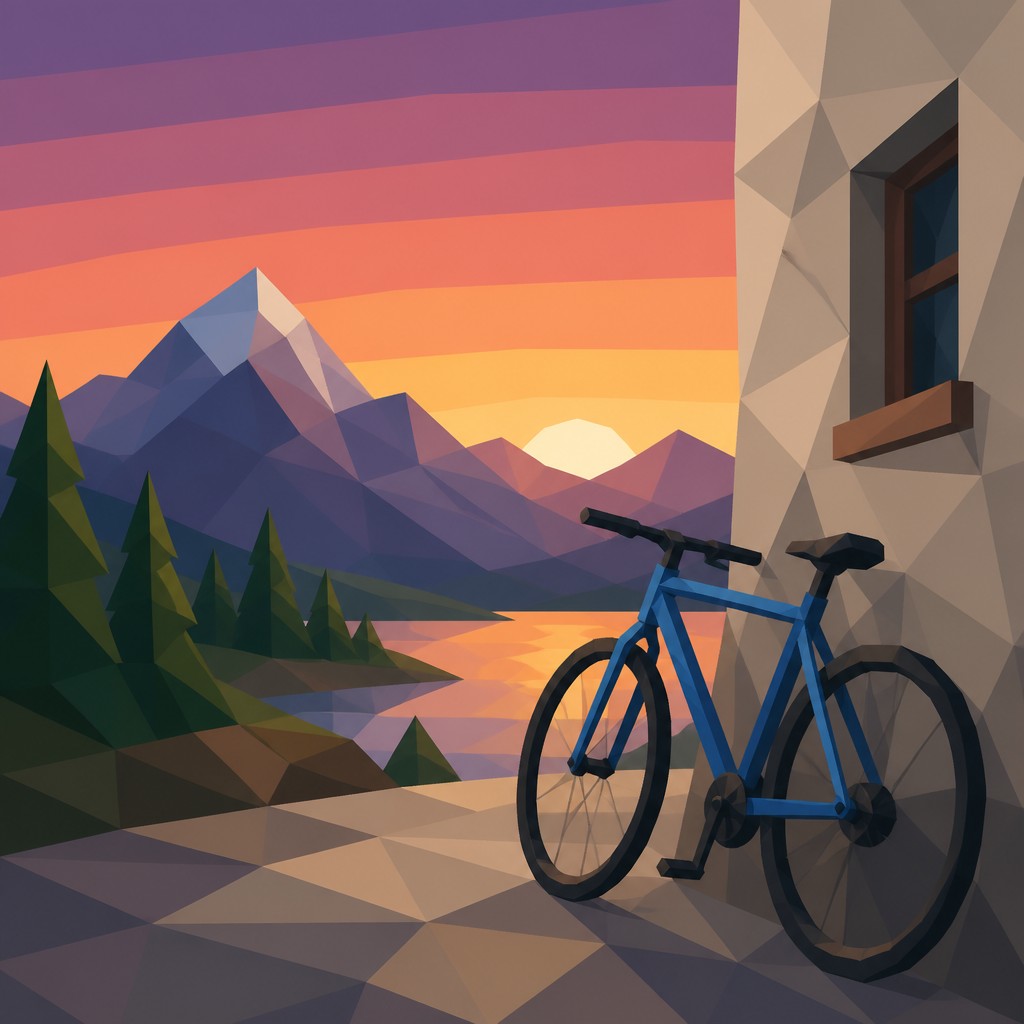
Crystalline spatial effect
The combination of angular modeling, planar lighting, and reduced texture gives scenes a sculptural, mineral-like quality. Perspective and atmospheric color often provide depth when surface detail is absent.
Low Poly Prompt Ideas
Start from an idea — each one opens the generator with the style ready to go. See all 40 Low Poly prompts →
How to Create Low Poly Art
Master the craft step by step — or skip straight to creating. Read the full guide →
- 1
Block out the silhouette
Begin with primitive forms such as cones, pyramids, planes, and low-resolution spheres. Establish the overall silhouette and major proportions before adding secondary facets.
- 2
Use deliberate low-resolution modeling
Reduce polygon density, triangulate selected surfaces, and move vertices manually to create purposeful planes rather than random fragmentation. Keep important contours clean and readable.
- 3
Apply flat lighting
Use flat or non-smoothed shading, a clear key light, and restrained ambient illumination. Test a limited palette so adjacent faces separate through value or hue without becoming noisy.
- 4
Build depth with composition
Arrange large geometric masses in foreground, middle ground, and background, then use scale, overlap, atmospheric color, and perspective to suggest distance. Avoid relying on photographic texture for spatial information.
- 5
Use traditional or 2D methods
For drawing or painting, construct subjects from triangular color fields with hard-edged brushes, masking, cut paper, or collage. Keep planes intentional and avoid soft blending except where a broad sky or atmospheric band requires it.
- 6
Write precise generation prompts
Specify the subject, low polygon count, visible triangular facets, flat shading, hard edges, simplified geometry, and a restrained palette. Add composition and lighting instructions, while excluding photorealistic texture, excessive detail, and smooth organic modeling.
The Story
History & Origins of Low Poly
Low poly art developed from the technical and visual language of computer-generated 3D imagery, especially the polygonal modeling and real-time rendering practices that became widespread in late twentieth-century computer graphics and video games. Earlier hardware limitations encouraged artists and designers to work with fewer polygons, simpler textures, and efficient shading, making the underlying mesh visibly important to the final image.
As computing power increased, intentionally sparse geometry became an aesthetic choice rather than merely a technical constraint. Contemporary low poly work draws on 3D modeling, game environment design, motion graphics, illustration, and digital sculpture, often combining nostalgic early-computer imagery with contemporary minimalist composition.
Influences: Low poly art is related to polygonal 3D modeling, real-time game graphics, computer-generated imagery, digital sculpture, and minimalist illustration. Its visual economy also connects with geometric abstraction, constructivist composition, paper sculpture, isometric design, cel shading, and the faceted treatment found in some modern sculpture and crystal-inspired imagery. Depending on the subject, it may borrow the color organization of landscape painting, the simplified silhouettes of graphic design, or the spatial clarity of architectural visualization.
Frequently Asked Questions
What defines low poly art?
Its defining features are deliberately sparse polygonal geometry, visible planar surfaces, and flat or minimally blended shading. The style prioritizes clear silhouettes and constructed form over texture-rich realism.
Is low poly art only made in 3D software?
No. It is strongly associated with 3D modeling, but the look can be recreated through vector illustration, digital painting, paper collage, traditional painting, or cut-and-fold sculpture. The essential requirement is a faceted, simplified treatment of form.
How is low poly different from voxel art?
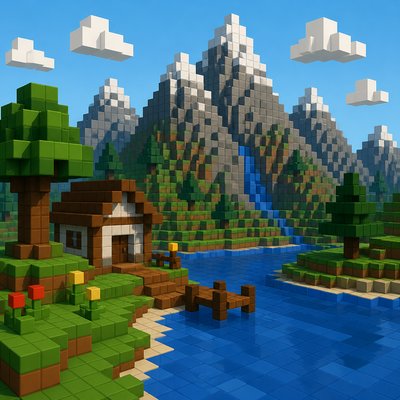
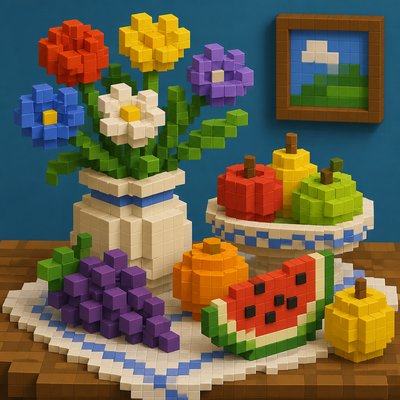
Low poly art uses polygonal faces, usually triangles or other flat planes, to approximate surfaces. Voxel art builds subjects from three-dimensional cubic units, creating a block-based appearance with predominantly right-angled forms.
How is low poly different from smooth 3D rendering?
Smooth 3D rendering hides the mesh through curved surfaces, interpolated shading, and detailed materials. Low poly rendering keeps the simplified mesh visible and uses abrupt changes between faces as a central visual feature.
What subjects work well in this style?
Landscapes, animals, vehicles, architecture, game environments, portraits, and science-fiction scenes all translate effectively. Subjects with recognizable silhouettes and strong large-scale planes are especially suitable.
How can I prompt for a convincing low poly image?
Describe the subject first, then request a low polygon count, visible triangular facets, flat-shaded planes, hard edges, simplified geometry, and a limited palette. Specify lighting and composition, and exclude photorealistic textures, excessive detail, and smooth organic surfaces when those qualities are unwanted.
Create your first Low Poly artwork
Describe anything — or upload a photo — and see it in Low Poly Art Style in seconds.
Related Styles
Discover similar art styles