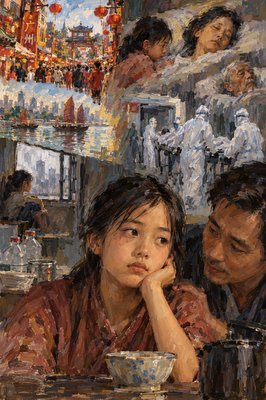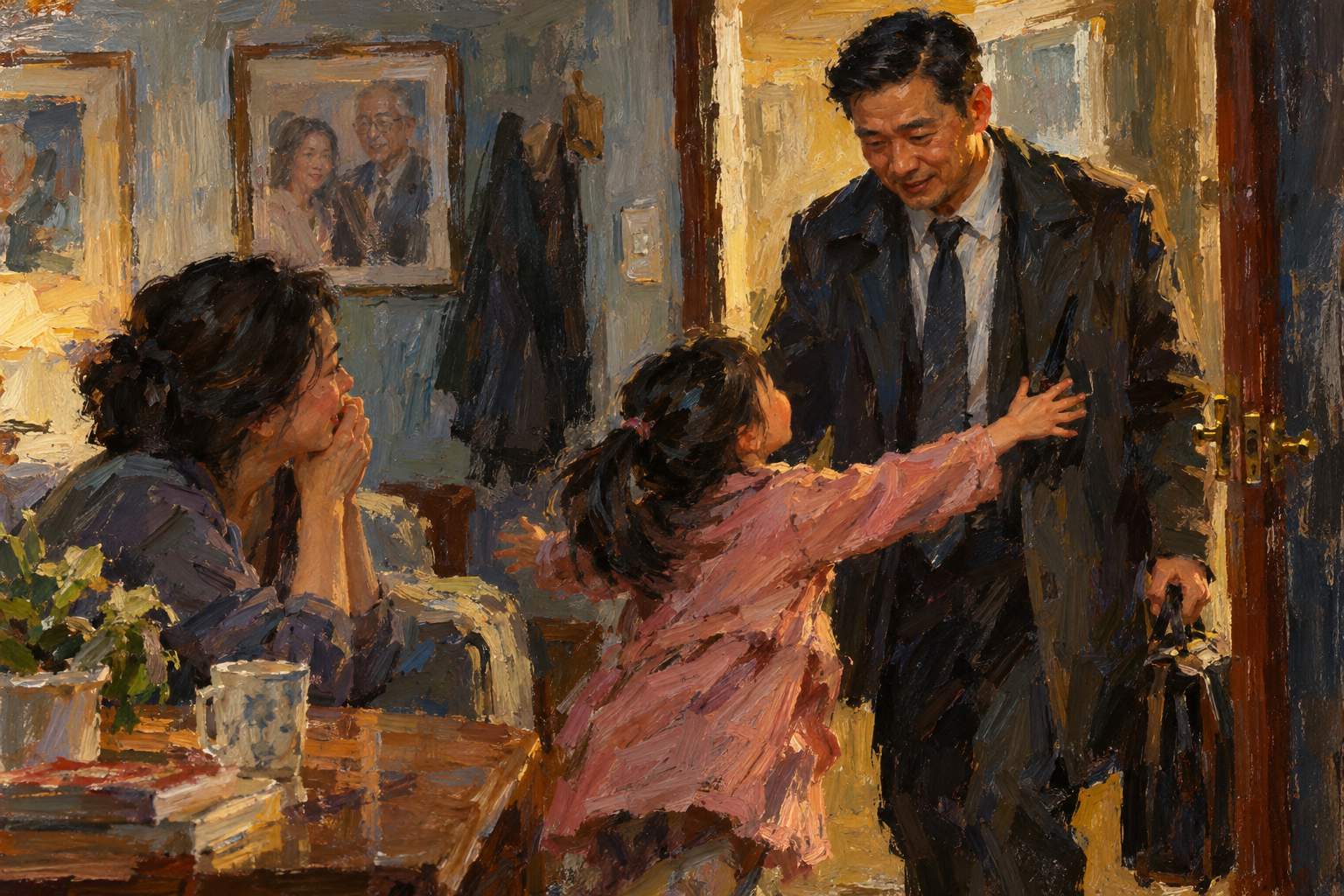
Paint this scene fo rme:  At length, they reached a plan in which Ah Zi's father would ask for a leave of absence.  It was understandable because of the loss of his wife and father-in-law.  He would need time to rearrange his life and make a way to care for Siu-Zi.
Siu Zi spent several weeks wondering each day if Father would come home from work, tension mounting and the apartment becoming more and more quiet, until finally Father would open the door, and the little family would breathe a long sigh of relief.
Public

Paint this scene fo rme: At length, they reached a plan in which Ah Zi's father would ask for a leave of absence. It was understandable because of the loss of his wife and father-in-law. He would need time to rearrange his life and make a way to care for Siu-Zi. Siu Zi spent several weeks wondering each day if Father would come home from work, tension mounting and the apartment becoming more and more quiet, until finally Father would open the door, and the little family would breathe a long sigh of relief.

Style Used
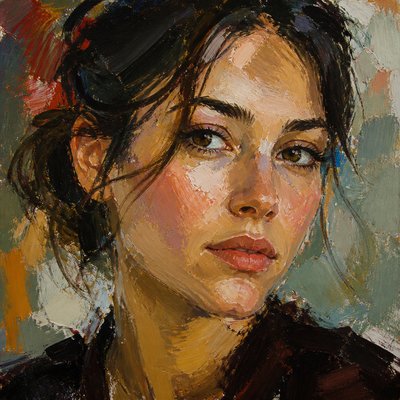
Wet-into-wet oil finished in one sitting — every stroke left alive.

See More
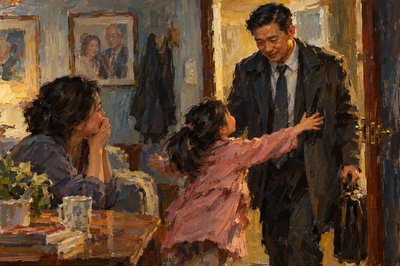
Paint this scene fo rme:  At length, they reached a plan in which Ah Zi's father would ask for a leave of absence.  It was understandable because of the loss of his wife and father-in-law.  He would need time to rearrange his life and make a way to care for Siu-Zi.
Siu Zi spent several weeks wondering each day if Father would come home from work, tension mounting and the apartment becoming more and more quiet, until finally Father would open the door, and the little family would breathe a long sigh of relief.
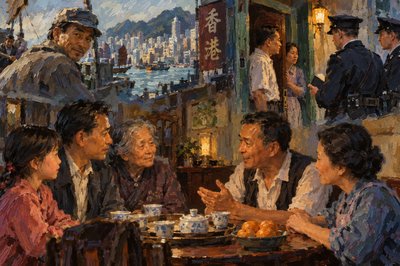
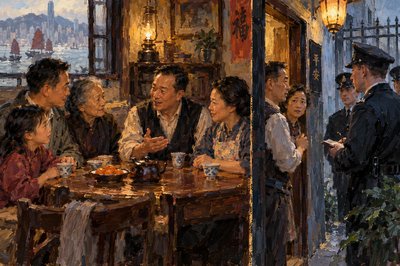
Paint this scene fo rme: At length Siu-Zi and her father and grandmother and the others in their little company of friends came to a safe house in Hong Kong.   It wasn’t as if there was no more reason to be afraid, though.  One of the people who were helping Siu-Zi’s father remarked that they were very fortunate, since officers from the foreign ministry had come to the door just one day before Siu-Zi and her family had arrived, asking if there were any illegitimate travelers staying there.  The man, whose name Ah Zi couldn’t remember, had laughed when he said, “We were able to tell them the whole truth!  Nobody was staying at that house but me and my wife.”  Show a montage with Siu-Zi and her father and grandmother, and the couple who run the safe house seated at a table talking, and the man and his wife answering the door, with police outside questioning them, and the kind man who Siu-Ze had seen outside the boat in the background.
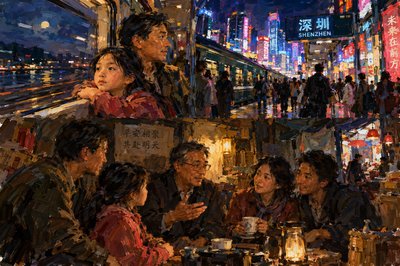
Paint this scene fo rme:  After leaving their home in Guangzhou, Siu Zi and her Father traveled by train to Shenzhen, where the city’s neon lights replaced Guangzhou’s lanterns. The train rumbled through the night, its rhythmic clatter a steady reminder that every mile taken was a step away from the life they once knew—and a step closer to hope, although it still wasn’t clear where or how they would find this new hope. In Shenzhen, they met Mr. Chen once more. In a modest safe house tucked away behind a busy market, he introduced them to a small group of others who, like them, were on the run. There was Mei, a kind woman who had once taught music, and Li, a gentle man whose eyes sparkled with hidden stories. These newfound friends shared whispered words of encouragement, turning fear into a sense of shared purpose.
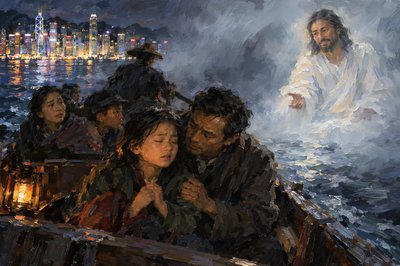
Paint this scene fo rme:  Soon, Mr. Chen arranged for them to cross into Hong Kong—a place known for its bright skyline and bustling streets. Under the cover of darkness and with careful planning, the family and their companions boarded a small boat that carried them silently across the water.  At about the halfway point they sailed into a thick bank of fog, so dark it felt as if they were inside a bottle of ink.  Siu-Zi couldn’t even see her father’s face.  A worry, and dark despair began to overwhelm her, she closed her eyes.  Then, in the stillness of her own thoughts, as if on a movie screen, Siu-Zi saw a handsome, kind man in white dress.  It was as if he was sitting outside the boat on top of the water.  He sat there, smiling at Siu-Zi, keeping the same distance from them, outside the boat, and at length, he said, “It’s going to be alright, Siu-Zi.  I’ll be here to protect you and no harm will come to you or your family anymore.” The next thing she knew, Siu-Zi’s father was shaking her awake, telling her that the crossing was over.
Paint this scene: At length Siu-Zi and her father and grandmother and the others in their little company of friends came to a safe house in Hong Kong.   It wasn’t as if there was no more reason to be afraid, though.  One of the people who were helping Siu-Zi’s father remarked that they were very fortunate, since officers from the foreign ministry had come to the door just one day before Siu-Zi and her family had arrived, asking if there were any illegitimate travelers staying there.  The man, whose name Ah Zi couldn’t remember, had laughed when he said, “We were able to tell them the whole truth!  Nobody was staying at that house but me and my wife.”  Show a montage with Siu-Zi and her father and grandmother, and the couple who run the safe house seated at a table talking, and the man and his wife answering the door, with police outside questioning them.
Paint this scene fo rme:  Siu-Zi is 12 years old, and her father lovingly calls her Ah Zi, meaning “little seed.”  She has always been a quiet, observant child. In the bustling streets of Guangzhou, where her early memories shimmered with bright festivals and quiet moments by the river, life had once seemed full of endless possibility. Until two years ago. She could still see vividly the day her Mother had come home early from her job. She was ill, and while Siu-Zi had seen her ill before, it had never been like this. She remembered with painful clarity the days and nights when her Mother, and then her Grandfather, had lay in bed, hardly moving, barely able to breathe. And then the terrible sadness of the day they were taken by the doctors – were they doctors? They seemed more like policemen in white uniforms! – to the hospital. Siu-Zi never saw either of them again. And it wasn’t just in her home, but in many homes in her part of the city, and then, she learned later, all over the country, something her Father called a pandemic was breaking up families, making mothers and fathers, and grandmothers and grandfathers, disappear. Siu-Zi and her Father were locked in their apartment for a very long time, unable to go outside. They scarcely had enough water to drink, and not nearly enough food to eat. After those terrible days, a deep, silent sorrow had settled over the family.
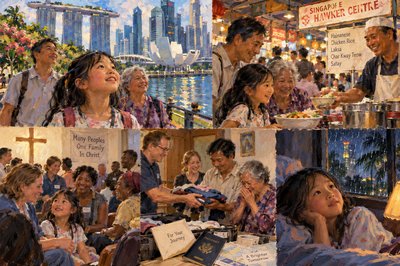
Paint this scene: Singapore was like stepping into a dream for Siu-Zi. Everything was new—the clean streets, the orderly gardens, and the friendly smiles of strangers, things she had only ever seen on television. In a modest hotel near a bustling hawker centre, she discovered the tastes and smells of dishes that were both strange and delightful. For a few weeks, she and her family settled into a quiet rhythm. Siu- Zi made tentative friends at a local church, where she listened wide-eyed to stories of many other people who had traveled from far-off lands, seeking freedom and safety. Each tale, woven with hope and resilience, whispered promises of a safer, kinder world.  They met missionaries there who said they had been praying for Siu-Zi and her family.  Siu-Zi’s grandmother was very moved by their faithfulness, and father was overwhelmed by their gifts of clothing, so they would no longer look like Chinese refugees, but a proper Asian family on holiday, and enough money to continue their journey, a pre-arranged place to stay and a job to do when they got there.
Every night, as the tropical rain tapped gently on the window, Ah Zi lay awake imagining a future free from fear—a future where her father’s faith could shine without the dark threat of government officers taking them away. In Singapore, she learned that sometimes, even in moments of deep loss and uncertainty, God has a mysterious way of planting new seeds of hope and renewing life.
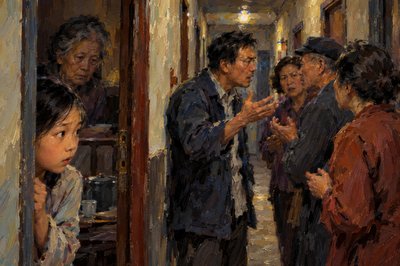
Paint this scene fo rme:  Siu-Zi and her Father were locked in their apartment for a very long time, unable to go outside. They scarcely had enough water to drink, and not nearly enough food to eat. After those terrible days, a deep, silent sorrow had settled over the family. Siu-Zi’s Father and Grandmother were now the adults in her life, and it seemed as if they were at a loss for what to do.  Siu-Zi's Father was very unhappy, not only about the death of his wife and father-in-law, but also about the way the family had been treated by the government officials.  Siu-Zi heard him talking to their neighbor in the hallway outside their apartment, and thought to herself that she had never before heard Father complain about anything. As they talked, two other neighbors came out of their apartments.  The conversation became loud, and it seemed to Siu-Zi that everyone was very upset.
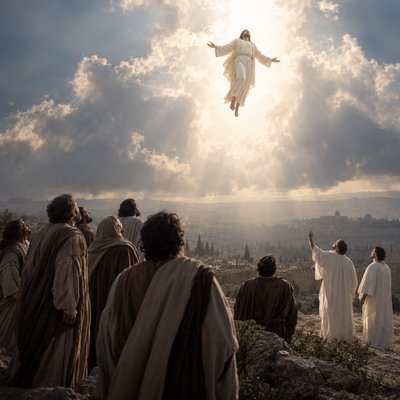
Acts 1:6-11 JUB
(6)  ¶ Then those that were come together asked of him, saying, Lord, wilt thou at this time restore again the kingdom to Israel?
(7)  And he said unto them, It is not for you to know the times or the seasons, which the Father has put under his authority only.
(8)  But ye shall receive the virtue of the Holy Spirit which shall come upon you, and ye shall be witnesses unto me both in Jerusalem and in all Judaea and in Samaria and unto the uttermost part of the earth.
(9)  And when he had spoken these things, while they beheld, he was taken up; and a cloud received him out of their sight.
(10)  And while they looked steadfastly toward heaven as he went up, behold, two men stood by them in white apparel,
(11)  who also said, Ye men of Galilee, what do ye stand gazing at up into heaven? This same Jesus, who is taken up from you into heaven, shall so come in like manner as ye have seen him go into heaven.
Siu Zi is a 10 year old Chinese girl in Guangzhou. Late one humid evening, Siu Zi's father meets with a discreet man known simply as Mr. Chen.  In a quiet corner of a small teahouse near the back alleys of Guangzhou, Mr. Chen explains, in careful whispers, how he can help the family obtain the documents they needed to leave the country safely. Other patrons are in the teahouse, and a waiter stands nearby, but nobody can hear what Mr. Chen is saying.  It's safe to talk here.
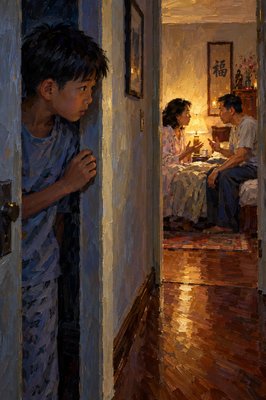
Ji Wing Soon is a 12 year old Malaysian Chinese boy.  This scene occurs at his home in Kuala Lumpur.  Late that night, as Wing-Sun lay in his bed, he heard voices coming from his parents' room down the hall.  He arose and opened his door quietly, then stepped into the hallway where he could hear their conversation.
	“Ah-Wai… I’ve been thinking about the path we're on. I’ve been reading the Bible again, like I did when I was younger. I remember the peace I felt back then. But now… everything feels so different. I believe we should honor your family, but things just don’t feel the same to me anymore.” Mei-Ling said softly but urgently.
	“Not this again, Ah-Ling. We’ve talked about this. Traditions are our foundation—our way of life. They’ve brought us good luck, success. Do you really want to upset things?” Hon-Wai said, a tone of impatience creeping into his voice.
This is a crazy scene. A tiny car, something like a Fiat Bambino careens down a mountain road with 4 people inside. 1 of them, the driver, is holding up the steering wheel, which is detached from its column. The people are comically frightened. The caption is "Hey, Who's Driving This Thing, Anyway?"
This is a crazy scene.  A tiny car, something like a Fiat Bambino careens down a mountain road with 4 people inside.  1 of them, the driver, is holding up the steering wheel, which is detached from its column.  The people are comically frightened.  The caption is "Hey, Who's Driving This Thing, Anyway?"
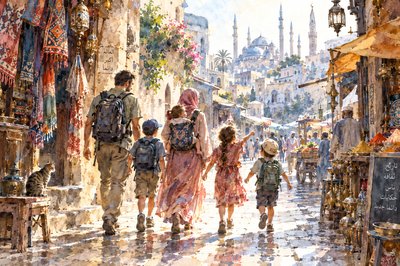
A street scene in a majority world city (perhaps the middle east or asia).  A young man and his wife and 3 children walk away from the camera into this city, with all its history and culture.  They're off to discover and learn about this new old world.  The youngest child is in a pack on her back, and dad has a day pack.  The kids are as excited as the parents.  What will today hold?
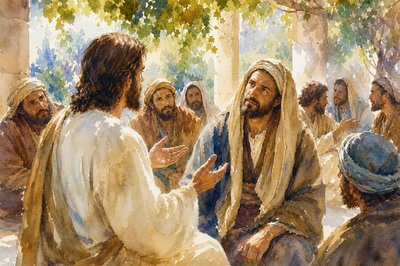
“And one of the scribes came up and heard them disputing with one another, and seeing that he answered them well, asked him, “Which commandment is the most important of all?” Jesus answered, “The most important is, ‘Hear, O Israel: The Lord our God, the Lord is one. And you shall love the Lord your God with all your heart and with all your soul and with all your mind and with all your strength.’ The second is this: ‘You shall love your neighbor as yourself.’ There is no other commandment greater than these.” And the scribe said to him, “You are right, Teacher. You have truly said that he is one, and there is no other besides him. And to love him with all the heart and with all the understanding and with all the strength, and to love one’s neighbor as oneself, is much more than all whole burnt offerings and sacrifices.” And when Jesus saw that he answered wisely, he said to him, “You are not far from the kingdom of God.”  Jesus stands among His disciples in a shady patio area outdoors talking to this scribe.  His disciples wonder at the exchange.  Several of them are also engaged in conversations set around the one Jesus is having.  We see Jesus from the left rear quarter, where we can see only the back of His head and the side of his face.  His hands are expressing His point.  The scribe to whom He speaks has a poignant, thoughtful expression.
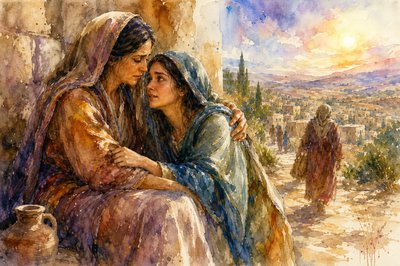
From the Book of Ruth:  "“would you wait for them till they were grown? Would you restrain yourselves from having husbands? No, my daughters; for it grieves me very much for your sakes that the hand of the LORD has gone out against me!” Then they lifted up their voices and wept again; and Orpah kissed her mother-in-law, but Ruth clung to her. And she said, “Look, your sister-in-law has gone back to her people and to her gods; return after your sister-in-law.” But Ruth said: “Entreat me not to leave you, Or to turn back from following after you; For wherever you go, I will go; And wherever you lodge, I will lodge; Your people shall be my people, And your God, my God. Where you die, I will die, And there will I be buried. The LORD do so to me, and more also, If anything but death parts you and me.”"
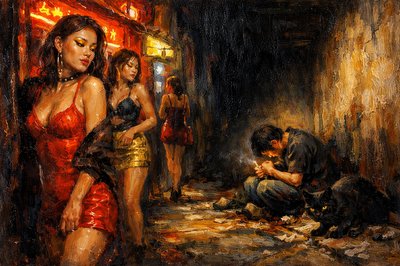
An Asian Slice
At the dark end of an alley on a moonless night,
A youth squats low to the ground, turned toward the wall with his face in his lap.  Someone might think he’s sleeping.  He’s smoking heroin.  Soon he’ll fall over and soil himself, and stay right there until dawn.

Back at the neon-lit mouth of this dark alley, 
hookers walk back and forth, hurrying to get past the alley, either for fear or because is smells so bad.  Eyelids, all painted golden, Asian whores always look like they’re made of candy.  Candy it is; but a snarling cat awaits its prey.
Absolutely. Here’s a detailed prompt matching the KING AFFISU 2 poster you uploaded. I’ve kept the visual style, composition, costumes, atmosphere, and typography direction very close to the reference. A strong poster works best when the hero is the clear focal point and the title has its own clean space. 

🎬 KING AFFISU 2 — Movie Poster Prompt

> Create an ultra-realistic cinematic African historical-action movie poster for a film titled “KING AFFISU 2.”

A powerful young Black African king stands prominently in the foreground, occupying the left and center of the frame. He has an intense commanding expression, mouth open as if shouting a battle command, strong facial features, realistic dark skin texture, and a fierce royal presence.

He wears a traditional golden-yellow royal warrior garment draped over one shoulder, a textured yellow ceremonial headband/crown, with several tall fresh green leaves rising from the crown. Around his neck is a dark traditional beaded necklace with a small metallic royal pendant.

Behind him are four African royal guards/warriors, standing in formation at different distances. They wear matching yellow headbands, traditional brown waist garments, and simple white ceremonial body markings. They stand proudly in a natural African landscape, creating depth and scale.

Background: lush tropical African vegetation, earthy brown ground, distant trees, dramatic dark storm clouds covering the sky, sunlight breaking through the clouds, powerful atmospheric contrast, subtle mist and dust in the air.

Lighting: dramatic cinematic lighting, warm golden sunlight hitting the king from the side, deep shadows, strong facial highlights, realistic skin texture, volumetric rays through the clouds, high contrast, subtle golden color grading, epic historical-film atmosphere.

Composition: premium theatrical movie-poster composition, hero extremely prominent in the foreground, supporting characters smaller in the background, strong depth of field, realistic perspective, layered cinematic composition, visually balanced negative space on the upper-right side for the movie title. The poster should feel like an expensive African epic film.

Typography: On the upper-right, place large dramatic three-dimensional weathered stone-and-gold metallic lettering:

KING
AFFISU
2

Above the title, small widely spaced white uppercase text: JAZY FILMS PRESENTS

Under the title: THE SPIRIT OF THE LAND

At the bottom: LEGENDS ARE BORN. EMPIRES ARE BUILT.

Then smaller golden text: COMING SOON

Make the title extremely readable, monumental, embossed, textured, metallic, slightly weathered, with realistic shadows and highlights.

Visual style: photorealistic, cinematic Hollywood-quality African epic, 8K detail, realistic skin pores, realistic fabric texture, natural vegetation, dramatic clouds, volumetric lighting, atmospheric perspective, cinematic depth of field, subtle film grain, HDR, high dynamic range, professional theatrical key art, premium color grading, epic and powerful mood.

Aspect ratio: 2:3 vertical theatrical movie poster.

Important: no cartoon appearance, no plastic skin, no distorted faces, no extra limbs, no duplicated characters, no blurry faces, no misspelled title, no modern buildings, no modern clothing, no futuristic elements.


This follows the same kind of hero-first hierarchy, dramatic contrast, atmospheric depth, and typography-aware composition commonly used in cinematic poster design.
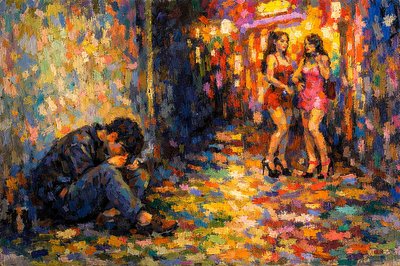
An Asian Slice
At the dark end of an alley on a moonless night,
A youth squats low to the ground, turned toward the wall with his face in his lap.  Someone might think he’s sleeping.  He’s smoking heroin.  Soon he’ll fall over and soil himself, and stay right there until dawn.

Back at the neon-lit mouth of this dark alley, 
hookers walk back and forth, hurrying to get past the alley, either for fear or because is smells so bad.  Eyelids, all painted golden, Asian whores always look like they’re made of candy.  Candy it is; but a snarling cat awaits its prey.
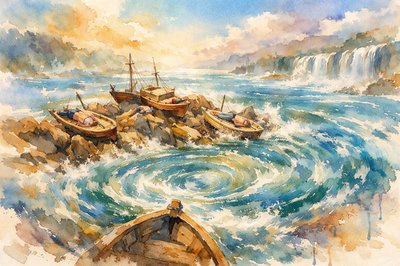
Now, those captains must learn what the river will do
when it makes that great turn out of sight.
How it dashes them up on the rocks of the shore
How it spins to the left and the right.
It beats them and breaks them and crushes their pride
Leaves them dizzy and sick and all jumbled inside
‘til they’ve all but forgotten that glorious ride
lying flat on their deck in the sun.
There they lie, drying out in the sun.

As you round the point where the river was bent
and survey the great wideness ahead,
you can see all those captains alone on their decks,
beat and broken and very near dead.
Then the current takes hold and there’s naught you can do
as it drags you down into its maw.
Headed straight for those rocks, you make ready to crash
but at last, you rise up, roll and yaw.

Going back and away, then forward again,
fearing each time, the rocks will prevail!
You’re trapped in a cycling, circling tide,
in an eddy withstanding a gale.
But each time you circle that great whirling tide
and you’ve not hit the rocks or been thrown to the side
and you’re kept from the falls, cascading and wide,
for the eddy’s small mercy give praise.
Give the merciful currents your praise!
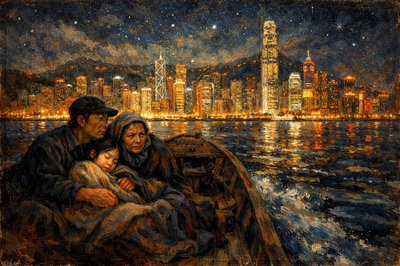
Mr. Chen has arranged for the little family  to cross secretly into Hong Kong—a place known for its bright skyline and bustling streets. Under the cover of darkness and with careful planning, Siu Zi, her father and Grandmother, along with Mr. Chen have boarded a small boat that carries them silently across the water. The sea is calm, its surface reflecting a tapestry of starlight, as if the heavens themselves are guiding them.  Siu-Zi lies nestled between her father and grandmother, wrapped up in blankets, in the forward part of an open boat with quiet motors propelling them along. Their is an air of mystery and tension.
Now, those captains must learn what the river will do
when it makes that great turn out of sight.
How it dashes them up on the rocks of the shore
How it spins to the left and the right.
It beats them and breaks them and crushes their pride
Leaves them dizzy and sick and all jumbled inside
‘til they’ve all but forgotten that glorious ride
lying flat on their deck in the sun.
There they lie, drying out in the sun.

As you round the point where the river was bent
and survey the great wideness ahead,
you can see all those captains alone on their decks,
beat and broken and very near dead.
Then the current takes hold and there’s naught you can do
as it drags you down into its maw.
Headed straight for those rocks, you make ready to crash
but at last, you rise up, roll and yaw.

Going back and away, then forward again,
fearing each time, the rocks will prevail!
You’re trapped in a cycling, circling tide,
in an eddy withstanding a gale.
But each time you circle that great whirling tide
and you’ve not hit the rocks or been thrown to the side
and you’re kept from the falls, cascading and wide,
for the eddy’s small mercy give praise.
Give the merciful currents your praise!
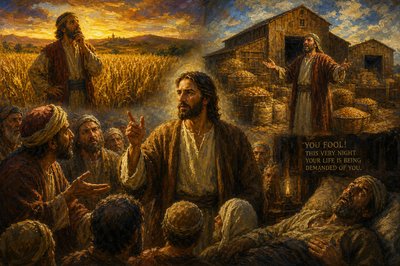
13 Someone in the crowd said to him, “Teacher, tell my brother to divide the family inheritance with me.” 14 But he said to him, “Friend, who set me to be a judge or arbitrator over you?” 15 And he said to them, “Take care! Be on your guard against all kinds of greed, for one’s life does not consist in the abundance of possessions.” 16 Then he told them a parable: “The land of a rich man produced abundantly. 17And he thought to himself, ‘What should I do, for I have no place to store my crops?’ 18 Then he said, ‘I will do this: I will pull down my barns and build larger ones, and there I will store all my grain and my goods. 19 And I will say to my soul, Soul, you have ample goods laid up for many years; relax, eat, drink, be merry.’ 20 But God said to him, ‘You fool! This very night your life is being demanded of you. And the things you have prepared, whose will they be?’ 21 So it is with those who store up treasures for themselves but are not rich toward God.” 
–  Luke 12:13-21
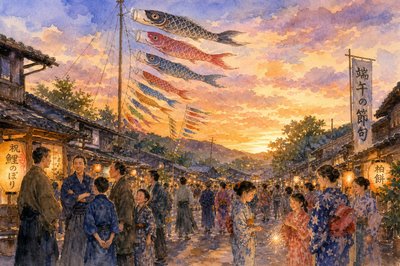
The scene is a rural mid-sized village in central Japan, sometime in the 19th or early 20th century.  It's late afternoon, just before sunset, twilight, and the heat of the day has passed.  This is Boy's Day, May 5th.  Men and boys dressed in hakama, and women and girls in yukata and some in kimono are milling around in the street.  Some are holding sparklers.  Others are standing in groups talking proudly about the boys in their families.  Prominently displayed above the buildings, on a high pole, about 20 "koi nobori" are flying in the evening breeze.  "Koi nobori,” are large tubular kites made from silk and attached to high poles.  The kites are shaped something like a windsock, but are decorated as brightly colored koi fish, with the large end attached to the pole.  When the wind blows through the opening, decorated like the open mouth of the Koi, the fish looks like it is swimming, but not going anywhere.  Boys are encouraged to look up and admire the fish on the pole for their strength and stamina.  The scene is festive, but also very important.