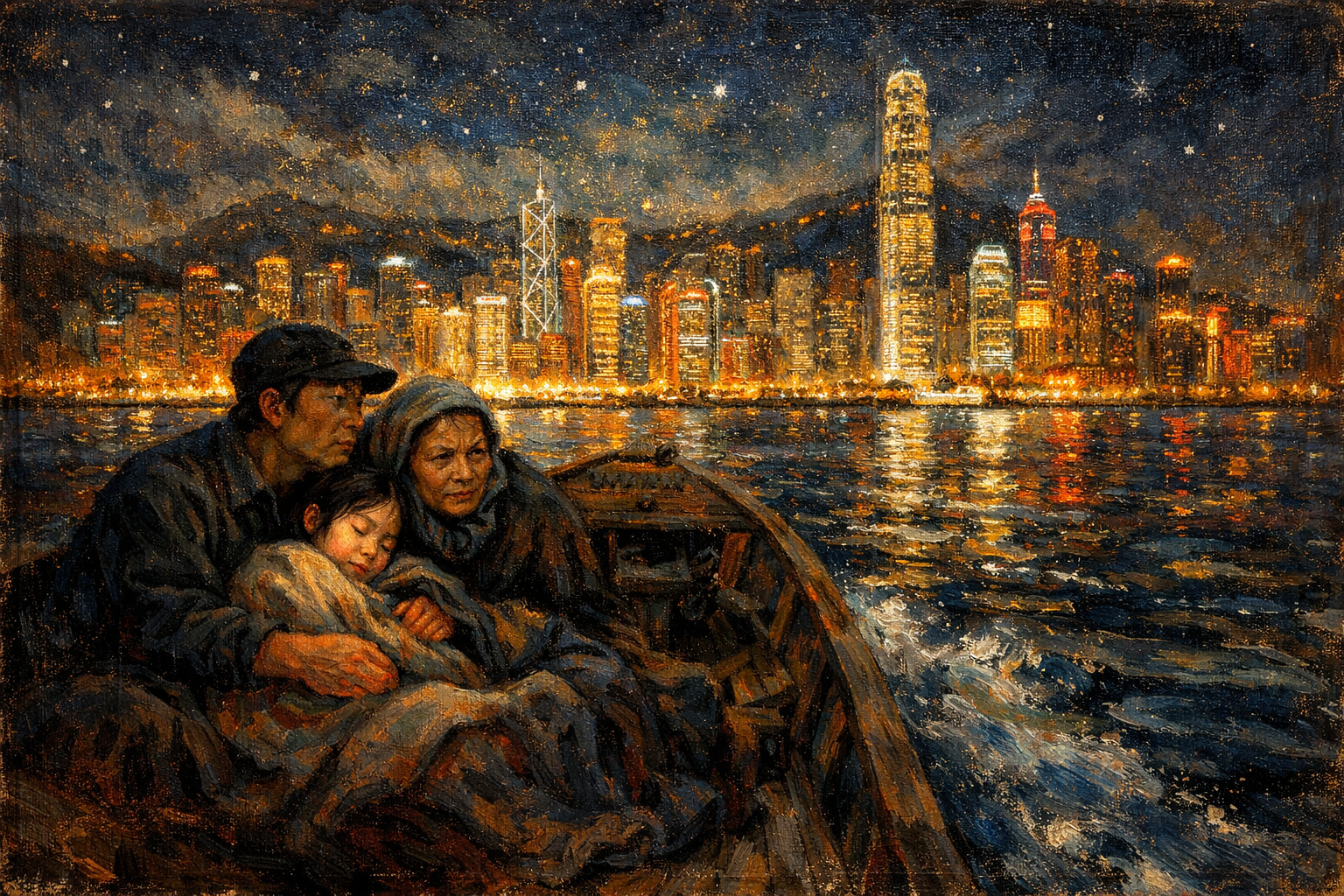
Mr. Chen has arranged for the little family  to cross secretly into Hong Kong—a place known for its bright skyline and bustling streets. Under the cover of darkness and with careful planning, Siu Zi, her father and Grandmother, along with Mr. Chen have boarded a small boat that carries them silently across the water. The sea is calm, its surface reflecting a tapestry of starlight, as if the heavens themselves are guiding them.  Siu-Zi lies nestled between her father and grandmother, wrapped up in blankets, in the forward part of an open boat with quiet motors propelling them along. Their is an air of mystery and tension.
Public

Mr. Chen has arranged for the little family to cross secretly into Hong Kong—a place known for its bright skyline and bustling streets. Under the cover of darkness and with careful planning, Siu Zi, her father and Grandmother, along with Mr. Chen have boarded a small boat that carries them silently across the water. The sea is calm, its surface reflecting a tapestry of starlight, as if the heavens themselves are guiding them. Siu-Zi lies nestled between her father and grandmother, wrapped up in blankets, in the forward part of an open boat with quiet motors propelling them along. Their is an air of mystery and tension.

Style Used
Oil Painting Art Style preview
Oil Painting Art Styleby @stylecreator
A versatile oil painting style that captures the timeless qualities of the medium - from its rich, blendable colors to its distinctive texture and depth. This style emphasizes the natural characteristics of oil paint including smooth color transitions, subtle brushwork, and the luminous quality that makes oil paintings so captivating, while adapting to any subject matter.

See More
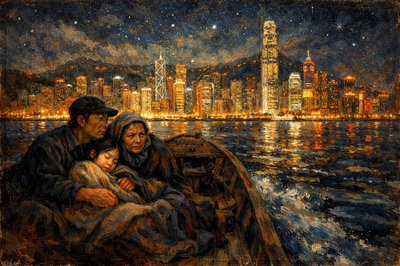
Mr. Chen has arranged for the little family  to cross secretly into Hong Kong—a place known for its bright skyline and bustling streets. Under the cover of darkness and with careful planning, Siu Zi, her father and Grandmother, along with Mr. Chen have boarded a small boat that carries them silently across the water. The sea is calm, its surface reflecting a tapestry of starlight, as if the heavens themselves are guiding them.  Siu-Zi lies nestled between her father and grandmother, wrapped up in blankets, in the forward part of an open boat with quiet motors propelling them along. Their is an air of mystery and tension.
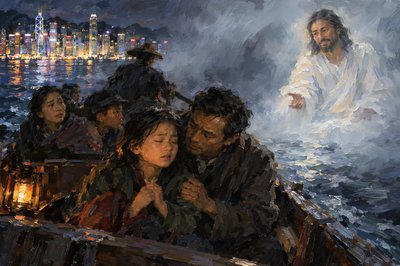
Paint this scene fo rme:  Soon, Mr. Chen arranged for them to cross into Hong Kong—a place known for its bright skyline and bustling streets. Under the cover of darkness and with careful planning, the family and their companions boarded a small boat that carried them silently across the water.  At about the halfway point they sailed into a thick bank of fog, so dark it felt as if they were inside a bottle of ink.  Siu-Zi couldn’t even see her father’s face.  A worry, and dark despair began to overwhelm her, she closed her eyes.  Then, in the stillness of her own thoughts, as if on a movie screen, Siu-Zi saw a handsome, kind man in white dress.  It was as if he was sitting outside the boat on top of the water.  He sat there, smiling at Siu-Zi, keeping the same distance from them, outside the boat, and at length, he said, “It’s going to be alright, Siu-Zi.  I’ll be here to protect you and no harm will come to you or your family anymore.” The next thing she knew, Siu-Zi’s father was shaking her awake, telling her that the crossing was over.
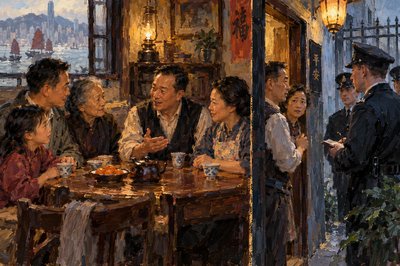
Paint this scene: At length Siu-Zi and her father and grandmother and the others in their little company of friends came to a safe house in Hong Kong.   It wasn’t as if there was no more reason to be afraid, though.  One of the people who were helping Siu-Zi’s father remarked that they were very fortunate, since officers from the foreign ministry had come to the door just one day before Siu-Zi and her family had arrived, asking if there were any illegitimate travelers staying there.  The man, whose name Ah Zi couldn’t remember, had laughed when he said, “We were able to tell them the whole truth!  Nobody was staying at that house but me and my wife.”  Show a montage with Siu-Zi and her father and grandmother, and the couple who run the safe house seated at a table talking, and the man and his wife answering the door, with police outside questioning them.
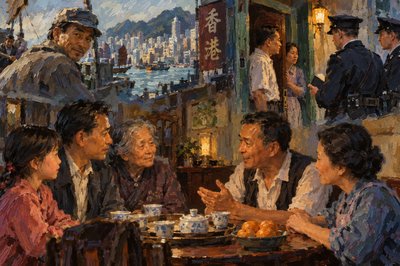
Paint this scene fo rme: At length Siu-Zi and her father and grandmother and the others in their little company of friends came to a safe house in Hong Kong.   It wasn’t as if there was no more reason to be afraid, though.  One of the people who were helping Siu-Zi’s father remarked that they were very fortunate, since officers from the foreign ministry had come to the door just one day before Siu-Zi and her family had arrived, asking if there were any illegitimate travelers staying there.  The man, whose name Ah Zi couldn’t remember, had laughed when he said, “We were able to tell them the whole truth!  Nobody was staying at that house but me and my wife.”  Show a montage with Siu-Zi and her father and grandmother, and the couple who run the safe house seated at a table talking, and the man and his wife answering the door, with police outside questioning them, and the kind man who Siu-Ze had seen outside the boat in the background.
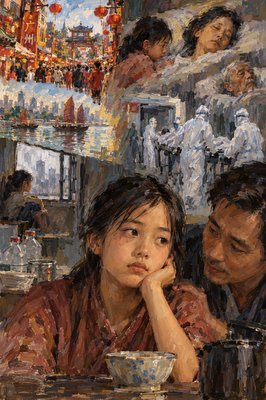
Paint this scene fo rme:  Siu-Zi is 12 years old, and her father lovingly calls her Ah Zi, meaning “little seed.”  She has always been a quiet, observant child. In the bustling streets of Guangzhou, where her early memories shimmered with bright festivals and quiet moments by the river, life had once seemed full of endless possibility. Until two years ago. She could still see vividly the day her Mother had come home early from her job. She was ill, and while Siu-Zi had seen her ill before, it had never been like this. She remembered with painful clarity the days and nights when her Mother, and then her Grandfather, had lay in bed, hardly moving, barely able to breathe. And then the terrible sadness of the day they were taken by the doctors – were they doctors? They seemed more like policemen in white uniforms! – to the hospital. Siu-Zi never saw either of them again. And it wasn’t just in her home, but in many homes in her part of the city, and then, she learned later, all over the country, something her Father called a pandemic was breaking up families, making mothers and fathers, and grandmothers and grandfathers, disappear. Siu-Zi and her Father were locked in their apartment for a very long time, unable to go outside. They scarcely had enough water to drink, and not nearly enough food to eat. After those terrible days, a deep, silent sorrow had settled over the family.
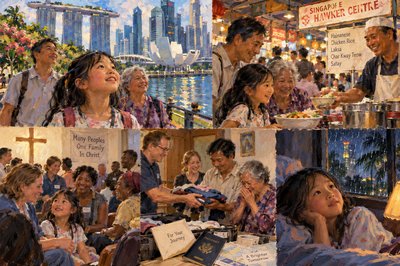
Paint this scene: Singapore was like stepping into a dream for Siu-Zi. Everything was new—the clean streets, the orderly gardens, and the friendly smiles of strangers, things she had only ever seen on television. In a modest hotel near a bustling hawker centre, she discovered the tastes and smells of dishes that were both strange and delightful. For a few weeks, she and her family settled into a quiet rhythm. Siu- Zi made tentative friends at a local church, where she listened wide-eyed to stories of many other people who had traveled from far-off lands, seeking freedom and safety. Each tale, woven with hope and resilience, whispered promises of a safer, kinder world.  They met missionaries there who said they had been praying for Siu-Zi and her family.  Siu-Zi’s grandmother was very moved by their faithfulness, and father was overwhelmed by their gifts of clothing, so they would no longer look like Chinese refugees, but a proper Asian family on holiday, and enough money to continue their journey, a pre-arranged place to stay and a job to do when they got there.
Every night, as the tropical rain tapped gently on the window, Ah Zi lay awake imagining a future free from fear—a future where her father’s faith could shine without the dark threat of government officers taking them away. In Singapore, she learned that sometimes, even in moments of deep loss and uncertainty, God has a mysterious way of planting new seeds of hope and renewing life.
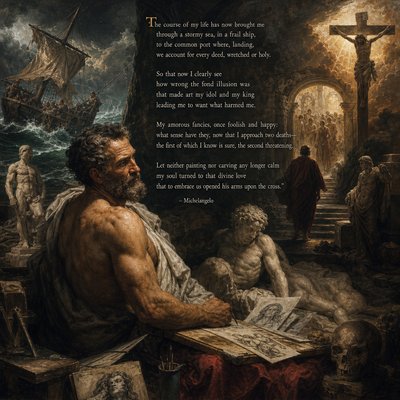
"The course of my life has now brought me
through a stormy sea, in a frail ship,
to the common port where, landing,
we account for every deed, wretched or holy.

So that now I clearly see
how wrong the fond illusion was
that made art my idol and my king
leading me to want what harmed me.

My amorous fancies, once foolish and happy:
what sense have they, now that I approach two deaths-
the first of which I know is sure, the second threatening.

Let neither painting nor carving any longer calm
my soul turned to that divine love
that to embrace us opened his arms upon the cross." - Michelangelo