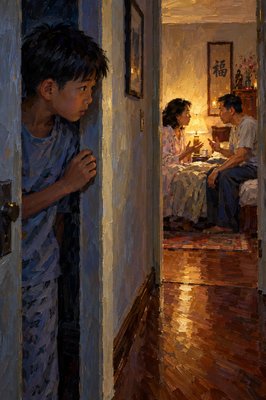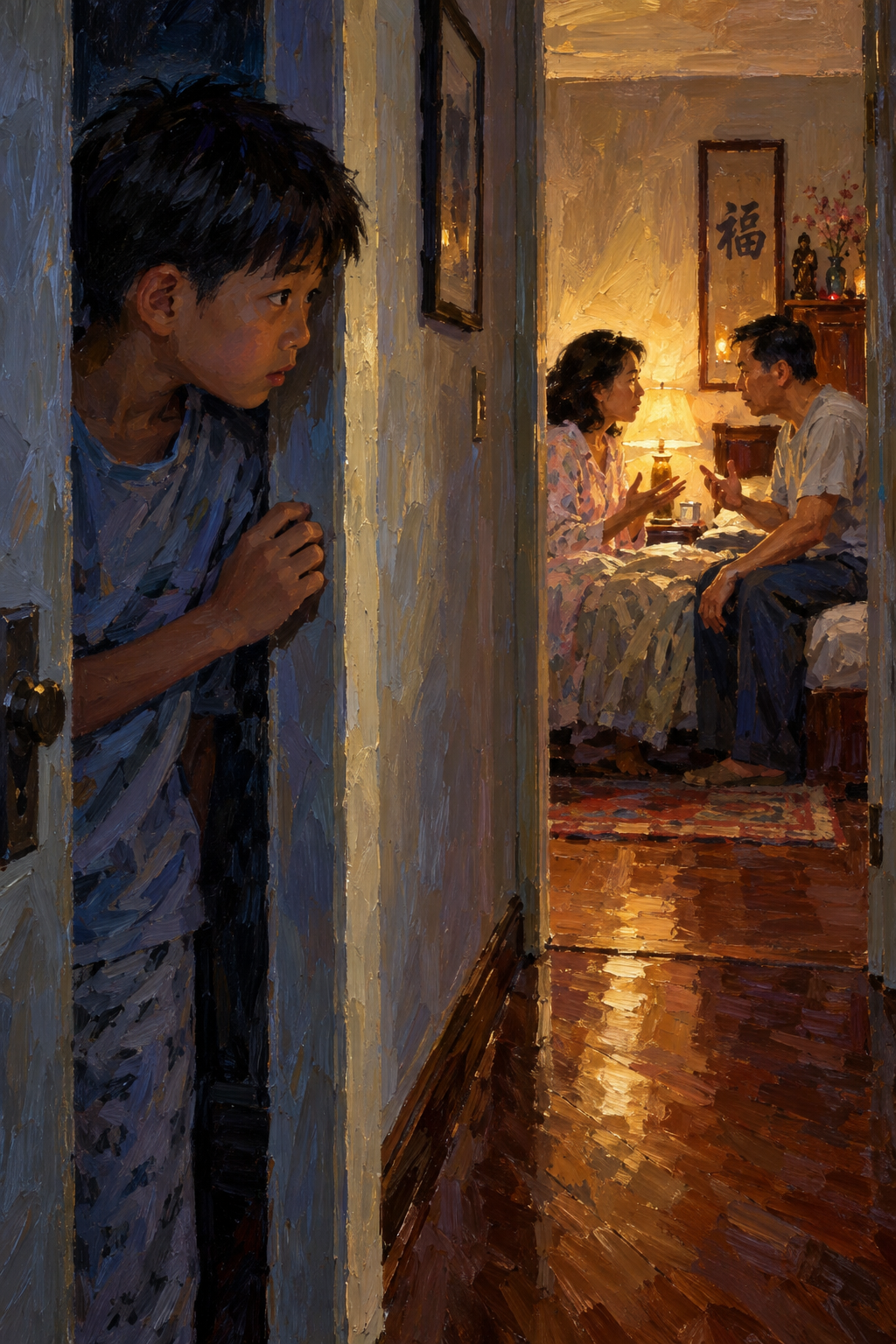
Ji Wing Soon is a 12 year old Malaysian Chinese boy.  This scene occurs at his home in Kuala Lumpur.  Late that night, as Wing-Sun lay in his bed, he heard voices coming from his parents' room down the hall.  He arose and opened his door quietly, then stepped into the hallway where he could hear their conversation.
	“Ah-Wai… I’ve been thinking about the path we're on. I’ve been reading the Bible again, like I did when I was younger. I remember the peace I felt back then. But now… everything feels so different. I believe we should honor your family, but things just don’t feel the same to me anymore.” Mei-Ling said softly but urgently.
	“Not this again, Ah-Ling. We’ve talked about this. Traditions are our foundation—our way of life. They’ve brought us good luck, success. Do you really want to upset things?” Hon-Wai said, a tone of impatience creeping into his voice.
Public

Ji Wing Soon is a 12 year old Malaysian Chinese boy. This scene occurs at his home in Kuala Lumpur. Late that night, as Wing-Sun lay in his bed, he heard voices coming from his parents' room down the hall. He arose and opened his door quietly, then stepped into the hallway where he could hear their conversation. “Ah-Wai… I’ve been thinking about the path we're on. I’ve been reading the Bible again, like I did when I was younger. I remember the peace I felt back then. But now… everything feels so different. I believe we should honor your family, but things just don’t feel the same to me anymore.” Mei-Ling said softly but urgently. “Not this again, Ah-Ling. We’ve talked about this. Traditions are our foundation—our way of life. They’ve brought us good luck, success. Do you really want to upset things?” Hon-Wai said, a tone of impatience creeping into his voice.

Style Used
Wet-into-wet oil finished in one sitting — every stroke left alive.

See More

Ji Wing Soon is a 12 year old Malaysian Chinese boy.  This scene occurs at his home in Kuala Lumpur.  Late that night, as Wing-Sun lay in his bed, he heard voices coming from his parents' room down the hall.  He arose and opened his door quietly, then stepped into the hallway where he could hear their conversation.
	“Ah-Wai… I’ve been thinking about the path we're on. I’ve been reading the Bible again, like I did when I was younger. I remember the peace I felt back then. But now… everything feels so different. I believe we should honor your family, but things just don’t feel the same to me anymore.” Mei-Ling said softly but urgently.
	“Not this again, Ah-Ling. We’ve talked about this. Traditions are our foundation—our way of life. They’ve brought us good luck, success. Do you really want to upset things?” Hon-Wai said, a tone of impatience creeping into his voice.
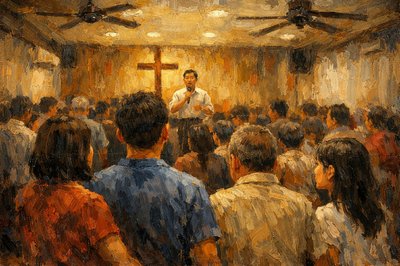
Inside an informal church in Kuala Lumpur.  Wing Sun and his father and mother, along with Siu Zi, his friend from school are there together.  We are standing in the back of the room, and there are many more people than there were in the London church.  There are people of different ethnicities, but mostly Chinese Malaysian.  The Pastor, a Chinese man, is standing up front speaking to the congregation, facing them.  The atmosphere is hot and sweaty, with ceiling fans running, but still welcoming, Wing Sun is happy that his family is together and also that his friend Siu Zi, who he has just learned is a Christian, can be there too.
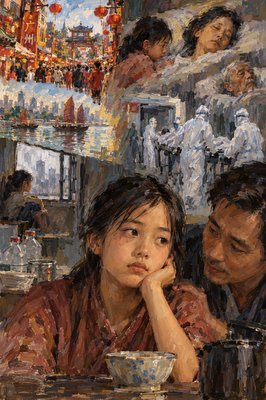
Paint this scene fo rme:  Siu-Zi is 12 years old, and her father lovingly calls her Ah Zi, meaning “little seed.”  She has always been a quiet, observant child. In the bustling streets of Guangzhou, where her early memories shimmered with bright festivals and quiet moments by the river, life had once seemed full of endless possibility. Until two years ago. She could still see vividly the day her Mother had come home early from her job. She was ill, and while Siu-Zi had seen her ill before, it had never been like this. She remembered with painful clarity the days and nights when her Mother, and then her Grandfather, had lay in bed, hardly moving, barely able to breathe. And then the terrible sadness of the day they were taken by the doctors – were they doctors? They seemed more like policemen in white uniforms! – to the hospital. Siu-Zi never saw either of them again. And it wasn’t just in her home, but in many homes in her part of the city, and then, she learned later, all over the country, something her Father called a pandemic was breaking up families, making mothers and fathers, and grandmothers and grandfathers, disappear. Siu-Zi and her Father were locked in their apartment for a very long time, unable to go outside. They scarcely had enough water to drink, and not nearly enough food to eat. After those terrible days, a deep, silent sorrow had settled over the family.
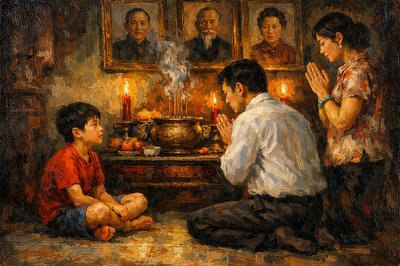
Inside a home in Petaling Jaya, Wing-Sun, a 10 year old Chinese boy sits cross-legged on the cool tile floor, watching the delicate tendrils of smoke rise from the joss sticks his father has just placed in the family altar’s bronze urn. The flickering candlelight casts shifting shadows over the framed portraits of the ancestors, their solemn faces gazing out from another time.
Wing-Sun's father, dressed in crisp slacks and a neatly pressed white shirt, murmurs a quiet prayer, his voice low and rhythmic. Beside him, Wing-Sun’s mother clasps her hands together in a quiet moment of respect before adjusting the jade bangle on her wrist. Their morning ritual is a quiet, practiced thing; one they perform, and Wing-Sun observes, every day.
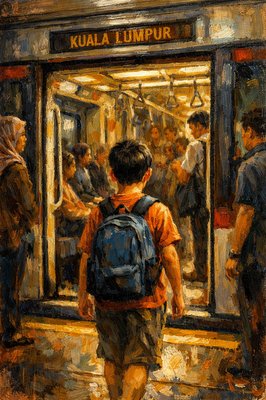
Morning scene. A 10 year old chinese boy enters a train car at the platform on the MRT in Kuala Lumpur.  We see him from the back.  Other passengers are inside the train car and also waiting on the platform.
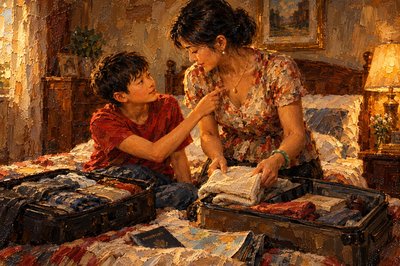
a painting of a woman and a child sitting on a bed