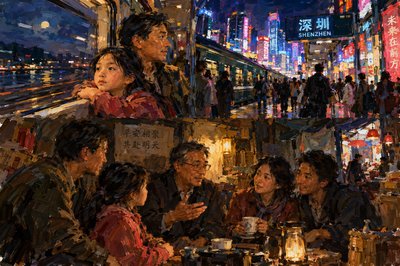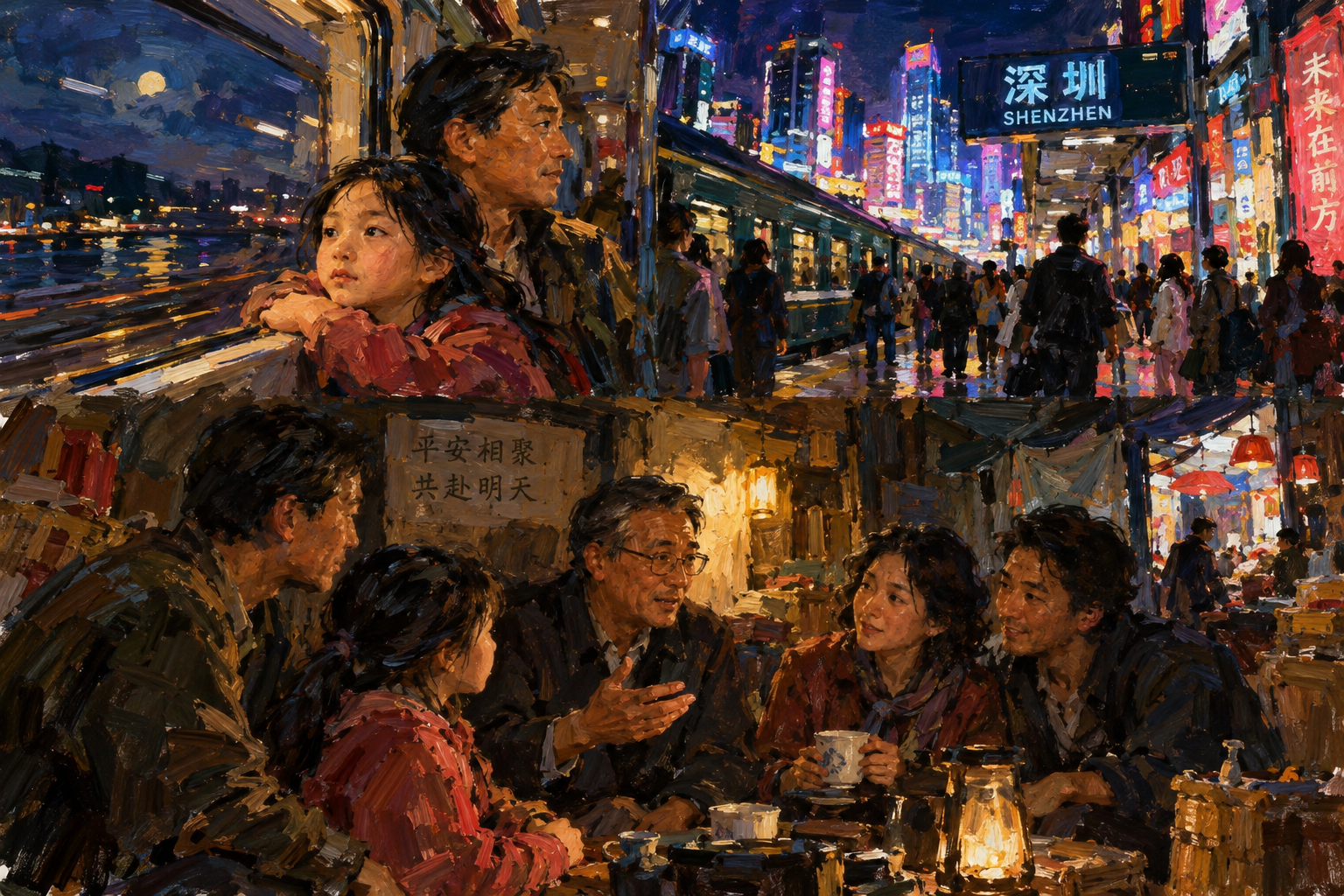
Paint this scene fo rme:  After leaving their home in Guangzhou, Siu Zi and her Father traveled by train to Shenzhen, where the city’s neon lights replaced Guangzhou’s lanterns. The train rumbled through the night, its rhythmic clatter a steady reminder that every mile taken was a step away from the life they once knew—and a step closer to hope, although it still wasn’t clear where or how they would find this new hope. In Shenzhen, they met Mr. Chen once more. In a modest safe house tucked away behind a busy market, he introduced them to a small group of others who, like them, were on the run. There was Mei, a kind woman who had once taught music, and Li, a gentle man whose eyes sparkled with hidden stories. These newfound friends shared whispered words of encouragement, turning fear into a sense of shared purpose.

Public

Paint this scene fo rme: After leaving their home in Guangzhou, Siu Zi and her Father traveled by train to Shenzhen, where the city’s neon lights replaced Guangzhou’s lanterns. The train rumbled through the night, its rhythmic clatter a steady reminder that every mile taken was a step away from the life they once knew—and a step closer to hope, although it still wasn’t clear where or how they would find this new hope. In Shenzhen, they met Mr. Chen once more. In a modest safe house tucked away behind a busy market, he introduced them to a small group of others who, like them, were on the run. There was Mei, a kind woman who had once taught music, and Li, a gentle man whose eyes sparkled with hidden stories. These newfound friends shared whispered words of encouragement, turning fear into a sense of shared purpose.

Style Used
Wet-into-wet oil finished in one sitting — every stroke left alive.

See More

Paint this scene fo rme:  After leaving their home in Guangzhou, Siu Zi and her Father traveled by train to Shenzhen, where the city’s neon lights replaced Guangzhou’s lanterns. The train rumbled through the night, its rhythmic clatter a steady reminder that every mile taken was a step away from the life they once knew—and a step closer to hope, although it still wasn’t clear where or how they would find this new hope. In Shenzhen, they met Mr. Chen once more. In a modest safe house tucked away behind a busy market, he introduced them to a small group of others who, like them, were on the run. There was Mei, a kind woman who had once taught music, and Li, a gentle man whose eyes sparkled with hidden stories. These newfound friends shared whispered words of encouragement, turning fear into a sense of shared purpose.
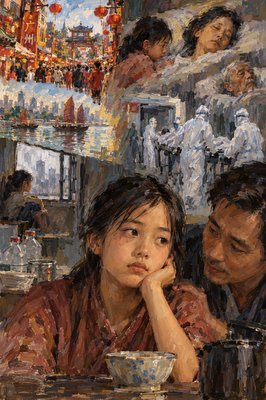
Paint this scene fo rme:  Siu-Zi is 12 years old, and her father lovingly calls her Ah Zi, meaning “little seed.”  She has always been a quiet, observant child. In the bustling streets of Guangzhou, where her early memories shimmered with bright festivals and quiet moments by the river, life had once seemed full of endless possibility. Until two years ago. She could still see vividly the day her Mother had come home early from her job. She was ill, and while Siu-Zi had seen her ill before, it had never been like this. She remembered with painful clarity the days and nights when her Mother, and then her Grandfather, had lay in bed, hardly moving, barely able to breathe. And then the terrible sadness of the day they were taken by the doctors – were they doctors? They seemed more like policemen in white uniforms! – to the hospital. Siu-Zi never saw either of them again. And it wasn’t just in her home, but in many homes in her part of the city, and then, she learned later, all over the country, something her Father called a pandemic was breaking up families, making mothers and fathers, and grandmothers and grandfathers, disappear. Siu-Zi and her Father were locked in their apartment for a very long time, unable to go outside. They scarcely had enough water to drink, and not nearly enough food to eat. After those terrible days, a deep, silent sorrow had settled over the family.
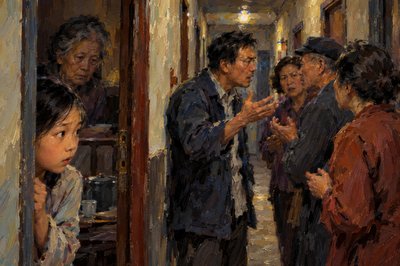
Paint this scene fo rme:  Siu-Zi and her Father were locked in their apartment for a very long time, unable to go outside. They scarcely had enough water to drink, and not nearly enough food to eat. After those terrible days, a deep, silent sorrow had settled over the family. Siu-Zi’s Father and Grandmother were now the adults in her life, and it seemed as if they were at a loss for what to do.  Siu-Zi's Father was very unhappy, not only about the death of his wife and father-in-law, but also about the way the family had been treated by the government officials.  Siu-Zi heard him talking to their neighbor in the hallway outside their apartment, and thought to herself that she had never before heard Father complain about anything. As they talked, two other neighbors came out of their apartments.  The conversation became loud, and it seemed to Siu-Zi that everyone was very upset.
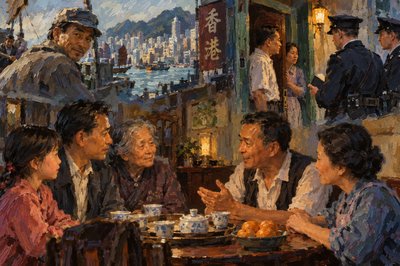
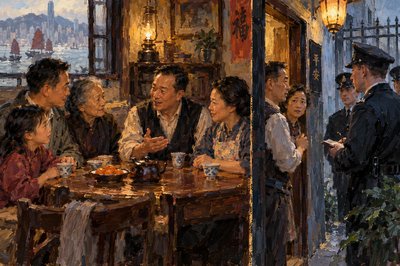
Paint this scene fo rme: At length Siu-Zi and her father and grandmother and the others in their little company of friends came to a safe house in Hong Kong.   It wasn’t as if there was no more reason to be afraid, though.  One of the people who were helping Siu-Zi’s father remarked that they were very fortunate, since officers from the foreign ministry had come to the door just one day before Siu-Zi and her family had arrived, asking if there were any illegitimate travelers staying there.  The man, whose name Ah Zi couldn’t remember, had laughed when he said, “We were able to tell them the whole truth!  Nobody was staying at that house but me and my wife.”  Show a montage with Siu-Zi and her father and grandmother, and the couple who run the safe house seated at a table talking, and the man and his wife answering the door, with police outside questioning them, and the kind man who Siu-Ze had seen outside the boat in the background.
Paint this scene fo rme:  At length, they reached a plan in which Ah Zi's father would ask for a leave of absence.  It was understandable because of the loss of his wife and father-in-law.  He would need time to rearrange his life and make a way to care for Siu-Zi.
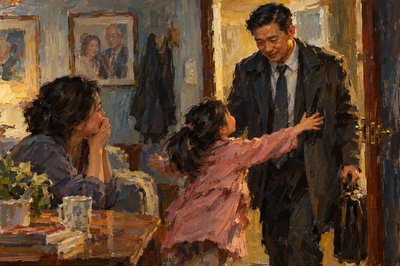
Siu Zi spent several weeks wondering each day if Father would come home from work, tension mounting and the apartment becoming more and more quiet, until finally Father would open the door, and the little family would breathe a long sigh of relief.
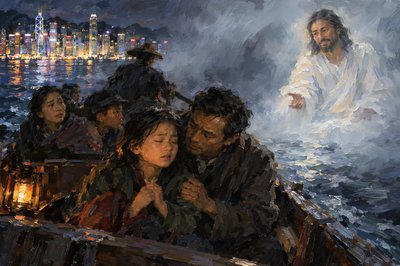
Paint this scene fo rme:  Soon, Mr. Chen arranged for them to cross into Hong Kong—a place known for its bright skyline and bustling streets. Under the cover of darkness and with careful planning, the family and their companions boarded a small boat that carried them silently across the water.  At about the halfway point they sailed into a thick bank of fog, so dark it felt as if they were inside a bottle of ink.  Siu-Zi couldn’t even see her father’s face.  A worry, and dark despair began to overwhelm her, she closed her eyes.  Then, in the stillness of her own thoughts, as if on a movie screen, Siu-Zi saw a handsome, kind man in white dress.  It was as if he was sitting outside the boat on top of the water.  He sat there, smiling at Siu-Zi, keeping the same distance from them, outside the boat, and at length, he said, “It’s going to be alright, Siu-Zi.  I’ll be here to protect you and no harm will come to you or your family anymore.” The next thing she knew, Siu-Zi’s father was shaking her awake, telling her that the crossing was over.
Father and Grandmother with Siu Zi leaving their home in a Guangzhou street in the dark of night.  There is an air of secrecy. Siu Zi clutches her small bag, its contents little more than a few treasured keepsakes and faded photographs. Her father’s reassuring hand on her shoulder, and the soft presence of her grandmother at his side, give her the courage to move forward. A taxi waits down the street to take them to the train.
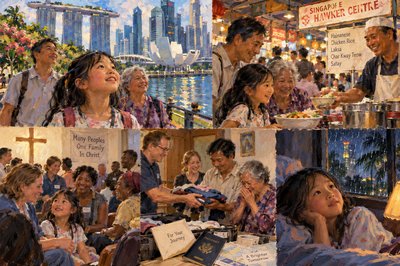
Paint this scene: Singapore was like stepping into a dream for Siu-Zi. Everything was new—the clean streets, the orderly gardens, and the friendly smiles of strangers, things she had only ever seen on television. In a modest hotel near a bustling hawker centre, she discovered the tastes and smells of dishes that were both strange and delightful. For a few weeks, she and her family settled into a quiet rhythm. Siu- Zi made tentative friends at a local church, where she listened wide-eyed to stories of many other people who had traveled from far-off lands, seeking freedom and safety. Each tale, woven with hope and resilience, whispered promises of a safer, kinder world.  They met missionaries there who said they had been praying for Siu-Zi and her family.  Siu-Zi’s grandmother was very moved by their faithfulness, and father was overwhelmed by their gifts of clothing, so they would no longer look like Chinese refugees, but a proper Asian family on holiday, and enough money to continue their journey, a pre-arranged place to stay and a job to do when they got there.
Every night, as the tropical rain tapped gently on the window, Ah Zi lay awake imagining a future free from fear—a future where her father’s faith could shine without the dark threat of government officers taking them away. In Singapore, she learned that sometimes, even in moments of deep loss and uncertainty, God has a mysterious way of planting new seeds of hope and renewing life.
Paint this scene: At length Siu-Zi and her father and grandmother and the others in their little company of friends came to a safe house in Hong Kong.   It wasn’t as if there was no more reason to be afraid, though.  One of the people who were helping Siu-Zi’s father remarked that they were very fortunate, since officers from the foreign ministry had come to the door just one day before Siu-Zi and her family had arrived, asking if there were any illegitimate travelers staying there.  The man, whose name Ah Zi couldn’t remember, had laughed when he said, “We were able to tell them the whole truth!  Nobody was staying at that house but me and my wife.”  Show a montage with Siu-Zi and her father and grandmother, and the couple who run the safe house seated at a table talking, and the man and his wife answering the door, with police outside questioning them.
Siu Zi is a 10 year old Chinese girl in Guangzhou. Late one humid evening, Siu Zi's father meets with a discreet man known simply as Mr. Chen.  In a quiet corner of a small teahouse near the back alleys of Guangzhou, Mr. Chen explains, in careful whispers, how he can help the family obtain the documents they needed to leave the country safely. Other patrons are in the teahouse, and a waiter stands nearby, but nobody can hear what Mr. Chen is saying.  It's safe to talk here.
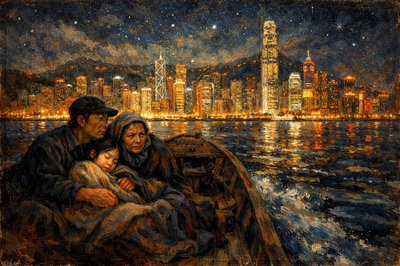
Mr. Chen has arranged for the little family  to cross secretly into Hong Kong—a place known for its bright skyline and bustling streets. Under the cover of darkness and with careful planning, Siu Zi, her father and Grandmother, along with Mr. Chen have boarded a small boat that carries them silently across the water. The sea is calm, its surface reflecting a tapestry of starlight, as if the heavens themselves are guiding them.  Siu-Zi lies nestled between her father and grandmother, wrapped up in blankets, in the forward part of an open boat with quiet motors propelling them along. Their is an air of mystery and tension.
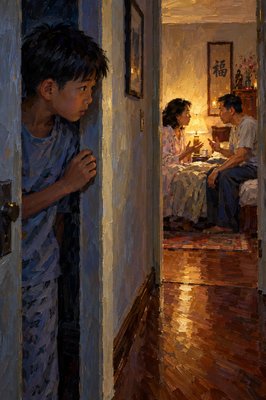
Ji Wing Soon is a 12 year old Malaysian Chinese boy.  This scene occurs at his home in Kuala Lumpur.  Late that night, as Wing-Sun lay in his bed, he heard voices coming from his parents' room down the hall.  He arose and opened his door quietly, then stepped into the hallway where he could hear their conversation.
	“Ah-Wai… I’ve been thinking about the path we're on. I’ve been reading the Bible again, like I did when I was younger. I remember the peace I felt back then. But now… everything feels so different. I believe we should honor your family, but things just don’t feel the same to me anymore.” Mei-Ling said softly but urgently.
	“Not this again, Ah-Ling. We’ve talked about this. Traditions are our foundation—our way of life. They’ve brought us good luck, success. Do you really want to upset things?” Hon-Wai said, a tone of impatience creeping into his voice.
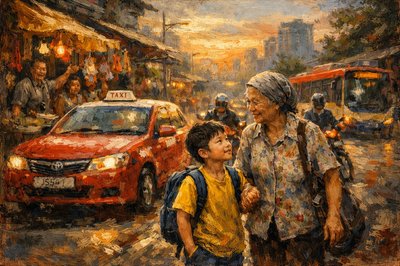
Morning city scene in Petaling Jaya. A 10 year old chinese boy and his grandmother.  As they weave through the narrow sidewalk,  taxis zip by, buses screech to a halt at stoplights, motorbikes wend their way through the stopped traffic, trying to get a head start when the light turns green.  People in the informal businesses set up along the sidewalks call out greetings in a mix of Cantonese, Malay, and English. The sky, still soft with the remnants of dawn, and yet already heavy with humid heat, hinted at another sweltering afternoon ahead.
Out where the river runs wild and free
and only the brave dare row;
where the rapids are deep, and the challenge is fresh
and it takes them where it means to go.
With breakneck speed, grinning into the wind,
standing straight on the bow of their craft,
just a glimpse now and then of those captains you’ll catch
flying by, near capsizing your raft.

They’ve no time for advice to those standing on shore
or to aid the ones just wading out,
for their task is to pilot this current, they think,
and it’s all they can do to stay out of the drink,
and their lives could be gone in the space of a wink
should they lose but a moment to doubt.
Standing tall, they never must doubt!