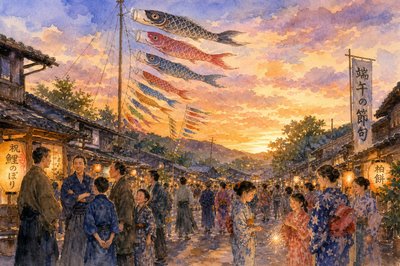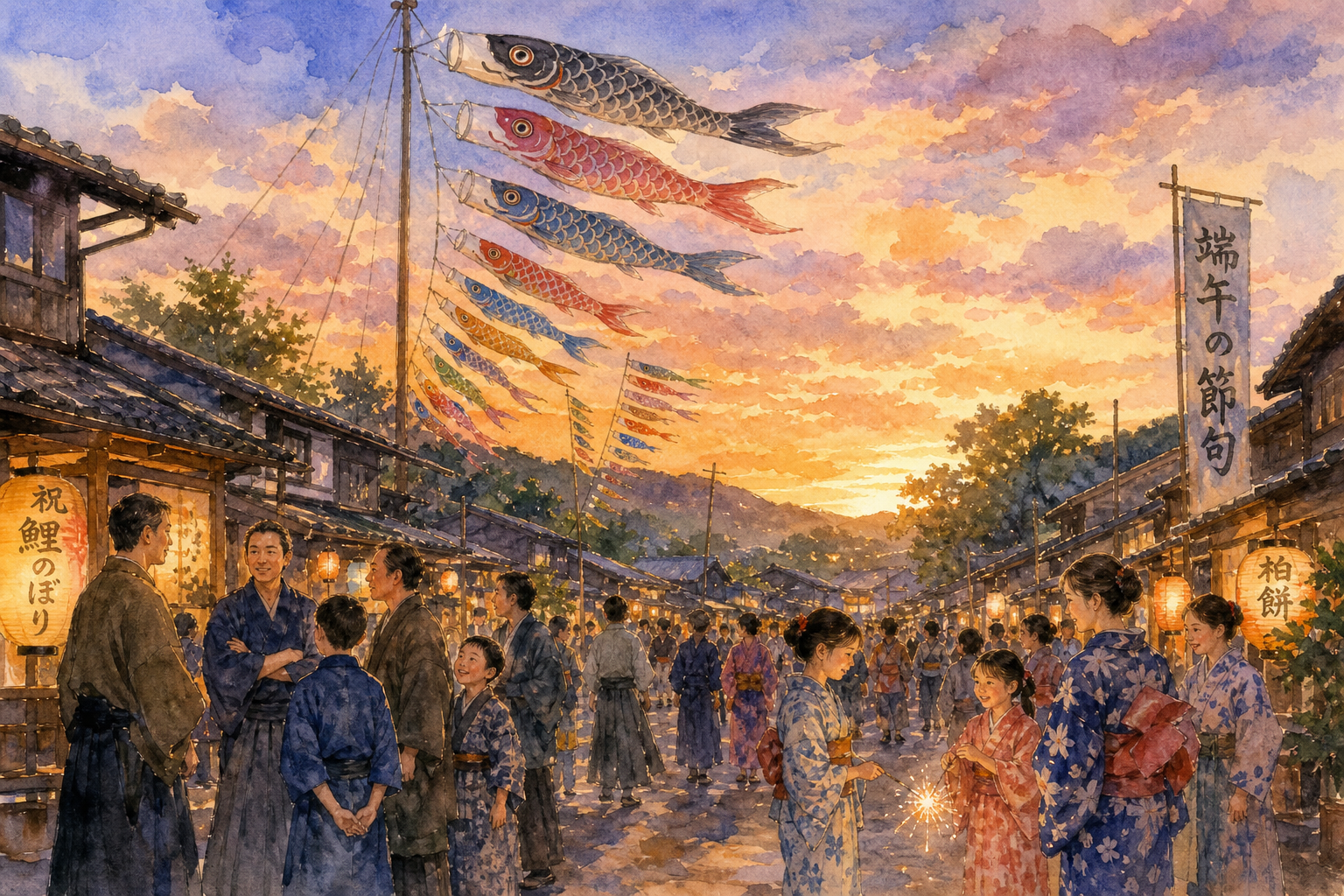
The scene is a rural mid-sized village in central Japan, sometime in the 19th or early 20th century.  It's late afternoon, just before sunset, twilight, and the heat of the day has passed.  This is Boy's Day, May 5th.  Men and boys dressed in hakama, and women and girls in yukata and some in kimono are milling around in the street.  Some are holding sparklers.  Others are standing in groups talking proudly about the boys in their families.  Prominently displayed above the buildings, on a high pole, about 20 "koi nobori" are flying in the evening breeze.  "Koi nobori,” are large tubular kites made from silk and attached to high poles.  The kites are shaped something like a windsock, but are decorated as brightly colored koi fish, with the large end attached to the pole.  When the wind blows through the opening, decorated like the open mouth of the Koi, the fish looks like it is swimming, but not going anywhere.  Boys are encouraged to look up and admire the fish on the pole for their strength and stamina.  The scene is festive, but also very important.

The scene is a rural mid-sized village in central Japan, sometime in the 19th or early 20th century. It's late afternoon, just before sunset, twilight, and the heat of the day has passed. This is Boy's Day, May 5th. Men and boys dressed in hakama, and women and girls in yukata and some in kimono are milling around in the street. Some are holding sparklers. Others are standing in groups talking proudly about the boys in their families. Prominently displayed above the buildings, on a high pole, about 20 "koi nobori" are flying in the evening breeze. "Koi nobori,” are large tubular kites made from silk and attached to high poles.  The kites are shaped something like a windsock, but are decorated as brightly colored koi fish, with the large end attached to the pole.  When the wind blows through the opening, decorated like the open mouth of the Koi, the fish looks like it is swimming, but not going anywhere. Boys are encouraged to look up and admire the fish on the pole for their strength and stamina. The scene is festive, but also very important.

Style Used
This watercolor portrait art style embraces the medium's fluidity for fresh, luminous portraits. Featuring transparent washes, wet-into-wet techniques, and strategic white space, it captures personality through spontaneous yet controlled paint flow.

See More

The scene is a rural mid-sized village in central Japan, sometime in the 19th or early 20th century.  It's late afternoon, just before sunset, twilight, and the heat of the day has passed.  This is Boy's Day, May 5th.  Men and boys dressed in hakama, and women and girls in yukata and some in kimono are milling around in the street.  Some are holding sparklers.  Others are standing in groups talking proudly about the boys in their families.  Prominently displayed above the buildings, on a high pole, about 20 "koi nobori" are flying in the evening breeze.  "Koi nobori,” are large tubular kites made from silk and attached to high poles.  The kites are shaped something like a windsock, but are decorated as brightly colored koi fish, with the large end attached to the pole.  When the wind blows through the opening, decorated like the open mouth of the Koi, the fish looks like it is swimming, but not going anywhere.  Boys are encouraged to look up and admire the fish on the pole for their strength and stamina.  The scene is festive, but also very important.