Strangers becoming friends
Created by
Public

Strangers becoming friends

Style Used

This relational contemporary art style prioritizes human connections over objects. Using documentation of social interactions and shared experiences, it makes relationships and conversations the primary artistic medium.

See More

Strangers becoming friends
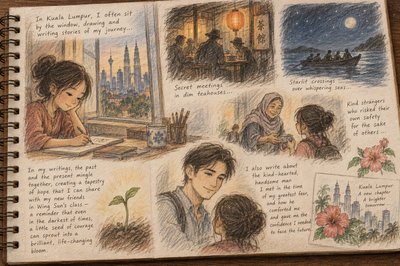
As the days turned into weeks in Kuala Lumpur, Ah Zi would often sit by the window, drawing in her notebook and writing stories of her journey. Stories of secret meetings in dim teahouses, of starlit crossings over whispering seas, and of kind strangers who risked their own safety for the sake of others. In her writings, the past and the present mingled together, creating a tapestry of hope that she could share with her new friends in Wing Sun’s class—a reminder that even in the darkest of times, a little seed of courage could sprout into a brilliant, life-changing bloom.  Ah Zi also wrote about the kind-hearted, handsome man she had met in the time of her greatest fear, and how He had comforted her and given her the confidence she needed to face the future.  Show me a page from Siu-Zi's sketchbook and make it look like sketches in colored pencil.
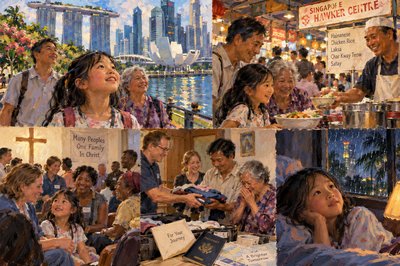
Paint this scene: Singapore was like stepping into a dream for Siu-Zi. Everything was new—the clean streets, the orderly gardens, and the friendly smiles of strangers, things she had only ever seen on television. In a modest hotel near a bustling hawker centre, she discovered the tastes and smells of dishes that were both strange and delightful. For a few weeks, she and her family settled into a quiet rhythm. Siu- Zi made tentative friends at a local church, where she listened wide-eyed to stories of many other people who had traveled from far-off lands, seeking freedom and safety. Each tale, woven with hope and resilience, whispered promises of a safer, kinder world.  They met missionaries there who said they had been praying for Siu-Zi and her family.  Siu-Zi’s grandmother was very moved by their faithfulness, and father was overwhelmed by their gifts of clothing, so they would no longer look like Chinese refugees, but a proper Asian family on holiday, and enough money to continue their journey, a pre-arranged place to stay and a job to do when they got there.
Every night, as the tropical rain tapped gently on the window, Ah Zi lay awake imagining a future free from fear—a future where her father’s faith could shine without the dark threat of government officers taking them away. In Singapore, she learned that sometimes, even in moments of deep loss and uncertainty, God has a mysterious way of planting new seeds of hope and renewing life.