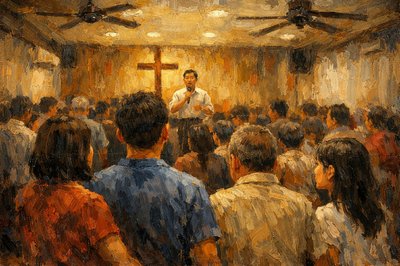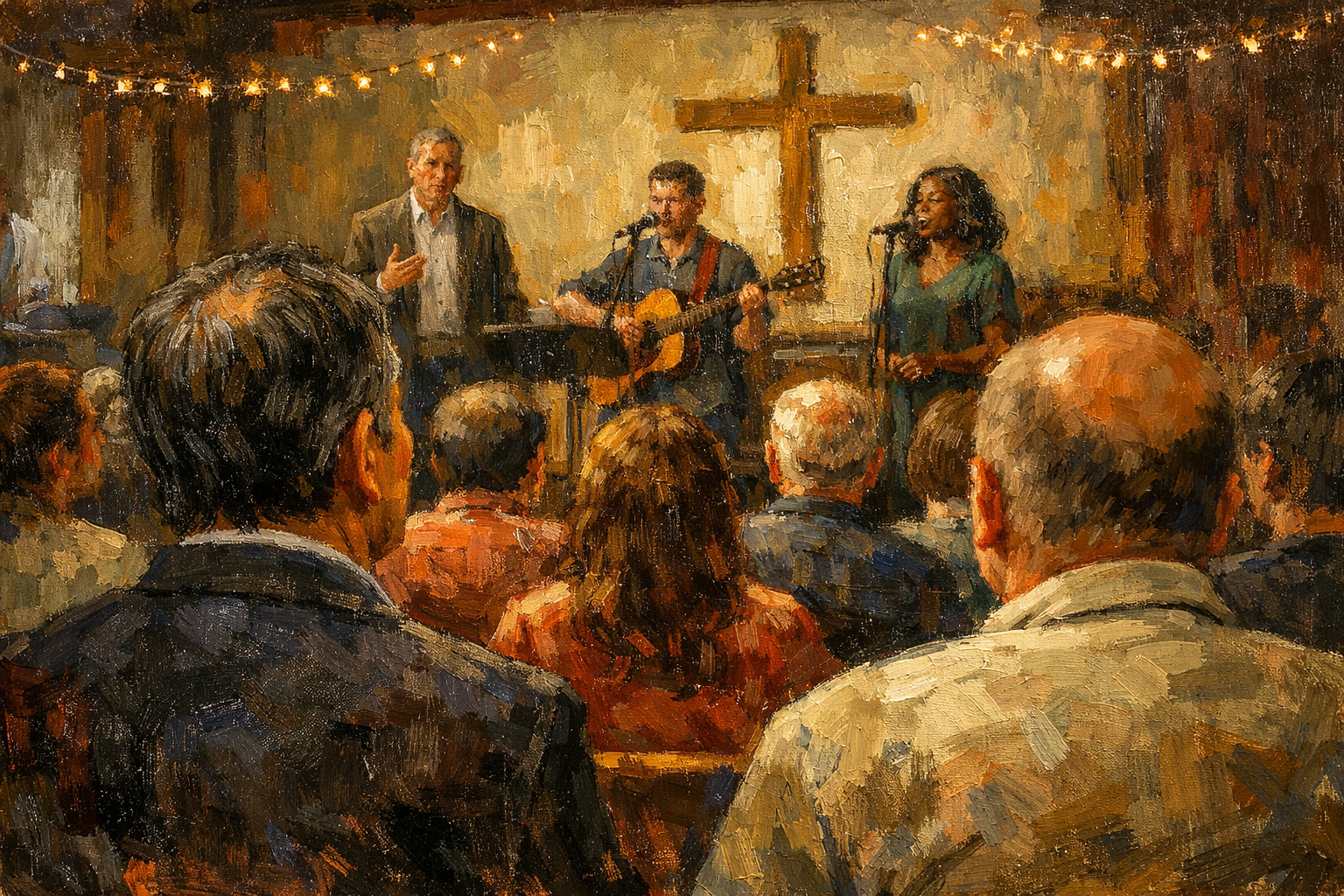
Inside an informal church in London.  Wing Sun's father has been invited to attend with his counterpart from the office.  He doesn't have anything else to do on Sunday morning, so he goes along.  we are standing in the back of the room.  There are many people of different ethnicities, the Pastor is standing up front alongside a worship leader with a guitar, and a young black woman, facing the audience.  The atmosphere is warm and welcoming, but Wing Sun's father feels a little uncomfortable.
Public

Inside an informal church in London. Wing Sun's father has been invited to attend with his counterpart from the office. He doesn't have anything else to do on Sunday morning, so he goes along. we are standing in the back of the room. There are many people of different ethnicities, the Pastor is standing up front alongside a worship leader with a guitar, and a young black woman, facing the audience. The atmosphere is warm and welcoming, but Wing Sun's father feels a little uncomfortable.

Style Used

Oil Painting Art Style preview
Oil Painting Art Styleby @stylecreator
A versatile oil painting style that captures the timeless qualities of the medium - from its rich, blendable colors to its distinctive texture and depth. This style emphasizes the natural characteristics of oil paint including smooth color transitions, subtle brushwork, and the luminous quality that makes oil paintings so captivating, while adapting to any subject matter.

See More
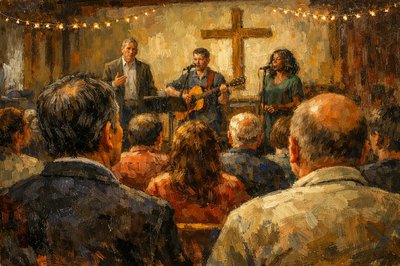
Inside an informal church in London.  Wing Sun's father has been invited to attend with his counterpart from the office.  He doesn't have anything else to do on Sunday morning, so he goes along.  we are standing in the back of the room.  There are many people of different ethnicities, the Pastor is standing up front alongside a worship leader with a guitar, and a young black woman, facing the audience.  The atmosphere is warm and welcoming, but Wing Sun's father feels a little uncomfortable.
Inside an informal church in Kuala Lumpur.  Wing Sun and his father and mother, along with Siu Zi, his friend from school are there together.  We are standing in the back of the room, and there are many more people than there were in the London church.  There are people of different ethnicities, but mostly Chinese Malaysian.  The Pastor, a Chinese man, is standing up front speaking to the congregation, facing them.  The atmosphere is hot and sweaty, with ceiling fans running, but still welcoming, Wing Sun is happy that his family is together and also that his friend Siu Zi, who he has just learned is a Christian, can be there too.
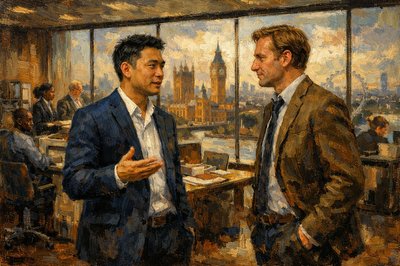
Inside a large office building in London, on the 5th floor, Wing Sun's father, a Chinese Malaysian man in his 30s, speaks to his counterpart in the company, and English man, about business.  Other workers are seated at their desks and standing at a copy machine.  There are some Black people, but mostly British.  One whole wall of the room is glass and we can see something of London outside.
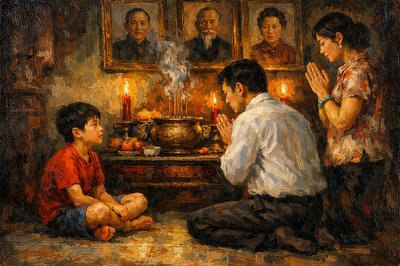
Inside a home in Petaling Jaya, Wing-Sun, a 10 year old Chinese boy sits cross-legged on the cool tile floor, watching the delicate tendrils of smoke rise from the joss sticks his father has just placed in the family altar’s bronze urn. The flickering candlelight casts shifting shadows over the framed portraits of the ancestors, their solemn faces gazing out from another time.
Wing-Sun's father, dressed in crisp slacks and a neatly pressed white shirt, murmurs a quiet prayer, his voice low and rhythmic. Beside him, Wing-Sun’s mother clasps her hands together in a quiet moment of respect before adjusting the jade bangle on her wrist. Their morning ritual is a quiet, practiced thing; one they perform, and Wing-Sun observes, every day.
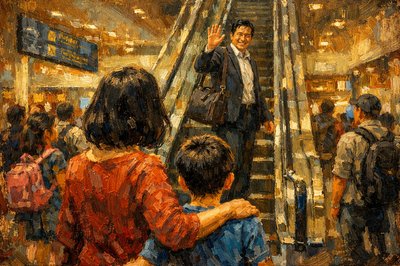
At the bustling Kuala Lumpur airport, Wing-Sun and his Mother say farewell to his father before he leaves for a six‐week business trip to London.  We see Wing Sun and his mother from the back, as Father stands on the escalator going up to his departure gate, and turns toward us to wave goodbye.  Many other passengers and children are standing around.  The airport is modern and well lit.
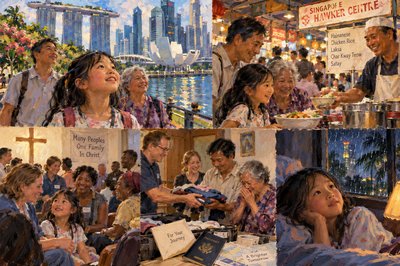
Paint this scene: Singapore was like stepping into a dream for Siu-Zi. Everything was new—the clean streets, the orderly gardens, and the friendly smiles of strangers, things she had only ever seen on television. In a modest hotel near a bustling hawker centre, she discovered the tastes and smells of dishes that were both strange and delightful. For a few weeks, she and her family settled into a quiet rhythm. Siu- Zi made tentative friends at a local church, where she listened wide-eyed to stories of many other people who had traveled from far-off lands, seeking freedom and safety. Each tale, woven with hope and resilience, whispered promises of a safer, kinder world.  They met missionaries there who said they had been praying for Siu-Zi and her family.  Siu-Zi’s grandmother was very moved by their faithfulness, and father was overwhelmed by their gifts of clothing, so they would no longer look like Chinese refugees, but a proper Asian family on holiday, and enough money to continue their journey, a pre-arranged place to stay and a job to do when they got there.
Every night, as the tropical rain tapped gently on the window, Ah Zi lay awake imagining a future free from fear—a future where her father’s faith could shine without the dark threat of government officers taking them away. In Singapore, she learned that sometimes, even in moments of deep loss and uncertainty, God has a mysterious way of planting new seeds of hope and renewing life.
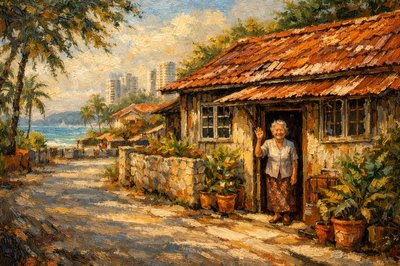
In Penang, Malaysia.  Wing Sun's Grandmother is elderly and lives in Penang, on the island.  Grandma's house is in a quieter part of the island, closer to the coastline where the sea breeze can be felt through the wooden windows. It's near the ocean, in Tanjung Bungah where there are old-style homes and a slower pace of life.  There are many resort "homestay" hotels, and also some high-rise condos, but Grandmother's house has been there many years.  Wing-Sun's mother grew up in that house, near the beach, with the ocean breeze.  We see the house from down the street with Grandma standing in the doorway greeting us.
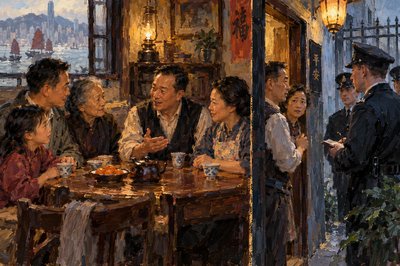
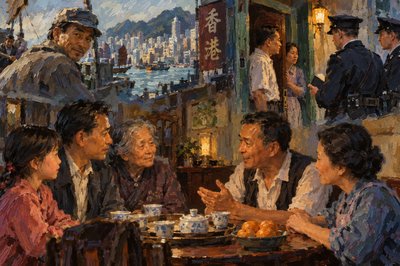
Paint this scene: At length Siu-Zi and her father and grandmother and the others in their little company of friends came to a safe house in Hong Kong.   It wasn’t as if there was no more reason to be afraid, though.  One of the people who were helping Siu-Zi’s father remarked that they were very fortunate, since officers from the foreign ministry had come to the door just one day before Siu-Zi and her family had arrived, asking if there were any illegitimate travelers staying there.  The man, whose name Ah Zi couldn’t remember, had laughed when he said, “We were able to tell them the whole truth!  Nobody was staying at that house but me and my wife.”  Show a montage with Siu-Zi and her father and grandmother, and the couple who run the safe house seated at a table talking, and the man and his wife answering the door, with police outside questioning them.
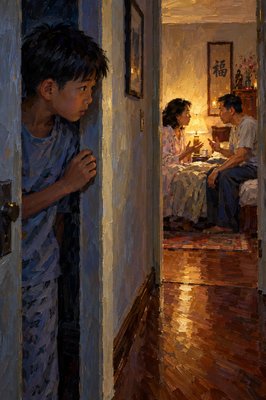
Ji Wing Soon is a 12 year old Malaysian Chinese boy.  This scene occurs at his home in Kuala Lumpur.  Late that night, as Wing-Sun lay in his bed, he heard voices coming from his parents' room down the hall.  He arose and opened his door quietly, then stepped into the hallway where he could hear their conversation.
	“Ah-Wai… I’ve been thinking about the path we're on. I’ve been reading the Bible again, like I did when I was younger. I remember the peace I felt back then. But now… everything feels so different. I believe we should honor your family, but things just don’t feel the same to me anymore.” Mei-Ling said softly but urgently.
	“Not this again, Ah-Ling. We’ve talked about this. Traditions are our foundation—our way of life. They’ve brought us good luck, success. Do you really want to upset things?” Hon-Wai said, a tone of impatience creeping into his voice.
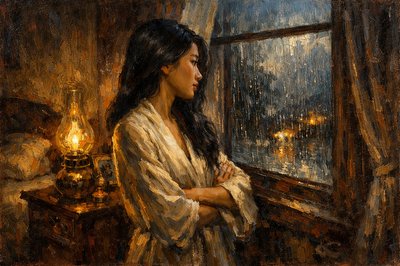
At her Mother's house in Penang, Wing Sun's mother, a beautiful chinese woman in her 30s, is standing in her bedroom looking out the window at night.  We see her from a quarter view inside the room.  She is pensive and an air of tension fills the room as she remembers growing up in this house.  Her hair is long and black, and she's wearing her housecoat.  A lantern gives low light inside the room.  It's raining outside.
Paint this scene fo rme: At length Siu-Zi and her father and grandmother and the others in their little company of friends came to a safe house in Hong Kong.   It wasn’t as if there was no more reason to be afraid, though.  One of the people who were helping Siu-Zi’s father remarked that they were very fortunate, since officers from the foreign ministry had come to the door just one day before Siu-Zi and her family had arrived, asking if there were any illegitimate travelers staying there.  The man, whose name Ah Zi couldn’t remember, had laughed when he said, “We were able to tell them the whole truth!  Nobody was staying at that house but me and my wife.”  Show a montage with Siu-Zi and her father and grandmother, and the couple who run the safe house seated at a table talking, and the man and his wife answering the door, with police outside questioning them, and the kind man who Siu-Ze had seen outside the boat in the background.
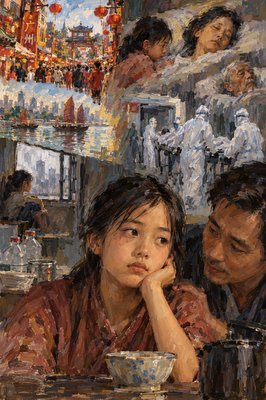
Paint this scene fo rme:  Siu-Zi is 12 years old, and her father lovingly calls her Ah Zi, meaning “little seed.”  She has always been a quiet, observant child. In the bustling streets of Guangzhou, where her early memories shimmered with bright festivals and quiet moments by the river, life had once seemed full of endless possibility. Until two years ago. She could still see vividly the day her Mother had come home early from her job. She was ill, and while Siu-Zi had seen her ill before, it had never been like this. She remembered with painful clarity the days and nights when her Mother, and then her Grandfather, had lay in bed, hardly moving, barely able to breathe. And then the terrible sadness of the day they were taken by the doctors – were they doctors? They seemed more like policemen in white uniforms! – to the hospital. Siu-Zi never saw either of them again. And it wasn’t just in her home, but in many homes in her part of the city, and then, she learned later, all over the country, something her Father called a pandemic was breaking up families, making mothers and fathers, and grandmothers and grandfathers, disappear. Siu-Zi and her Father were locked in their apartment for a very long time, unable to go outside. They scarcely had enough water to drink, and not nearly enough food to eat. After those terrible days, a deep, silent sorrow had settled over the family.
Acts 1:6-11 JUB
(6)  ¶ Then those that were come together asked of him, saying, Lord, wilt thou at this time restore again the kingdom to Israel?
(7)  And he said unto them, It is not for you to know the times or the seasons, which the Father has put under his authority only.
(8)  But ye shall receive the virtue of the Holy Spirit which shall come upon you, and ye shall be witnesses unto me both in Jerusalem and in all Judaea and in Samaria and unto the uttermost part of the earth.
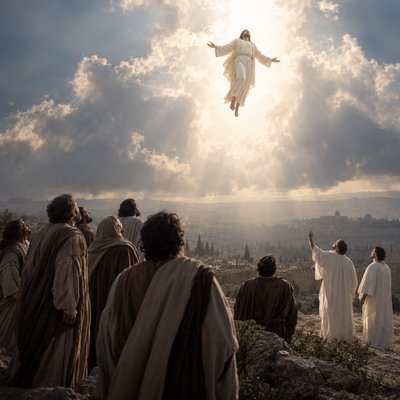
(9)  And when he had spoken these things, while they beheld, he was taken up; and a cloud received him out of their sight.
(10)  And while they looked steadfastly toward heaven as he went up, behold, two men stood by them in white apparel,
(11)  who also said, Ye men of Galilee, what do ye stand gazing at up into heaven? This same Jesus, who is taken up from you into heaven, shall so come in like manner as ye have seen him go into heaven.
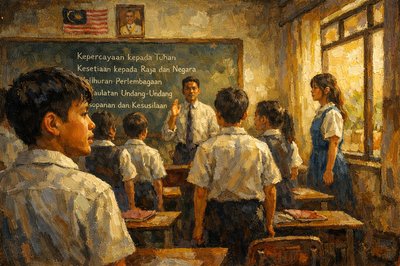
Morning inside the classroom at a private school in Kuala Lumpur before class begins. Students stand next to their desks as the teacher, standing in front, leads them in the usual morning recitations of the five national principles, their voices blending into one:
	"Kepercayaan kepada Tuhan." (Belief in God.)
	"Kesetiaan kepada Raja dan Negara." (Loyalty to the King and Country.)
	"Keluhuran Perlembagaan." (Supremacy of the Constitution.)
	"Kedaulatan Undang-Undang." (Rule of Law.)
	"Kesopanan dan Kesusilaan." (Courtesy and Morality.)
Wing-Sun repeats the words automatically, his eyes drift across the classroom, catching a glimpse of Siu-Zi, the new girl, standing in her usual spot near the window.
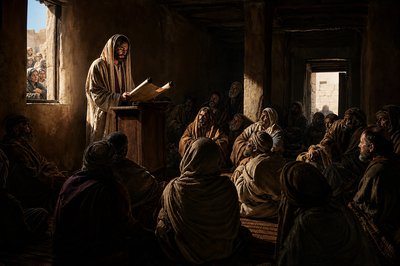
It's 6 AD.  Inside a small synagogue in Nazareth Jesus stands to read from the scroll of the prophet Isaiah.  His disciples sit on the floor nearby, and about 40 people, all middle-aged to elderly men in period appropriate dress sit, some in chairs, others on the floor.  The lighting is muted and the inside decor is sparse but warm and inviting.  Light streams in through a single window opening on one wall and through the back door, where everything else is dark and cool.  Outside the heat is beating down and the sun shines brightly.  Outside the window some women and children are gathered, waiting for their husbands and fathers and grandfathers to finish.  As Jesus reads, some of the men look at each other with surprised expressions.  Others show acceptance.
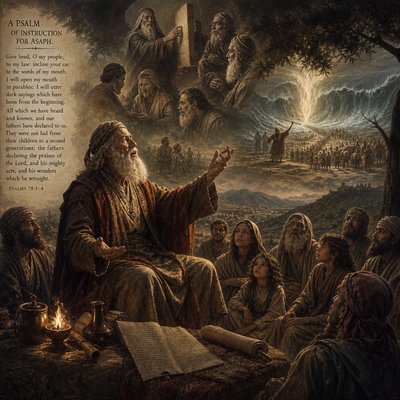
“A Psalm of instruction for Asaph. Give heed, O my people, to my law: incline your ear to the words of my mouth. I will open my mouth in parables: I will utter dark sayings which have been from the beginning. All which we have heard and known, and our fathers have declared to us. They were not hid from their children to a second generations; the fathers declaring the praises of the Lord, and his mighty acts, and his wonders which he wrought.” (Psalms 78:1-4, Brenton Septuagint eSword version)