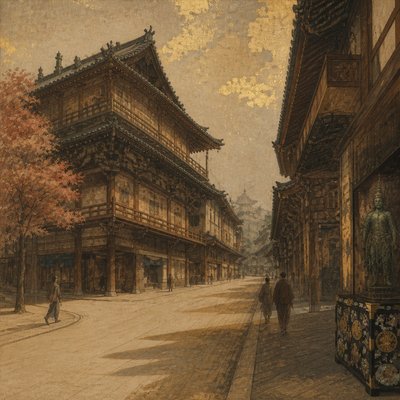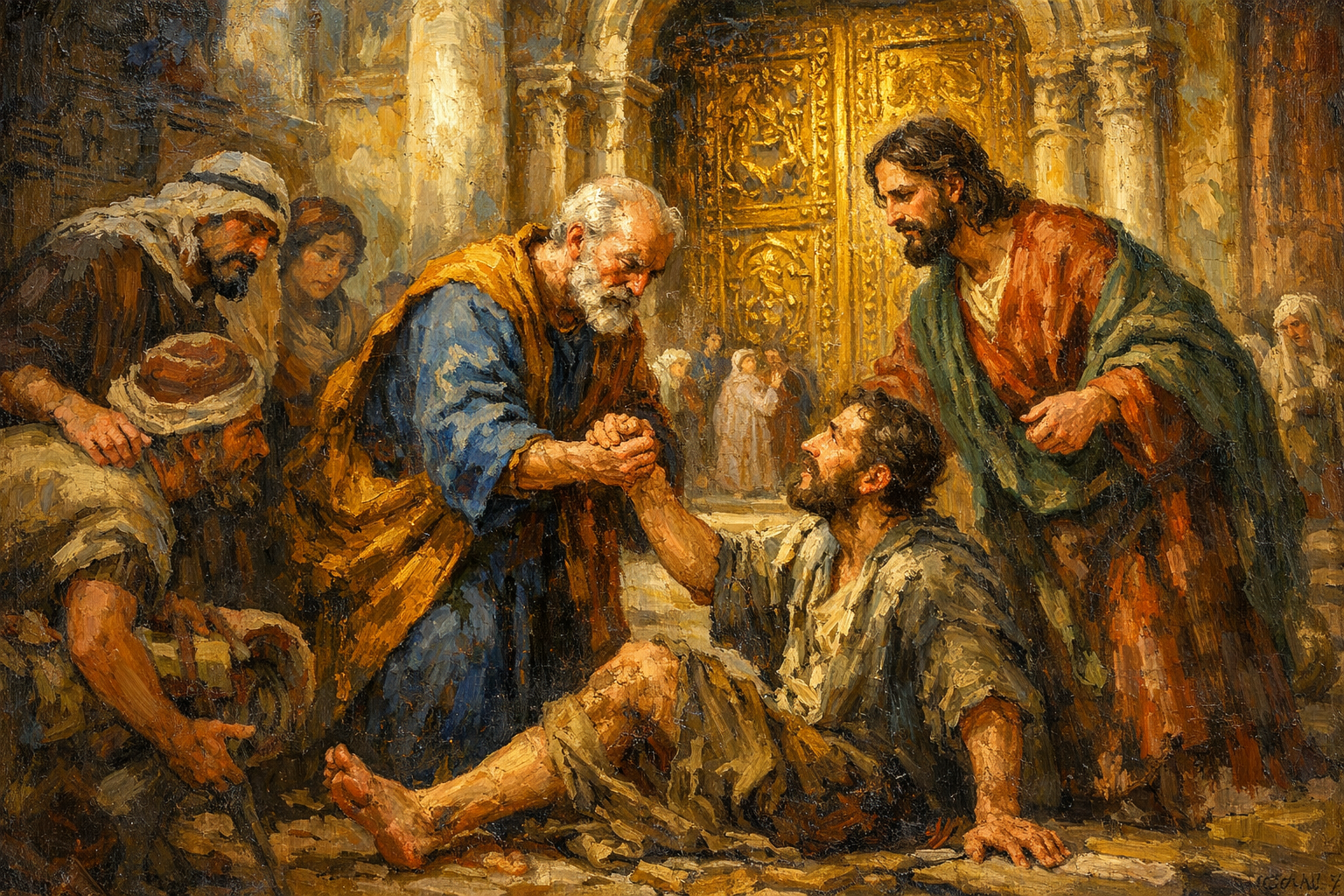
First century Jerusalem at the "gate beautiful" to the temple grounds.  Peter and John were going up to the temple at the hour of prayer, the ninth hour. And a man lame from birth was being carried, whom they laid daily at the gate of the temple that is called the Beautiful Gate to ask alms of those entering the temple. Seeing Peter and John about to go into the temple, he asked to receive alms. And Peter directed his gaze at him, as did John, and said, “Look at us.” And he fixed his attention on them, expecting to receive something from them. But Peter said, “I have no silver and gold, but what I do have I give to you. In the name of Jesus Christ of Nazareth, rise up and walk!” And he took him by the right hand and raised him up, and immediately his feet and ankles were made strong.
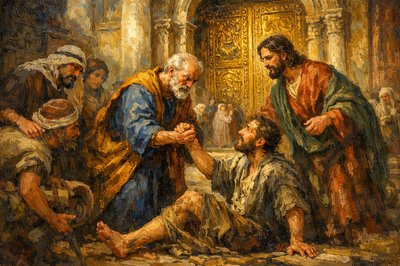
First century Jerusalem at the "gate beautiful" to the temple grounds. Peter and John were going up to the temple at the hour of prayer, the ninth hour. And a man lame from birth was being carried, whom they laid daily at the gate of the temple that is called the Beautiful Gate to ask alms of those entering the temple. Seeing Peter and John about to go into the temple, he asked to receive alms. And Peter directed his gaze at him, as did John, and said, “Look at us.” And he fixed his attention on them, expecting to receive something from them. But Peter said, “I have no silver and gold, but what I do have I give to you. In the name of Jesus Christ of Nazareth, rise up and walk!” And he took him by the right hand and raised him up, and immediately his feet and ankles were made strong.
Style Used
Oil Painting Art Style preview
Oil Painting Art Styleby @stylecreator
A versatile oil painting style that captures the timeless qualities of the medium - from its rich, blendable colors to its distinctive texture and depth. This style emphasizes the natural characteristics of oil paint including smooth color transitions, subtle brushwork, and the luminous quality that makes oil paintings so captivating, while adapting to any subject matter.

See More

First century Jerusalem at the "gate beautiful" to the temple grounds.  Peter and John were going up to the temple at the hour of prayer, the ninth hour. And a man lame from birth was being carried, whom they laid daily at the gate of the temple that is called the Beautiful Gate to ask alms of those entering the temple. Seeing Peter and John about to go into the temple, he asked to receive alms. And Peter directed his gaze at him, as did John, and said, “Look at us.” And he fixed his attention on them, expecting to receive something from them. But Peter said, “I have no silver and gold, but what I do have I give to you. In the name of Jesus Christ of Nazareth, rise up and walk!” And he took him by the right hand and raised him up, and immediately his feet and ankles were made strong.
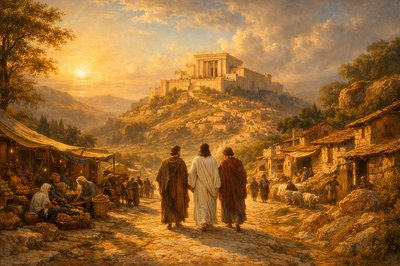
First century Palestine.  Jesus walking away from the camera with 2 of His disciples.  The Temple sits high on a hill in the distance with the road going up to it.  Merchants and houses line the road.  People are coming and going both ways.
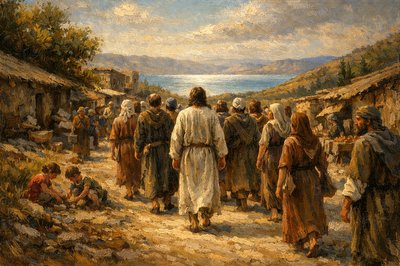
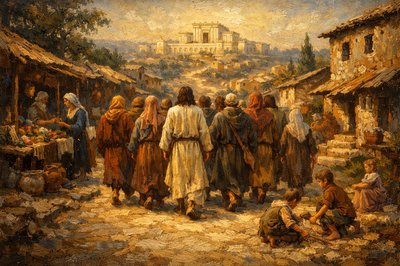
First century Palestine.  Jesus walks away from the camera along a road that goes through town with several of His disciples.   Jesus wears a plain robe like most ordinary men.  The other people are dressed like peasants, farmers, and tradesmen.  There are also women in the group, wearing plain, everyday clothing.  Some children are playing near the roadside.  Merchants are selling their goods in booths along the road.  There are houses along the road also.  The road goes upward toward the Temple in the far distance.
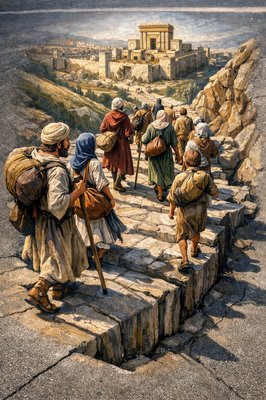
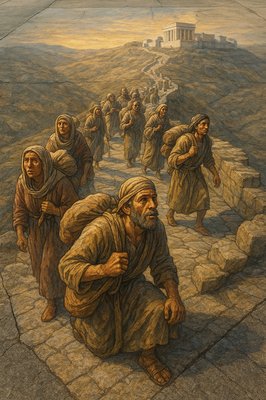
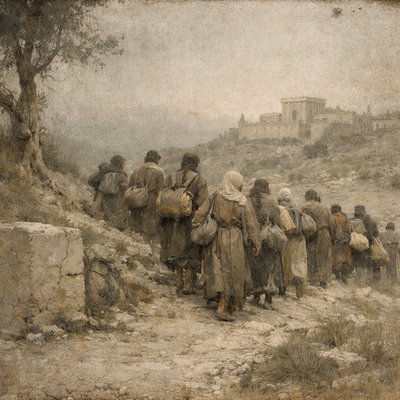
In Old Testament times a group of 12 - 15 Hebrew men and women on pilgrimage ascend a steep road toward Jerusalem and the Temple, headed for the feast of the Passover.  They each carry their own bag, sachel or bedroll.  Anticipation fills the air as the set out on their journey.
First century Palestine.  Jesus walks away from the camera down a road that goes through town with several of His disciples.   Jesus wears a plain robe like most ordinary men.  The other people are dressed like peasants, farmers, and tradesmen.  There are also women in the group, wearing plain, everyday clothing.  Some children are playing near the roadside.  The Sea of Galilee shines in the far distance.
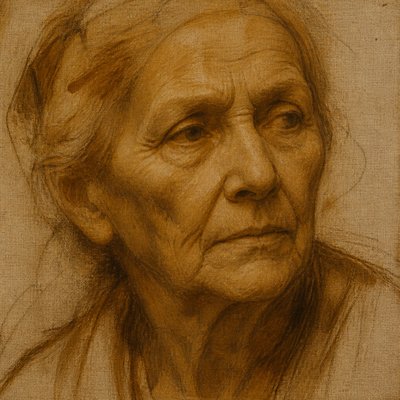
“And there was one Anna, a prophetess, the daughter of Phanuel, of the tribe of Aser: she was of a great age, and had lived with an husband seven years from her virginity; And she was a widow of about fourscore and four years, which departed not from the temple, but served God with fastings and prayers night and day. And she coming in that instant gave thanks likewise unto the Lord, and spake of him to all them that looked for redemption in Jerusalem.” (Luke 2:36-38, KJV)
Create with a photorealistic expression
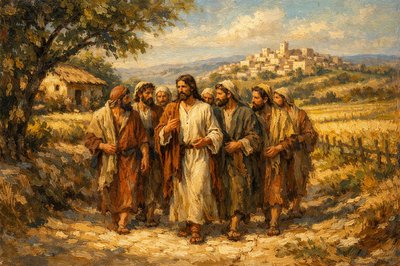
First century Palestine.  Mid-morning in a rural area.  The sun is warm and the atmosphere is positive.  Jesus and His disciples walk along a country road that goes to Bethany. There are some trees shading part of the road ahead, and cultivated fields on either side of the road.  Jesus, wears ordinary clothing like most men, and He’s talking to His disciples as the walk along.  The disciples are listening intently to Jesus, and His face is kind, but intense.  A farm house sits off to one side, and the town is visible in the distance.
Hyper-realistic Andean condor flying in the sky over a forest, leaving a shimmering trail of glittering sparkles where it goes, extreme detail, photorealistic, cinematic lighting
In Old Testament times a group of 12 - 15 Hebrew men and women on pilgrimage ascend a steep road toward Jerusalem and the Temple, headed for the feast of the Passover.  They each carry their own bag, sachel or bedroll.  Anticipation fills the air as the set out on their journey.
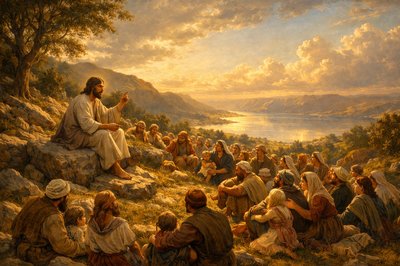
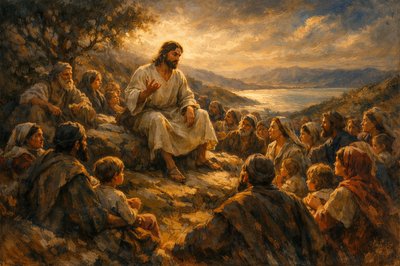
First century Palestine.  Jesus sits on a rock on a hillside teaching a large group of His disciples.  The Sermon on the Mount.  Jesus wears a plain robe like most ordinary men.  Jesus' face is kind, but intense, as He teaches. The other people are mostly peasants, farmers, and tradesmen.  There are also women present, wearing plain, everyday clothing.  Some couples have also brought their children.  The Sea of Galilee shines in the far distance.

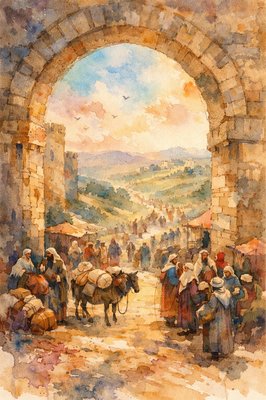
Ancient Jerusalem scene during the feast of passover.  Pilgrims have gathered inside the gate, preparing for departure back home.  Looking from inside the city toward the road that goes back to home, work, and ordinary life.
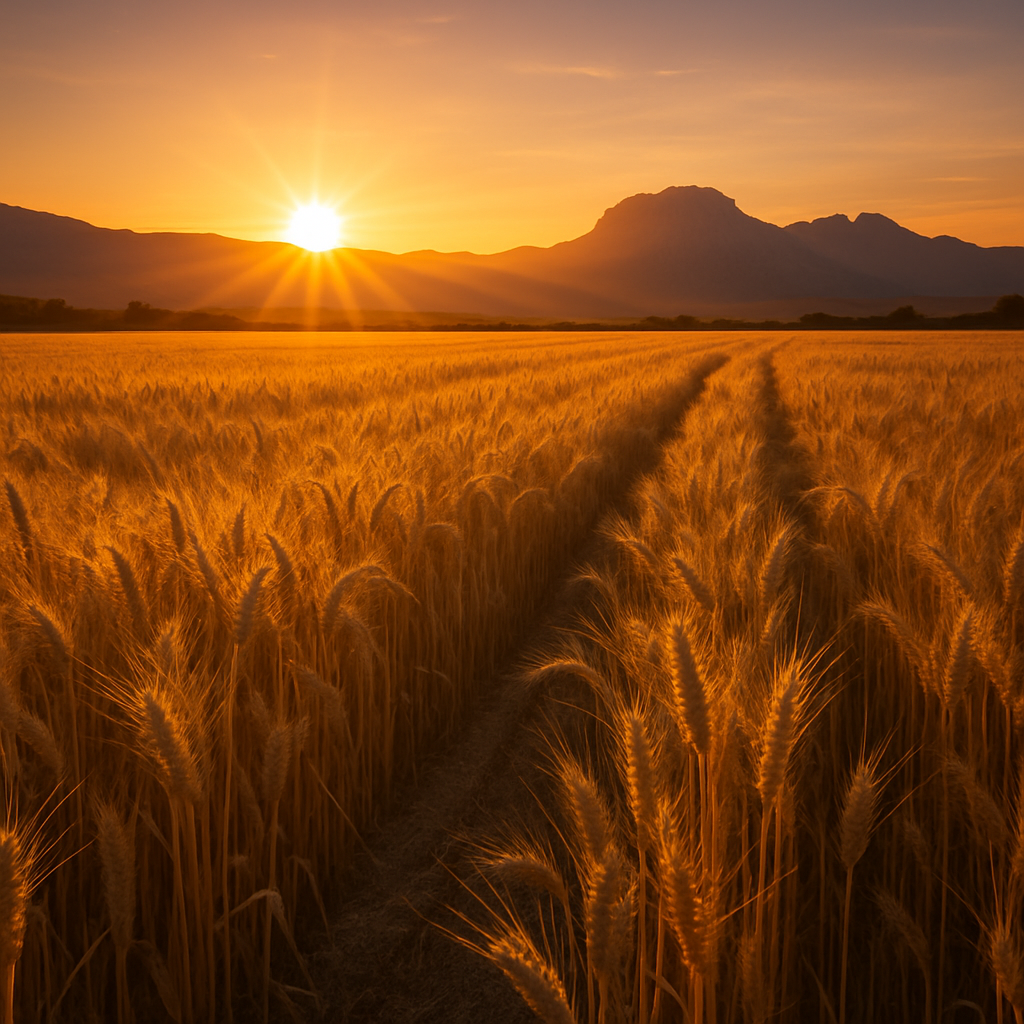
Wheat field with distant mountains
"A group of determined 19th-century gold miners panning for gold in a shallow, rocky stream in the Sierra Nevada mountains during the California Gold Rush. They are wearing rugged, worn clothing and wide-brimmed hats. Sunlight filters through pine trees, casting dappled light on the scene. One miner is intensely focused on his gold pan, while another is sifting through gravel. The water is clear, revealing pebbles and glints of potential gold. The background shows a rugged, forested landscape with distant hills."
a surreal Victorian faerie scene in a dense moonlit woodland, tiny luminous faeries perched on glowing mushrooms and curling flower petals, central faerie figure standing gracefully with layered iridescent wings, surrounded by clusters of miniature woodland spirits whispering and observing, jewel‑tone palette of ruby, emerald, sapphire, and opal glows, tall twisting trees framing the scene with hanging blossoms and tangled vines, soft mist drifting across the forest floor, delicate theatrical lighting illuminating faces and wings, scattered bioluminescent insects hovering in the air, intricate Victorian fabrics and filigree details on garments, dreamlike composition with overlapping layers of figures and foliage, painterly textures with fine detail and soft halos of light, styled in the artistic approach of John Anster Fitzgerald, 19th‑century fantasy illustration with whimsical yet mysterious atmosphere
a statue of a man with a fist up
Create a single, breathtaking mystical still image in ancient biblical apocalyptic art style, inspired by the Book of Enoch's Astronomical Book and Jewish esoteric mysticism. Depict the profound new moon phase at the sacred moment of renewal: profound cosmic darkness transitions to the very first emergence of light.A delicate, razor-thin silver crescent moon appears as a faint whisper against the vast starry heavens, with the tiniest sliver illuminated—symbolizing light just beginning to 'rise upon her.' The moon is portrayed as an ethereal, luminous feminine figure, veiled in soft mist and subtle glow, humble and receptive, her form blending pale and almost invisible into the bright daytime sky 'like the heaven,' near the radiant golden sun on the horizon.The sun blazes with warm, divine golden rays, gently transferring the first threads of holy light to the moon along an invisible ecliptic vine-like arc of faint stars and zodiac gates. Ethereal ancient Hebrew-like script glows softly in silver near the crescent: 'Erâe' (appearance/seeing/emergence), evoking first revelation, yoking to the divine source, and quiet abiding.Atmosphere: awe-inspiring cosmic scale, deep velvety blacks fading to golden-hour celestial light, silver-blue lunar luminescence contrasting warm sun rays, subtle particle effects of divine energy flowing. No modern elements; pure ancient mystical realism with sense of divine harmony, covenant faithfulness, and spiritual waiting/filling. High detail, cinematic composition, 16:9 aspect ratio, 8K resolution, inspired by Byzantine icons, Renaissance apocalyptic visions, and ethereal fantasy astronomy art
Volume 1 – Chapter 1: “Running Away”

Story Points:

Ji Hun is bored and unhappy with his life in the band “Forever.” Inner thoughts reveal his frustration and desire to escape.

He decides to run away; changes his appearance with a ginger curly wig and glasses to hide his identity.

Ji Hun sneaks out, but security guards notice him and start chasing him.

While running, he accidentally bumps into Min Joon, a girl with long curly black hair, wearing a hoodie and baggy jeans. They fall on the ground.

Min Joon helps him up and insists on taking him to her home to relax.

She offers him tea and biscuits; they start talking. Ji Hun lies and says his name is “Jin” and that he is an accountant.

He notices posters of his band “Forever” in her room and realizes she is a fan. Min Joon praises Ji Hun’s voice, making him shy.

Ji Hun talks about never enjoying life; Min Joon promises to teach him how to enjoy life.

Ji Hun hesitates, worried about being recognized, but she reassures him. He agrees to go with her.

Min Joon prepares to take him outside, setting up the transition to Chapter 2 (car ride and amusement park).

Page/Panel Flow Suggestions:

Pages 1–3: Ji Hun’s frustration, morning in the band dorm, decision to escape.

Pages 4–5: Ji Hun changing disguise.

Pages 6–8: Running and being chased by security guards.

Pages 9–12: Collision with Min Joon, first meeting.

Pages 13–16: Min Joon taking him home, tea and biscuits scene.

Pages 17–20: Conversation about Ji Hun’s unhappiness, Min Joon promising to show him joy.
Create an image inspired by the sentiment of 1 Peter 3:3-4, with an emphasis on elements of gentleness and tranquility. The art should evoke a deeply respectful and devotional tone towards Christianity. Although the style should be digital, no text or words should be used in the image. Instead, use symbolism and visual cues to express the essence of the scripture, creating a serene, spiritual atmosphere in the artwork.
Generate a vibrant, wide-angle image capturing the overwhelming scale and festive atmosphere of a Buc-ee's travel center during peak daylight hours. The central focus should be the massive, iconic Buc-ee the Beaver mascot statue at the entrance, welcoming visitors. Show the enormous, brightly lit gas station canopy stretching across dozens of pumps, with a continuous flow of cars and trucks. In the background, feature the distinctive red-roofed store building with its huge signage. Include details that convey the bustling energy: families walking in, people filling up their tanks, and the overall sense of a colossal, well-organized 'roadside attraction.' The image should highlight its cleanliness, vastness, and the unique, almost surreal experience of stopping at a Buc-ee's.
19th-Century Naturalistic Oil Painting Style, Rich Earth Tones, Rustic Textures and dramatic barn lighting. A tense, detailed scene inside an old, timber-framed stable at midday.

The Antagonist (The Dog): Right in the center of a large, rough wooden manger overflowing with golden, dry hay, a scruffy, snarling terrier-mix dog is curled up aggressively. Its teeth are bared in a vicious snap, its hackles are raised, and its eyes are fixed selfishly on the intruders.

The Victims (The Oxen): Two massive, powerful oxen with large yokes and gentle, hungry eyes are leaning over the manger rail. Their huge heads are close to the hay, but they are recoiling slightly from the snapping dog. One ox has drool dripping from its mouth, looking at the hay with desperation and confusion. The size difference between the massive heads of the oxen and the small, spiteful dog is emphasized.

The Atmosphere: A strong shaft of natural sunlight cuts through an open barn door, illuminating dancing dust motes and highlighting the textures of the straw, the rough wood grain of the manger, and the matted fur of the dog. The rest of the barn is in warm shadow.
Generate a vibrant, wide-angle image capturing the overwhelming scale and festive atmosphere of a Buc-ee's travel center during peak daylight hours. The central focus should be the massive, iconic Buc-ee the Beaver mascot statue at the entrance, welcoming visitors. Show the enormous, brightly lit gas station canopy stretching across dozens of pumps, with a continuous flow of cars and trucks. In the background, feature the distinctive red-roofed store building with its huge signage. Include details that convey the bustling energy: families walking in, people filling up their tanks, and the overall sense of a colossal, well-organized 'roadside attraction.' The image should highlight its cleanliness, vastness, and the unique, almost surreal experience of stopping at a Buc-ee's.
Got it. You'd like the full prompt again, including the updated detail about miners on the banks, ready for ArtStyles.com. Here it is:

Revised Prompt for ArtStyles.com:

"A bustling scene of 19th-century gold miners during the California Gold Rush. Several determined miners are panning for gold in a shallow, rocky stream in the Sierra Nevada mountains, their rugged, worn clothing and wide-brimmed hats indicating their toil. Along the banks of the stream, other miners are actively digging into the earth with shovels and picks, creating small piles of dirt and using sluice boxes to separate gold. Sunlight filters through tall pine trees, casting dappled light on the scene, illuminating the clear water and the industrious activity of the miners. The background showcases a rugged, forested landscape with distant hills.""sepia tone vintage photograph, grainy, aged look"
A historically accurate and atmospheric depiction of the signing of the Mayflower Compact aboard the ship in November 1620. The scene is set in the dimly lit, cramped cabin of the Mayflower, with the ship's timbers and rigging subtly visible, conveying the challenging conditions of the voyage. A simple table or chest serves as the signing surface. The primary focus is on a small group of the last individuals signing the document: specifically, the indentured servants (or 'strangers' not directly part of the Separatist congregation) approaching or at the table. Their expressions show a mix of weary determination, understanding of the necessity, and perhaps a hint of quiet apprehension or resignation to this new social contract, given their status. They are dressed in the plain, practical clothing typical of 17th-century commoners and laborers. Figures of prominent Pilgrims or 'Saints' (like William Bradford or John Carver) are visible in the background, observing the proceedings with a sense of gravity and leadership, but they are not the central focus. The lighting is low and warm, perhaps from a lantern, creating a chiaroscuro effect that highlights the faces of the signers. The atmosphere conveys the momentousness of the act under difficult circumstances, the diverse composition of the group, and the early seeds of self-governance in a new world. The artistic style is a realistic, historically detailed oil painting, capturing the solemnity and human element of this pivotal historical moment."
A breathtaking, highly detailed landscape and architectural illustration of historic Jonesborough, Tennessee, Appalachia, blanketed in fresh, pristine snow. The scene captures the charm of a 'Winter Wonderland' during the golden hour just before sunset. Focus on the main street (possibly Main Street or College Street) lined with preserved 18th and 19th-century Federal and Greek Revival style architecture, such as the Chester Inn or historic courthouse.

The buildings have warm, glowing lights spilling from their windows, creating a cozy contrast with the blue tones of the snow and dusk sky. Snow-dusted, bare deciduous trees frame the street. Include subtle details like a horse-drawn sleigh, tracks in the snow, and a thin wisp of smoke curling from chimneys. The style should be evocative, highly realistic, and painterly, capturing the quiet, historic ambiance of America's oldest town in Tennessee. Use a slightly elevated perspective to showcase the depth of the street and the surrounding Appalachian hillsides.
A photo-realistic image of the crumbling adobe ruins of Fort Lowell, New Mexico, nestled in a desolate, high desert landscape. The sun is setting, casting long, dramatic shadows. Include sparse, authentic 19th-century military supplies scattered in the foreground. Style: Hyper-detailed, cinematic, volumetric lighting.
Style: Gritty, epic historical fantasy photograph with high textural detail. The aesthetic is a fusion of "Ancient Near Eastern Warrior" and the "High Elven" nobility established in previous prompts. Golden hour lighting.

The Subject: A single warrior standing guard on the fortified walls of David’s stronghold (Jerusalem or Ziklag). He is immense, standing over seven feet tall, possessing a lean, gladiatorial musculature rather than brute bulk.

Facial Features: He has the signature Gibeonite look: a long, ageless face with high, sculpted cheekbones and intense, calculating eyes that scan the horizon. His dark beard is neatly trimmed, and his long hair is intricately braided with bronze rings and threads of royal blue dyed wool.

The Armor (A Fusion of Cultures): His gear represents his unique status. He wears a heavy cuirass of overlapping bronze scales (Canaanite style) reinforced with iron plates (Israelite adoption). A stylized emblem of the Lion of Judah is subtly engraved onto a central shoulder plate, marking his allegiance to David.

The Weapons: He rests one hand on a massive tower shield made of reinforced cedar and hide. In the other, he holds a spear of immense scale, its shaft thicker than a normal man’s wrist, with a long, leaf-shaped bronze head. A curved khopesh sword is sheathed at his hip.

Atmosphere & Setting: The sun is setting behind the Judean hills, casting long shadows and catching the scars on his armor. His expression is one of silent, dangerous vigilance. In the background, other normal-sized Israelite soldiers are visible, emphasizing his towering presence.
Style: Gritty, epic historical fantasy photograph with high textural detail. The aesthetic is a fusion of "Ancient Near Eastern Warrior" and the "High Elven" nobility established in previous prompts. Golden hour lighting.

The Subject: A single warrior standing guard on the fortified walls of David’s stronghold (Jerusalem or Ziklag). He is immense, standing over seven feet tall, possessing a lean, gladiatorial musculature rather than brute bulk.

Facial Features: He has the signature Gibeonite look: a long, ageless face with high, sculpted cheekbones and intense, calculating eyes that scan the horizon. His dark beard is neatly trimmed, and his long hair is intricately braided with bronze rings and threads of royal blue dyed wool.

The Armor (A Fusion of Cultures): His gear represents his unique status. He wears a heavy cuirass of overlapping bronze scales (Canaanite style) reinforced with iron plates (Israelite adoption). A stylized emblem of the Lion of Judah is subtly engraved onto a central shoulder plate, marking his allegiance to David.

The Weapons: He rests one hand on a massive tower shield made of reinforced cedar and hide. In the other, he holds a spear of immense scale, its shaft thicker than a normal man’s wrist, with a long, leaf-shaped bronze head. A curved khopesh sword is sheathed at his hip.

Atmosphere & Setting: The sun is setting behind the Judean hills, casting long shadows and catching the scars on his armor. His expression is one of silent, dangerous vigilance. In the background, other normal-sized Israelite soldiers are visible, emphasizing his towering presence.
"A historically accurate depiction of a Ghost Dance, focusing on the late 19th-century context, specifically around 1890-1891. The scene shows Lakota (Sioux) or Northern Paiute people (specify one or include elements of both, but avoid anachronisms) participating in the ceremony.

Setting: A vast, open prairie or high desert landscape, under an expansive sky. The time of day could be dusk or night, with a prominent moon or stars, or a bright, clear day. Avoid overtly spiritual or ethereal elements like floating spirits unless explicitly requested for a later, more symbolic iteration. The focus should be on the earthly ceremony.

Participants: A circle of men, women, and children, hand-in-hand, moving in a slow, rhythmic shuffle or circular motion. Their faces show a mixture of devotion, hope, and determination. Some may have expressions of trance or deep concentration.

Attire:

    Ghost Dance Shirts/Dresses: Emphasize the unique Ghost Dance shirts and dresses, which were typically made of muslin or canvas. These garments should feature painted designs such as stars, crescents, birds (especially eagles or crows), buffalo, human figures, or crosses. The designs should appear hand-painted, not mass-produced.

    Hair and Adornments: Participants should have braided hair or wear it long. Some may wear feathers (e.g., eagle or hawk feathers) in their hair. Minimal traditional adornments, as the focus was often on the Ghost Dance shirt itself. Avoid overly elaborate or Hollywood-esque depictions of war bonnets unless relevant to a specific individual and context.

    Footwear: Moccasins or bare feet.

Action/Atmosphere:

    The dancers are moving in a counter-clockwise circle, with a central figure or a small group often leading.

    The overall mood is one of earnest prayer and communal spiritual effort. The dance should convey a sense of hope for renewal and the return of the old ways, rather than aggression or despair.

    There might be a central pole or small fire as a focal point, around which the dance takes place.

    Avoid any signs of direct conflict or violence; the Ghost Dance itself was a non-violent spiritual movement.

Specific Considerations for Accuracy:

    Wovoka's Influence: The teachings of Wovoka (the Northern Paiute prophet) emphasized peace, hard work, and the return of the buffalo and deceased ancestors. The scene should subtly reflect this hopeful, redemptive spirit.

    Regional Variations: If focusing on Lakota, consider their specific interpretations, which sometimes included more imagery related to their warrior traditions on the shirts, but still within the peaceful framework of the dance.

    Respectful Portrayal: Ensure the depiction is respectful and avoids any stereotypical or caricatured representations of Indigenous people. Focus on their human dignity and spiritual sincerity.