Generate A Warm And Inviting Image Of The Silver Moon Cafe In Santa Rosa, New Mexico, As It Might Have Appeared In The 1950s Or Art

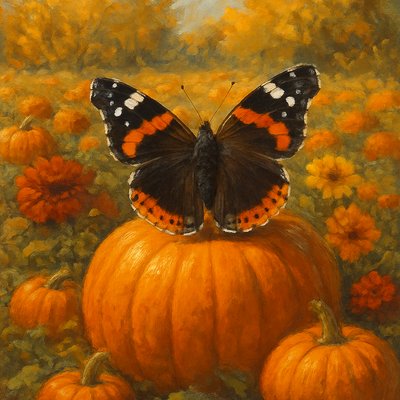
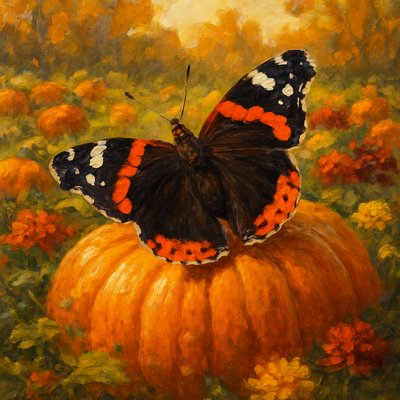
Oil Painting Art Style, a magnificent Red Admiral butterfly with its wings spread wide, revealing intricate patterns of bold black, vivid orange-red, and crisp white, gently perched on the stem or surface of a perfect, plump orange pumpkin. This scene is set within a sprawling, sun-drenched autumn pumpkin patch, where numerous pumpkins of various sizes are nestled amongst lush green and fading yellow vines. Surrounding the pumpkins are vibrant fall flowers arranged like a charming garden, in hues of deep red, golden yellow, and rustic orange. In the background, hints of golden aspen-like leaves glow from distant trees, adding to the rich autumn palette. The entire composition is bathed in clear, crisp, golden autumn sunlight, casting subtle shadows and highlighting the rich textures. Focus on the detailed brushwork on the butterfly's wings, the tangible texture of the pumpkin's skin, and the vibrant, layered colors of the fall foliage, flowers, and pumpkins, creating a detailed and serene artistic composition.
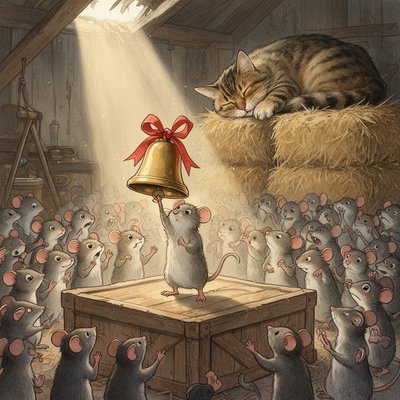
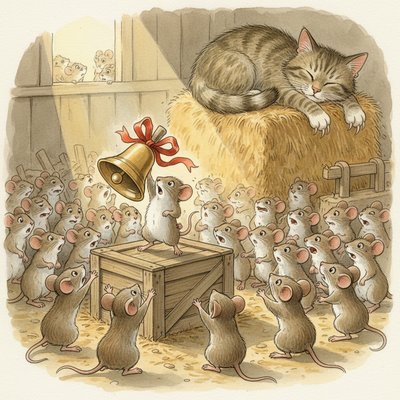
Whimsical Storybook Illustration Style, Warm Color Palette, Soft Textures and Detailed Linework. A wide-angle view of a secret, crowded meeting of dozens of anthropomorphic field mice taking place on an upturned wooden crate in the corner of a cluttered, dusty barn.

The Focal Point (The Plan): In the center of the crate spotlighted by a beam of sunlight coming through a crack in the roof, a small, earnest mouse stands on its hind legs, triumphantly holding aloft a shiny brass sleigh bell tied with a bright red ribbon. The bell looks impossibly large and heavy for the mouse.

The Reaction (The Hesitation): The surrounding crowd of mice is a mix of emotions. Some in the front row are cheering with tiny paws raised. However, many others towards the back are exchanging nervous, sidelong glances, scratching their heads, or looking fearfully over their shoulders.

The Threat (The Reality): In the background, on top of a high stack of hay bales, a giant, fluffy tabby cat is fast asleep. Though sleeping, its size and sharp claws are evident, casting a shadow over the edge of the meeting area. The contrast between the small, shiny bell and the enormous sleeping predator is central to the image.
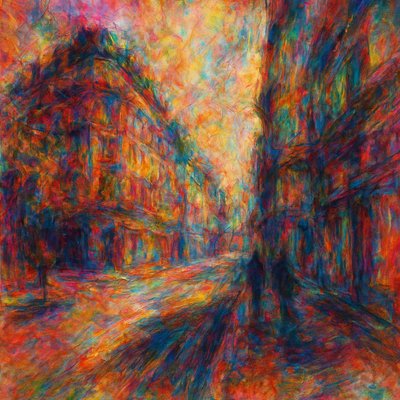
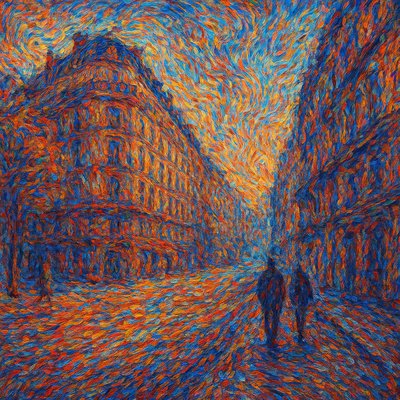
Memory Distortion Expressionism Art Style Style Transfer Example
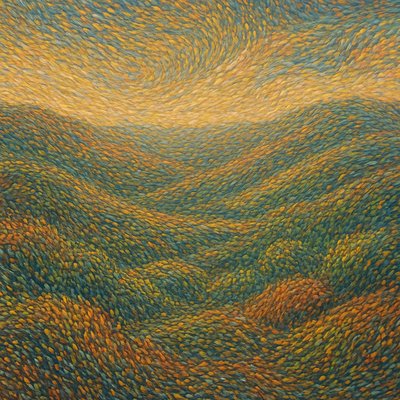
wide landscape with natural scenery
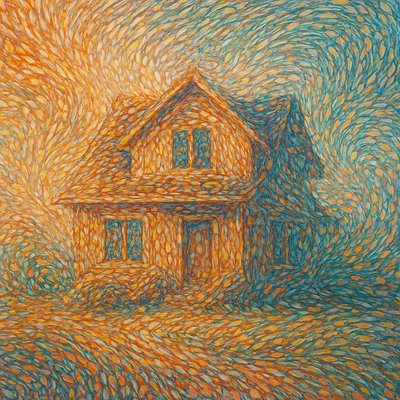
house with front view
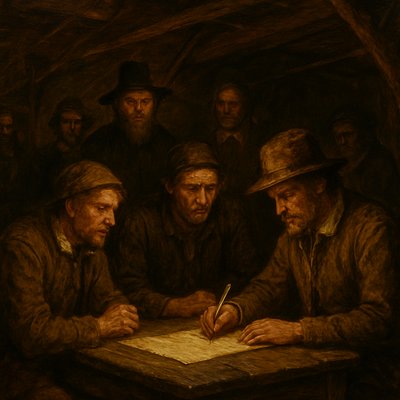
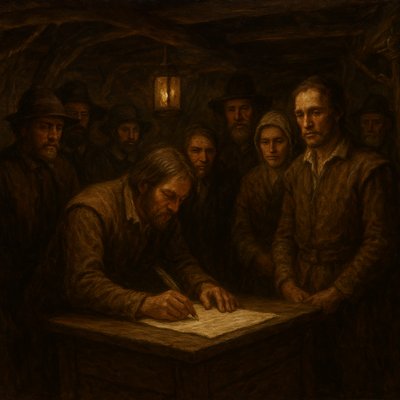
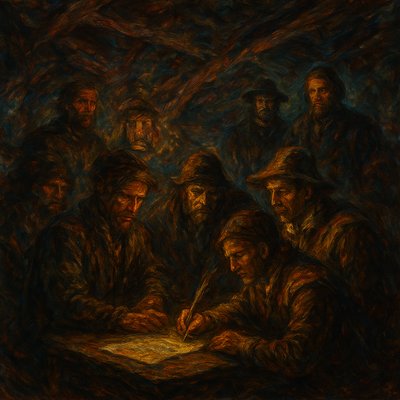
A historically accurate and atmospheric depiction of the signing of the Mayflower Compact aboard the ship in November 1620. The scene is set in the dimly lit, cramped cabin of the Mayflower, with the ship's timbers and rigging subtly visible, conveying the challenging conditions of the voyage. A simple table or chest serves as the signing surface. The primary focus is on a small group of the last individuals signing the document: specifically, the indentured servants (or 'strangers' not directly part of the Separatist congregation) approaching or at the table. Their expressions show a mix of weary determination, understanding of the necessity, and perhaps a hint of quiet apprehension or resignation to this new social contract, given their status. They are dressed in the plain, practical clothing typical of 17th-century commoners and laborers. Figures of prominent Pilgrims or 'Saints' (like William Bradford or John Carver) are visible in the background, observing the proceedings with a sense of gravity and leadership, but they are not the central focus. The lighting is low and warm, perhaps from a lantern, creating a chiaroscuro effect that highlights the faces of the signers. The atmosphere conveys the momentousness of the act under difficult circumstances, the diverse composition of the group, and the early seeds of self-governance in a new world. The artistic style is a realistic, historically detailed oil painting, capturing the solemnity and human element of this pivotal historical moment."
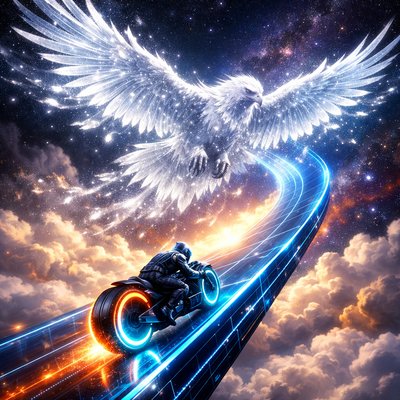
Neon-Futurism Digital Art Style, Bioluminescent Sci-Fi Cosmic Setting, High-Altitude Perspective. An exhilarating shot where the highway feels like it is suspended at the very top of the universe.

    The Rider & Bike Consistency: The lone motorcyclist—wearing the signature sleek, armored suit and helmet—is tucked tight for aerodynamics on the hubless "light-cycle." The cyan and orange neon rings of the wheels are glowing intensely as the bike reaches top speed.

    The Path (The Rising Ecliptic): The glowing blue laser-grid highway is no longer level; it is banking sharply upward, curving through a sea of soft, white-gold clouds made of ionized gas.

    The Cancer Presence (The Eagle): Soaring directly above the rider is the colossal, majestic Celestial Eagle. Its wingspan is massive, stretching across the entire frame. The bird is composed of shimmering white light and silver-blue circuitry. Its feathers look like individual blades of glowing glass, trailing "stardust" behind them.

    The Action: The Eagle is in mid-flight, its talons tucked and its head forward, appearing to lead the rider through a turbulent nebula. The rider is positioned directly in the "slipstream" of the Eagle’s wings, where the air is filled with glowing white feathers made of pure energy.

    Atmosphere: A sense of soaring freedom and divine protection. The color palette shifts to bright whites, ethereal silvers, and soft periwinkle, contrasting with the sharp neon of the motorcycle.

    Lighting: Radiant and "heavenly." The glow from the Eagle’s wings illuminates the top of the rider’s helmet and shoulders in a brilliant white rim-light.
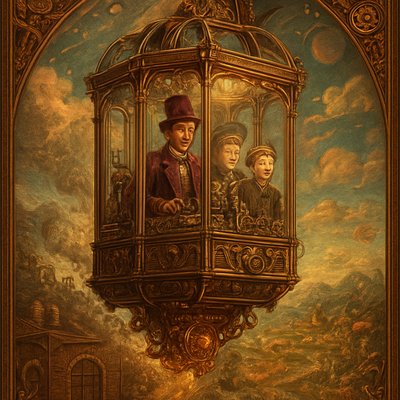
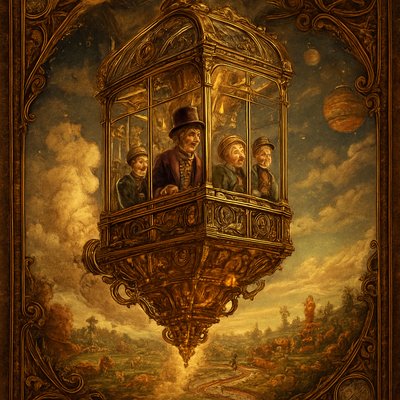
An awe-inspiring and whimsical scene featuring Willy Wonka's Great Glass Wonkavator, soaring through the sky and beyond the confines of the chocolate factory. The Wonkavator itself is a magnificent, multi-directional glass elevator, transparent and sparkling, with Willy Wonka (wearing his iconic top hat, purple coat, and bowtie) and Charlie Bucket (and perhaps Grandpa Joe) inside, looking out with expressions of wonder and excitement. The interior is filled with intricate buttons and levers for controlling its magical flight.

The Wonkavator is depicted in mid-flight, perhaps bursting through the factory roof or ascending above the clouds. Below it, the fantastical landscape of the Chocolate Factory is visible – chocolate rivers, edible gardens, candy cane trees, and various whimsical buildings. Beyond the factory, a stunning, imaginative sky unfolds, perhaps with floating candy clouds, distant fantastical landmarks, or even glimpses of outer space and planets. The lighting is bright and magical, emphasizing the glass's transparency and the vibrant colors of the world below and beyond. The overall mood is one of boundless adventure, limitless possibilities, and pure, joyful fantasy."
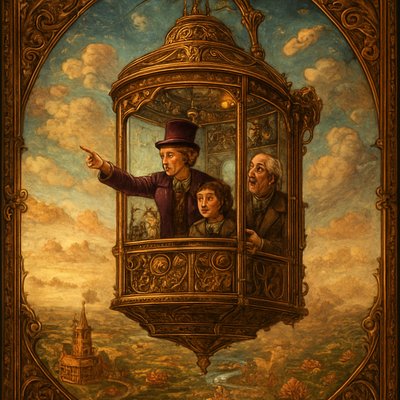
An awe-inspiring and whimsical scene featuring Willy Wonka's Great Glass Wonkavator, soaring high above the chocolate factory and ascending into a fantastical sky. The Wonkavator itself is a magnificent, multi-directional glass elevator, transparent and sparkling, with Willy Wonka (in his iconic purple coat and top hat), young Charlie Bucket, and Grandpa Joe clearly visible and enjoying the ride inside. Wonka points excitedly, Charlie looks out with wide-eyed wonder, and Grandpa Joe grins with delight. The interior of the Wonkavator shows intricate, whimsical control panels.

The Wonkavator is depicted in mid-flight, having just burst through the factory roof or rising above the clouds. Below it, the fantastical landscape of the Chocolate Factory is spread out – chocolate rivers, edible gardens, candy cane trees, and various whimsical buildings. Beyond the factory, a stunning, imaginative sky unfolds, filled with floating candy clouds, distant fantastical landmarks, and even glimpses of planets and stars. The lighting is bright and magical, emphasizing the glass's transparency and the vibrant colors of the world below and beyond. The overall mood is one of boundless adventure, limitless possibilities, and pure, joyful fantasy."
An awe-inspiring and whimsical scene featuring Willy Wonka's Great Glass Wonkavator, soaring through the sky and beyond the confines of the chocolate factory. The Wonkavator itself is a magnificent, multi-directional glass elevator, transparent and sparkling, with Willy Wonka (wearing his iconic top hat, purple coat, and bowtie) and Charlie Bucket and Grandpa Joe inside, looking out with expressions of wonder and excitement. The interior is filled with intricate buttons and levers for controlling its magical flight.

The Wonkavator is depicted in mid-flight, perhaps bursting through the factory roof or ascending above the clouds. Below it, the fantastical landscape of the Chocolate Factory is visible – chocolate rivers, edible gardens, candy cane trees, and various whimsical buildings. Beyond the factory, a stunning, imaginative sky unfolds, perhaps with floating candy clouds, distant fantastical landmarks, or even glimpses of outer space and planets. The lighting is bright and magical, emphasizing the glass's transparency and the vibrant colors of the world below and beyond. The overall mood is one of boundless adventure, limitless possibilities, and pure, joyful fantasy."
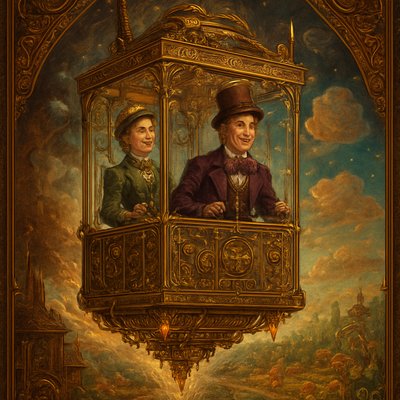
An awe-inspiring and whimsical scene featuring Willy Wonka's Great Glass Wonkavator, soaring through the sky and beyond the confines of the chocolate factory. The Wonkavator itself is a magnificent, multi-directional glass elevator, transparent and sparkling, with a middle aged Willy Wonka (wearing his iconic top hat, purple coat, and bowtie) and a young Victorian well dressed lady looking out with expressions of joy, wonder and excitement. The interior is filled with intricate buttons and levers for controlling its magical flight. The Wonkavator is depicted in mid-flight, perhaps bursting through the factory roof or ascending above the clouds. Below it, the fantastical landscape of the Chocolate Factory is visible – chocolate rivers, edible gardens, candy cane trees, and various whimsical buildings. Beyond the factory, a stunning, imaginative sky unfolds, perhaps with floating candy clouds, distant fantastical landmarks, or even glimpses of outer space and planets. The lighting is bright and magical, emphasizing the glass's transparency and the vibrant colors of the world below and beyond. The overall mood is one of boundless adventure, limitless possibilities, and pure, joyful fantasy."
Neon-Futurism Digital Art Style, Bioluminescent Sci-Fi Cosmic Setting, High-Altitude Perspective. An exhilarating shot where the highway feels like it is suspended at the very top of the universe.

    The Rider & Bike Consistency: The lone motorcyclist—wearing the signature sleek, armored suit and helmet—is tucked tight for aerodynamics on the hubless "light-cycle." The cyan and orange neon rings of the wheels are glowing intensely as the bike reaches top speed.

    The Path (The Rising Ecliptic): The glowing blue laser-grid highway is no longer level; it is banking sharply upward, curving through a sea of soft, white-gold clouds made of ionized gas.

    The Cancer Presence (The Eagle): Soaring directly above the rider is the colossal, majestic Celestial Eagle. Its wingspan is massive, stretching across the entire frame. The bird is composed of shimmering white light and silver-blue circuitry. Its feathers look like individual blades of glowing glass, trailing "stardust" behind them.

    The Action: The Eagle is in mid-flight, its talons tucked and its head forward, appearing to lead the rider through a turbulent nebula. The rider is positioned directly in the "slipstream" of the Eagle’s wings, where the air is filled with glowing white feathers made of pure energy.

    Atmosphere: A sense of soaring freedom and divine protection. The color palette shifts to bright whites, ethereal silvers, and soft periwinkle, contrasting with the sharp neon of the motorcycle.

    Lighting: Radiant and "heavenly." The glow from the Eagle’s wings illuminates the top of the rider’s helmet and shoulders in a brilliant white rim-light.
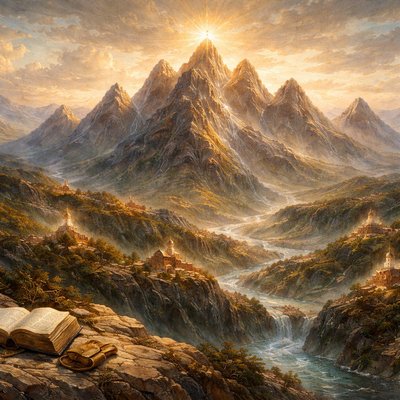
Create a mountain with Seven peaks and express without words “Saying, I am Alpha and Omega, the first and the last: and, What thou seest, write in a book, and send it unto the seven churches which are in Asia; unto Ephesus, and unto Smyrna, and unto Pergamos, and unto Thyatira, and unto Sardis, and unto Philadelphia, and unto Laodicea.” (Revelation 1:11, KJV)
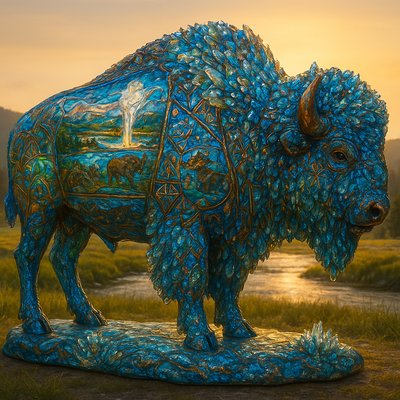
    A breathtaking, full-size artistic sculpture of a standing buffalo, rendered entirely in the style of intricate, luminous glass art, reminiscent of the painted buffalo installations. The buffalo's majestic form is composed of countless individual pieces of vibrant, multifaceted stained glass or fused glass, meticulously cut, arranged, and joined.

    The entire surface of this glass buffalo is adorned with various miniature, finely detailed scenes and patterns etched, painted, or embedded within the glass itself, or created by the unique coloration and texture of the glass pieces. These scenes depict:

        Iconic Yellowstone landscapes: Old Faithful erupting in miniature, the Grand Canyon of the Yellowstone, geothermal pools.

        Local wildlife: Elk, bears, wolves, eagles (all rendered in the glass medium).

        Native American art motifs: Geometric patterns, symbols, and figures (also within the glass).

    The buffalo's interior is subtly illuminated, causing the entire sculpture to glow from within, acting as a beacon of art and nature. Light catches every facet of the glass, creating a dazzling play of refracted colors that project intricate patterns onto the surrounding natural environment.

    The setting is the glory of Yellowstone National Park, specifically an expansive, iconic vista. Perhaps in a verdant meadow with distant geysers steaming, or near a crystal-clear river. The morning sun, bright and golden, backlights the buffalo, intensifying its inner glow and creating a dramatic contrast with the rugged, natural beauty of the park. The atmosphere is one of awe, harmony between art and nature, and a profound celebration of the spirit of the American West. The artistic style is hyper-realistic, emphasizing the detailed texture, transparency, and brilliant light play inherent in glass art, seamlessly integrated into a vibrant, natural landscape.
    A breathtaking, full-size artistic sculpture of a standing buffalo, rendered entirely in the style of intricate, luminous glass art, reminiscent of the painted buffalo installations. The buffalo's majestic form is composed of countless individual pieces of vibrant, multifaceted stained glass or fused glass, meticulously cut, arranged, and joined.

    The entire surface of this glass buffalo is adorned with various miniature, finely detailed scenes and patterns etched, painted, or embedded within the glass itself, or created by the unique coloration and texture of the glass pieces. These scenes depict:

        Iconic Yellowstone landscapes: Old Faithful erupting in miniature, the Grand Canyon of the Yellowstone, geothermal pools.

        Local wildlife: Elk, bears, wolves, eagles (all rendered in the glass medium).

        Native American art motifs: Geometric patterns, symbols, and figures (also within the glass).

    The buffalo's interior is subtly illuminated, causing the entire sculpture to glow from within, acting as a beacon of art and nature. Light catches every facet of the glass, creating a dazzling play of refracted colors that project intricate patterns onto the surrounding natural environment.

    The setting is the glory of Yellowstone National Park, specifically an expansive, iconic vista. Perhaps in a verdant meadow with distant geysers steaming, or near a crystal-clear river. The morning sun, bright and golden, backlights the buffalo, intensifying its inner glow and creating a dramatic contrast with the rugged, natural beauty of the park. The atmosphere is one of awe, harmony between art and nature, and a profound celebration of the spirit of the American West. The artistic style is hyper-realistic, emphasizing the detailed texture, transparency, and brilliant light play inherent in glass art, seamlessly integrated into a vibrant, natural landscape.
Sustainable Eco Jewelry Design Style Transfer Example
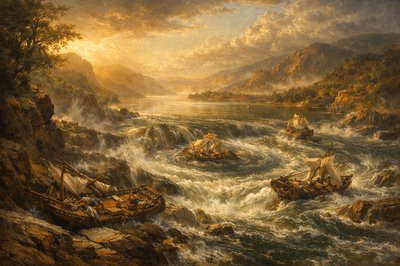
Now, those captains must learn what the river will do
when it makes that great turn out of sight.
How it dashes them up on the rocks of the shore
How it spins to the left and the right.
It beats them and breaks them and crushes their pride
Leaves them dizzy and sick and all jumbled inside
‘til they’ve all but forgotten that glorious ride
lying flat on their deck in the sun.
There they lie, drying out in the sun.

As you round the point where the river was bent
and survey the great wideness ahead,
you can see all those captains alone on their decks,
beat and broken and very near dead.
Then the current takes hold and there’s naught you can do
as it drags you down into its maw.
Headed straight for those rocks, you make ready to crash
but at last, you rise up, roll and yaw.

Going back and away, then forward again,
fearing each time, the rocks will prevail!
You’re trapped in a cycling, circling tide,
in an eddy withstanding a gale.
But each time you circle that great whirling tide
and you’ve not hit the rocks or been thrown to the side
and you’re kept from the falls, cascading and wide,
for the eddy’s small mercy give praise.
Give the merciful currents your praise!
A sweeping digital fantasy painting of a majestic angel with large, feathered wings made of glowing white light and golden energy, suspended within the center of a massive cosmic whirlwind. The whirlwind itself is a swirling spiral galaxy, composed of vibrant nebulae, millions of sparkling stars, dust lanes in deep blues, purples, and oranges, and miniature planets caught in the flow. The angel, wearing flowing, armored robes of starlight, looks serene with outstretched arms. The background is the dark expanse of deep space filled with distant galaxies. The style is epic and cinematic.
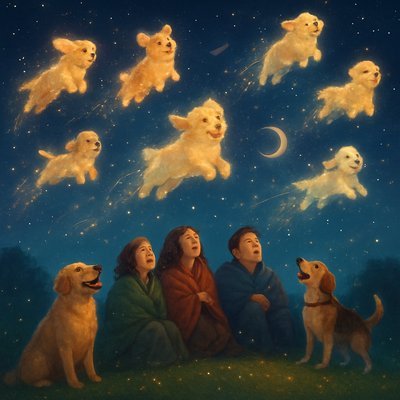
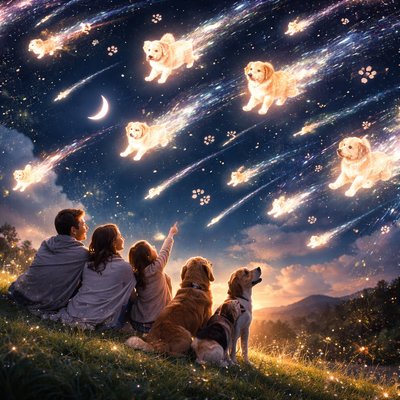
Art Style: A whimsical, magical fantasy photograph with a slight long-exposure effect. The aesthetic should be charming, warm, and full of wonder, like a scene from a high-budget Studio Ghibli film brought to real life.

The Sky (The Shower): The deep, dark night sky is alive with activity. Instead of standard meteor streaks, dozens of glowing, translucent "puppy-meteors" are zooming across the heavens.

The Puppies: They are clearly recognizable as adorable, fluffy puppies—golden retrievers, chunky corgis, fluffy samoyeds, and floppy-eared spaniels.

    Appearance: They emit a soft, warm, bioluminescent glow (golds, creams, and soft blues).

    Motion: They aren't falling tragically; they look playful, soaring and tumbling through space, leaving long, glittering trails of stardust and paw-print sparkles behind them. Let's make sure to include the moon phase we established earlier for continuity! A slender waning crescent moon is visible among the puppy-streaks.

The Foreground Setting: A wide, grassy hill perfect for stargazing.

    The Viewers: A family or group of friends wrapped in cozy blankets are sitting on the grass, looking up with expressions of pure joy and disbelief, pointing at the sky.

    Animal Reaction: On the ground next to them, two real dogs (an earth-bound golden retriever and a beagle) are looking up at the sky, barking happily and wagging their tails wildly at their celestial cousins.

Lighting: The primary light source is the magical, warm glow from the dozens of puppy-meteors streaking overhead, casting soft light on the landscape below.
A historically accurate and atmospheric depiction of the signing of the Mayflower Compact aboard the ship in November 1620. The scene is set in the dimly lit, cramped cabin of the Mayflower, with the ship's timbers and rigging subtly visible, conveying the challenging conditions of the voyage. A simple table or chest serves as the signing surface. The primary focus is on a small group of the last individuals signing the document: specifically, the indentured servants (or 'strangers' not directly part of the Separatist congregation) approaching or at the table. Their expressions show a mix of weary determination, understanding of the necessity, and perhaps a hint of quiet apprehension or resignation to this new social contract, given their status. They are dressed in the plain, practical clothing typical of 17th-century commoners and laborers. Figures of prominent Pilgrims or 'Saints' (like William Bradford or John Carver) are visible in the background, observing the proceedings with a sense of gravity and leadership, but they are not the central focus. The lighting is low and warm, perhaps from a lantern, creating a chiaroscuro effect that highlights the faces of the signers. The atmosphere conveys the momentousness of the act under difficult circumstances, the diverse composition of the group, and the early seeds of self-governance in a new world. The artistic style is a realistic, historically detailed oil painting, capturing the solemnity and human element of this pivotal historical moment."
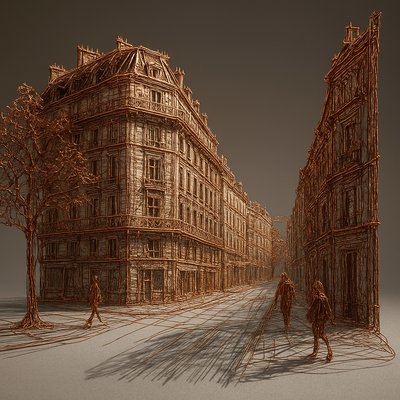
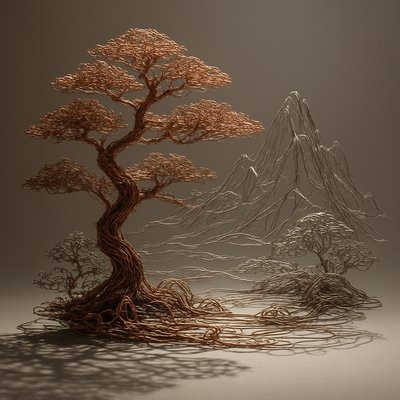
Bonsai Wire Sculpture Style Transfer Example
still life with everyday objects
wide landscape with natural scenery
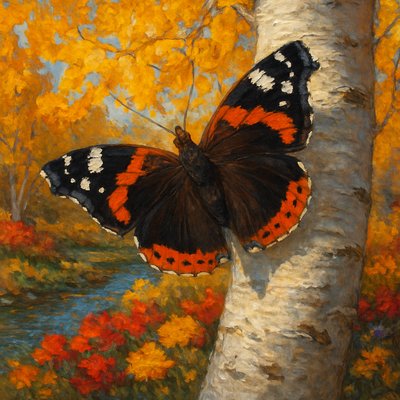
Oil Painting Art Style, a magnificent Red Admiral butterfly with its wings spread wide, revealing intricate patterns of bold black, vivid orange-red, and crisp white, firmly perched on the distinctive, textured white bark of an aspen tree. This scene is set at a lower elevation, where the aspen grows near a gently flowing stream, its banks adorned with a lush fall garden of colorful autumn flowers—deep reds, golden yellows, and fiery oranges—arranged in a picturesque display. Overhead and around, the aspen tree's own leaves are ablaze with brilliant, bright gold, adding a stunning luminosity to the scene. The entire composition is illuminated by clear, crisp autumn light, casting subtle shadows and highlighting the rich textures. Focus on the detailed brushwork on the butterfly's wings, the tangible texture of the aspen bark, and the vibrant, layered colors of the fall foliage and flowers, especially the striking golden aspen leaves, creating a detailed and serene artistic composition.
Oil Painting Art Style, a magnificent, normal-sized Red Admiral butterfly with its wings spread wide, revealing intricate patterns of bold black, vivid orange-red, and crisp white, delicately perched on the stem or curving surface of a large, plump orange pumpkin. This scene is set within a sprawling, sun-drenched autumn pumpkin patch, where numerous pumpkins of various sizes are nestled amongst lush green and fading yellow vines. Surrounding the pumpkins are vibrant fall flowers arranged like a charming garden, in hues of deep red, golden yellow, and rustic orange. In the background, hints of golden aspen-like leaves glow from distant trees, adding to the rich autumn palette. The entire composition is bathed in clear, crisp, golden autumn sunlight, casting subtle shadows and highlighting the rich textures. Focus on the detailed brushwork on the butterfly's tiny wings, the tangible texture of the pumpkin's skin, and the vibrant, layered colors of the fall foliage, flowers, and pumpkins, creating a detailed and serene artistic composition.
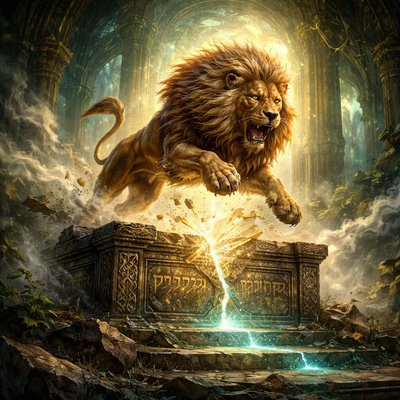
A hyper-realistic, majestic golden Lion of Judah leaping powerfully over a crumbling ancient stone altar. The altar is engraved with Hebrew letters and surrounded by drifting incense smoke. As the lion "springs out," the heavy stone of the altar cracks under its paws, revealing a path of brilliant celestial light. Cinematic lighting, dramatic shadows, baroque art style, 8k resolution, divine and regal atmosphere.
Cinematic Documentary Photography, Warm Analog Film Grain, Golden Hour Backlighting. A high-energy, joyful shot of a young Appalachian woman with a mane of long, fiery red hair playing a dobro resonator guitar on a weathered log cabin porch.

The Action & "Lively" Feel: She is seated with the guitar flat across her lap, caught in a moment of pure musical passion, her head tilted back in a laugh. Her long red hair is swirling around her face, catching the orange sunset light like glowing copper.

The Slide Detail: Her left hand is firmly gripping a heavy, polished chrome steel tone bar (slide), gliding it masterfully across the strings. The bar is a focal point, catching a brilliant glint of sunlight as it creates a soulful, sliding resonance. Her right hand is a blur of motion, using metal fingerpicks to pluck the strings near the bridge.

The Environment: The dobro's signature round metal resonator plate reflects the rustic porch and the sky. In the background, the hazy, rolling blue ridges of the Appalachian mountains stretch toward a soft, dusky horizon. The atmosphere is rustic, authentic, and vibrating with sound.
A historically accurate and atmospheric depiction of the signing of the Mayflower Compact aboard the ship in November 1620. The scene is set in the dimly lit, cramped cabin of the Mayflower, with the ship's timbers and rigging subtly visible, conveying the challenging conditions of the voyage. A simple table or chest serves as the signing surface. The primary focus is on a small group of the last individuals signing the document: specifically, the indentured servants (or 'strangers' not directly part of the Separatist congregation) approaching or at the table. Their expressions show a mix of weary determination, understanding of the necessity, and perhaps a hint of quiet apprehension or resignation to this new social contract, given their status. They are dressed in the plain, practical clothing typical of 17th-century commoners and laborers. Figures of prominent Pilgrims or 'Saints' (like William Bradford or John Carver) are visible in the background, observing the proceedings with a sense of gravity and leadership, but they are not the central focus. The lighting is low and warm, perhaps from a lantern, creating a chiaroscuro effect that highlights the faces of the signers. The atmosphere conveys the momentousness of the act under difficult circumstances, the diverse composition of the group, and the early seeds of self-governance in a new world. The artistic style is a realistic, historically detailed oil painting, capturing the solemnity and human element of this pivotal historical moment."
Art Style: A whimsical, magical fantasy photograph with a slight long-exposure effect. The aesthetic should be charming, warm, and full of wonder, like a scene from a high-budget Studio Ghibli film brought to real life.

The Sky (The Shower): The deep, dark night sky is alive with activity. Instead of standard meteor streaks, dozens of glowing, translucent "puppy-meteors" are zooming across the heavens.

The Puppies: They are clearly recognizable as adorable, fluffy puppies—golden retrievers, chunky corgis, fluffy samoyeds, and floppy-eared spaniels.

    Appearance: They emit a soft, warm, bioluminescent glow (golds, creams, and soft blues).

    Motion: They aren't falling tragically; they look playful, soaring and tumbling through space, leaving long, glittering trails of stardust and paw-print sparkles behind them. Let's make sure to include the moon phase we established earlier for continuity! A slender waning crescent moon is visible among the puppy-streaks.

The Foreground Setting: A wide, grassy hill perfect for stargazing.

    The Viewers: A family or group of friends wrapped in cozy blankets are sitting on the grass, looking up with expressions of pure joy and disbelief, pointing at the sky.

    Animal Reaction: On the ground next to them, two real dogs (an earth-bound golden retriever and a beagle) are looking up at the sky, barking happily and wagging their tails wildly at their celestial cousins.

Lighting: The primary light source is the magical, warm glow from the dozens of puppy-meteors streaking overhead, casting soft light on the landscape below.
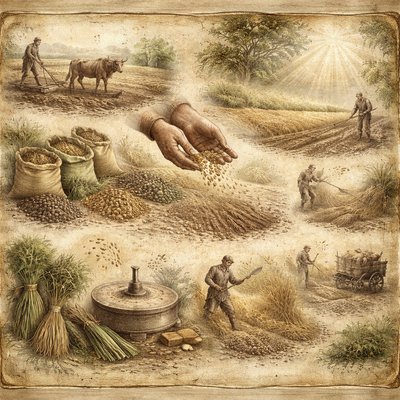
Without using words create “Doth the plowman plow all day to sow? doth he open and break the clods of his ground? When he hath made plain the face thereof, doth he not cast abroad the fitches, and scatter the cummin, and cast in the principal wheat and the appointed barley and the rie in their place? For his God doth instruct him to discretion, and doth teach him. For the fitches are not threshed with a threshing instrument, neither is a cart wheel turned about upon the cummin; but the fitches are beaten out with a staff, and the cummin with a rod. Bread corn is bruised; because he will not ever be threshing it, nor break it with the wheel of his cart, nor bruise it with his horsemen. This also cometh forth from the LORD of hosts, which is wonderful in counsel, and excellent in working.” (Isaiah 28:24-29, KJV)
Art Style: A fusion of "Mystical Sci-Fi" and "Cinematic Fantasy Concept Art." The look should be detailed, textured, but dominated by glowing energy effects. Think Dune meets high-fantasy magic.

The Subject: A woman with incredibly long, fiery red hair. Her hair isn't just resting; it appears almost weightless, billowing slightly around her as if charged with static electricity or magic, glowing with a faint internal copper light.

The "Tent" (The Force Field): She is inside a structure that resembles the frame of a large expedition tent. However, instead of fabric, the spaces between the poles are filled with a shimmering, translucent energy barrier.

    Appearance: The field is a dome of rippling, geometric light patterns (amber, gold, and electric blue) that hum with power. It looks solid yet transparent.

    The Action (The Protection): The force field is actively working. Outside the tent, a fierce, dark environmental threat—perhaps a swirling dust storm full of jagged rocks, or shadowy, ethereal creatures—is bombarding the outside of the dome.

    The Impact: Where the threat hits the tent, the energy field flares brightly, sending out crackling sparks of light, deflecting the danger completely.

Atmosphere & Setting: The interior of the tent is calm and warmly lit by the energy field, while the outside is chaotic and dark. The setting is a rugged, alien canyon at twilight.
Art Style: A fusion of "Mystical Sci-Fi" and "Cinematic Fantasy Concept Art." The look should be detailed, textured, but dominated by glowing energy effects. Think Dune meets high-fantasy magic.

The Subject: A woman with incredibly long, fiery red hair. Her hair isn't just resting; it appears almost weightless, billowing slightly around her as if charged with static electricity or magic, glowing with a faint internal copper light.

The "Tent" (The Force Field): She is sitting cross-legged inside a structure that resembles the frame of a large expedition tent. However, instead of fabric, the spaces between the poles are filled with a shimmering, translucent energy barrier.

    Appearance: The field is a dome of rippling, geometric light patterns (amber, gold, and electric blue) that hum with power. It looks solid yet transparent.

    The Action (The Protection): The force field is actively working. Outside the tent, a fierce, dark environmental threat—perhaps a swirling dust storm full of jagged rocks, or shadowy, ethereal creatures—is bombarding the outside of the dome.

    The Impact: Where the threat hits the tent, the energy field flares brightly, sending out crackling sparks of light, deflecting the danger completely.

Atmosphere & Setting: The interior of the tent is calm and warmly lit by the energy field, while the outside is chaotic and dark. The setting is a rugged, alien canyon at twilight.
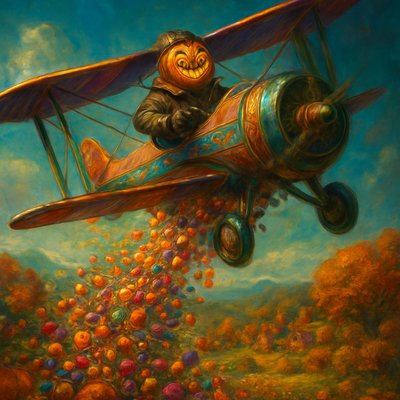
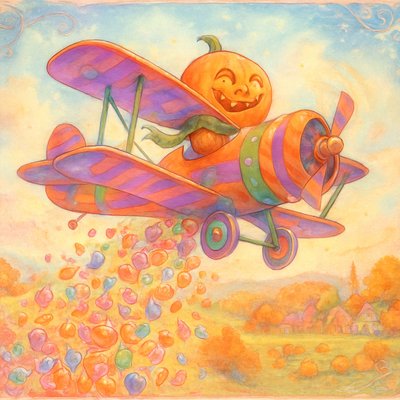
A fantastically cheerful and dynamic scene featuring the happy pumpkin-head figure (with the swirled, smiling carved face and internal glow) as the pilot of a classic, brightly colored biplane. The biplane itself is whimsically designed, perhaps with candy-themed accents or painted in vibrant, cheerful colors like orange, purple, and green.

The biplane is soaring through a clear, azure autumn sky, actively 'crop-dusting' a massive, exuberant stream of colorful Halloween candy from its underside. The candy (an abundant mix of wrapped chocolates, lollipops, candy corn, and various sweets) cascades downwards in a wide, joyous plume, spreading across the landscape below.

The landscape beneath the biplane is an idyllic, festive autumnal scene: rolling hills covered in vibrant fall foliage (golden, red, orange trees), a charming pumpkin patch, or a quaint, candy-colored village. The perspective is dynamic, capturing the plane in motion with the candy streaming behind it. The lighting is bright and sunny, emphasizing the vivid colors of the plane, the candy, and the autumn scenery. The overall mood is one of pure, unadulterated joy, playful magic, and festive exuberance, like a sugary parade from the sky."
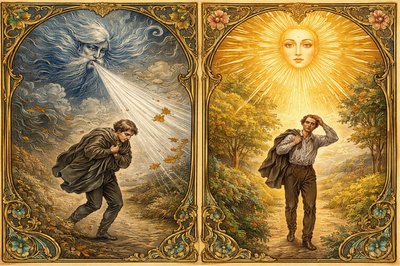
Vintage Art Nouveau Lithograph Style, Highly Decorative Borders, Rich Earth Tones and Gold Leaf. A vertically split "before and after" composition illustrating the classic fable of "The Wind and the Sun."

The Left Side (The Wind's Force): A personified North Wind, depicted as a swirling, ethereal figure made of cold blue and silver clouds with puffed cheeks, blows a jagged, visible blast of air downward. Below, a traveler on a dusty road is hunched over, his face strained, gripping his heavy woolen coat tightly around his chest as the gale whips his hair and sends autumn leaves flying in a chaotic spiral. The colors are cool, muted, and turbulent.

The Right Side (The Sun's Warmth): A personified Sun, depicted as a serene, radiant golden face surrounded by a massive, ornate circular halo of sunbeams, looks down with a gentle smile. Below, the same traveler is standing tall and relaxed on the path. His coat is draped loosely over one arm, his shirt collar is open, and he is wiping a bead of sweat from his forehead. The landscape around him is bathed in warm gold and vibrant greens, with tiny flowers blooming at his feet.

The Framing: The two scenes are separated by an elegant, winding vine border. The overall mood shifts from the frantic, cold energy on the left to the peaceful, overwhelming warmth on the right.
A magical, high-fantasy illustration capturing the final scene of Reepicheep's journey from C.S. Lewis's The Voyage of the Dawn Treader. A very small, simple, wooden coracle (boat) is drifting alone across the vast, calm, crystalline waters of the Silver Sea, which is covered in a dense carpet of large, creamy-white and luminous purple sea flowers (lilies or star-shaped blossoms).

The noble Mouse, Reepicheep, stands bravely in the little boat. He is wearing his formal armor and sword, and his tiny sail is lowered. He is looking ahead with an expression of hope and determination toward the far, shimmering horizon where the sky and sea meet the edge of the world, represented by a column or curtain of bright, clear light. The lighting is ethereal and soft, emphasizing the profound stillness and peacefulness of the scene. The overall style should be reminiscent of classic book illustrations, rich in detail, color, and wonder. Golden light of Aethel-red, epic atmosphere, fantasy illustration."
A historically accurate and atmospheric depiction of the signing of the Mayflower Compact aboard the ship in November 1620. The scene is set in the dimly lit, cramped cabin of the Mayflower, with the ship's timbers and rigging subtly visible, conveying the challenging conditions of the voyage. A simple table or chest serves as the signing surface. The primary focus is on a small group of the last individuals signing the document: specifically, the indentured servants (or 'strangers' not directly part of the Separatist congregation) approaching or at the table. Their expressions show a mix of weary determination, understanding of the necessity, and perhaps a hint of quiet apprehension or resignation to this new social contract, given their status. They are dressed in the plain, practical clothing typical of 17th-century commoners and laborers. Figures of prominent Pilgrims or 'Saints' (like William Bradford or John Carver) are visible in the background, observing the proceedings with a sense of gravity and leadership, but they are not the central focus. The lighting is low and warm, perhaps from a lantern, creating a chiaroscuro effect that highlights the faces of the signers. The atmosphere conveys the momentousness of the act under difficult circumstances, the diverse composition of the group, and the early seeds of self-governance in a new world. The artistic style is a realistic, historically detailed oil painting, capturing the solemnity and human element of this pivotal historical moment."
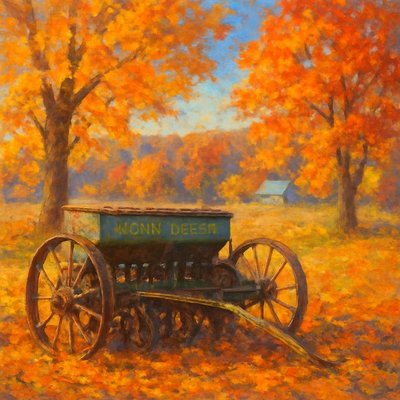
A serene and rustic autumn landscape, featuring an aged John Deere farm implement (a seeder or planter) in the foreground. The old machinery retains its weathered green and rust colors but is now positioned amidst a carpet of vibrant fallen autumn leaves in shades of gold, orange, and russet.

The large, leafy trees in the middle ground, which were green in the original image, are now transformed into glorious specimens of fall foliage, displaying brilliant yellows, fiery oranges, and deep reds. The distant field shows hints of freshly turned earth or dry, golden stubble. In the background, the small house with the blue roof remains, nestled amongst a dense forest that is also ablaze with autumn colors.

The sky is a clear, bright autumn blue, with warm, golden sunlight characteristic of a pleasant fall day, casting gentle shadows and highlighting the rich textures of the old equipment, the tree bark, and the colorful leaves. The overall mood is one of peaceful rural charm, autumnal beauty, and the quiet dignity of farm life as the seasons change.
A fantastically cheerful and dynamic scene featuring the happy pumpkin-head figure (with the swirled, smiling carved face and internal glow) as the pilot of a classic, brightly colored biplane. The biplane itself is whimsically designed, perhaps with candy-themed accents or painted in vibrant, cheerful colors like orange, purple, and green.

The biplane is soaring through a clear, azure autumn sky, actively 'crop-dusting' a massive, exuberant stream of colorful Halloween candy from its underside. The candy (an abundant mix of wrapped chocolates, lollipops, candy corn, and various sweets) cascades downwards in a wide, joyous plume, spreading across the landscape below.

The landscape beneath the biplane is an idyllic, festive autumnal scene: rolling hills covered in vibrant fall foliage (golden, red, orange trees), a charming pumpkin patch, or a quaint, candy-colored village. The perspective is dynamic, capturing the plane in motion with the candy streaming behind it. The lighting is bright and sunny, emphasizing the vivid colors of the plane, the candy, and the autumn scenery. The overall mood is one of pure, unadulterated joy, playful magic, and festive exuberance, like a sugary parade from the sky." whimsical illustration, cartoon animation style, vibrant, dynamic motion, expressive character, detailed candy and plane design, festive atmosphere
Murmuration Particle Painting Style Transfer Example
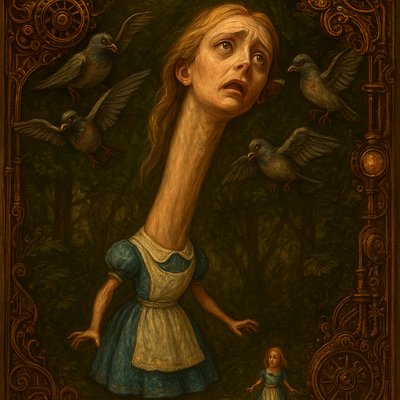
Alice, wearing her blue dress, looking distressed, with her neck stretched impossibly high, vanishing into the foliage above. Her head emerges far above the trees of the Wonderland forest. A flock of angry Pigeons fly around her immense face, one landing on her ear and pecking at it, mistakenly believing her to be a serpent trying to steal their eggs. Below, the tiny, disoriented body of Alice stands near the base of the massive neck. Whimsical, detailed oil painting, saturated colors, storybook illustration by John Tenniel crossed with Salvador Dali, high contrast lighting.
Whimsical Storybook Illustration Style, Warm Color Palette, Soft Textures and Detailed Linework. A wide-angle view of a secret, crowded meeting of dozens of anthropomorphic field mice taking place on an upturned wooden crate in the corner of a cluttered, dusty barn.

The Focal Point (The Plan): In the center of the crate spotlighted by a beam of sunlight coming through a crack in the roof, a small, earnest mouse stands on its hind legs, triumphantly holding aloft a shiny brass sleigh bell tied with a bright red ribbon. The bell looks impossibly large and heavy for the mouse.

The Reaction (The Hesitation): The surrounding crowd of mice is a mix of emotions. Some in the front row are cheering with tiny paws raised. However, many others towards the back are exchanging nervous, sidelong glances, scratching their heads, or looking fearfully over their shoulders.

The Threat (The Reality): In the background, on top of a high stack of hay bales, a giant, fluffy tabby cat is fast asleep. Though sleeping, its size and sharp claws are evident, casting a shadow over the edge of the meeting area. The contrast between the small, shiny bell and the enormous sleeping predator is central to the image.