At His Grandmother's House In Penang, Wing Sun Is Lying Down On A Futon In His Bedroom, Covered Up With A Beautiful Lightweight Art

Father and Grandmother with Siu Zi leaving their home in a Guangzhou street in the dark of night.  There is an air of secrecy. Siu Zi clutches her small bag, its contents little more than a few treasured keepsakes and faded photographs. Her father’s reassuring hand on her shoulder, and the soft presence of her grandmother at his side, give her the courage to move forward. A taxi waits down the street to take them to the train.
A historically accurate and deeply somber depiction of the immediate aftermath of the Wounded Knee Massacre in December 1890. The scene captures the desolate, snow-covered landscape of the Pine Ridge Reservation. Focus on the fallen Lakota men, women, and children, scattered across the snow, their bodies still and tragic. A few surviving individuals are shown in postures of profound grief or shock, perhaps tending to the wounded. The distant presence of U.S. soldiers, heavily armed, stands as a stark and cold counterpoint to the devastation. The atmosphere is one of profound sorrow, loss, and the brutal silence of winter. The lighting is cold and muted, emphasizing the harshness of the environment and the tragedy of the event. The artistic style should be a realistic, painterly approach, evoking the historical period with unflinching honesty but without graphic sensationalism. The intent is to serve as a memorial to the victims and a historical testament to the tragic event."
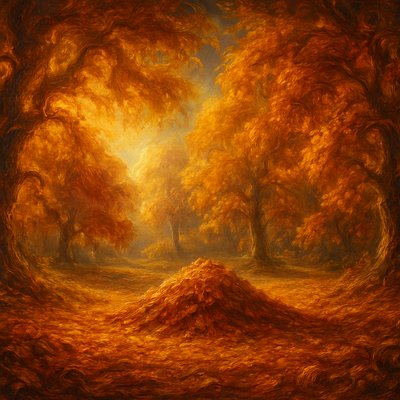
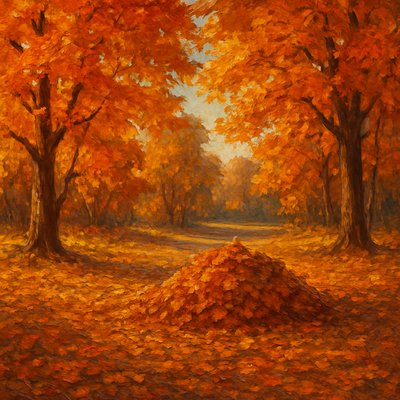
A tranquil and inviting autumn landscape based on the provided image, depicting a park-like setting with large trees and a pile of fallen leaves. The trees framing the foreground and extending into the middle ground are now in their full, glorious fall colors. One feels as if they are under a canopy of trees.

The ground is generously covered with a soft, thick carpet of fallen autumn leaves, rendered in various warm hues. A prominent, neatly gathered pile of raked leaves sits in the middle ground, inviting curiosity or play, with its textures and colors clearly visible. In the background, hints of a path or road gently wind through more fall foliage, suggesting a peaceful stroll.

The sky above is a soft, clear autumn blue, allowing warm, diffused sunlight to filter through the canopy, casting gentle shadows and highlighting the vibrant colors of the leaves both on the trees and on the ground. The overall mood is one of serene autumnal beauty, crisp air, and the pleasant, nostalgic feeling of a beautiful fall day in a park."
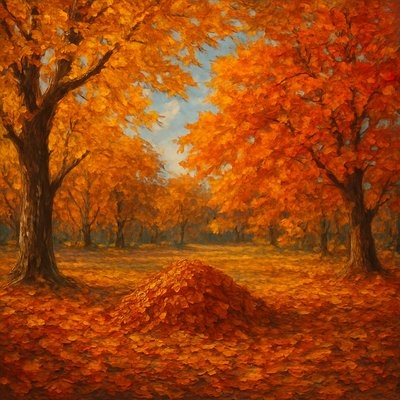
A tranquil and inviting autumn landscape based on the provided image, depicting a park-like setting with large trees and a central pile of fallen leaves. The trees framing the foreground and extending into the middle ground are now in their full, glorious fall colors, displaying a rich tapestry of brilliant yellows, deep oranges, fiery reds, and warm russets.

The ground is generously covered with a soft, thick carpet of fallen autumn leaves, rendered in various warm hues. A prominent, neatly gathered pile of raked leaves sits in the middle ground, inviting curiosity or play, with its textures and colors clearly visible. In the background, hints of a path or road gently wind through more fall foliage, suggesting a peaceful stroll.

The sky above is a soft, clear autumn blue, allowing warm, diffused sunlight to filter through the canopy, casting gentle shadows and highlighting the vibrant colors of the leaves both on the trees and on the ground. The overall mood is one of serene autumnal beauty, crisp air, and the pleasant, nostalgic feeling of a beautiful fall day in a park."
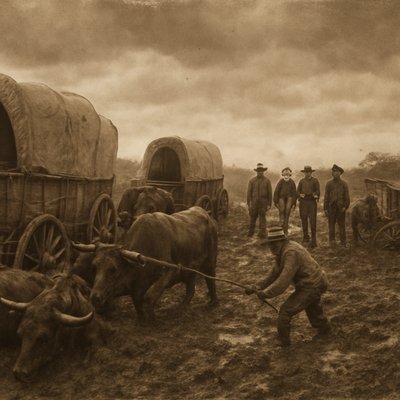
A highly realistic and historically accurate image set in the deep, waterlogged mud of the Texas Cross Timbers (Montague County) in 1840. The scene captures the frustrating moment when the Chihuahua Traders caravan is completely stuck. Foreground focus is on several heavy, wooden Conestoga freight wagons, mired up to their axles in dark, thick mud. Exhausted oxen are straining and distressed, their drivers in rough frontier attire attempting to free the wheels with ropes and levers. In the mid-ground, a small group of the American equestrian circus performers stands next to their distinctive, high-quality riding horses, which are visibly more refined than the typical pack animals. The performers are dressed in sturdy but distinct traveling clothes, looking ill-equipped and frustrated by the muddy conditions. One performer is carefully securing a colorful carriage or cart containing unique circus props, struggling to keep it from sinking. The overall mood is one of miserable delay and hardship. Cloudy, oppressive sky; detailed realism; wide-angle shot; dark, moody lighting.
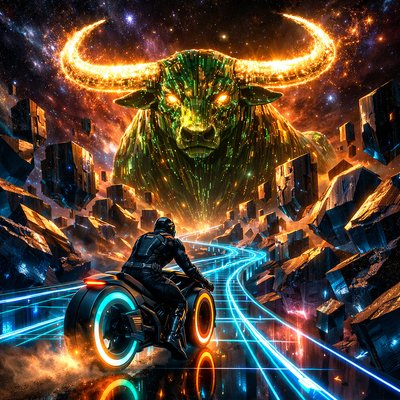
Neon-Futurism Digital Art Style, Bioluminescent Sci-Fi Cosmic Setting, Monolithic Scale. A perspective shot from behind the rider, looking toward a massive obstacle course in deep space.

The Rider & Bike Consistency: The lone motorcyclist—wearing the same sleek armored suit and helmet—is navigating the hubless "light-cycle" sportbike. The cyan and orange neon rings of the wheels reflect off the floating crystalline surfaces surrounding the road.

The Path (The Labyrinth): The glowing blue laser-grid highway enters a colossal asteroid field where the rocks are perfectly geometric, hovering like floating obsidian city blocks. The path winds through these monoliths, creating a "Cosmic Labyrinth."

The Taurus Presence: Standing at the center of this labyrinth, spanning across the highway, is the monumental form of the Celestial Bull. He is composed of dense, glowing emerald and earth-toned circuitry. His massive, forward-curving horns are made of solid, brilliant starlight and form a natural "archway" that the highway passes beneath.

The Atmosphere: The scene feels grounded and powerful. The deep greens and golds of the Taurus figure contrast with the dark, heavy shadows of the geometric asteroids.

Lighting: The "starlight horns" cast a warm, heavy glow downward onto the rider, illuminating the dust of crushed nebulae kicked up by the bike’s tires.
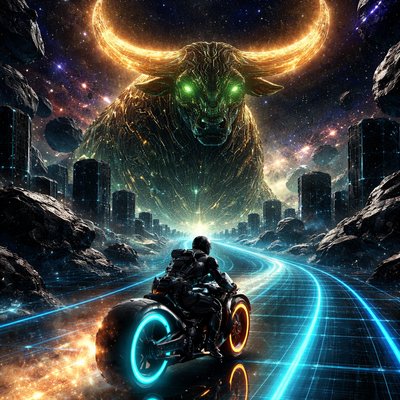
Neon-Futurism Digital Art Style, Bioluminescent Sci-Fi Cosmic Setting, Monolithic Scale. A perspective shot from behind the rider, looking toward a massive obstacle course in deep space.

The Rider & Bike Consistency: The lone motorcyclist—wearing the same sleek armored suit and helmet—is navigating the hubless "light-cycle" sportbike. The cyan and orange neon rings of the wheels reflect off the floating crystalline surfaces surrounding the road.

The Path (The Labyrinth): The glowing blue laser-grid highway enters a colossal asteroid field where the rocks are perfectly geometric, hovering like floating obsidian city blocks. The path winds through these monoliths, creating a "Cosmic Labyrinth."

The Taurus Presence: Standing at the center of this labyrinth, spanning across the highway, is the monumental form of the Celestial Bull. He is composed of dense, glowing emerald and earth-toned circuitry. His massive, forward-curving horns are made of solid, brilliant starlight and form a natural "archway" that the highway passes beneath.

The Atmosphere: The scene feels grounded and powerful. The deep greens and golds of the Taurus figure contrast with the dark, heavy shadows of the geometric asteroids.

Lighting: The "starlight horns" cast a warm, heavy glow downward onto the rider, illuminating the dust of crushed nebulae kicked up by the bike’s tires.
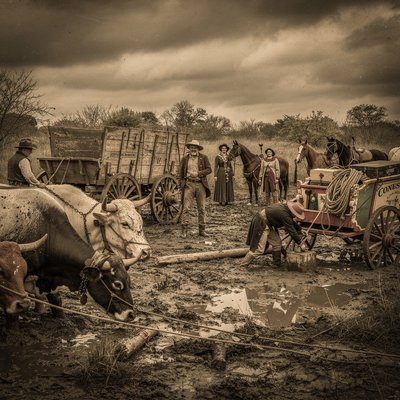
A highly realistic and historically accurate image set in the deep, waterlogged mud of the Texas Cross Timbers (Montague County) in 1840. The scene captures the frustrating moment when the Chihuahua Traders caravan is completely stuck. Foreground focus is on several heavy, wooden Conestoga freight wagons, mired up to their axles in dark, thick mud. Exhausted oxen are straining and distressed, their drivers in rough frontier attire attempting to free the wheels with ropes and levers. In the mid-ground, a small group of the American equestrian circus performers stands next to their distinctive, high-quality riding horses, which are visibly more refined than the typical pack animals. The performers are dressed in sturdy but distinct traveling clothes, looking ill-equipped and frustrated by the muddy conditions. One performer is carefully securing a colorful carriage or cart containing unique circus props, struggling to keep it from sinking. The overall mood is one of miserable delay and hardship. Cloudy, oppressive sky; detailed realism; wide-angle shot; dark, moody lighting.
A highly realistic and historically accurate image set in the deep, waterlogged mud of the Texas Cross Timbers (Montague County) in 1840. The scene captures the frustrating moment when the Chihuahua Traders caravan is completely stuck.

Foreground focus is on several heavy, wooden Conestoga freight wagons, mired up to their axles in dark, thick mud. Exhausted oxen are straining and distressed, their drivers in rough frontier attire attempting to free the wheels with ropes and levers.

In the mid-ground, a small group of the American equestrian circus performers stands next to their distinctive, high-quality riding horses, which are visibly more refined than the typical pack animals. The performers are dressed in sturdy but distinct traveling clothes, looking ill-equipped and frustrated by the muddy conditions. One performer is carefully securing a colorful carriage or cart containing unique circus props, struggling to keep it from sinking. The overall mood is one of miserable delay and hardship. Cloudy, oppressive sky; detailed realism; wide-angle shot; dark, moody lighting.
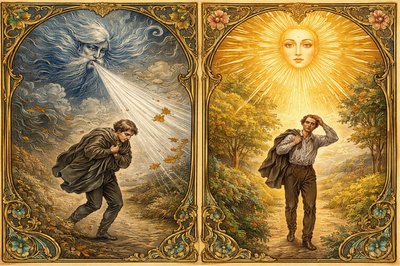
Vintage Art Nouveau Lithograph Style, Highly Decorative Borders, Rich Earth Tones and Gold Leaf. A vertically split "before and after" composition illustrating the classic fable of "The Wind and the Sun."

The Left Side (The Wind's Force): A personified North Wind, depicted as a swirling, ethereal figure made of cold blue and silver clouds with puffed cheeks, blows a jagged, visible blast of air downward. Below, a traveler on a dusty road is hunched over, his face strained, gripping his heavy woolen coat tightly around his chest as the gale whips his hair and sends autumn leaves flying in a chaotic spiral. The colors are cool, muted, and turbulent.

The Right Side (The Sun's Warmth): A personified Sun, depicted as a serene, radiant golden face surrounded by a massive, ornate circular halo of sunbeams, looks down with a gentle smile. Below, the same traveler is standing tall and relaxed on the path. His coat is draped loosely over one arm, his shirt collar is open, and he is wiping a bead of sweat from his forehead. The landscape around him is bathed in warm gold and vibrant greens, with tiny flowers blooming at his feet.

The Framing: The two scenes are separated by an elegant, winding vine border. The overall mood shifts from the frantic, cold energy on the left to the peaceful, overwhelming warmth on the right.
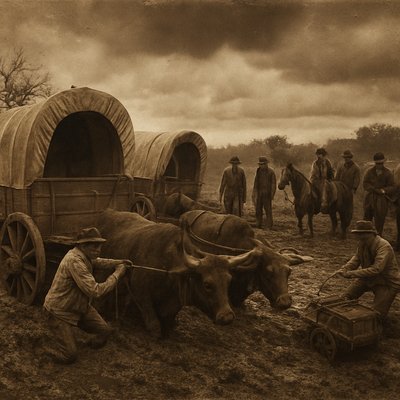
A highly realistic and historically accurate image set in the deep, waterlogged mud of the Texas Cross Timbers (Montague County) in 1840. The scene captures the frustrating moment when the Chihuahua Traders caravan is completely stuck.

Foreground focus is on several heavy, wooden Conestoga freight wagons, mired up to their axles in dark, thick mud. Exhausted oxen are straining and distressed, their drivers in rough frontier attire attempting to free the wheels with ropes and levers.

In the mid-ground, a small group of the American equestrian circus performers stands next to their distinctive, high-quality riding horses, which are visibly more refined than the typical pack animals. The performers are dressed in sturdy but distinct traveling clothes—perhaps featuring slightly tailored jackets or vests—rather than performance costumes, looking ill-equipped and frustrated by the muddy conditions. One performer is carefully securing a small, colorful carriage or cart containing unique circus props, struggling to keep it from sinking. The overall mood is one of miserable delay and hardship. Cloudy, oppressive sky; detailed realism; wide-angle shot; dark, moody lighting.
Gritty Historical Realism Style, Cinematic Film Photography, Natural Daylight. A powerful, candid medium shot of the infamous pirate duo, Anne Bonny and Mary Read, standing side-by-side on the weathered wooden deck of the sloop Revenge in the Caribbean Sea (circa 1720).

The Subjects: Both are dressed in practical, worn 18th-century male sailor's attire—loose canvas breeches, oversized linen shirts, heavy leather waistcoats, and bandanas—scruffy clothing that disguises their gender at a distance but reveals them as fiercely capable women upon closer inspection. Their faces are sun-weathered, dirty, and determined.
Specific Details: Anne Bonny (left) has fiery red hair escaping a dark bandana and a tricorn hat pushed back; she holds a drawn cutlass and has a defiant, volatile expression. Mary Read (right) looks sturdier, wearing a heavy wool coat, arms crossed over her chest with two flintlock pistols visible in her sash, looking steady and calculating.

The Setting: The background is a chaotic, working pirate ship deck with coils of tarred rope, rigging, barrels, and a cannon. Beyond the rail is the turquoise ocean and a hazy tropical coastline. The lighting is harsh, midday sun, with salt spray in the air. The mood is tense, rebellious, and authentic. Film grain texture.
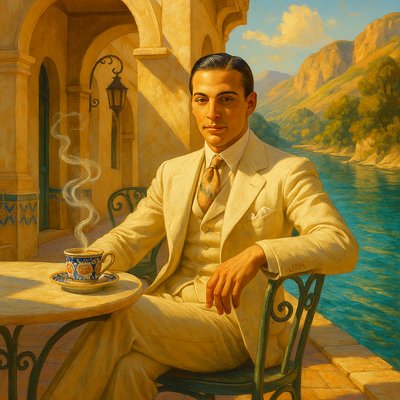
cinematic, vibrant scene of Rudolph Valentino in his youthful prime, seated at a French-style outdoor café table beside a clear, highly reflective teal-blue stream in the Italian mountains. He is strikingly handsome with smooth Mediterranean features, youthful charm, and a confident presence. He wears a tailored cream linen suit with a crisp white shirt, a silk cravat in soft pastel tones, and polished leather shoes. His hair is sleek and perfectly styled in a classic 1920s fashion, evoking timeless elegance. On the table rests a delicate porcelain coffee cup of fine Italian china, painted with intricate cobalt blue, gold, and crimson patterns. Steam rises gracefully from the cup, curling upward like ethereal ribbons, catching the sunlight in cinematic detail. The atmosphere glows with radiant, vibrant colors teal waters shimmering, golden mountain light illuminating the scene, reflections dance across the café table. No dark overlay, only luminous tones and crisp clarity.
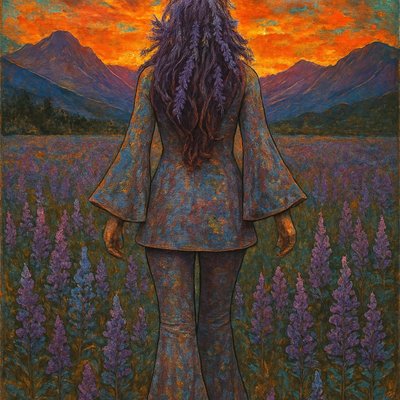
A breathtaking full-body photograph captures a woman from behind, standing in a vast, vibrant field of purple lupin flowers in Glacier National Park. Her long, rich plum purple hair is beautifully intertwined with fresh lupin blooms, forming an ethereal halo. She wears a unique 70s-inspired outfit consisting of shimmering lavender bell-bottom pants and a matching tunic-style top with bell sleeves and a square neckline, flared at the waist, adorned with subtle white horse patterns. The setting sun paints the sky in dramatic hues of fiery orange and deep red, silhouetting the majestic purple mountain ranges in the distance. The scene evokes a sense of wonder, serenity, and a deep connection to the wild beauty of nature, with a magical, almost fantastical feel, within the iconic landscape of Glacier National Park.
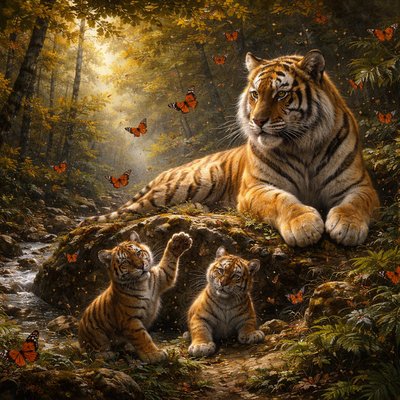
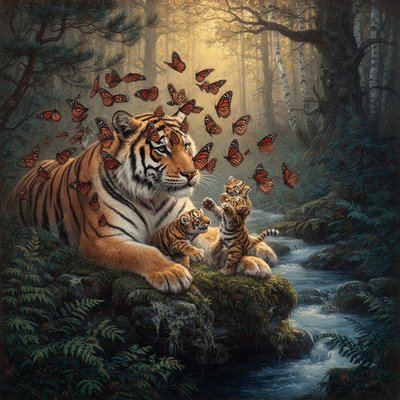
Nature Photography Style, Romantic Naturalism Painting, a breathtaking, incredibly detailed scene deep within the primeval forests of Russia's Amur-Ussuri region. A massive, powerful female Amur Tiger with thick, pale orange and dark striped fur rests on a moss-covered rocky outcrop, watching over her two playful cubs who are batting at the air. The scene is absolutely swarming with hundreds of Red Admiral butterflies (distinct black wings with vibrant orange-red bands and white spots). The butterflies form swirling clouds, landing gently on the tigers' fur, their noses, and the surrounding lush ferns and Korean pine branches. The forest floor is dense with undergrowth, lichen, and a clear, cold stream nearby. The lighting is dappled golden hour sunlight filtering through a canopy of birch and ancient oak trees, creating a magical, serene atmosphere. Focus on the texture of the thick tiger fur and the delicate wings of the butterflies.
A tranquil and inviting autumn landscape based, depicting a park-like setting with large trees and a central pile of fallen leaves. The trees framing the foreground and extending into the middle ground are now in their full, glorious fall colors, displaying a rich tapestry of brilliant yellows, deep oranges, fiery reds, and warm russets.

The ground is generously covered with a soft, thick carpet of fallen autumn leaves, rendered in various warm hues. A prominent, neatly gathered pile of raked leaves sits in the middle ground, inviting curiosity or play, with its textures and colors clearly visible. In the background, hints of a path or road gently wind through more fall foliage, suggesting a peaceful stroll.

The sky above is a soft, clear autumn blue, allowing warm, diffused sunlight to filter through the canopy, casting gentle shadows and highlighting the vibrant colors of the leaves both on the trees and on the ground. The overall mood is one of serene autumnal beauty, crisp air, and the pleasant, nostalgic feeling of a beautiful fall day in a park."
Steampunk Historical Fantasy, Satirical Illustration Style, Cinematic Lighting. A bizarre, anachronistic scene inside a drafty medieval castle great hall (Camelot). A group of noblewomen, dressed in elaborate 6th-century velvet gowns, wimples, and tall pointed hennin hats with veils, are seated on rough wooden stools. They are furiously working a massive, makeshift telephone switchboard operator station.

The Technology: The switchboard is constructed from rough-hewn oak timbers, gleaming brass gears, porcelain insulators, and hundreds of thick, chaotic copper wires that are strung haphazardly across ancient tapestries and stone walls, disappearing out narrow arrow-slit windows.

The Action: The ladies hold bulky, antique Victorian-era earpieces and large brass mouthpieces, plugging heavy cables with oversized jacks into the board with expressions of intense concentration and mild confusion. Knights in armor walk past in the background, looking bewildered. Sunlight streams through gothic windows, illuminating the dust and the clash of eras.
A band of five anthropomorphic cats, depicted as the "Bay City Rollers," performing on a brightly lit stage. They are dressed in matching tartan suits, reminiscent of the band's iconic style. Each cat has expressive facial features, conveying a sense of rock-and-roll energy.

The central cat is the lead singer, holding a vintage microphone and wearing a striking tartan suit. To his left, another cat plays a bass guitar. To his right, another cat stands with drumsticks, ready to play. Two other cats complete the band, striking poses with their fists raised in the air, embodying the energetic performance style of the Bay City Rollers.

In the background, a large, enthusiastic crowd of blurred, indistinct figures is cheering, illuminated by stage lights. Above the stage, spotlights shine down. The stage itself is dark, allowing the cats and their instruments to stand out.

At the bottom of the image, in large, bold, sparkly letters, is the text "CATURDAY NIGHT!" The overall style is vibrant, fun, and captures the retro pop essence of the 1970s.
Steampunk Historical Fantasy, Satirical Illustration Style, Cinematic Lighting. A bizarre, anachronistic scene inside a drafty medieval castle great hall (Camelot). A group of noblewomen, dressed in elaborate 6th-century velvet gowns, wimples, and tall pointed hennin hats with veils, are seated on rough wooden stools. They are furiously working a massive, makeshift telephone switchboard operator station.

The Technology: The switchboard is constructed from rough-hewn oak timbers, gleaming brass gears, porcelain insulators, and hundreds of thick, chaotic copper wires that are strung haphazardly across ancient tapestries and stone walls, disappearing out narrow arrow-slit windows.

The Action: The ladies hold bulky, antique Victorian-era earpieces and large brass mouthpieces, plugging heavy cables with oversized jacks into the board with expressions of intense concentration and mild confusion. Knights in armor walk past in the background, looking bewildered. Sunlight streams through gothic windows, illuminating the dust and the clash of eras.
Steampunk Historical Fantasy, Satirical Illustration Style, Cinematic Lighting. A bizarre, anachronistic scene inside a drafty medieval castle great hall (Camelot). A group of noblewomen, dressed in elaborate 6th-century velvet gowns, wimples, and tall pointed hennin hats with veils, are seated on rough wooden stools. They are furiously working a massive, makeshift telephone switchboard operator station.

The Technology: The switchboard is constructed from rough-hewn oak timbers, gleaming brass gears, porcelain insulators, and hundreds of thick, chaotic copper wires that are strung haphazardly across ancient tapestries and stone walls, disappearing out narrow arrow-slit windows.

The Action: The ladies hold bulky, antique Victorian-era earpieces and large brass mouthpieces, plugging heavy cables with oversized jacks into the board with expressions of intense concentration and mild confusion. Knights in armor walk past in the background, looking bewildered. Sunlight streams through gothic windows, illuminating the dust and the clash of eras.
A band of five anthropomorphic cats, depicted as the "Bay City Rollers," performing on a brightly lit stage. They are dressed in matching tartan suits, reminiscent of the band's iconic style. Each cat has expressive facial features, conveying a sense of rock-and-roll energy.

The central cat is the lead singer, holding a vintage microphone and wearing a striking tartan suit. To his left, another cat plays a bass guitar. To his right, another cat stands with drumsticks, ready to play. Two other cats complete the band, striking poses with their fists raised in the air, embodying the energetic performance style of the Bay City Rollers.

In the background, a large, enthusiastic crowd of blurred, indistinct figures is cheering, illuminated by stage lights. Above the stage, spotlights shine down. The stage itself is dark, allowing the cats and their instruments to stand out.

At the bottom of the image, in large, bold, sparkly letters, is the text "CATURDAY NIGHT!" The overall style is vibrant, fun, and captures the retro pop essence of the 1970s.
A fantastically cheerful and dynamic scene featuring the happy pumpkin-head figure (with the swirled, smiling carved face and internal glow) as the pilot of a classic, brightly colored biplane. The biplane itself is whimsically designed, perhaps with candy-themed accents or painted in vibrant, cheerful colors like orange, purple, and green.

The biplane is soaring through a clear, azure autumn sky, actively 'crop-dusting' a massive, exuberant stream of colorful Halloween candy from its underside. The candy (an abundant mix of wrapped chocolates, lollipops, candy corn, and various sweets) cascades downwards in a wide, joyous plume, spreading across the landscape below.

The landscape beneath the biplane is an idyllic, festive autumnal scene: rolling hills covered in vibrant fall foliage (golden, red, orange trees), a charming pumpkin patch, or a quaint, candy-colored village. The perspective is dynamic, capturing the plane in motion with the candy streaming behind it. The lighting is bright and sunny, emphasizing the vivid colors of the plane, the candy, and the autumn scenery. The overall mood is one of pure, unadulterated joy, playful magic, and festive exuberance, like a sugary parade from the sky." whimsical illustration, cartoon animation style, vibrant, dynamic motion, expressive character, detailed candy and plane design, festive atmosphere
A whimsical and enchanting scene inside Willy Wonka's Chocolate Factory, featuring his extraordinary golden egg-laying geese. Several plump, pristine white geese are perched comfortably in ornate, perhaps slightly absurd, nests made of candy floss or sweet wrappers. Each goose is in the process of laying, or has just laid, a perfectly smooth, shimmering golden egg, which glows with a soft, magical luminescence. The geese themselves have a benevolent, slightly proud expression. The background reveals a fantastical, imaginative section of the factory, with edible landscapes, rivers of chocolate, and machinery built from confectionery. The lighting is soft, warm, and magical, emphasizing the golden glow of the eggs and the fantastical nature of the setting. The overall mood is one of sweet wonder, delight, and a touch of eccentricity."
A fantastically cheerful and dynamic scene featuring the happy pumpkin-head figure (with the swirled, smiling carved face and internal glow) as the pilot of a classic, brightly colored biplane. The biplane itself is whimsically designed, perhaps with candy-themed accents or painted in vibrant, cheerful colors like orange, purple, and green.

The biplane is soaring through a clear, azure autumn sky, actively 'crop-dusting' a massive, exuberant stream of colorful Halloween candy from its underside. The candy (an abundant mix of wrapped chocolates, lollipops, candy corn, and various sweets) cascades downwards in a wide, joyous plume, spreading across the landscape below.

The landscape beneath the biplane is an idyllic, festive autumnal scene: rolling hills covered in vibrant fall foliage (golden, red, orange trees), a charming pumpkin patch, or a quaint, candy-colored village. The perspective is dynamic, capturing the plane in motion with the candy streaming behind it. The lighting is bright and sunny, emphasizing the vivid colors of the plane, the candy, and the autumn scenery. The overall mood is one of pure, unadulterated joy, playful magic, and festive exuberance, like a sugary parade from the sky."
A historically accurate, deeply reverent and spiritually evocative oil painting. Two traditional Southern Ute individuals, a man and a woman, stand side-by-side with profound solemnity and ancient peace on the high mesa overlooking the twin spires of Chimney Rock National Monument (Chimney Rock and Companion Rock). They are dressed in authentic, richly detailed traditional attire. The man holds a feathered staff, his gaze directed towards the horizon, symbolizing his role as a protector and observer of the earth. The woman gestures subtly towards the sky, her posture conveying an intimate connection to the celestial, perhaps in a gesture of spiritual offering or acknowledgment. The scene's context is the stalling of the moon's analemma, with the moon itself appearing large and prominent, hanging low in the sky, its unique position clearly marking this cyclical astronomical pause. The atmosphere is bathed in the ethereal, soft glow of early morning light, just as the sun begins to kiss the distant peaks, casting long, significant shadows that stretch across the mesa. Their faces are etched with wisdom and a quiet understanding of the cosmos. The vast, spiritual landscape of Chimney Rock is an integral part of the composition, symbolizing their deep, timeless connection to both earth and sky, and their role as guardians of this sacred knowledge. Fine art composition, conveying a powerful sense of timeless ritual, astronomical reverence, and cultural continuity
Steampunk Historical Fantasy, Satirical Illustration Style, Cinematic Lighting. A bizarre, anachronistic scene inside a drafty medieval castle great hall (Camelot). A group of noblewomen, dressed in elaborate 6th-century velvet gowns, wimples, and tall pointed hennin hats with veils, are seated on rough wooden stools. They are furiously working a massive, makeshift telephone switchboard operator station.

The Technology: The switchboard is constructed from rough-hewn oak timbers, gleaming brass gears, porcelain insulators, and hundreds of thick, chaotic copper wires that are strung haphazardly across ancient tapestries and stone walls, disappearing out narrow arrow-slit windows.

The Action: The ladies hold bulky, antique Victorian-era earpieces and large brass mouthpieces, plugging heavy cables with oversized jacks into the board with expressions of intense concentration and mild confusion. Knights in armor walk past in the background, looking bewildered. Sunlight streams through gothic windows, illuminating the dust and the clash of eras.
A breathtaking and dynamic close-up scene depicting two iridescent hummingbirds engaged in a vigorous mid-air duel over a cluster of vibrant, nectar-rich flowers. Their tiny wings are blurred into translucent arcs of motion, a testament to their incredible speed and agility, creating a frantic, energetic atmosphere.

One hummingbird, perhaps a brilliant emerald green, lunges forward, while the other, possibly a fiery ruby red or shimmering blue, hovers defensively, their long beaks pointed towards each other in a fierce territorial display. Their tiny, intense eyes are sharply focused on their opponent.

They are positioned directly above or fiercely guarding a cluster of brightly colored, inviting flowers, such as trumpet vines, fuchsias, or salvia, which are depicted with exquisite detail and rich, saturated hues, dripping with nectar. The background is a soft, dreamlike blur of lush green foliage and dappled sunlight, keeping the focus entirely on the intense aerial ballet. The lighting is bright and dramatic, catching the metallic sheen of their feathers and emphasizing their jewel-like colors. The overall mood is one of intense energy, fierce beauty, and natural competition
A fantastically cheerful and dynamic scene featuring the happy pumpkin-head figure (with the swirled, smiling carved face and internal glow) as the pilot of a classic, brightly colored biplane. The biplane itself is whimsically designed, perhaps with candy-themed accents or painted in vibrant, cheerful colors like orange, purple, and green.

The biplane is soaring through a clear, azure autumn sky, actively 'crop-dusting' a massive, exuberant stream of colorful Halloween candy from its underside. The candy (an abundant mix of wrapped chocolates, lollipops, candy corn, and various sweets) cascades downwards in a wide, joyous plume, spreading across the landscape below.

The landscape beneath the biplane is an idyllic, festive autumnal scene: rolling hills covered in vibrant fall foliage (golden, red, orange trees), a charming pumpkin patch, or a quaint, candy-colored village. The perspective is dynamic, capturing the plane in motion with the candy streaming behind it. The lighting is bright and sunny, emphasizing the vivid colors of the plane, the candy, and the autumn scenery. The overall mood is one of pure, unadulterated joy, playful magic, and festive exuberance, like a sugary parade from the sky." whimsical illustration, vibrant, dynamic motion, expressive character, detailed candy and plane design, festive atmosphere
Nature Photography Style, Romantic Naturalism Painting, a breathtaking, incredibly detailed scene deep within the primeval forests of Russia's Amur-Ussuri region. A massive, powerful female Amur Tiger with thick, pale orange and dark striped fur rests on a moss-covered rocky outcrop, watching over her two playful cubs who are batting at the air. The scene is absolutely swarming with hundreds of Red Admiral butterflies (distinct black wings with vibrant orange-red bands and white spots). The butterflies form swirling clouds, landing gently on the tigers' fur, their noses, and the surrounding lush ferns and Korean pine branches. The forest floor is dense with undergrowth, lichen, and a clear, cold stream nearby. The lighting is dappled golden hour sunlight filtering through a canopy of birch and ancient oak trees, creating a magical, serene atmosphere. Focus on the texture of the thick tiger fur and the delicate wings of the butterflies.
A breathtaking and dynamic close-up scene depicting two iridescent hummingbirds engaged in a vigorous mid-air duel over a cluster of vibrant, nectar-rich flowers. Their tiny wings are blurred into translucent arcs of motion, a testament to their incredible speed and agility, creating a frantic, energetic atmosphere.

One hummingbird, perhaps a brilliant emerald green, lunges forward, while the other, possibly a fiery ruby red or shimmering blue, hovers defensively, their long beaks pointed towards each other in a fierce territorial display. Their tiny, intense eyes are sharply focused on their opponent.

They are positioned directly above or fiercely guarding a cluster of brightly colored, inviting flowers, such as trumpet vines, fuchsias, or salvia, which are depicted with exquisite detail and rich, saturated hues, dripping with nectar. The background is a soft, dreamlike blur of lush green foliage and dappled sunlight, keeping the focus entirely on the intense aerial ballet. The lighting is bright and dramatic, catching the metallic sheen of their feathers and emphasizing their jewel-like colors. The overall mood is one of intense energy, fierce beauty, and natural competition dynamic illustration. hyperrealistic digital painting, intricate feather detail, luminous iridescent colors, dynamic composition, detailed flowers, energetic brushwork (for motion)
A breathtaking and dynamic close-up scene depicting two iridescent hummingbirds engaged in a vigorous mid-air duel over a cluster of vibrant, nectar-rich flowers. Their tiny wings are blurred into translucent arcs of motion, a testament to their incredible speed and agility, creating a frantic, energetic atmosphere.

One hummingbird, perhaps a brilliant emerald green, lunges forward, while the other, possibly a fiery ruby red or shimmering blue, hovers defensively, their long beaks pointed towards each other in a fierce territorial display. Their tiny, intense eyes are sharply focused on their opponent.

They are positioned directly above or fiercely guarding a cluster of brightly colored, inviting flowers, such as trumpet vines, fuchsias, or salvia, which are depicted with exquisite detail and rich, saturated hues, dripping with nectar. The background is a soft, dreamlike blur of lush green foliage and dappled sunlight, keeping the focus entirely on the intense aerial ballet. The lighting is bright and dramatic, catching the metallic sheen of their feathers and emphasizing their jewel-like colors. The overall mood is one of intense energy, fierce beauty, and natural competition dynamic illustration.dynamic illustration, vibrant fantasy art, exaggerated motion lines, glowing effects on iridescence, stylized flowers, energetic and fluid composition
A breathtaking and dynamic close-up scene depicting two iridescent hummingbirds engaged in a vigorous mid-air duel over a cluster of vibrant, nectar-rich flowers. Their tiny wings are blurred into translucent arcs of motion, a testament to their incredible speed and agility, creating a frantic, energetic atmosphere.

One hummingbird, perhaps a brilliant emerald green, lunges forward, while the other, possibly a fiery ruby red or shimmering blue, hovers defensively, their long beaks pointed towards each other in a fierce territorial display. Their tiny, intense eyes are sharply focused on their opponent.

They are positioned directly above or fiercely guarding a cluster of brightly colored, inviting flowers, such as trumpet vines, fuchsias, or salvia, which are depicted with exquisite detail and rich, saturated hues, dripping with nectar. The background is a soft, dreamlike blur of lush green foliage and dappled sunlight, keeping the focus entirely on the intense aerial ballet. The lighting is bright and dramatic, catching the metallic sheen of their feathers and emphasizing their jewel-like colors. The overall mood is one of intense energy, fierce beauty, and natural competition dynamic illustration, vibrant fantasy art, exaggerated motion lines, glowing effects on iridescence, stylized flowers, energetic and fluid composition
Victorian Oil Painting Art Style, Historical Digital Art Style, a rich and detailed full-body portrait of the famous giantess Anna Swan standing in the center of a lavish, gaslit exhibition hall at P.T. Barnum's American Museum in the 1860s. She is towering over the surrounding crowd of average-sized gentlemen in top hats and ladies in bonnets, whose heads only reach her waistline; they look up at her with expressions of awe and curiosity. Anna is dressed with immense dignity in a fashionable, expansive Victorian silk gown with a crinoline hoop skirt, tailored bodice, and lace trim. Her face is gentle, intelligent, and composed. The background is crowded with heavy red velvet drapery, gilded architectural details, curiosities in glass cases, and painted circus banners faintly visible. The lighting is warm, dramatic gaslight, creating deep shadows and highlighting the rich fabrics and the incredible scale of Anna Swan compared to her environment.
A triptych oil painting, presented as three heavily framed, connected panels in the dramatic, tenebrism style of Baroque masters like Caravaggio. The overall atmosphere is one of supernatural, oppressive darkness and violent chaos.

The Left Panel shows the penitent thief on his cross, body twisted in pain but his face turned toward the center panel with a look of sorrowful acceptance. A faint, supernatural light illuminates his face against a nearly black sky. Below him, rocks are splitting.

The Center Panel is dominated by Jesus on the cross, head bowed in finality. The sky is a swirling vortex of eclipse darkness, blotting out the sun. The ground beneath the cross is violently cracking open, emitting dust and smoke, with debris caught in mid-air from the earthquake shockwave.

The Right Panel shows the impenitent thief, writhing and screaming against his bonds, his face contorted in rage looking away from the center. He is almost swallowed by the shadows. The cross appears unstable as the cliffside crumbles beneath it. The entire triptych has a rich, dark color palette of deep browns, blacks, and muted crimson, textured with visible, frantic brushstrokes.
Seabiscuit vs. War Admiral (The Gaze)

    A hyper-realistic, high-resolution photograph capturing the apex of the 1938 match race between Seabiscuit and War Admiral.

    Focus: The composition is tight, showing both horses running neck-and-neck, dominating the frame. The camera angle is side-on and slightly low, emphasizing their size and muscle. The critical focus is on the space between the horses' heads as they are running stride for stride.

    Details: War Admiral (the dark bay) should show determination and slight surprise, with his head stretched out. Seabiscuit (the smaller bay) should display his characteristic "game" look—intense, focused, and seemingly looking directly into War Admiral's eyes (or toward his rival). Both jockeys (Red Pollard or George Woolf for Seabiscuit; Charles Kurtsinger for War Admiral) are visible, leaning low and urging their mounts on.

    Atmosphere: The light should be bright but slightly diffused, suggesting an autumn afternoon at Pimlico. Dust and track debris are kicked up behind them, blurred slightly by the horses' tremendous speed. The image must convey the raw power, intense rivalry, and the exact moment when the smaller horse asserts his dominance.

    Style: Cinematic photography, realistic texture, sharp focus on the horses' eyes and muscle definition.
Seabiscuit vs. War Admiral (The Gaze)

    A hyper-realistic, high-resolution photograph capturing the apex of the 1938 match race between Seabiscuit and War Admiral.

    Focus: The composition is tight, showing both horses running neck-and-neck, dominating the frame. The camera angle is side-on and slightly low, emphasizing their size and muscle. The critical focus is on the space between the horses' heads as they are running stride for stride.

    Details: War Admiral (the dark bay) should show determination and slight surprise, with his head stretched out. Seabiscuit (the smaller bay) should display his characteristic "game" look—intense, focused, and seemingly looking directly into War Admiral's eyes (or toward his rival). Both jockeys (Red Pollard or George Woolf for Seabiscuit; Charles Kurtsinger for War Admiral) are visible, leaning low and urging their mounts on.

    Atmosphere: The light should be bright but slightly diffused, suggesting an autumn afternoon at Pimlico. Dust and track debris are kicked up behind them, blurred slightly by the horses' tremendous speed. The image must convey the raw power, intense rivalry, and the exact moment when the smaller horse asserts his dominance.

    Style: Cinematic photography, realistic texture, sharp focus on the horses' eyes and muscle definition.