A Painting Of Two Hands Holding A Book Art

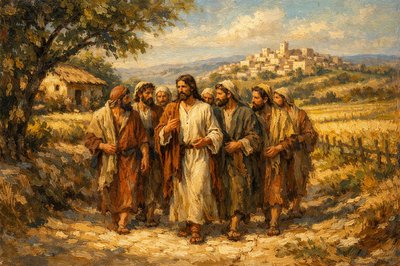
First century Palestine.  Mid-morning in a rural area.  The sun is warm and the atmosphere is positive.  Jesus and His disciples walk along a country road that goes to Bethany. There are some trees shading part of the road ahead, and cultivated fields on either side of the road.  Jesus, wears ordinary clothing like most men, and He’s talking to His disciples as the walk along.  The disciples are listening intently to Jesus, and His face is kind, but intense.  A farm house sits off to one side, and the town is visible in the distance.
Unstressed vowels weakened to schwa.
The final -e in words like name became silent.
Endings like -ed and -es lost their full vowel sound, making English more rhythmically stress-timed.
6. The wh sound stayed distinct longer.
Which and witch sounded different—which started with a breathy hw. Today the pronunciation is similar but the difference remains in some dialects. create a picture withoud words
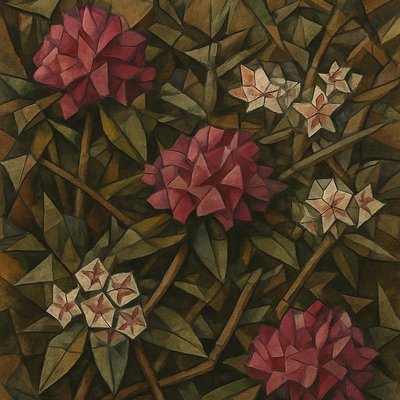
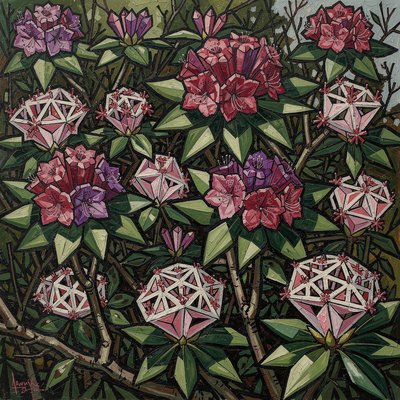
Art Style: Analytical Cubism, avant-garde oil painting style reminiscent of Picasso and Braque.

Subject: A dense, tangled thicket of Rhododendrons and Mountain Laurel bushes.

Composition & Details: The entire natural scene is deconstructed into overlapping geometric planes, fractured shards, and intersecting angles. There are no curved lines; everything is rendered in cubes, cones, and trapezoids.

    The Rhododendrons: Large, showy flower trusses are broken into faceted crystalline structures of deep magenta, rose pink, and violet blocks, looking like explosions of colored quartz rather than soft petals.

    The Mountain Laurels: The smaller, intricate flowers are rendered as complex, repeating geometric star-patterns and angular cups in white and pale pink with distinct red polygonal markings.

    Foliage & Branches: The thick, leathery leaves are fragmented green triangles and parallelograms overlapping each other, creating a sense of depth without traditional perspective. The woody stems and branches are jagged, intersecting brown and grey cylinders that shatter across the frame.
Color & Texture: A palette of muted earth tones—ochre, burnt umber, forest green, and slate grey—contrasted sharply with the jewel-toned facets of the flower colors. The finish should have a heavy, textured oil paint feel with visible palette knife marks and rough brushwork.
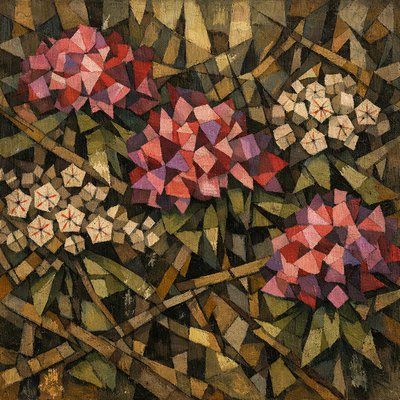
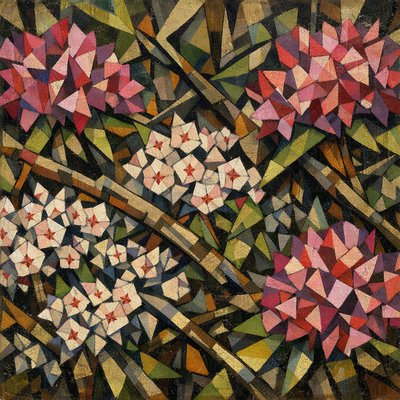
Art Style: Analytical Cubism, avant-garde oil painting style reminiscent of Picasso and Braque.

Subject: A dense, tangled thicket of Rhododendrons and Mountain Laurel bushes.

Composition & Details: The entire natural scene is deconstructed into overlapping geometric planes, fractured shards, and intersecting angles. There are no curved lines; everything is rendered in cubes, cones, and trapezoids.

    The Rhododendrons: Large, showy flower trusses are broken into faceted crystalline structures of deep magenta, rose pink, and violet blocks, looking like explosions of colored quartz rather than soft petals.

    The Mountain Laurels: The smaller, intricate flowers are rendered as complex, repeating geometric star-patterns and angular cups in white and pale pink with distinct red polygonal markings.

    Foliage & Branches: The thick, leathery leaves are fragmented green triangles and parallelograms overlapping each other, creating a sense of depth without traditional perspective. The woody stems and branches are jagged, intersecting brown and grey cylinders that shatter across the frame.
Color & Texture: A palette of muted earth tones—ochre, burnt umber, forest green, and slate grey—contrasted sharply with the jewel-toned facets of the flower colors. The finish should have a heavy, textured oil paint feel with visible palette knife marks and rough brushwork.
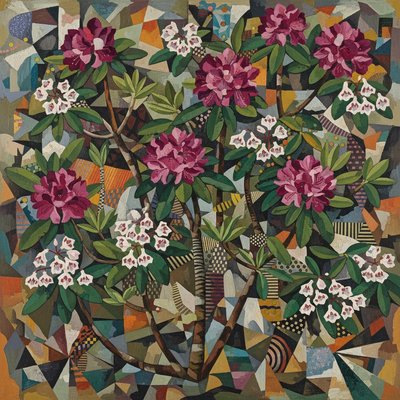
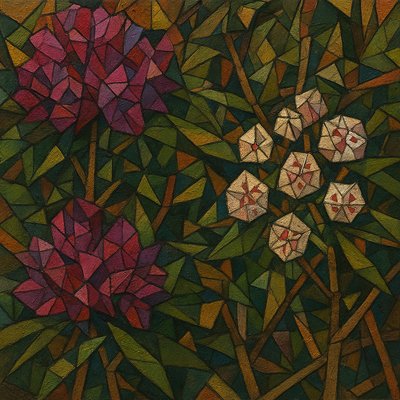
Art Style: Analytical Cubism, avant-garde oil painting style reminiscent of Picasso and Braque.

Subject: A dense, tangled thicket of Rhododendrons and Mountain Laurel bushes.

Composition & Details: The entire natural scene is deconstructed into overlapping geometric planes, fractured shards, and intersecting angles. There are no curved lines; everything is rendered in cubes, cones, and trapezoids.

    The Rhododendrons: Large, showy flower trusses are broken into faceted crystalline structures of deep magenta, rose pink, and violet blocks, looking like explosions of colored quartz rather than soft petals.

    The Mountain Laurels: The smaller, intricate flowers are rendered as complex, repeating geometric star-patterns and angular cups in white and pale pink with distinct red polygonal markings.

    Foliage & Branches: The thick, leathery leaves are fragmented green triangles and parallelograms overlapping each other, creating a sense of depth without traditional perspective. The woody stems and branches are jagged, intersecting brown and grey cylinders that shatter across the frame.

Color & Texture: A palette of muted earth tones—ochre, burnt umber, forest green, and slate grey—contrasted sharply with the jewel-toned facets of the flower colors. The finish should have a heavy, textured oil paint feel with visible palette knife marks and rough brushwork.
Art Style: Analytical Cubism, avant-garde oil painting style reminiscent of Picasso and Braque.

Subject: A dense, tangled thicket of Rhododendrons and Mountain Laurel bushes.

Composition & Details: The entire natural scene is deconstructed into overlapping geometric planes, fractured shards, and intersecting angles. There are no curved lines; everything is rendered in cubes, cones, and trapezoids.

    The Rhododendrons: Large, showy flower trusses are broken into faceted crystalline structures of deep magenta, rose pink, and violet blocks, looking like explosions of colored quartz rather than soft petals.

    The Mountain Laurels: The smaller, intricate flowers are rendered as complex, repeating geometric star-patterns and angular cups in white and pale pink with distinct red polygonal markings.

    Foliage & Branches: The thick, leathery leaves are fragmented green triangles and parallelograms overlapping each other, creating a sense of depth without traditional perspective. The woody stems and branches are jagged, intersecting brown and grey cylinders that shatter across the frame.

Color & Texture: A palette of muted earth tones—ochre, burnt umber, forest green, and slate grey—contrasted sharply with the jewel-toned facets of the flower colors. The finish should have a heavy, textured oil paint feel with visible palette knife marks and rough brushwork.
Art Style: Analytical Cubism, avant-garde oil painting style reminiscent of Picasso and Braque.

Subject: A dense, tangled thicket of Rhododendrons and Mountain Laurel bushes.

Composition & Details: The entire natural scene is deconstructed into overlapping geometric planes, fractured shards, and intersecting angles. There are no curved lines; everything is rendered in cubes, cones, and trapezoids.

    The Rhododendrons: Large, showy flower trusses are broken into faceted crystalline structures of deep magenta, rose pink, and violet blocks, looking like explosions of colored quartz rather than soft petals.

    The Mountain Laurels: The smaller, intricate flowers are rendered as complex, repeating geometric star-patterns and angular cups in white and pale pink with distinct red polygonal markings.

    Foliage & Branches: The thick, leathery leaves are fragmented green triangles and parallelograms overlapping each other, creating a sense of depth without traditional perspective. The woody stems and branches are jagged, intersecting brown and grey cylinders that shatter across the frame.

Color & Texture: A palette of muted earth tones—ochre, burnt umber, forest green, and slate grey—contrasted sharply with the jewel-toned facets of the flower colors. The finish should have a heavy, textured oil paint feel with visible palette knife marks and rough brushwork.
Art Style: Analytical Cubism, avant-garde oil painting style reminiscent of Picasso and Braque.

Subject: A dense, tangled thicket of Rhododendrons and Mountain Laurel bushes.

Composition & Details: The entire natural scene is deconstructed into overlapping geometric planes, fractured shards, and intersecting angles. There are no curved lines; everything is rendered in cubes, cones, and trapezoids.

    The Rhododendrons: Large, showy flower trusses are broken into faceted crystalline structures of deep magenta, rose pink, and violet blocks, looking like explosions of colored quartz rather than soft petals.

    The Mountain Laurels: The smaller, intricate flowers are rendered as complex, repeating geometric star-patterns and angular cups in white and pale pink with distinct red polygonal markings.

    Foliage & Branches: The thick, leathery leaves are fragmented green triangles and parallelograms overlapping each other, creating a sense of depth without traditional perspective. The woody stems and branches are jagged, intersecting brown and grey cylinders that shatter across the frame.

Color & Texture: A palette of muted earth tones—ochre, burnt umber, forest green, and slate grey—contrasted sharply with the jewel-toned facets of the flower colors. The finish should have a heavy, textured oil paint feel with visible palette knife marks and rough brushwork.
Duotone Icon Design Style Transfer Example
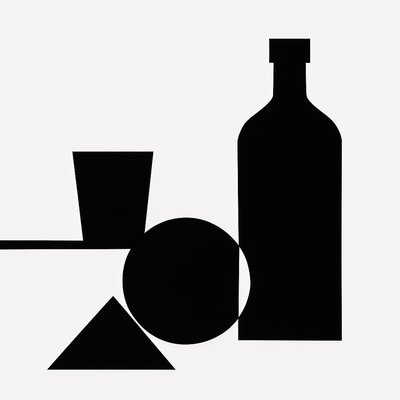
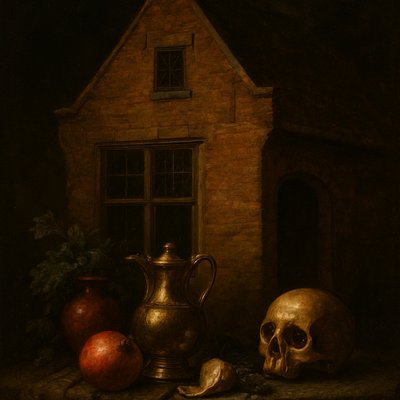
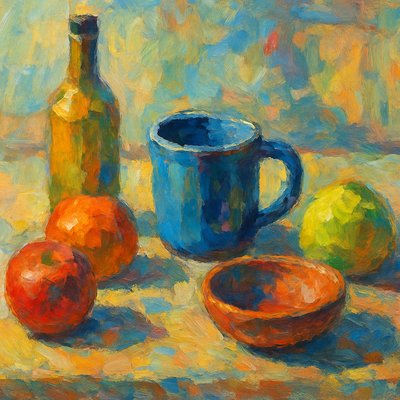
still life with everyday objects
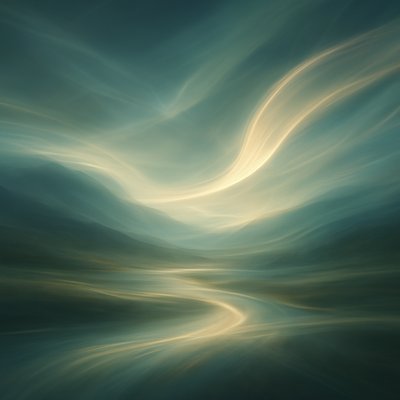
wide landscape with natural scenery
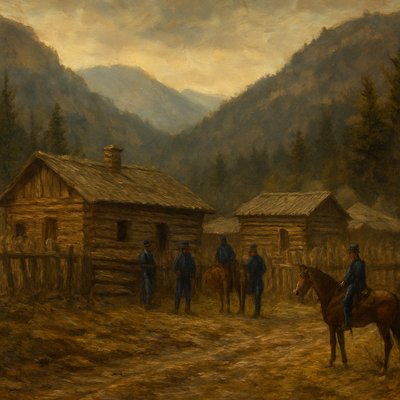
Create an image of the short-lived U.S. Army post known as Fort Lowell, New Mexico, circa 1868. The buildings are made of rough-hewn, rustic logs and timber, surrounded by a high mountain valley and coniferous trees, reflecting the high altitude of the New Mexico territory. Show a small number of New Mexico volunteers in period uniforms and their horses within a simple log palisade or fence line. The scene should be overcast and rugged, capturing the isolation of a frontier outpost
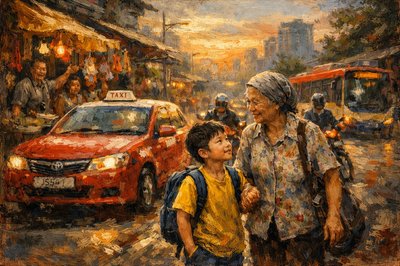
Morning city scene in Petaling Jaya. A 10 year old chinese boy and his grandmother.  As they weave through the narrow sidewalk,  taxis zip by, buses screech to a halt at stoplights, motorbikes wend their way through the stopped traffic, trying to get a head start when the light turns green.  People in the informal businesses set up along the sidewalks call out greetings in a mix of Cantonese, Malay, and English. The sky, still soft with the remnants of dawn, and yet already heavy with humid heat, hinted at another sweltering afternoon ahead.
wide landscape with natural scenery
still life with everyday objects
New York City
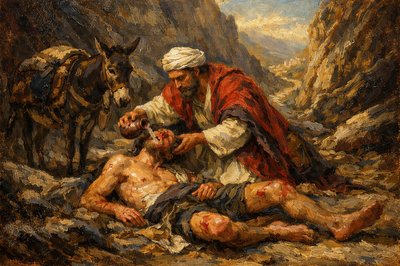
First century Palestine on the road toward Jericho.  In a treacherous pass, a man lies on the roadside, beaten half to death.  A passerby with a donkey is trying to help.  The story of the good samaritan.
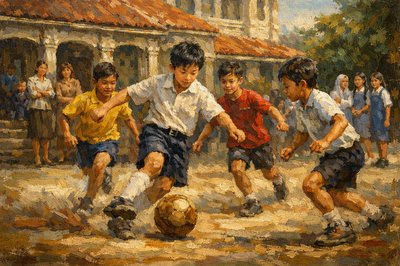
At a private school in Kuala Lumpur, 10 year old Wing Sun and his friends play a game of soccer in the schoolyard.  The school's main building is visible and some teachers are looking on.  Some schoolgirls are standing nearby.
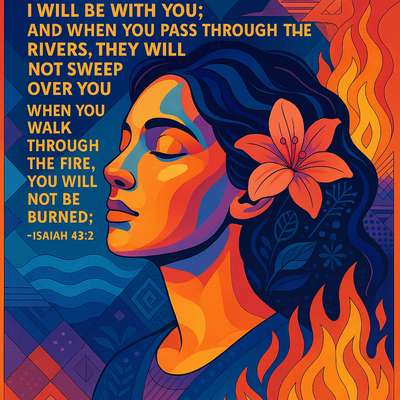
When you pass through the waters,
    I will be with you;
and when you pass through the rivers,
    they will not sweep over you.
When you walk through the fire,
    you will not be burned;
    the flames will not set you ablaze.
Person with water droplets on face
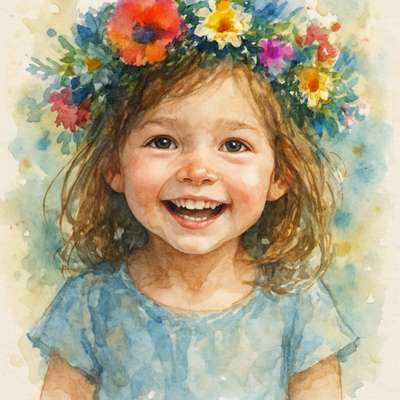
Child with flower crown
a man in a tank top posing for a picture
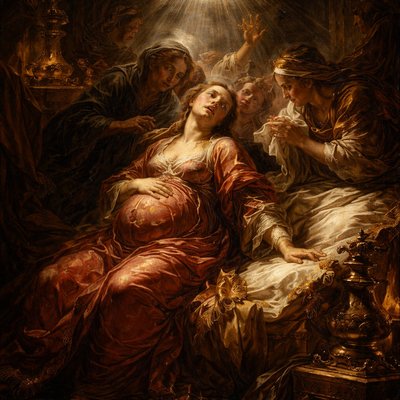
“And his daughter in law, Phinehas' wife, was with child, near to be delivered: and when she heard the tidings that the ark of God was taken, and that her father in law and her husband were dead, she bowed herself and travailed; for her pains came upon her.” (1 Samuel 4:19, KJV)
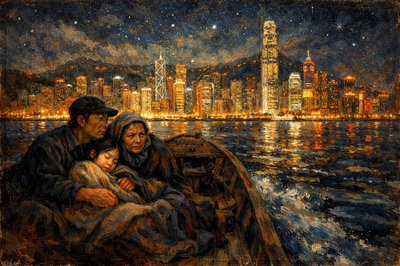
Mr. Chen has arranged for the little family  to cross secretly into Hong Kong—a place known for its bright skyline and bustling streets. Under the cover of darkness and with careful planning, Siu Zi, her father and Grandmother, along with Mr. Chen have boarded a small boat that carries them silently across the water. The sea is calm, its surface reflecting a tapestry of starlight, as if the heavens themselves are guiding them.  Siu-Zi lies nestled between her father and grandmother, wrapped up in blankets, in the forward part of an open boat with quiet motors propelling them along. Their is an air of mystery and tension.
Long Exposure Photography Style Style Transfer Example
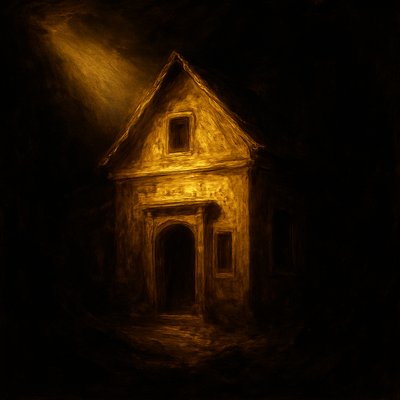
house with front view
wide landscape with natural scenery
house with front view
wide landscape with natural scenery
still life with everyday objects
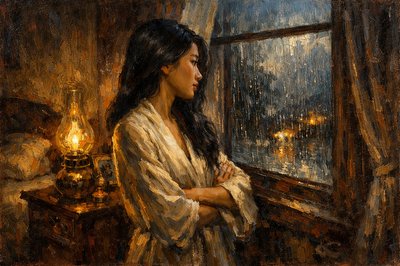
At her Mother's house in Penang, Wing Sun's mother, a beautiful chinese woman in her 30s, is standing in her bedroom looking out the window at night.  We see her from a quarter view inside the room.  She is pensive and an air of tension fills the room as she remembers growing up in this house.  Her hair is long and black, and she's wearing her housecoat.  A lantern gives low light inside the room.  It's raining outside.
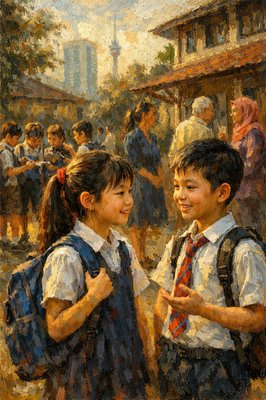
Morning scene. A 10 year old chinese girl and boy stand together talking in the schoolyard at a private school in Kerinchi neighborhood, Kuala Lumpur.  Several teachers are also there.  A circle of other children are standing off to the side playing games and comparing Pokemon cards, etc.
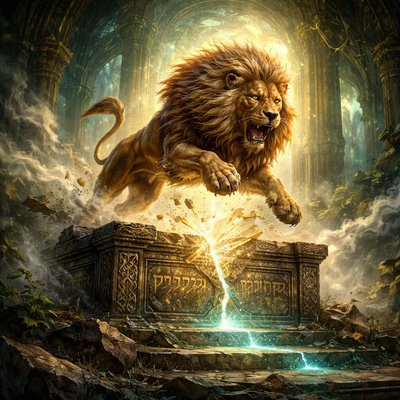
A hyper-realistic, majestic golden Lion of Judah leaping powerfully over a crumbling ancient stone altar. The altar is engraved with Hebrew letters and surrounded by drifting incense smoke. As the lion "springs out," the heavy stone of the altar cracks under its paws, revealing a path of brilliant celestial light. Cinematic lighting, dramatic shadows, baroque art style, 8k resolution, divine and regal atmosphere.
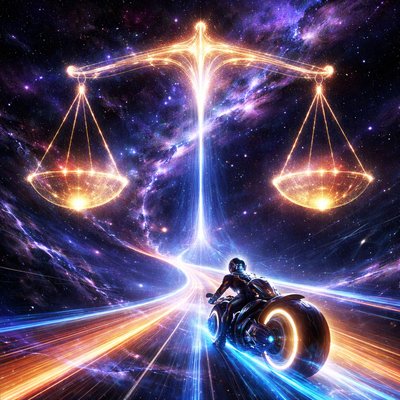
Neon-Futurism Digital Art Style, Bioluminescent Sci-Fi Cosmic Setting. A sleek, futuristic scene set deep in the interstellar void, with absolutely no Earth terrain, asphalt, or atmosphere visible. The Path (The Ecliptic): The "road" is a floating, translucent highway constructed entirely of glowing blue and orange laser grids and condensed stardust, arcing through infinite dark space. The Rider: A lone rider on a futuristic, hubless "light-cycle" sportbike speeds along this cosmic path. The rider is fully encased in a sleek, glowing armored suit with an integrated full-face helmet, leaving a vibrant neon light trail behind them. The Constellation (Abstract Libra Scales as Archway): Dominating the cosmic background and towering directly overhead is the immense celestial symbol of Libra: a pair of perfectly balanced, monumental golden scales made of glowing stars, luminous energy threads, and shimmering stardust. The scales' beam forms a grand, arched gateway structure high above, with the two pans hanging symmetrically on either side like massive portals or wings of equilibrium. The floating cosmic highway arcs directly under this uplifted arched scale structure, so the rider speeds beneath the balanced beam and between the hanging pans as if passing through the gateway of harmony and justice. No humanoid figure is present—only the majestic, abstract scales as the central cosmic emblem, radiating soft silver, deep indigo, and golden light against the nebula-filled void. The rider approaches and passes under the archway calmly and serenely.
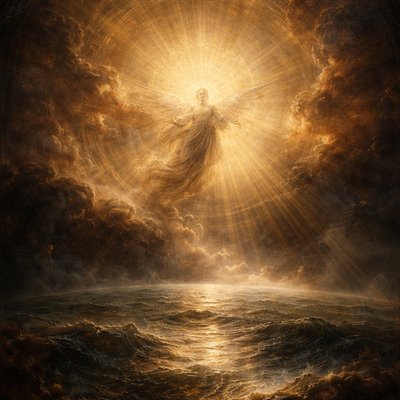
“In the beginning God created the heaven and the earth. And the earth was without form, and void; and darkness was upon the face of the deep. And the Spirit of God moved upon the face of the waters.” (Genesis 1:1-2, KJV)
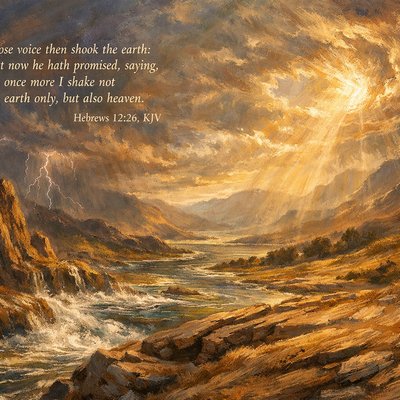
“Whose voice then shook the earth: but now he hath promised, saying, Yet once more I shake not the earth only, but also heaven.” (Hebrews 12:26, KJV)
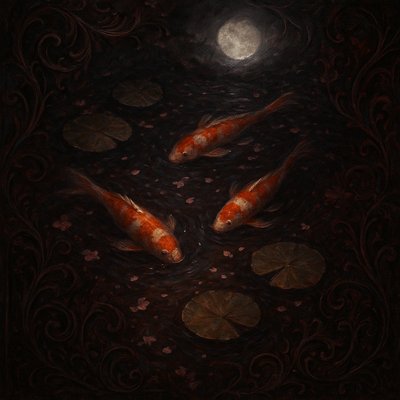
A koi pond seen from above, orange and white koi fish swimming among lily pads, clear water with subtle ripples, fallen cherry blossom petals floating on the surface, dappled sunlight
Room of strings
a man in a hat and cape standing in front of a sunset
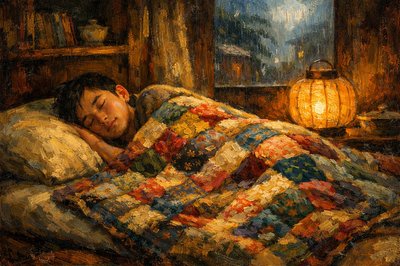
At his Grandmother's house in Penang, Wing Sun is lying down on a futon in his bedroom, covered up with a beautiful lightweight quilt Grandma made.  Outside his room the rain is coming down.  In Penang, every corner of the old town—every whisper of the wind through ancient trees—seems to echo with promises of renewal and love. And as the rain softens outside, Wing-Sun closes his eyes with the comforting knowledge that every detour, every farewell, is simply a step toward a new beginning.  A lantern gives soft light to the room, and all is quiet.