A Painting Of A Man With His Hands On His Chest Art

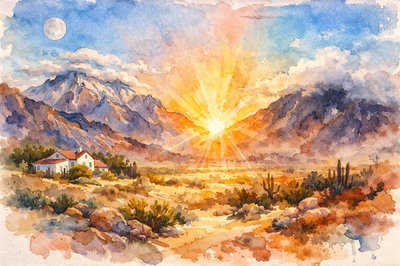
The San Gorgonio Pass, Mt. San Gorgonio) rises in the North, all hoary-frost and granite.  Snake-like clouds adorning her peak, I gaze past the big white house toward her uplifted boulders.
And at the South, Mt. San Jacinto has lost his head in cloud.  Burned bones against a blue sky backdrop.  Between the two, another sunrise gleams and beams of brilliant, white-hot day flash forth:  They accentuate the Sonora desert’s west extreme, and last night’s moon, high up on the left, forgot to go away.
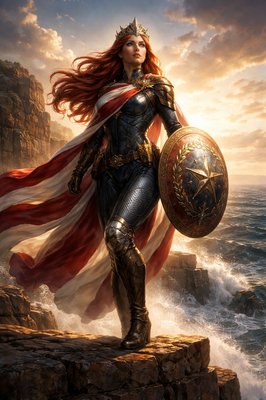
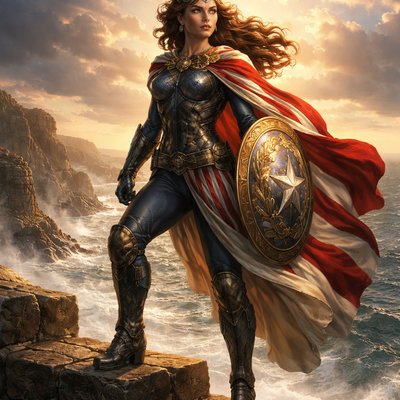
Epic Comic Book Cover Art, Neoclassical Painting Influence, Cinematic Lighting. A majestic female superhero with long red hair, a fusion of Captain America's tactical practicality and the classical personification of "Columbia." She stands atop a rugged coastal fortress wall with the ocean crashing below at dawn.

The Costume: A blend of armored protection and classical drapery. She wears a fitted, reinforced tactical suit in deep ocean blue with scale-mail elements. Over this, a heavy, flowing crimson and white striped sash is draped toga-style across her chest and shoulder, held by a golden eagle clasp. Modest styling.

The Gear: Instead of a cowl, she wears a gleaming, stylized armored tiara/crown with a prominent central star, evoking classical statues. On her left arm is a massive, ornate round shield. The shield features a relief sculpture design: a central star surrounded by an anchor motif and an encircling laurel wreath, painted in muted red, white, blue, and antique gold. She wears heavy armored gauntlets and combat boots.

The Vibe: Powerful, statuesque, and inspiring. Her pose is strong and unwavering, looking out over the horizon. The lighting is golden sunrise light mixing with sea spray.
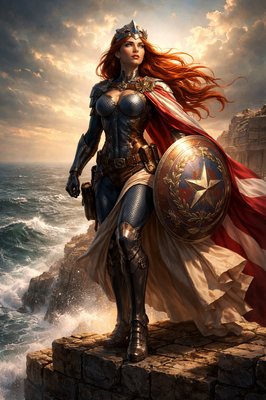
Epic Comic Book Cover Art, Neoclassical Painting Influence, Cinematic Lighting. A majestic female superhero with long red hair, a fusion of Captain America's tactical practicality and the classical personification of "Columbia." She stands atop a rugged coastal fortress wall with the ocean crashing below at dawn.

The Costume: A blend of armored protection and classical drapery. She wears a fitted, reinforced tactical suit in deep ocean blue with scale-mail elements. Over this, a heavy, flowing crimson and white striped sash is draped toga-style across her chest and shoulder, held by a golden eagle clasp.

The Gear: Instead of a cowl, she wears a gleaming, stylized armored tiara/crown with a prominent central star, evoking classical statues. On her left arm is a massive, ornate round shield. The shield features a relief sculpture design: a central star surrounded by an anchor motif and an encircling laurel wreath, painted in muted red, white, blue, and antique gold. She wears heavy armored gauntlets and combat boots.

The Vibe: Powerful, statuesque, and inspiring. Her pose is strong and unwavering, looking out over the horizon. The lighting is golden sunrise light mixing with sea spray.
“Lift up your eyes on high, and behold who hath created these things, that bringeth out their host by number: he calleth them all by names by the greatness of his might, for that he is strong in power; not one faileth.” (Isaiah 40:26, KJV)
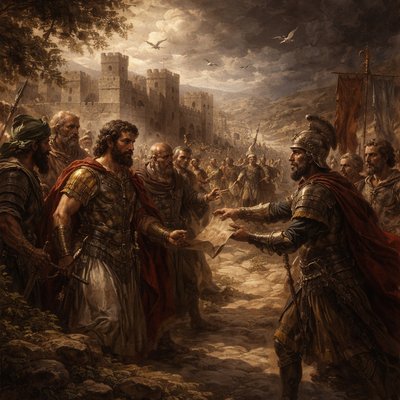
“So they departed, and came with a great power into the land of Judea, where they sent messengers to Judas and his brethren with peaceable words deceitfully.” (1 Maccabees 7:10, KJVA)
An outdoor scene at home in the back yard.  A white Dad and his African-American little girl (5) who is crying.  Dad is calming her and making her feel secure.
Epic Comic Book Cover Art, Neoclassical Painting Influence, Cinematic Lighting. A majestic female superhero, a fusion of Captain America's tactical practicality and the classical personification of "Columbia." She stands atop a rugged coastal fortress wall with the ocean crashing below at dawn.

The Costume: A blend of armored protection and classical drapery. She wears a fitted, reinforced tactical suit in deep ocean blue with scale-mail elements. Over this, a heavy, flowing crimson and white striped sash is draped toga-style across her chest and shoulder, held by a golden eagle clasp.

The Gear: Instead of a cowl, she wears a gleaming, stylized armored tiara/crown with a prominent central star, evoking classical statues. On her left arm is a massive, ornate round shield. The shield features a relief sculpture design: a central star surrounded by an anchor motif and an encircling laurel wreath, painted in muted red, white, blue, and antique gold. She wears heavy armored gauntlets and combat boots.

The Vibe: Powerful, statuesque, and inspiring. Her pose is strong and unwavering, looking out over the horizon. The lighting is golden sunrise light mixing with sea spray.
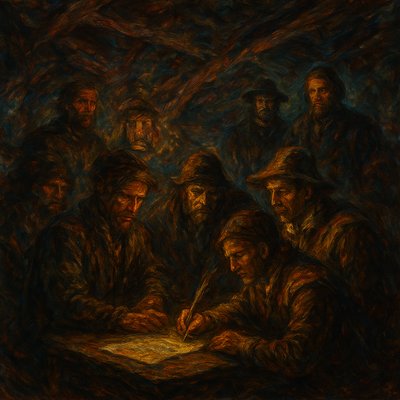
A historically accurate and atmospheric depiction of the signing of the Mayflower Compact aboard the ship in November 1620. The scene is set in the dimly lit, cramped cabin of the Mayflower, with the ship's timbers and rigging subtly visible, conveying the challenging conditions of the voyage. A simple table or chest serves as the signing surface. The primary focus is on a small group of the last individuals signing the document: specifically, the indentured servants (or 'strangers' not directly part of the Separatist congregation) approaching or at the table. Their expressions show a mix of weary determination, understanding of the necessity, and perhaps a hint of quiet apprehension or resignation to this new social contract, given their status. They are dressed in the plain, practical clothing typical of 17th-century commoners and laborers. Figures of prominent Pilgrims or 'Saints' (like William Bradford or John Carver) are visible in the background, observing the proceedings with a sense of gravity and leadership, but they are not the central focus. The lighting is low and warm, perhaps from a lantern, creating a chiaroscuro effect that highlights the faces of the signers. The atmosphere conveys the momentousness of the act under difficult circumstances, the diverse composition of the group, and the early seeds of self-governance in a new world. The artistic style is a realistic, historically detailed oil painting, capturing the solemnity and human element of this pivotal historical moment."

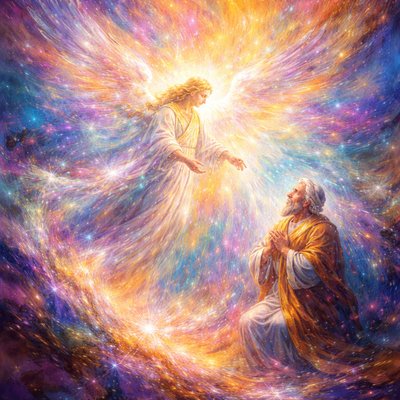
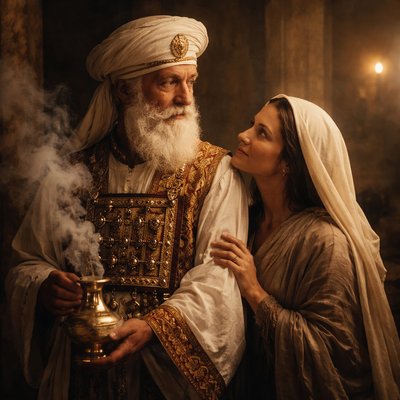
“But the angel said unto him, Fear not, Zacharias: for thy prayer is heard; and thy wife Elisabeth shall bear thee a son, and thou shalt call his name John.” (Luke 1:13, KJV)
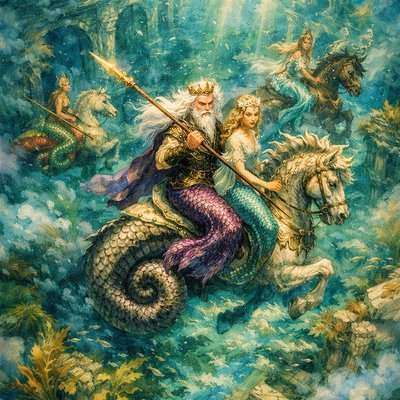
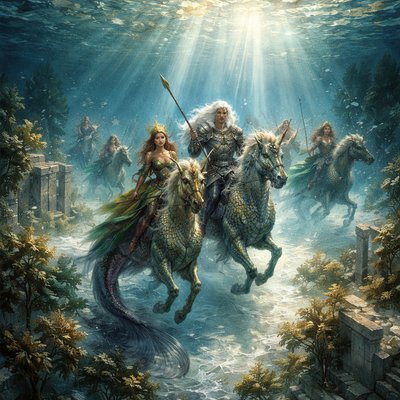
Golden Age Fantasy Illustration Style, Painterly Realism, Crystalline Underwater Photography Aesthetic. A stunning view looking down through impossibly clear ocean water at a royal hunting party of Narnian Merpeople riding through ancient, seaweed-covered ruins on the seabed.

The Crucial Riding Posture: The Merpeople are riding large, powerful, scaled hippocamps (mythical sea-horses). Crucially, the merfolk are perched securely in a distinct side-saddle position on the backs of their mounts. Their powerful, scaled fish tails are coiled elegantly around the side flank of the hippocampus for stability, rather than straddling them like a human.

The Seahorse Anatomy: The hippocamps themselves have massive, armored tails that curl tightly forward beneath their own bodies, pushing them through the water.

Key Figures & Details: The Mer-King, with flowing white hair and fierce eyes, sits side-saddle, holding a gold-tipped spear. His deep amethyst tail is visible coiled against the mount’s scales. A Mer-Queen rides beside him wearing a shimmering gown. Bright shafts of sunlight pierce the water, illuminating the specific details of their riding posture and glittering scales.
Golden Age Fantasy Illustration Style, Painterly Realism, Crystalline Underwater Photography Aesthetic. A stunning view looking straight down through impossibly clear, glassy ocean water, as if peering over the edge of a ship. Below, on the white sand seabed, are the seaweed-covered ruins of a sunken, ancient civilization.

The Merpeople: A royal hunting party of Narnian Merpeople is riding on seas horses through the submerged streets. They are not gentle, fairy-tale creatures, but possess a wild, fierce majesty. They ride large, powerful, scaled hippocamps (mythical sea-horses).

Key Figures & Details: The Mer-King, with flowing white hair and a stern expression, wears armor crafted from iridescent pearl and abalone shells, brandishing a long spear tipped with gold. The merpeople sit side saddle with their tails on one side of their sea horse. His powerful tail is deep amethyst. A fierce Mer-Queen rides beside him, her colors shimmering emerald and gold. Smaller merfolk follow, shaking spears.

Lighting & Atmosphere: Bright shafts of sunlight pierce the deep water, illuminating the underwater dust motes and making the scales of the merfolk and their mounts sparkle intensely. The mood is silent, ancient, and awe-inspiring.
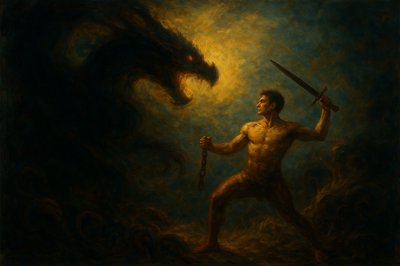
a painting of a man holding a sword next to a demon
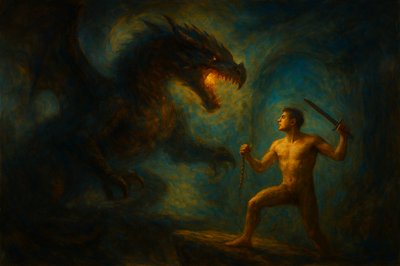
a painting of a man holding a sword next to a dragon
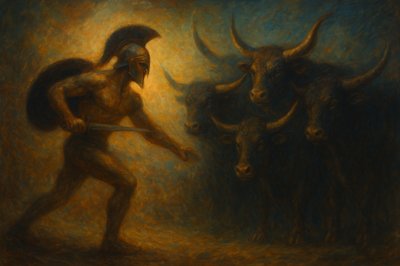
a painting of a man standing next to two bulls
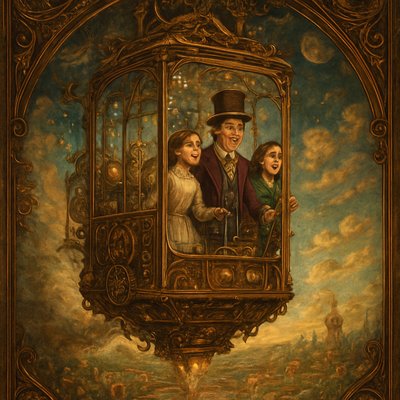
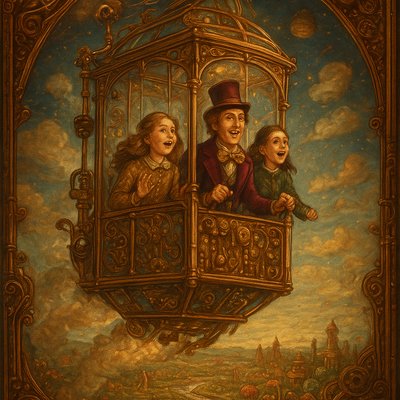
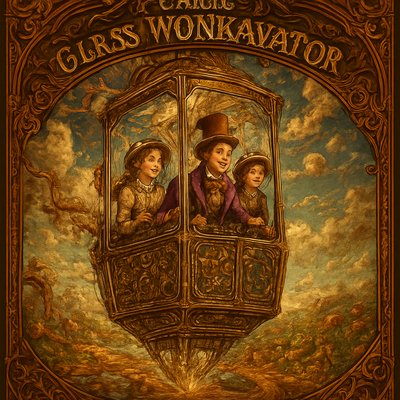
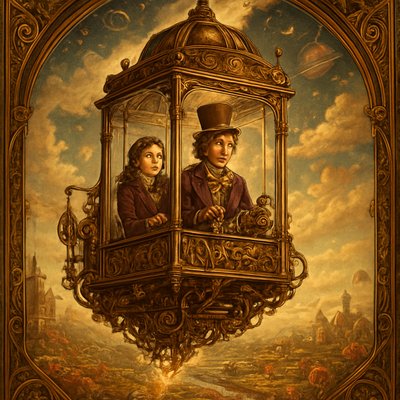
An awe-inspiring and whimsical scene featuring Willy Wonka's Great Glass Wonkavator, soaring through the sky and beyond the confines of the chocolate factory. The Wonkavator itself is a magnificent, multi-directional glass elevator, transparent and sparkling, with Willy Wonka (wearing his iconic top hat, purple coat, and bowtie) and 2 young Victorian well dressed ladies looking out with expressions of joy, wonder and excitement. The interior is filled with intricate buttons and levers for controlling its magical flight. The Wonkavator is depicted in mid-flight, perhaps bursting through the factory roof or ascending above the clouds. Below it, the fantastical landscape of the Chocolate Factory is visible – chocolate rivers, edible gardens, candy cane trees, and various whimsical buildings. Beyond the factory, a stunning, imaginative sky unfolds, perhaps with floating candy clouds, distant fantastical landmarks, or even glimpses of outer space and planets. The lighting is bright and magical, emphasizing the glass's transparency and the vibrant colors of the world below and beyond. The overall mood is one of boundless adventure, limitless possibilities, and pure, joyful fantasy."
An awe-inspiring and whimsical scene featuring Willy Wonka's Great Glass Wonkavator, soaring through the sky and beyond the confines of the chocolate factory. The Wonkavator itself is a magnificent, multi-directional glass elevator, transparent and sparkling, with a middle aged Willy Wonka (wearing his iconic top hat, purple coat, and bowtie) and 2 young Victorian well dressed ladies looking out with expressions of joy, wonder and excitement. The interior is filled with intricate buttons and levers for controlling its magical flight. The Wonkavator is depicted in mid-flight, perhaps bursting through the factory roof or ascending above the clouds. Below it, the fantastical landscape of the Chocolate Factory is visible – chocolate rivers, edible gardens, candy cane trees, and various whimsical buildings. Beyond the factory, a stunning, imaginative sky unfolds, perhaps with floating candy clouds, distant fantastical landmarks, or even glimpses of outer space and planets. The lighting is bright and magical, emphasizing the glass's transparency and the vibrant colors of the world below and beyond. The overall mood is one of boundless adventure, limitless possibilities, and pure, joyful fantasy."
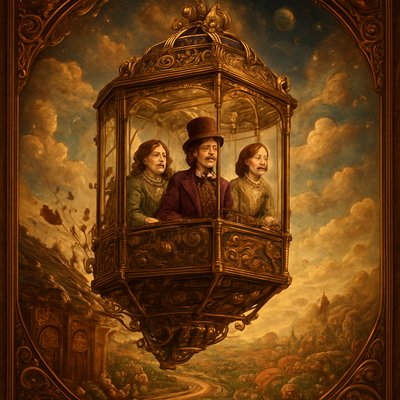
An awe-inspiring and whimsical scene featuring Willy Wonka's Great Glass Wonkavator, soaring through the sky and beyond the confines of the chocolate factory. The Wonkavator itself is a magnificent, multi-directional glass elevator, transparent and sparkling, with a middle aged Willy Wonka (wearing his iconic top hat, purple coat, and bowtie) and a young Victorian well dressed lady looking out with expressions of wonder and excitement. The interior is filled with intricate buttons and levers for controlling its magical flight. The Wonkavator is depicted in mid-flight, perhaps bursting through the factory roof or ascending above the clouds. Below it, the fantastical landscape of the Chocolate Factory is visible – chocolate rivers, edible gardens, candy cane trees, and various whimsical buildings. Beyond the factory, a stunning, imaginative sky unfolds, perhaps with floating candy clouds, distant fantastical landmarks, or even glimpses of outer space and planets. The lighting is bright and magical, emphasizing the glass's transparency and the vibrant colors of the world below and beyond. The overall mood is one of boundless adventure, limitless possibilities, and pure, joyful fantasy."
“There was in the days of Herod, the king of Judaea, a certain priest named Zacharias, of the course of Abia: and his wife was of the daughters of Aaron, and her name was Elisabeth.” (Luke 1:5, KJV)
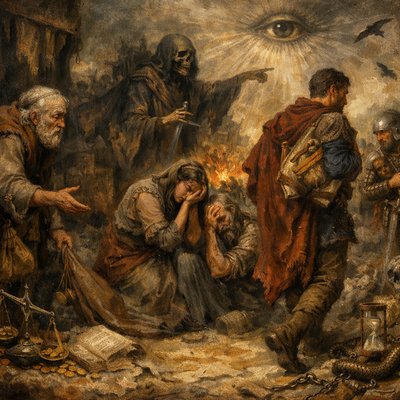
“For the seller shall not return to that which is sold, although they were yet alive: for the vision is touching the whole multitude thereof, which shall not return; neither shall any strengthen himself in the iniquity of his life.” (Ezekiel 7:13, KJV)
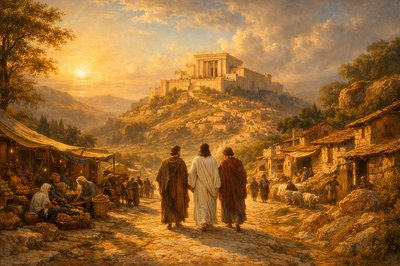
First century Palestine.  Jesus walking away from the camera with 2 of His disciples.  The Temple sits high on a hill in the distance with the road going up to it.  Merchants and houses line the road.  People are coming and going both ways.
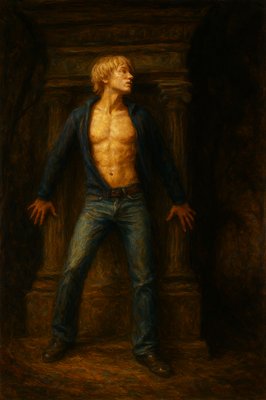
a painting of a man standing in a doorway
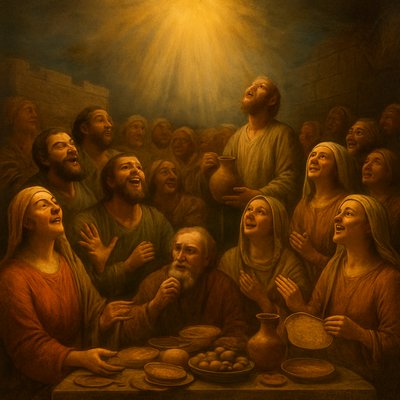
Renaissance Painting Art Style, Symbolism Art Style, a profoundly joyful and uplifting painting inspired by Nehemiah 8:10, emphasizing "the joy of the Lord is your strength." The scene depicts a vibrant, bustling gathering of diverse ancient Israelites, engaged in a communal feast and celebration. People of all ages are shown with radiant, happy faces, some laughing heartily, others sharing food and drinks, and many with expressions of deep, peaceful contentment and spiritual upliftment. A few figures have their heads tilted upwards or hands gently raised, as if receiving a subtle, warm, golden divine light that bathes the scene, emanating from above and symbolizing the presence and strength of the Lord. The setting is an outdoor gathering, perhaps near a restored wall or a communal square, filled with rich textures of food, drink, and colorful garments. The atmosphere is one of shared delight, spiritual renewal, and unbreakable strength. Focus on the authentic, diverse expressions of joy on each individual's face, the sense of vibrant community and shared celebration, and the ethereal, empowering golden light that symbolizes the Lord's strength.
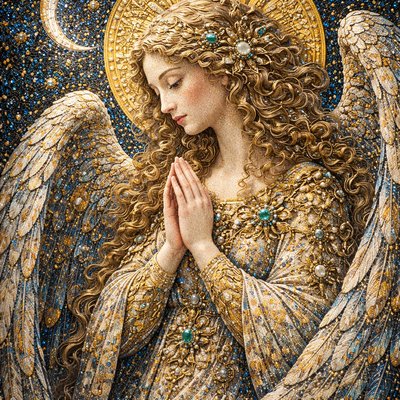
Angelic Woman: A highly detailed photorealistic mosaic artwork in the elegant Art Nouveau style strongly influenced by Gustav Klimt, depicting a serene ethereal angelic female figure in three-quarter profile view from the left, eyes gently closed, calm contemplative expression with subtle blush and red lips, head slightly bowed, hands clasped in prayer over the chest. The entire form--including flawless skin, elaborate voluminous curly hair with flowing organic swirls, large intricate angelic wings, and ornate decorative covering--is intricately composed as a luxurious mixed-material mosaic using tiny irregular tesserae dominated by deep midnight blue and radiant gold tones; vibrant hand-cut smalti glass in midnight blue, sapphire, and luminous gold; abundant sparkling embedded gemstones in lapis, turquoise, and pearl hues; extensive metallic gold leaf accents forming spiral, floral, and whiplash curve patterns; opaque ceramic and marble tiles for subtle texture; and delicate pearl inlays for soft luminosity. Hair and figure feature characteristic Klimt-inspired swirling gold filigree, geometric motifs, and organic curving lines; prominent wings rendered in layered feather-like segments with Art Nouveau flowing forms in gold-outlined midnight blue; radiant golden sunburst halo behind the head enhanced with decorative radial patterns. Vast midnight blue night sky background filled with scattered twinkling stars crafted from pearl and silver inlays and a prominent glowing crescent moon in gold and pearl tesserae, dramatic luminous highlights and iridescent reflections on glass, metals, and gems, slight dimensional depth from raised tiles, thin subtle grout lines for elegant contrast, opulent baroque-infused Art Nouveau hyper-intricate style blending surreal fantasy and symbolic celestial ornamentation, sharp focus, transcendent serene mood
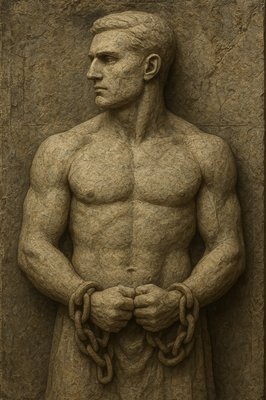
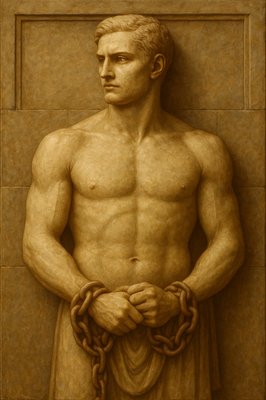
a statue of a man with a chain around his waist
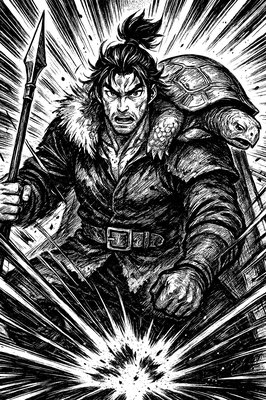
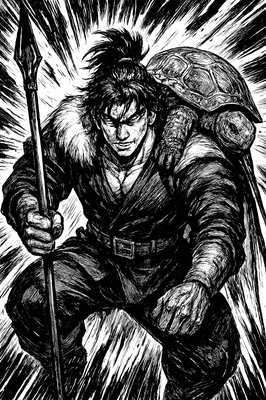
a man sitting on a chair with a turtle on his shoulders
A grand, cinematic wide-angle shot of Santa Claus and his reindeer team galloping across a shimmering, translucent Rainbow Bridge (Bifrost-style) in deep space.

The Bridge & Track: The bridge is a massive, glowing crystalline structure that functions like a celestial racetrack. It features distinct, glowing "cosmic lanes" separated by ribbons of starlight. Along the track are towering, ornate arches that serve as "gates" or "warps," pulsing with magical energy.

The Scene: In the center, Santa’s sleigh is a high-tech, reinforced wooden vessel, leaving a trail of sparkling gold dust. The reindeer are in mid-leap, looking powerful and heroic. They are just passing through a massive, crystalline gate that marks the entrance to a new galaxy.

Background: The background is a vibrant nebula of deep purples, teals, and golds. Distant stars and planets are visible, and the bridge itself stretches out into the infinite distance, winding through the stars.

Style Details:

Visual Style: Epic High-Fantasy meets Sci-Fi (Cyberpunk-adjacent lighting).

Lighting: Dramatic rim lighting on Santa and the reindeer from the glowing bridge below. The "gates" cast a bright, cinematic flare.

Atmosphere: Intense speed, magical wonder, and a sense of an epic, cross-universal mission.
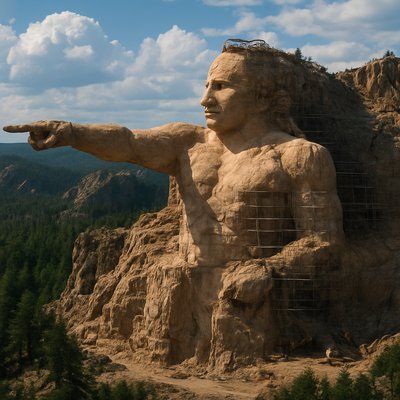
A majestic and inspiring depiction of the Crazy Horse National Memorial, captured from a slightly elevated, wide-angle perspective that emphasizes its immense scale and ongoing construction. The colossal carving of Crazy Horse on his war pony is the dominant feature, shown in its current state of detailed progress, with the iconic outstretched arm and pointing finger prominent against the rugged Black Hills. Visible elements of the carving process, such as scaffolding, construction equipment (subtly integrated), or evidence of rock removal, are present, highlighting the monumental effort and generations of work involved. The surrounding landscape of the Black Hills is an integral part of the composition, with pine forests, granite formations, and the vast, open sky providing a dramatic and respectful setting. The lighting is strong and clear, perhaps mid-morning or late afternoon sun, casting dramatic shadows that define the contours of the mountain and the carving. The atmosphere conveys a sense of enduring tribute, cultural pride, determination, and the sheer scale of human endeavor dedicated to honoring a legendary figure. The artistic style is a highly realistic, detailed landscape painting or photograph, emphasizing grandeur and reverence
Express without words 2 Kings 4:39 (KJV)
39 And one went out into the field to gather herbs, and found a wild vine, and gathered thereof wild gourds his lap full, and came and shred them into the pot of pottage: for they knew them not.
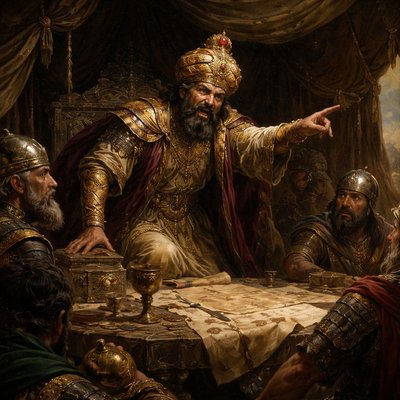
“Therefore the heart of the king of Syria was sore troubled for this thing; and he called his servants, and said unto them, Will ye not shew me which of us is for the king of Israel?” (2 Kings 6:11, KJV)
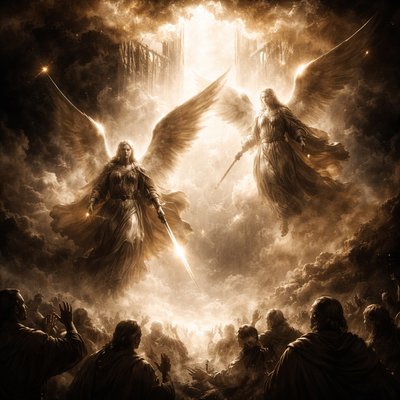
“Then the all-glorious, all-powerful, and true God, displayed his holy countenance, and opened the gates of heaven, from which two angels, dreadful of form, came down and were visible to all but the Jews.” (3 Maccabees 6:18, Brenton)
An outdoor scene on a street in town.  A White Mom and African-American Dad with their two Asian children are sitting at a sidewalk cafe.  The mood is warm and safe.  Everyone has a drink.  Mom and Dad are talking to the boy, who is making a fuss.  He is unhappy about something, and crying.  His sister is looking on.  Dad is about to say something.
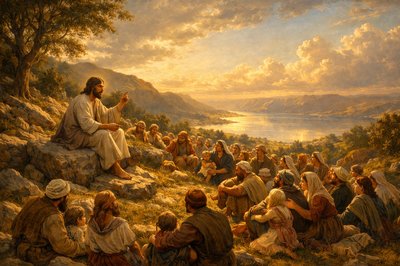
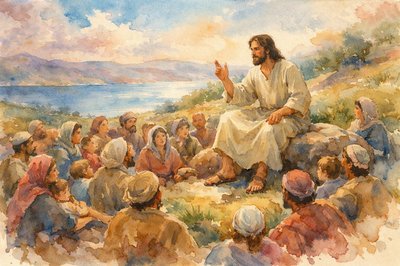
First century Palestine.  Jesus sits on a rock on a hillside teaching a large group of His disciples.  The Sermon on the Mount.  Jesus wears a plain robe like most ordinary men.  Jesus' face is kind, but intense, as He teaches. The other people are mostly peasants, farmers, and tradesmen.  There are also women present, wearing plain, everyday clothing.  Some couples have also brought their children.  The Sea of Galilee shines in the far distance.
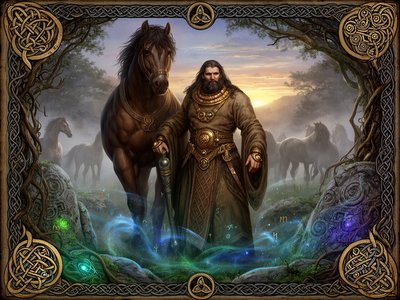
The Dagda, powerful Celtic god, standing with a massive, muscular horse at his side. Earthy robes, bronze and gold torc, long dark hair, commanding presence. Horses moving in the background like living wealth of the land. Misty forest or rolling hills, dawn light piercing fog, mythic realism, cinematic Celtic fantasy, raw authority, natural textures.
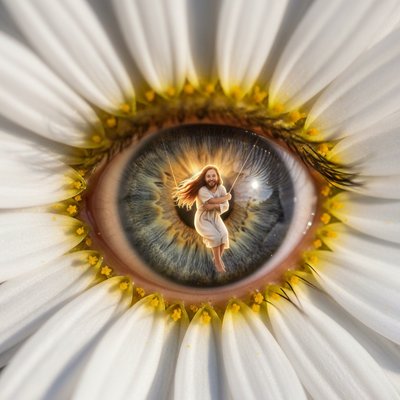
A close up of an eye. Around the eye are daisy petals - as if the eye is the center of the daisy. In the pupil a picture of Jesus swinging a little girl with long red hair, her arms around His neck, close-up view, macro perspective, joyful mood, golden hour color palette, god rays lighting, framing composition, masterpiece, best quality, ultra detailed, sharp focus, highly detailed