A Close Up Of A Painting Of A Person Art

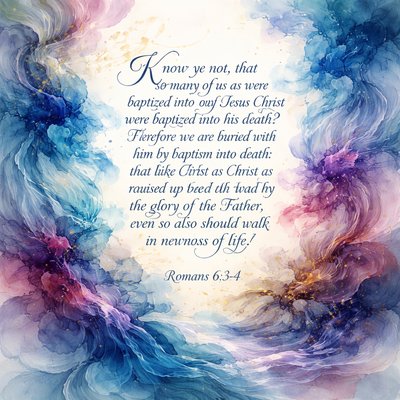
“Know ye not, that so many of us as were baptized into Jesus Christ were baptized into his death? Therefore we are buried with him by baptism into death: that like as Christ was raised up from the dead by the glory of the Father, even so we also should walk in newness of life.” (Romans 6:3-4, KJV)
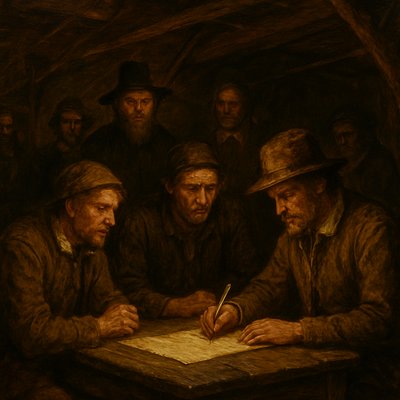
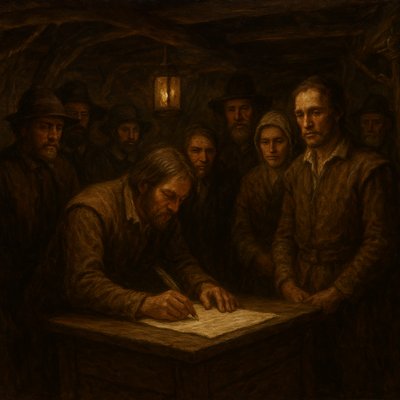
A historically accurate and atmospheric depiction of the signing of the Mayflower Compact aboard the ship in November 1620. The scene is set in the dimly lit, cramped cabin of the Mayflower, with the ship's timbers and rigging subtly visible, conveying the challenging conditions of the voyage. A simple table or chest serves as the signing surface. The primary focus is on a small group of the last individuals signing the document: specifically, the indentured servants (or 'strangers' not directly part of the Separatist congregation) approaching or at the table. Their expressions show a mix of weary determination, understanding of the necessity, and perhaps a hint of quiet apprehension or resignation to this new social contract, given their status. They are dressed in the plain, practical clothing typical of 17th-century commoners and laborers. Figures of prominent Pilgrims or 'Saints' (like William Bradford or John Carver) are visible in the background, observing the proceedings with a sense of gravity and leadership, but they are not the central focus. The lighting is low and warm, perhaps from a lantern, creating a chiaroscuro effect that highlights the faces of the signers. The atmosphere conveys the momentousness of the act under difficult circumstances, the diverse composition of the group, and the early seeds of self-governance in a new world. The artistic style is a realistic, historically detailed oil painting, capturing the solemnity and human element of this pivotal historical moment."
A group of people dressed up for a ball having a balloon fight
Intuitive abstract painting with personal symbolism in the art style of Outsider Art --v 6.1
An Asian Slice
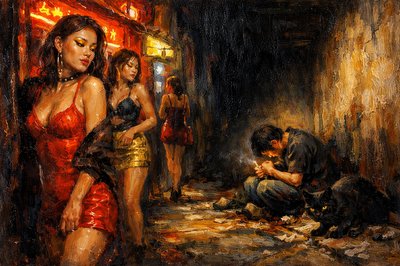
At the dark end of an alley on a moonless night,
A youth squats low to the ground, turned toward the wall with his face in his lap.  Someone might think he’s sleeping.  He’s smoking heroin.  Soon he’ll fall over and soil himself, and stay right there until dawn.

Back at the neon-lit mouth of this dark alley, 
hookers walk back and forth, hurrying to get past the alley, either for fear or because is smells so bad.  Eyelids, all painted golden, Asian whores always look like they’re made of candy.  Candy it is; but a snarling cat awaits its prey.
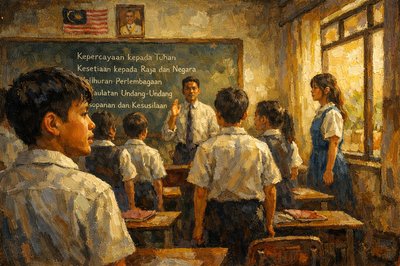
Morning inside the classroom at a private school in Kuala Lumpur before class begins. Students stand next to their desks as the teacher, standing in front, leads them in the usual morning recitations of the five national principles, their voices blending into one:
	"Kepercayaan kepada Tuhan." (Belief in God.)
	"Kesetiaan kepada Raja dan Negara." (Loyalty to the King and Country.)
	"Keluhuran Perlembagaan." (Supremacy of the Constitution.)
	"Kedaulatan Undang-Undang." (Rule of Law.)
	"Kesopanan dan Kesusilaan." (Courtesy and Morality.)
Wing-Sun repeats the words automatically, his eyes drift across the classroom, catching a glimpse of Siu-Zi, the new girl, standing in her usual spot near the window.
A historically accurate and atmospheric depiction of the signing of the Mayflower Compact aboard the ship in November 1620. The scene is set in the dimly lit, cramped cabin of the Mayflower, with the ship's timbers and rigging subtly visible, conveying the challenging conditions of the voyage. A simple table or chest serves as the signing surface. The primary focus is on a small group of the last individuals signing the document: specifically, the indentured servants (or 'strangers' not directly part of the Separatist congregation) approaching or at the table. Their expressions show a mix of weary determination, understanding of the necessity, and perhaps a hint of quiet apprehension or resignation to this new social contract, given their status. They are dressed in the plain, practical clothing typical of 17th-century commoners and laborers. Figures of prominent Pilgrims or 'Saints' (like William Bradford or John Carver) are visible in the background, observing the proceedings with a sense of gravity and leadership, but they are not the central focus. The lighting is low and warm, perhaps from a lantern, creating a chiaroscuro effect that highlights the faces of the signers. The atmosphere conveys the momentousness of the act under difficult circumstances, the diverse composition of the group, and the early seeds of self-governance in a new world. The artistic style is a realistic, historically detailed oil painting, capturing the solemnity and human element of this pivotal historical moment."
Intuitive painting with personal symbolism by self-taught artist in the art style of Outsider Art --v 6.1
A serene and majestic watercolor painting, capturing the essence of a grand, towering evergreen tree (like the dominant one in the provided image) standing proudly in a sun-dappled, open forest glade. The tree's deep green needles are rendered with varying washes, showcasing its immense height and full, tiered branches that reach towards a partly cloudy, bright blue sky.

In the foreground and around the base of this glorious tree, two or three graceful mule deer are depicted. One might be grazing peacefully, another looking up towards the viewer with its large, expressive ears, and a fawn possibly tucked nearby. Their coats are rendered in soft, earthy watercolor tones of grey-brown, with delicate highlights and shading to suggest their gentle forms and distinctive white rumps and tails.

The surrounding landscape features a subtle ground cover of dry grasses and scattered undergrowth, characteristic of a high-desert or mountain forest floor, painted with soft, blended washes of ochre, sage green, and light brown. The sky above is a classic watercolor blend of soft blues and wispy white clouds. The overall mood is one of tranquil natural beauty, quiet majesty, and a harmonious coexistence of wildlife and ancient trees, rendered with the flowing, luminous quality of watercolor art loose watercolor style, vibrant yet soft washes, visible brushstrokes, luminous transparency, natural light, serene atmosphere
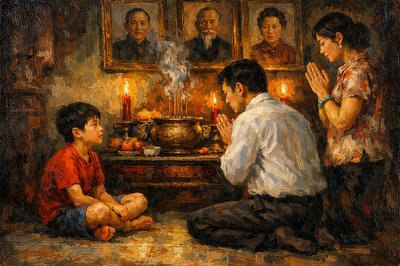
Inside a home in Petaling Jaya, Wing-Sun, a 10 year old Chinese boy sits cross-legged on the cool tile floor, watching the delicate tendrils of smoke rise from the joss sticks his father has just placed in the family altar’s bronze urn. The flickering candlelight casts shifting shadows over the framed portraits of the ancestors, their solemn faces gazing out from another time.
Wing-Sun's father, dressed in crisp slacks and a neatly pressed white shirt, murmurs a quiet prayer, his voice low and rhythmic. Beside him, Wing-Sun’s mother clasps her hands together in a quiet moment of respect before adjusting the jade bangle on her wrist. Their morning ritual is a quiet, practiced thing; one they perform, and Wing-Sun observes, every day.
Intuitive painting with personal symbolism by self-taught artist in the art style of Outsider Art --v 6.1
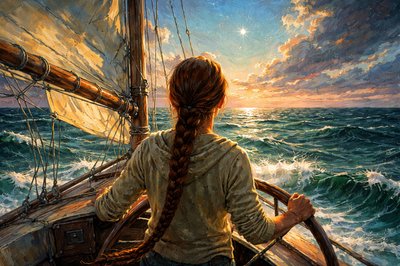
A woman with long braided hair down to the waist is holding the rudder of a keel boat right at the time between day and night. She is looking towards the sail and to The morning star.. This is A first-person or over-the-shoulder perspective from behind a woman with a long red braid steering a keelboat, looking past the sails and rigging to the bright morning star.
Fantasy knight character
A roaring lion
Dragon
The feeling of dawn
Southeast Asia.  Modern day.  Back out on the open plain, our bus hurtles toward the city.
Smokestacks and temples rise up from the earth; two visions competing for the sky.
The woman on my right holds a chicken in her lap; rural wealth for a city friend?  On my left a Buddhist priest sits in quiet repose and presides over the world.
A giant grouper fish, over a coral reef in the ocean, professional photography, extreme detail (
Psalms 124:1-6 KJVA  A Song of degrees of David. If it had not been the LORD who was on our side, now may Israel say;  (2)  If it had not been the LORD who was on our side, when men rose up against us:  (3)  Then they had swallowed us up quick, when their wrath was kindled against us:  (4)  Then the waters had overwhelmed us, the stream had gone over our soul:  (5)  Then the proud waters had gone over our soul.  (6)  Blessed be the LORD, who hath not given us as a prey to their teeth.
Fatuous
A cosmic nebula
A human face in profile
An ancient wall
Magical baker girl with cupcakes
New York City
New European Painting Style Style Transfer Example
New York City
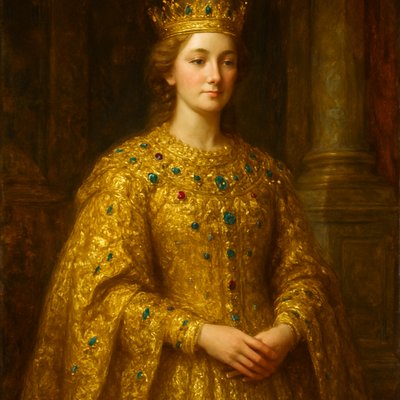
My sincerest apologies that the Queen appeared angry! That's completely contrary to the "serene and noble expression" we aimed for and the dignity implied by Psalm 45. We need to explicitly reinforce a gentler, more gracious demeanor.

You're also right to focus on the gold's shine. We can definitely enhance that.

To address both issues—the expression and the gold's luminosity—we'll make two key adjustments:

    Refine Expression: Use stronger words for a gentle, majestic, and perhaps beatific expression.

    Enhance Gold's Shine: Introduce Baroque Art Style as a secondary influence. Baroque is famous for its dramatic light, intense gleam on metals and jewels, and dynamic richness, which will make the gold truly radiant. It pairs beautifully with Oil Painting for opulence.

Revised Prompt for "Queen in Gold of Ophir - Gentle Expression & Shining Gold"

    Oil Painting Art Style, Baroque Art Style, a breathtakingly majestic and regal portrait of "The Queen in Gold of Ophir," inspired by Psalm 45. The Queen stands with impeccable grace and royal dignity, her posture radiating quiet power. Her expression is serene, gentle, and profoundly gracious, with a subtle, knowing smile, reflecting noble peace. She is adorned in an exquisitely elaborate gown woven entirely from the finest, purest gold of Ophir, which shimmers and gleams with unparalleled brilliance, catching every ray of light. Her attire is intricately embellished with countless precious jewels—sapphires, rubies, and emeralds—each sparkling intensely with Baroque dynamism. A delicate yet regal golden crown, also ablaze with light, rests upon her head. The setting is a grand, opulent royal palace chamber, with rich tapestries and polished marble, bathed in dramatic, warm, golden ambient light that creates striking highlights and deep, luxurious shadows, making her and her lavish garments glow. Focus on the unparalleled brilliance, texture, and radiant shine of her golden gown, the intense sparkle of her jewels, her majestic yet gentle presence, and the luxurious, sacred atmosphere befitting a queen in God's presence.
Atmospheric interior scene from Nancy Drew book #81 The Mardi Gras Mystery, set inside the grand, dimly lit Seaton Mansion nicknamed 'Bat Hollow' in New Orleans during Mardi Gras. Teenage detective Nancy Drew with her classic reddish-blonde hair, blue eyes, and determined smile, trying on an elegant masquerade costume—perhaps a sparkling gown with purple, green, and gold accents, feathered mask in hand, beads around her neck. Her friends Bess (blonde, bubbly, in a glamorous pink feathered outfit) and George (short dark hair, athletic, in a fun jester or adventurous costume) are nearby, laughing and adjusting outfits in front of a large antique mirror. Ned Nickerson helps Nancy with a clasp, smiling. In the background: Brian Seaton and his father Bartholomew in partial bat-themed costumes (capes, masks with bat ears/wings), an old grand staircase with wrought-iron details, flickering candlelight or chandeliers casting shadows, antique furniture, a framed portrait on the wall hinting at the stolen painting mystery, Mardi Gras beads and confetti scattered around. Moody yet festive lighting—warm glows against dark wood paneling and high ceilings—evoking a haunted Southern mansion vibe mixed with holiday excitement. 1980s Nancy Drew book illustration style, adventurous, detailed costumes, cinematic composition, vibrant colors popping against gothic shadows
Fatuous
Melting clocktower
Bipolar self-portrait
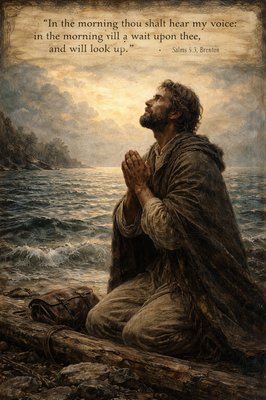
“In the morning thou shalt hear my voice: in the morning will I wait upon thee, and will look up.” (Psalms 5:3, Brenton)
a christmas tree is lit up in the snow
a group of young children holding up signs
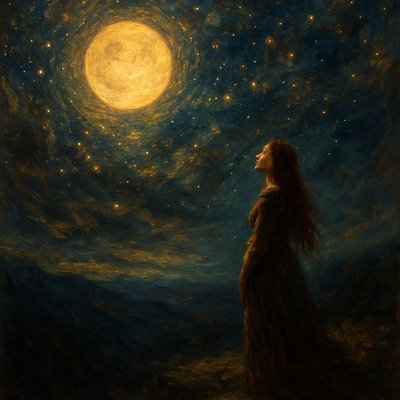
Romanticism Art Style, a profoundly emotional and majestic painting inspired by Psalm 8:3-6. The scene captures a vast, sweeping, and dramatic night sky, filled with an awe-inspiring celestial display of a luminous, prominent moon and countless brilliant stars, depicted with the grandeur and depth characteristic of Romantic landscape painting. In the foreground, set against the overwhelming scale of the cosmos, stands a solitary long red-haired woman, her back partially to the viewer or her face upturned in profound contemplation. She is small in the frame, emphasizing the immense scale, dressed in simple, flowing attire, positioned on a rugged, subtle earthly vantage point like a mountain overlook. Her posture and presence evoke a deep sense of humility, wonder, and spiritual awe at God's creation. The painting is dominated by dramatic chiaroscuro, with the intense glow of the moon and stars piercing through deep, atmospheric shadows. Focus on the sublime scale of the cosmos, the emotional resonance of the human figure contemplating the divine works, and the deep, spiritual awe that pervades the scene, reflecting God's majesty and mindfulness of humanity.
“In the morning thou shalt hear my voice: in the morning will I wait upon thee, and will look up.” (Psalms 5:3, Brenton)