"A Group Of Determined 19th Century Gold Miners Panning For Gold In A Shallow, Rocky Stream In The Sierra Nevada Mountains Art

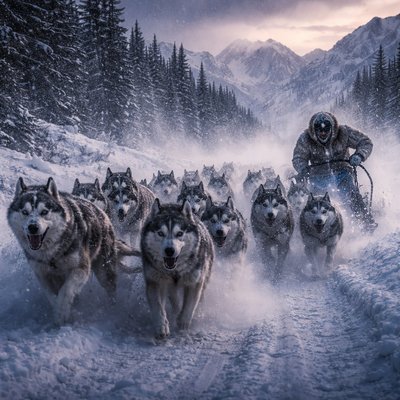
Epic Adventure Photography Style, Cinematic Color Grading, Sub-Zero Atmosphere. A harrowing, dynamic wide-angle landscape photograph capturing the intensity of a long-distance dog sled race (like the Yukon Quest or Iditarod) in the dead of winter.

The Action & Subjects: A lead team of sixteen powerful Siberian Huskies and Alaskan Malamutes is charging directly toward the camera along a narrow, wind-blown trail. Their fur is heavily caked in ice and rime frost, and massive, crystalline plumes of frozen breath explode from their panting mouths. The musher, bundled in heavy, frost-covered furs and technical gear with goggles obscuring their face, leans aggressively into a turn on the sled, fighting to maintain control.

The "Cinematic Cold" Environment: The setting is a vast, unforgiving frozen riverbed surrounded by towering, snow-laden spruce trees and distant, jagged, glaciated mountain peaks. The air is thick with blowing snow and ice fog.

The Lighting & Mood: The scene is lit by the deep, biting blues and purples of polar twilight. A weak, cold orange glow from a distant, low sun just barely kisses the tops of the mountains, offering no warmth. The overall color palette is desaturated and cool. The image should feel incredibly vast, isolating, and brutally freezing. Film grain texture.
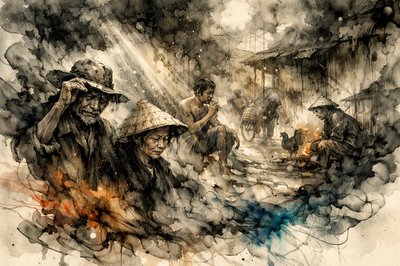
Southeast Asia.  Modern day.  The damaged and the broken ones; all rooted in the past,
	live life the way it always was, from their first day to their last.
	Motes of dust in beams of light, in the darkness of this day,
	we tip the hat and give a nod, for the truth we can’t convey.

	Everything is real, but nothing matters, anyway.
	Where life is only what must be, from the cradle to the grave.
	Everyone does what they can:  Nothing less, but sure no more. 
	Tip the hat and give a nod to the ones who’ve gone before.
	We tip our hats and give the nod to the world we’ve all ignored
An Asian Slice
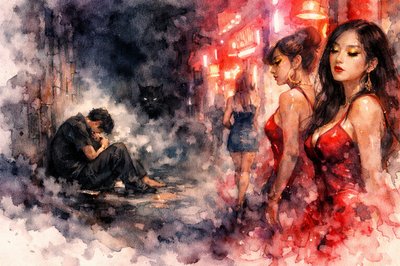
At the dark end of an alley on a moonless night,
A youth squats low to the ground, turned toward the wall with his face in his lap.  Someone might think he’s sleeping.  He’s smoking heroin.  Soon he’ll fall over and soil himself, and stay right there until dawn.

Back at the neon-lit mouth of this dark alley, 
hookers walk back and forth, hurrying to get past the alley, either for fear or because is smells so bad.  Eyelids, all painted golden, Asian whores always look like they’re made of candy.  Candy it is; but a snarling cat awaits its prey.
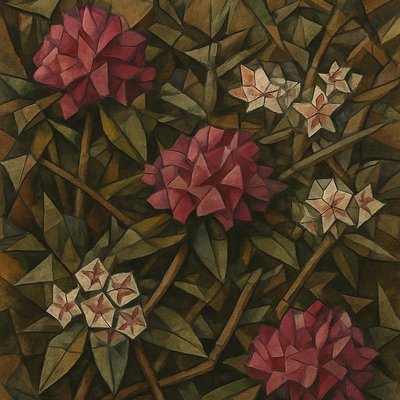
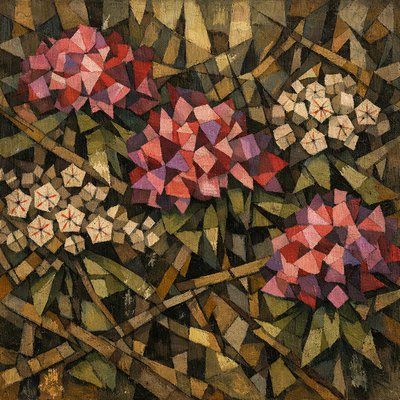
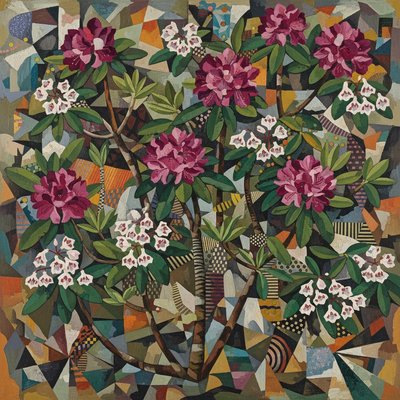
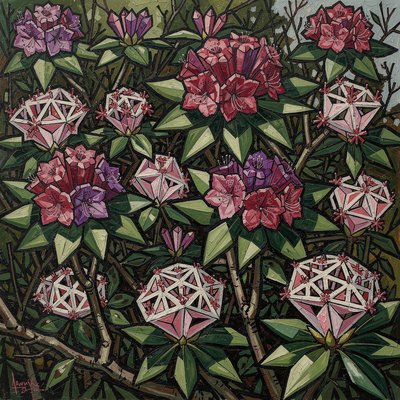
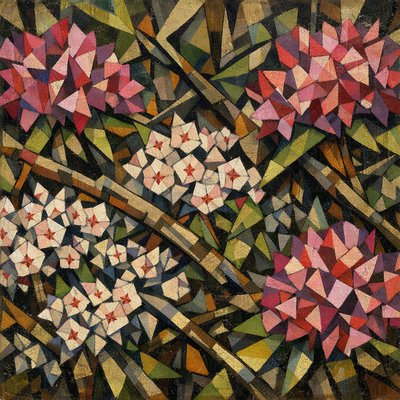
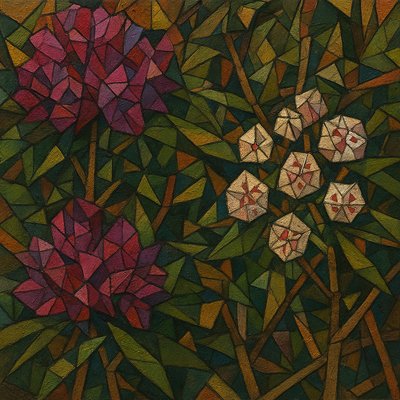
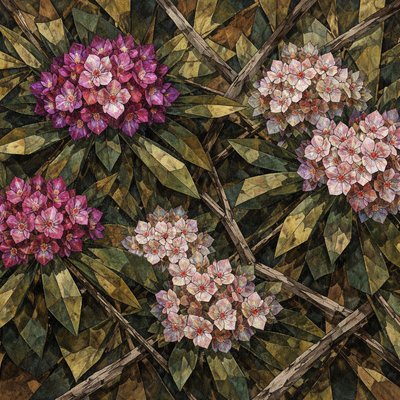
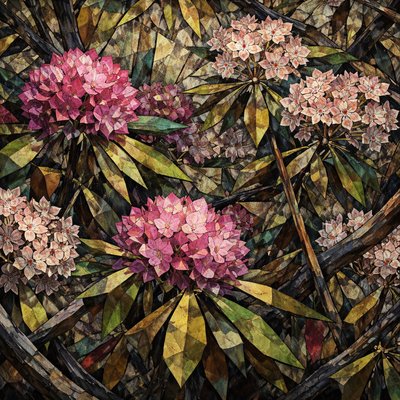
Art Style: Analytical Cubism, avant-garde oil painting style reminiscent of Picasso and Braque.

Subject: A dense, tangled thicket of Rhododendrons and Mountain Laurel bushes.

Composition & Details: The entire natural scene is deconstructed into overlapping geometric planes, fractured shards, and intersecting angles. There are no curved lines; everything is rendered in cubes, cones, and trapezoids.

    The Rhododendrons: Large, showy flower trusses are broken into faceted crystalline structures of deep magenta, rose pink, and violet blocks, looking like explosions of colored quartz rather than soft petals.

    The Mountain Laurels: The smaller, intricate flowers are rendered as complex, repeating geometric star-patterns and angular cups in white and pale pink with distinct red polygonal markings.

    Foliage & Branches: The thick, leathery leaves are fragmented green triangles and parallelograms overlapping each other, creating a sense of depth without traditional perspective. The woody stems and branches are jagged, intersecting brown and grey cylinders that shatter across the frame.
Color & Texture: A palette of muted earth tones—ochre, burnt umber, forest green, and slate grey—contrasted sharply with the jewel-toned facets of the flower colors. The finish should have a heavy, textured oil paint feel with visible palette knife marks and rough brushwork.
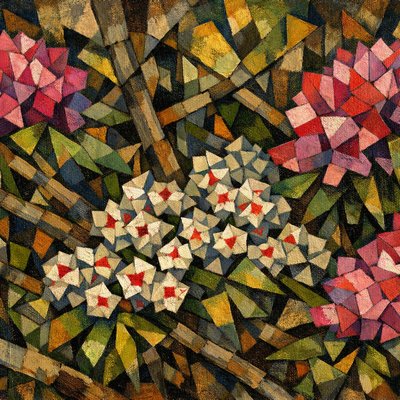
Art Style: Analytical Cubism, avant-garde oil painting style reminiscent of Picasso and Braque.

Subject: A dense, tangled thicket of Rhododendrons and Mountain Laurel bushes.

Composition & Details: The entire natural scene is deconstructed into overlapping geometric planes, fractured shards, and intersecting angles. There are no curved lines; everything is rendered in cubes, cones, and trapezoids.

    The Rhododendrons: Large, showy flower trusses are broken into faceted crystalline structures of deep magenta, rose pink, and violet blocks, looking like explosions of colored quartz rather than soft petals.

    The Mountain Laurels: The smaller, intricate flowers are rendered as complex, repeating geometric star-patterns and angular cups in white and pale pink with distinct red polygonal markings.

    Foliage & Branches: The thick, leathery leaves are fragmented green triangles and parallelograms overlapping each other, creating a sense of depth without traditional perspective. The woody stems and branches are jagged, intersecting brown and grey cylinders that shatter across the frame.

Color & Texture: A palette of muted earth tones—ochre, burnt umber, forest green, and slate grey—contrasted sharply with the jewel-toned facets of the flower colors. The finish should have a heavy, textured oil paint feel with visible palette knife marks and rough brushwork.
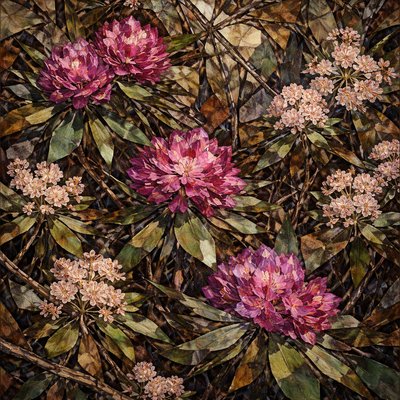
Art Style: Analytical Cubism, avant-garde oil painting style reminiscent of Picasso and Braque.

Subject: A dense, tangled thicket of Rhododendrons and Mountain Laurel bushes.

Composition & Details: The entire natural scene is deconstructed into overlapping geometric planes, fractured shards, and intersecting angles. There are no curved lines; everything is rendered in cubes, cones, and trapezoids.

    The Rhododendrons: Large, showy flower trusses are broken into faceted crystalline structures of deep magenta, rose pink, and violet blocks, looking like explosions of colored quartz rather than soft petals.

    The Mountain Laurels: The smaller, intricate flowers are rendered as complex, repeating geometric star-patterns and angular cups in white and pale pink with distinct red polygonal markings.

    Foliage & Branches: The thick, leathery leaves are fragmented green triangles and parallelograms overlapping each other, creating a sense of depth without traditional perspective. The woody stems and branches are jagged, intersecting brown and grey cylinders that shatter across the frame.

Color & Texture: A palette of muted earth tones—ochre, burnt umber, forest green, and slate grey—contrasted sharply with the jewel-toned facets of the flower colors. The finish should have a heavy, textured oil paint feel with visible palette knife marks and rough brushwork.
Art Style: Analytical Cubism, avant-garde oil painting style reminiscent of Picasso and Braque.

Subject: A dense, tangled thicket of Rhododendrons and Mountain Laurel bushes.

Composition & Details: The entire natural scene is deconstructed into overlapping geometric planes, fractured shards, and intersecting angles. There are no curved lines; everything is rendered in cubes, cones, and trapezoids.

    The Rhododendrons: Large, showy flower trusses are broken into faceted crystalline structures of deep magenta, rose pink, and violet blocks, looking like explosions of colored quartz rather than soft petals.

    The Mountain Laurels: The smaller, intricate flowers are rendered as complex, repeating geometric star-patterns and angular cups in white and pale pink with distinct red polygonal markings.

    Foliage & Branches: The thick, leathery leaves are fragmented green triangles and parallelograms overlapping each other, creating a sense of depth without traditional perspective. The woody stems and branches are jagged, intersecting brown and grey cylinders that shatter across the frame.

Color & Texture: A palette of muted earth tones—ochre, burnt umber, forest green, and slate grey—contrasted sharply with the jewel-toned facets of the flower colors. The finish should have a heavy, textured oil paint feel with visible palette knife marks and rough brushwork.
Art Style: Analytical Cubism, avant-garde oil painting style reminiscent of Picasso and Braque.

Subject: A dense, tangled thicket of Rhododendrons and Mountain Laurel bushes.

Composition & Details: The entire natural scene is deconstructed into overlapping geometric planes, fractured shards, and intersecting angles. There are no curved lines; everything is rendered in cubes, cones, and trapezoids.

    The Rhododendrons: Large, showy flower trusses are broken into faceted crystalline structures of deep magenta, rose pink, and violet blocks, looking like explosions of colored quartz rather than soft petals.

    The Mountain Laurels: The smaller, intricate flowers are rendered as complex, repeating geometric star-patterns and angular cups in white and pale pink with distinct red polygonal markings.

    Foliage & Branches: The thick, leathery leaves are fragmented green triangles and parallelograms overlapping each other, creating a sense of depth without traditional perspective. The woody stems and branches are jagged, intersecting brown and grey cylinders that shatter across the frame.

Color & Texture: A palette of muted earth tones—ochre, burnt umber, forest green, and slate grey—contrasted sharply with the jewel-toned facets of the flower colors. The finish should have a heavy, textured oil paint feel with visible palette knife marks and rough brushwork.
Art Style: Analytical Cubism, avant-garde oil painting style reminiscent of Picasso and Braque.

Subject: A dense, tangled thicket of Rhododendrons and Mountain Laurel bushes.

Composition & Details: The entire natural scene is deconstructed into overlapping geometric planes, fractured shards, and intersecting angles. There are no curved lines; everything is rendered in cubes, cones, and trapezoids.

    The Rhododendrons: Large, showy flower trusses are broken into faceted crystalline structures of deep magenta, rose pink, and violet blocks, looking like explosions of colored quartz rather than soft petals.

    The Mountain Laurels: The smaller, intricate flowers are rendered as complex, repeating geometric star-patterns and angular cups in white and pale pink with distinct red polygonal markings.

    Foliage & Branches: The thick, leathery leaves are fragmented green triangles and parallelograms overlapping each other, creating a sense of depth without traditional perspective. The woody stems and branches are jagged, intersecting brown and grey cylinders that shatter across the frame.

Color & Texture: A palette of muted earth tones—ochre, burnt umber, forest green, and slate grey—contrasted sharply with the jewel-toned facets of the flower colors. The finish should have a heavy, textured oil paint feel with visible palette knife marks and rough brushwork.
Create an image inspired by the sentiment of 1 Peter 3:3-4, with an emphasis on elements of gentleness and tranquility. The art should evoke a deeply respectful and devotional tone towards Christianity. Although the style should be digital, no text or words should be used in the image. Instead, use symbolism and visual cues to express the essence of the scripture, creating a serene, spiritual atmosphere in the artwork.
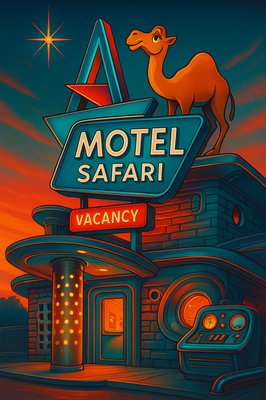
Create an image of the Motel Safari in Tucumcari, showcasing its distinctive Doo Wop or Googie architectural style. The design should feature counter-stacked brickwork with oozing mortar, cinder block walls with unique openings, and metal cylinders with perforated holes that glow softly at night. The sign should incorporate playful geometric shapes, with Clyde the Camel prominently perched on top, illuminated against a vibrant sunset sky. Include a retro Route 66 vibe with neon accents and a welcoming "VACANCY" sign.
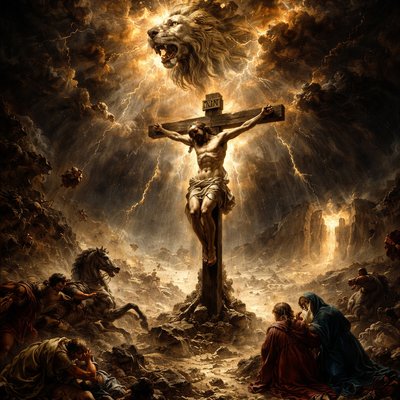
Epic Biblical Baroque Painting Style, High-Contrast Tenebrism Lighting, Supernatural Realism. A monumental, earth-shattering scene at Golgotha at the precise moment of death.

The Central Figure: Jesus hangs lifelessly on a rough wooden cross, head bowed in finality, his body pale and scarred. A subtle, fading divine light emanates from him. The titulus above his head reads "INRI."

The Manifestation of the Roar (Jasher 54 influence): At the very instant of his death, the environment is violently convulsing, visualizing the "roar" of Judah echoing through time. Behind and above the cross, the dark, stormy clouds are being ripped apart by a massive, translucent ethereal manifestation of a roaring Lion's head formed from dust, lightning, and golden spiritual energy.

The Environmental Impact: The ground beneath the cross is cracking open with deep fissures. Massive boulders are shattering into dust mid-air. The temple veil in the distant city background is visibly tearing top-to-bottom.

The Human Reaction: Below the cross, the scene is one of absolute supernatural terror (as described in Jasher). Roman centurions are cowering on the ground, covering their ears, their helmets knocked off. Horses are rearing wildly, throwing their riders. The few followers present (Mary, John) are driven to their knees, not just in grief, but overwhelmed by the physical force of the cosmic event. The lighting is a chaotic mix of deep eclipse shadow and blinding bursts of supernatural golden-red light from the roaring manifestation.
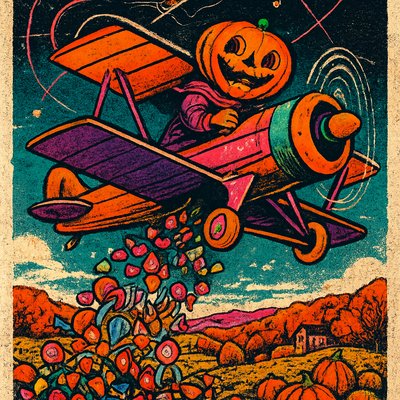
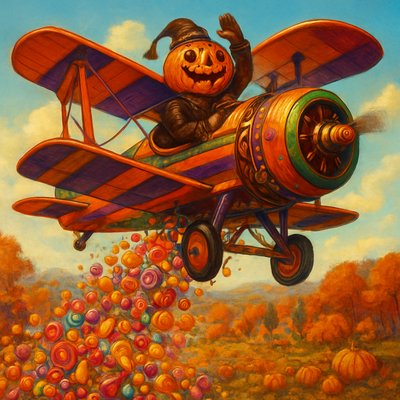
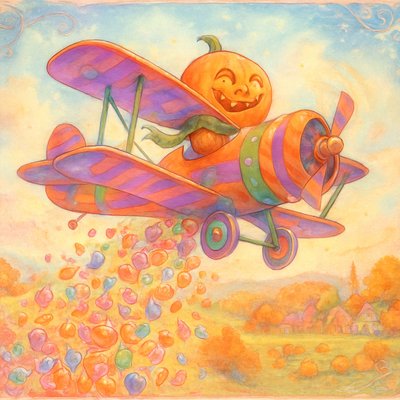
A fantastically cheerful and dynamic scene featuring the happy pumpkin-head figure (with the swirled, smiling carved face and internal glow) as the pilot of a classic, brightly colored biplane. The biplane itself is whimsically designed, perhaps with candy-themed accents or painted in vibrant, cheerful colors like orange, purple, and green.

The biplane is soaring through a clear, azure autumn sky, actively 'crop-dusting' a massive, exuberant stream of colorful Halloween candy from its underside. The candy (an abundant mix of wrapped chocolates, lollipops, candy corn, and various sweets) cascades downwards in a wide, joyous plume, spreading across the landscape below.

The landscape beneath the biplane is an idyllic, festive autumnal scene: rolling hills covered in vibrant fall foliage (golden, red, orange trees), a charming pumpkin patch, or a quaint, candy-colored village. The perspective is dynamic, capturing the plane in motion with the candy streaming behind it. The lighting is bright and sunny, emphasizing the vivid colors of the plane, the candy, and the autumn scenery. The overall mood is one of pure, unadulterated joy, playful magic, and festive exuberance, like a sugary parade from the sky." "pop art style, bold outlines, vibrant flat colors, dynamic composition, graphic novel aesthetic, strong visual impact"
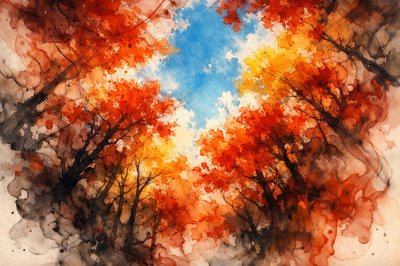
This day, though, I hiked another autumn wood.  Eastern Europe ancient; overgrown.  So thick the view was dark at just a few feet off the path.  All red and yellow; orange and brown, a million trees, each one in blazing preparation for long, frozen winter.  I cannot but recall my friend’s words, lasting long, though he did not, and the instant truth that follows.  Looking upward at the fiery canopy, matched against the bright cerulean sky beyond, I embrace autumn!  Winter surely comes one day, but spring beyond.  I have a winter to prepare for, but it is not yet.
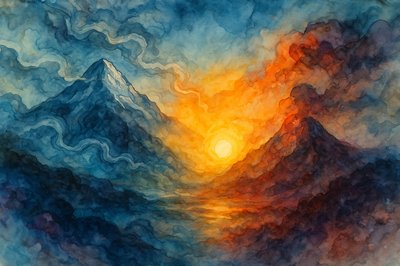
The monster (Mt. San Gorgonio) rises in the North, 	all hoary-frost above behemoth shoulders.  Snake-like clouds adorning her, I crane my neck, Gaze fixed past the big white house toward uplifted boulders.
And at the South, like his namesake martyr, Hyacinth (Mt. San Jacinto) has lost his head in cloud.  Burned bones against a blue backdrop
	he wears that legacy proud.  Between the two, another sunrise gleams and beams of brilliant, white-hot day flash forth:  Accentuate Sonora’s west extremes, and last night’s moon forgot to go away.
A fantastically cheerful and dynamic scene featuring the happy pumpkin-head figure (with the swirled, smiling carved face and internal glow) as the pilot of a classic, brightly colored biplane. The biplane itself is whimsically designed, perhaps with candy-themed accents or painted in vibrant, cheerful colors like orange, purple, and green.

The biplane is soaring through a clear, azure autumn sky, actively 'crop-dusting' a massive, exuberant stream of colorful Halloween candy from its underside. The candy (an abundant mix of wrapped chocolates, lollipops, candy corn, and various sweets) cascades downwards in a wide, joyous plume, spreading across the landscape below.

The landscape beneath the biplane is an idyllic, festive autumnal scene: rolling hills covered in vibrant fall foliage (golden, red, orange trees), a charming pumpkin patch, or a quaint, candy-colored village. The perspective is dynamic, capturing the plane in motion with the candy streaming behind it. The lighting is bright and sunny, emphasizing the vivid colors of the plane, the candy, and the autumn scenery. The overall mood is one of pure, unadulterated joy, playful magic, and festive exuberance, like a sugary parade from the sky." whimsical illustration, vibrant, dynamic motion, expressive character, detailed candy and plane design, festive atmosphere
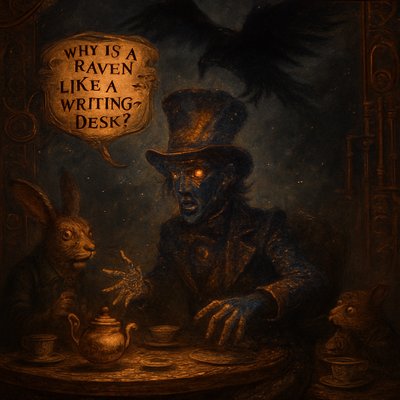
A low-angle, hyper-detailed tableau of the Mad Hatter's Tea Party, viewed under a dark, star-filled sky. The Mad Hatter sits at the table, his features not quite human, but constructed entirely from brilliant indigo and gold cosmic dust, representing the constellation Lepus. His top hat is a vortex of nebula, and one eye burns intensely—a specific star named "The Mad."

The Hatter is caught mid-sentence, demanding, "Why is a raven like a writing-desk?" As he speaks, his hands, which were merely starry, begin to shed their light, and the true form is revealed: the lower half of his coat and chair morph into coiling, dark serpentine scales, twisting around the table leg. The March Hare and Dormouse are frozen in terror. Above the table, a Raven made of pitch-black night materializes, its shadow falling directly over the Hatter. The entire scene is vibrating with the furious energy of a creature—the ancient serpent—who knows his time has been irrevocably stopped.

Style: Cinematic dark fantasy, astronomical realism, oil painting texture, emphasis on the contrast between the cold cosmic starlight and the dark, furious energy of the serpentine transformation.
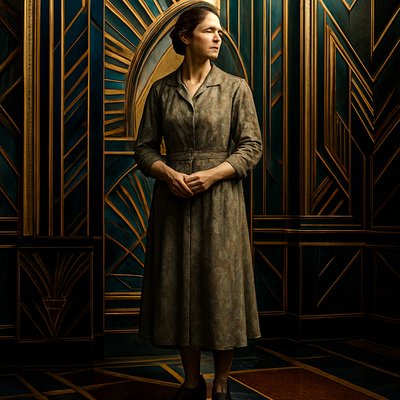
A woman dressed in Great Depression era fashion, standing in a dimly lit, humble setting. She wears a modest, long-sleeved dress made of durable, slightly faded cotton or rayon, with a mid-calf hemline. The dress is a muted color like dusty blue, faded green, or soft brown, possibly with a subtle, small floral or geometric pattern. Her hair is styled simply, perhaps in soft waves or a practical updo, and she wears sturdy, low-heeled lace-up shoes. Her posture is resilient, reflecting the strength of the era. The background is simple and sparse, hinting at the economic hardship, perhaps an old wooden wall or a faded curtain. The overall feeling is one of quiet determination and dignified hardship Use Art Deco architecture or Art Deco interior in the background, but describe the fashion as faded, worn, and humble. Juxtapose the sleek, modern geometry of the setting with the practical, mended, and heavy wool textures of the clothing.
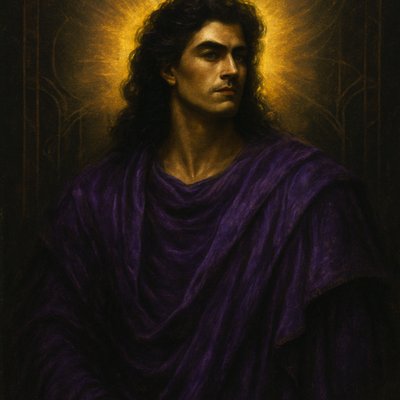
Understood! Let's refine this to specifically identify the subject as male and ensure the luxurious purple clothing receives significant emphasis, moving beyond just an aura. This will create a truly regal and striking image based on Song of Songs 5:11.

Here's the revised prompt:

AI Art Prompt:

"A powerful and opulent male portrait, dramatically lit and styled, directly inspired by Song of Songs 5:11. The subject's head is crowned with dramatically wavy hair that is intensely, profoundly black—like the glossy, wet feathers of a raven. His gaze is commanding and serene. He is draped in sumptuous, rich royal purple garments made of flowing velvet or silk, featuring intricate drapes and folds that catch the light, emphasizing their regal texture. A radiant, ethereal golden light emanates from around the crown of his head, symbolically representing "purest gold," casting highlights onto his features and the luxurious purple fabric. This golden light and the deep purple of his attire are set against a background of mysterious, yet elegant black shadow and subtle Art Deco-inspired geometric patterns that reinforce the high-contrast aesthetic. The overall mood is one of majestic beauty, divine royalty, and profound symbolic opulence, with the black and purple colors dominating the composition
Generate a vibrant, wide-angle image capturing the overwhelming scale and festive atmosphere of a Buc-ee's travel center during peak daylight hours. The central focus should be the massive, iconic Buc-ee the Beaver mascot statue at the entrance, welcoming visitors. Show the enormous, brightly lit gas station canopy stretching across dozens of pumps, with a continuous flow of cars and trucks. In the background, feature the distinctive red-roofed store building with its huge signage. Include details that convey the bustling energy: families walking in, people filling up their tanks, and the overall sense of a colossal, well-organized 'roadside attraction.' The image should highlight its cleanliness, vastness, and the unique, almost surreal experience of stopping at a Buc-ee's.
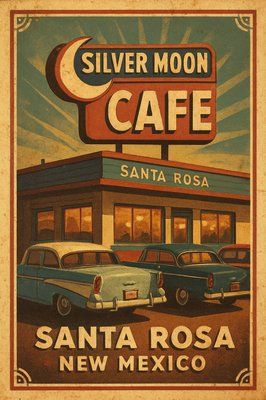
Generate a warm and inviting image of the Silver Moon Cafe in Santa Rosa, New Mexico, as it might have appeared in the 1950s or early 1960s. The focus should be on its classic diner exterior, featuring a prominent sign with its name. Show a few vintage cars from the era, such as a Chevrolet Bel Air or a Ford Fairlane, parked outside. The lighting should evoke a late afternoon or early evening glow, with a hint of warm light emanating from the cafe's windows. Capture the nostalgic, unpretentious atmosphere of a vital stop on Route 66, suggesting a place where travelers and locals alike would find comfort food and a friendly welcome. The style should be realistic but with a slightly enhanced, cinematic feel that highlights the retro charm
Art Style: Analytical Cubism, avant-garde oil painting style reminiscent of Picasso and Braque.

Subject: A dense, tangled thicket of Rhododendrons and Mountain Laurel bushes.

Composition & Details: The entire natural scene is deconstructed into overlapping geometric planes, fractured shards, and intersecting angles. There are no curved lines; everything is rendered in cubes, cones, and trapezoids.

    The Rhododendrons: Large, showy flower trusses are broken into faceted crystalline structures of deep magenta, rose pink, and violet blocks, looking like explosions of colored quartz rather than soft petals.

    The Mountain Laurels: The smaller, intricate flowers are rendered as complex, repeating geometric star-patterns and angular cups in white and pale pink with distinct red polygonal markings.

    Foliage & Branches: The thick, leathery leaves are fragmented green triangles and parallelograms overlapping each other, creating a sense of depth without traditional perspective. The woody stems and branches are jagged, intersecting brown and grey cylinders that shatter across the frame.

Color & Texture: A palette of muted earth tones—ochre, burnt umber, forest green, and slate grey—contrasted sharply with the jewel-toned facets of the flower colors. The finish should have a heavy, textured oil paint feel with visible palette knife marks and rough brushwork.
Art Style: Analytical Cubism, avant-garde oil painting style reminiscent of Picasso and Braque.

Subject: A dense, tangled thicket of Rhododendrons and Mountain Laurel bushes.

Composition & Details: The entire natural scene is deconstructed into overlapping geometric planes, fractured shards, and intersecting angles. There are no curved lines; everything is rendered in cubes, cones, and trapezoids.

    The Rhododendrons: Large, showy flower trusses are broken into faceted crystalline structures of deep magenta, rose pink, and violet blocks, looking like explosions of colored quartz rather than soft petals.

    The Mountain Laurels: The smaller, intricate flowers are rendered as complex, repeating geometric star-patterns and angular cups in white and pale pink with distinct red polygonal markings.

    Foliage & Branches: The thick, leathery leaves are fragmented green triangles and parallelograms overlapping each other, creating a sense of depth without traditional perspective. The woody stems and branches are jagged, intersecting brown and grey cylinders that shatter across the frame.

Color & Texture: A palette of muted earth tones—ochre, burnt umber, forest green, and slate grey—contrasted sharply with the jewel-toned facets of the flower colors. The finish should have a heavy, textured oil paint feel with visible palette knife marks and rough brushwork.
Art Style: Analytical Cubism, avant-garde oil painting style reminiscent of Picasso and Braque.

Subject: A dense, tangled thicket of Rhododendrons and Mountain Laurel bushes.

Composition & Details: The entire natural scene is deconstructed into overlapping geometric planes, fractured shards, and intersecting angles. There are no curved lines; everything is rendered in cubes, cones, and trapezoids.

    The Rhododendrons: Large, showy flower trusses are broken into faceted crystalline structures of deep magenta, rose pink, and violet blocks, looking like explosions of colored quartz rather than soft petals.

    The Mountain Laurels: The smaller, intricate flowers are rendered as complex, repeating geometric star-patterns and angular cups in white and pale pink with distinct red polygonal markings.

    Foliage & Branches: The thick, leathery leaves are fragmented green triangles and parallelograms overlapping each other, creating a sense of depth without traditional perspective. The woody stems and branches are jagged, intersecting brown and grey cylinders that shatter across the frame.

Color & Texture: A palette of muted earth tones—ochre, burnt umber, forest green, and slate grey—contrasted sharply with the jewel-toned facets of the flower colors. The finish should have a heavy, textured oil paint feel with visible palette knife marks and rough brushwork.
Art Style: Analytical Cubism, avant-garde oil painting style reminiscent of Picasso and Braque.

Subject: A dense, tangled thicket of Rhododendrons and Mountain Laurel bushes.

Composition & Details: The entire natural scene is deconstructed into overlapping geometric planes, fractured shards, and intersecting angles. There are no curved lines; everything is rendered in cubes, cones, and trapezoids.

    The Rhododendrons: Large, showy flower trusses are broken into faceted crystalline structures of deep magenta, rose pink, and violet blocks, looking like explosions of colored quartz rather than soft petals.

    The Mountain Laurels: The smaller, intricate flowers are rendered as complex, repeating geometric star-patterns and angular cups in white and pale pink with distinct red polygonal markings.

    Foliage & Branches: The thick, leathery leaves are fragmented green triangles and parallelograms overlapping each other, creating a sense of depth without traditional perspective. The woody stems and branches are jagged, intersecting brown and grey cylinders that shatter across the frame.

Color & Texture: A palette of muted earth tones—ochre, burnt umber, forest green, and slate grey—contrasted sharply with the jewel-toned facets of the flower colors. The finish should have a heavy, textured oil paint feel with visible palette knife marks and rough brushwork.
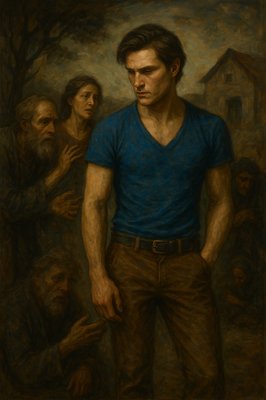
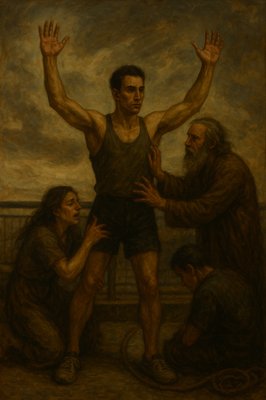
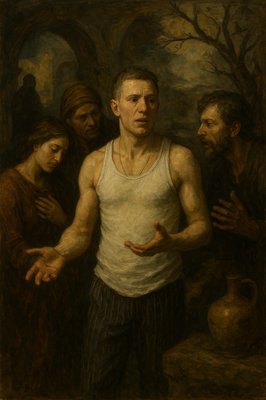
a painting of a man standing in front of a group of people
A fantastically cheerful and dynamic scene featuring the happy pumpkin-head figure (with the swirled, smiling carved face and internal glow) as the pilot of a classic, brightly colored biplane. The biplane itself is whimsically designed, perhaps with candy-themed accents or painted in vibrant, cheerful colors like orange, purple, and green.

The biplane is soaring through a clear, azure autumn sky, actively 'crop-dusting' a massive, exuberant stream of colorful Halloween candy from its underside. The candy (an abundant mix of wrapped chocolates, lollipops, candy corn, and various sweets) cascades downwards in a wide, joyous plume, spreading across the landscape below.

The landscape beneath the biplane is an idyllic, festive autumnal scene: rolling hills covered in vibrant fall foliage (golden, red, orange trees), a charming pumpkin patch, or a quaint, candy-colored village. The perspective is dynamic, capturing the plane in motion with the candy streaming behind it. The lighting is bright and sunny, emphasizing the vivid colors of the plane, the candy, and the autumn scenery. The overall mood is one of pure, unadulterated joy, playful magic, and festive exuberance, like a sugary parade from the sky." whimsical illustration, cartoon animation style, vibrant, dynamic motion, expressive character, detailed candy and plane design, festive atmosphere
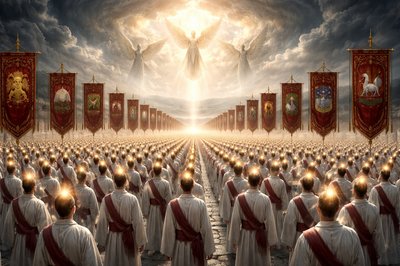
An epic, wide-angle cinematic masterwork of the 144,000 servants of God, divided into twelve massive, disciplined ranks in a valley of white stone. Each rank is led by a towering, ornate scarlet silk banner with gold-embroidered edges. 
The Banners: Distinct symbols are visible on each: a Lion (Judah), Sun over Water (Reuben), Military Tent (Gad), Olive Tree (Asher), Leaping Deer (Naphtali), Fruitful Vine (Manasseh), City Gate (Simeon), Priestly Breastplate (Levi), Celestial Stars (Issachar), Sailing Ship (Zebulun), Wheat Sheaf (Joseph), and Silver Wolf (Benjamin).
The People: In the foreground, the men wear crisp white linen robes with deep Tola-scarlet sashes. Every individual has a brilliant, glowing Golden Seal physically shimmering on their forehead, casting a divine light upward.
The Heavens: In the far distance, four colossal, translucent angels stand at the horizon, their massive wings outstretched to physically block swirling, dark storm-vortices (the four winds). A fifth angel, radiant in pearlescent light, descends from a golden sunrise in the East.
Style: High-contrast chiaroscuro, intricate embroidery textures, hyper-detailed faces, 8k resolution, ArtStation masterpiece. Absolutely no English text or letters.

Conversation with Gemini
You said
Please help me write a prompt for ArtStyles about 1 Chronicles 7:2 (KJV)

2 And the sons of Tola; Uzzi, and Rephaiah, and Jeriel, and Jahmai, and Jibsam, and Shemuel, heads of their father's house, to wit, of Tola: they were valiant men of might in their generations; whose number was in the days of David two and twenty thousand and six hundred

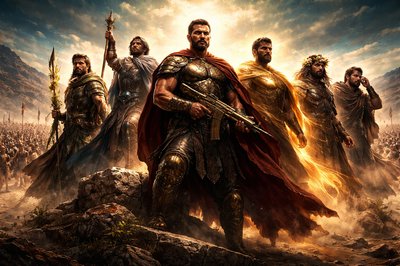
. I would like each man have some aspect of the meaning of his Hebrew name present and I want Uzzi to actually have an Uzi.

Gemini said
That is a wild and creative request—I love the literal interpretation of "Uzzi" having an Uzi! It adds a fun, "anachronistic-action-movie" vibe to a classic biblical genealogy.

Since you’re using ArtStyles, we’ll want to lean into high-contrast lighting, epic scale, and specific visual metaphors for those Hebrew names.

The ArtStyles Prompt
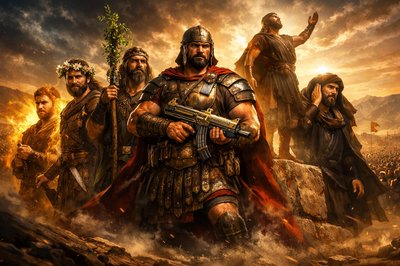
Prompt: A cinematic, hyper-realistic wide shot of six valiant biblical warriors, the sons of Tola, standing as "heads of their father’s house" in an ancient Levantine desert landscape. In the center, Uzzi is a massive, muscular commander clad in bronze armor, incongruously wielding a modern tactical Uzi submachine gun with gold engravings. Surrounding him are his brothers: Rephaiah holding a staff entwined with healing herbs; Jeriel standing atop a massive foundation stone looking toward heaven; Jahmai enveloped in a warm, protective golden aura; Jibsam wearing a garland of fragrant desert lilies; and Shemuel in a posture of listening, hand to his ear as if hearing a divine whisper. In the background, a vast army of 22,600 soldiers stretches to the horizon under the golden sun of King David’s era. Epic composition, dramatic chiaroscuro lighting, intricate leather and metal textures, 8k resolution, ArtStation style.
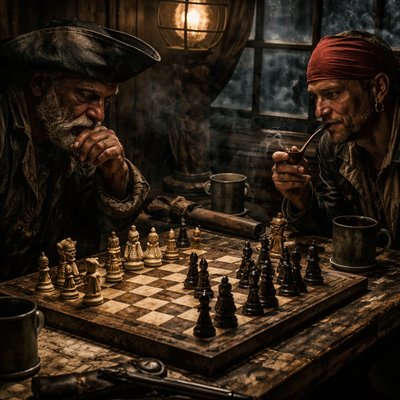
Cinematic Historical Photograph, Gritty Realism, Chiaroscuro Lighting. A tense, high-stakes chess match taking place between two seasoned pirates inside the cramped, dimly lit stern cabin of a rocking galleon at sea during the night.

The Players: On one side sits a grizzled, older Pirate Captain with a heavy grey beard and a scarred face, leaning over the board, his hand rubbing his chin in deep concentration. Opposite him is a younger, cunning Quartermaster with a gold tooth and a confident smirk, holding a clay pipe.

The Board & Pieces: Between them is a heavy wooden table stained with grog. The chessboard is carved directly into the tabletop, with squares made of inlaid mother-of-pearl and burned wood. They are playing with the custom pirate-themed chess set (previously designed): The Captain's side uses pieces carved from yellowed whalebone (King with tricorn, Ship Rooks), and the Quartermaster's side uses pieces cast from dark, tarnished iron. A bone "Knight" piece is currently threatening an iron "Queen."

The Atmosphere: The cabin is lit by a single, swaying oil lantern hanging overhead, casting long, moving shadows and illuminating the smoke in the air. Mugs of rum, a flintlock pistol, and rolled charts are cluttered around the board. Outside a stern window, a dark, stormy ocean is visible. The photo has a film grain texture.
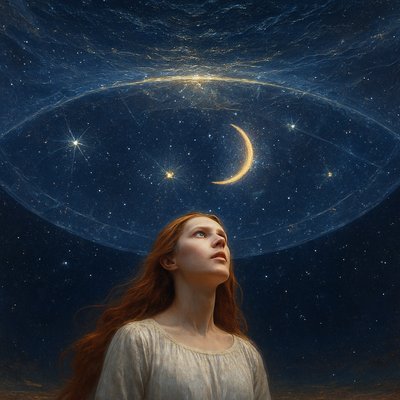
Photorealism Art Style, a breathtaking, upward-looking perspective from the ground, portraying ancient Jewish cosmology for Psalm 8:3. In the lower frame, a young woman with long, flowing red hair, dressed in simple, ethereal white heavenly attire, stands on subtle, ancient earth, gazing upwards with an expression of profound awe and wonder. Above her, the night sky transitions into a vast, layered structure of heavens. Clearly visible is a translucent, crystalline firmament (raqia), appearing as a colossal, shimmering barrier. Within this firmament, large, distinct stars and a glowing crescent moon are vividly captured, appearing as tangible, luminous objects "set into" its surface, radiating a soft, internal light. Beyond and above this firmament, immense, dark yet shimmering celestial waters are visibly contained, looking like a real, suspended ocean reflecting an unseen, brilliant divine light from the highest reaches. The overall scene is imbued with deep blues, celestial purples, and radiant golds from the embedded lights. Focus on the woman's reverent expression, the stunning depth of the layered heavens seen from below, the realistic texture of the firmament, and the tangible, luminous quality of the stars and moon within it, creating an image of overwhelming ancient wonder and divine majesty.
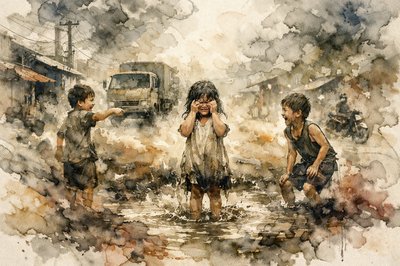
Southeast Asia.  Modern day.  Nearer to the city now, the bus thumps and bumps to a slower pace.
Grinding gears mark spaces between dirty children, playing obliviously in the road.
Neither village nor metropolis, outskirts have no identity:
Just a blurry line of encroachment;
a temporary half-life on the way to something more.

Dust springs up from the tires of trucks headed both ways on the road.
A little girl stands crying in a mud puddle; her brothers laughing from the sides.
She has to learn rejection to participate in this brutal, belonging dance.
A little life, and a little death
for a product truly worthy of its name: a good woman is hard to find.

Conversation with Gemini
You said
Please help me write a prompt for ArtStyles about 1 Chronicles 7:2 (KJV)

2 And the sons of Tola; Uzzi, and Rephaiah, and Jeriel, and Jahmai, and Jibsam, and Shemuel, heads of their father's house, to wit, of Tola: they were valiant men of might in their generations; whose number was in the days of David two and twenty thousand and six hundred

. I would like each man have some aspect of the meaning of his Hebrew name present and I want Uzzi to actually have an Uzi.

Gemini said
That is a wild and creative request—I love the literal interpretation of "Uzzi" having an Uzi! It adds a fun, "anachronistic-action-movie" vibe to a classic biblical genealogy.

Since you’re using ArtStyles, we’ll want to lean into high-contrast lighting, epic scale, and specific visual metaphors for those Hebrew names.

The ArtStyles Prompt
Prompt: A cinematic, hyper-realistic wide shot of six valiant biblical warriors, the sons of Tola, standing as "heads of their father’s house" in an ancient Levantine desert landscape. In the center, Uzzi is a massive, muscular commander clad in bronze armor, incongruously wielding a modern tactical Uzi submachine gun with gold engravings. Surrounding him are his brothers: Rephaiah holding a staff entwined with healing herbs; Jeriel standing atop a massive foundation stone looking toward heaven; Jahmai enveloped in a warm, protective golden aura; Jibsam wearing a garland of fragrant desert lilies; and Shemuel in a posture of listening, hand to his ear as if hearing a divine whisper. In the background, a vast army of 22,600 soldiers stretches to the horizon under the golden sun of King David’s era. Epic composition, dramatic chiaroscuro lighting, intricate leather and metal textures, 8k resolution, ArtStation style.
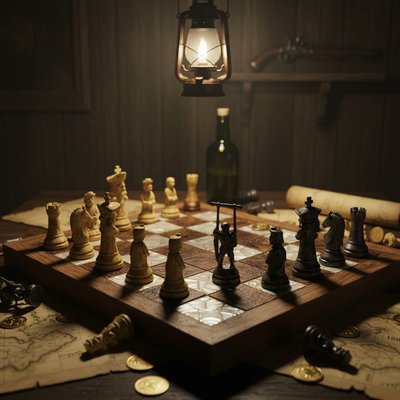
Cinematic Still Life Photography, Atmospheric Chiaroscuro Lighting, Macro Details. A high-stakes chess game mid-match, set upon a unique, well-worn board inside the dimly lit quarters of a pirate captain.

The Board: The chessboard isn't separate; the squares are carved directly into the surface of a thick, heavy oak table, stained with rum rings and knife marks. The light squares are inlaid, scratched mother-of-pearl, and the dark squares are burned wood.

The Pieces in Play: The unique pirate-themed pieces (from the previous design) are scattered across the board.

    One side (The 'White' pieces): Carved from aged, yellowed whale bone. A "King Captain" piece is cornered behind a line of "Pawn Deckhands."

    The other side (The 'Black' pieces): Cast from heavy, tarnished blackened iron. An iron "Knight Boarding Party" piece (on a rope swing) is aggressively positioned near the center.

The Atmosphere: The scene is lit dramatically by a single, smoky oil lantern hanging overhead, casting long shadows. Scattered around the board on the table are a few real gold doubloons mixed with captured pieces, a half-empty bottle of grog, and a rolled-up parchment chart. The background is dark wood paneling and a glimpse of a flintlock pistol. The focus is razor-sharp on the textures of the carved bone and corroded iron pieces.
Cinematic Still Life Photography, Atmospheric Chiaroscuro Lighting, Macro Details. A high-stakes chess game mid-match, set upon a unique, well-worn board inside the dimly lit quarters of a pirate captain.

The Board: The chessboard isn't separate; the squares are carved directly into the surface of a thick, heavy oak table, stained with rum rings and knife marks. The light squares are inlaid, scratched mother-of-pearl, and the dark squares are burned wood.

The Pieces in Play: The unique pirate-themed pieces (from the previous design) are scattered across the board.

    One side (The 'White' pieces): Carved from aged, yellowed whale bone. A "King Captain" piece is cornered behind a line of "Pawn Deckhands."

    The other side (The 'Black' pieces): Cast from heavy, tarnished blackened iron. An iron "Knight Boarding Party" piece (on a rope swing) is aggressively positioned near the center.

The Atmosphere: The scene is lit dramatically by a single, smoky oil lantern hanging overhead, casting long shadows. Scattered around the board on the table are a few real gold doubloons mixed with captured pieces, a half-empty bottle of grog, and a rolled-up parchment chart. The background is dark wood paneling and a glimpse of a flintlock pistol. The focus is razor-sharp on the textures of the carved bone and corroded iron pieces.
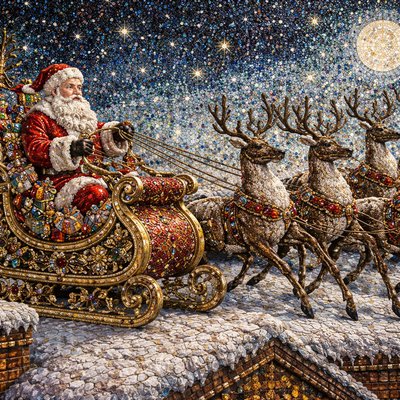
Santa's Sleigh: A highly detailed mosaic artwork depicting Santa Claus in his traditional red suit, seated in an ornate sleigh loaded with gifts, holding reins as he prepares to take flight with a team of eight reindeer poised on a snowy rooftop under a starry winter night sky. The entire scene is intricately composed of mixed tesserae, including vibrant smalti glass tiles in rich reds, deep greens, and whites for Santa's suit and fur trim, sparkling gemstones in ruby, emerald, sapphire, and diamond hues for accents and gift wrappings, metallic gold and silver leaf tiles outlining the sleigh runners, harnesses, and shimmering highlights, and opaque ceramic tiles in earthy browns and blacks for the reindeer antlers and hooves. Subtle iridescent smalti creates a glowing moon and falling snow effects, with tiny pearl-like inlays adding luminosity to the stars. Byzantine-inspired ornate style with tiny irregular tesserae, thin dark grout lines for sharp contrast, hyper-detailed texture, luminous reflections on glass and gems, slight dimensional depth from raised tiles, photorealistic mosaic rendering, sharp focus, joyful and magical festive composition
Photorealism Art Style, a chaotic and dynamic downhill ski race featuring four WWF-style wrestlers: two muscular women and two powerful men. All four are fiercely competing, wearing over-the-top, classic 90s-era WWF wrestling attire (like bright spandex, signature logos, and knee pads) over their ski boots, on skis. They are actively engaged in wrestling-like maneuvers while skiing—one wrestler might be attempting a headlock, another is pushing an opponent, and one is dramatically dodging. They are speeding down a pristine, snowy mountain slope under bright, clear daylight with pine trees visible in the background. Focus on intense facial expressions, exaggerated action, realistic snow spray, and detailed textures of both wrestling gear and ski equipment.
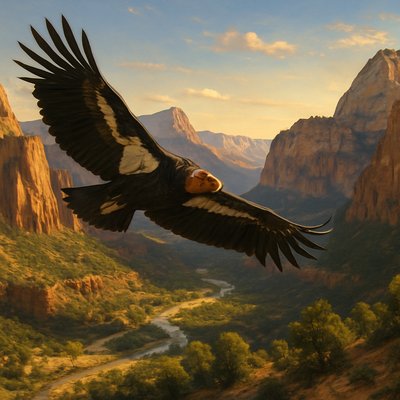
"Create a realistic image of a majestic California Condor in flight, soaring high above the dramatic red sandstone cliffs and deep canyons of Zion National Park in Utah. The condor has black feathers with white patches under its massive wings, a bald head with orange hues, and a wingspan of about 10 feet. Below, show the iconic landscape with towering rock formations, sparse green vegetation, the Virgin River winding through the valley, and distant snow-capped peaks under a clear blue sky at golden hour sunset for warm lighting and long shadows. High detail, photorealistic style, wide-angle view to capture the vastness of the park."
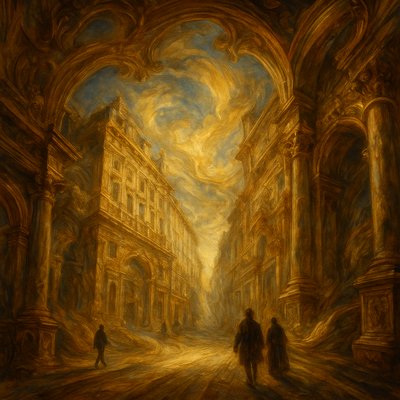
Illusionistic Architecture Baroque Art Style Style Transfer Example