At His Grandmother's House In Penang, Wing Sun Is Lying Down On A Futon In His Bedroom, Covered Up With A Beautiful Lightweight Art

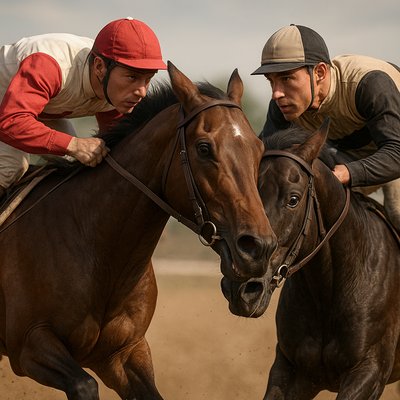
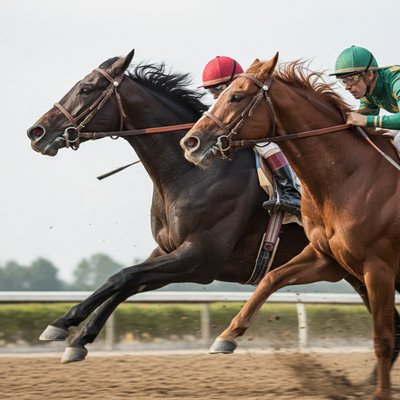
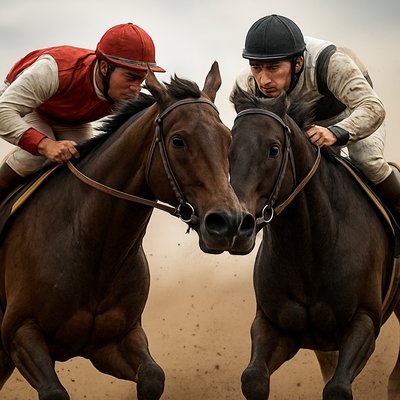
Seabiscuit vs. War Admiral (The Gaze)

    A hyper-realistic, high-resolution photograph capturing the apex of the 1938 match race between Seabiscuit and War Admiral.

    Focus: The composition is tight, showing both horses running neck-and-neck, dominating the frame. The camera angle is side-on and slightly low, emphasizing their size and muscle. The critical focus is on the space between the horses' heads as they are running stride for stride.

    Details: War Admiral (the dark bay) should show determination and slight surprise, with his head stretched out. Seabiscuit (the smaller bay) should display his characteristic "game" look—intense, focused, and seemingly looking directly into War Admiral's eyes (or toward his rival). Both jockeys (Red Pollard or George Woolf for Seabiscuit; Charles Kurtsinger for War Admiral) are visible, leaning low and urging their mounts on.

    Atmosphere: The light should be bright but slightly diffused, suggesting an autumn afternoon at Pimlico. Dust and track debris are kicked up behind them, blurred slightly by the horses' tremendous speed. The image must convey the raw power, intense rivalry, and the exact moment when the smaller horse asserts his dominance.

    Style: Cinematic photography, realistic texture, sharp focus on the horses' eyes and muscle definition.
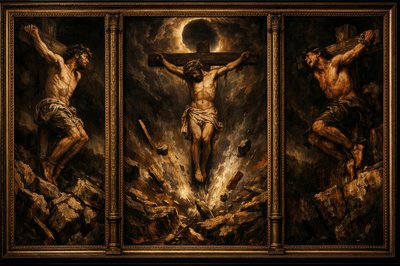
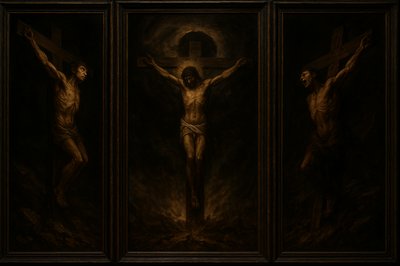
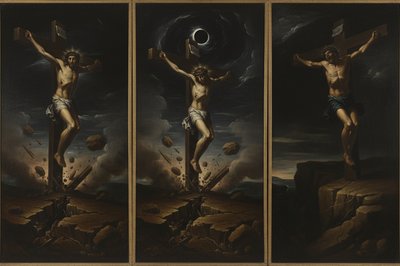
A triptych oil painting, presented as three heavily framed, connected panels in the dramatic, tenebrism style of Baroque masters like Caravaggio. The overall atmosphere is one of supernatural, oppressive darkness and violent chaos.

The Left Panel shows the penitent thief on his cross, body twisted in pain but his face turned toward the center panel with a look of sorrowful acceptance. A faint, supernatural light illuminates his face against a nearly black sky. Below him, rocks are splitting.

The Center Panel is dominated by Jesus on the cross, head bowed in finality. The sky is a swirling vortex of eclipse darkness, blotting out the sun. The ground beneath the cross is violently cracking open, emitting dust and smoke, with debris caught in mid-air from the earthquake shockwave.

The Right Panel shows the impenitent thief, writhing and screaming against his bonds, his face contorted in rage looking away from the center. He is almost swallowed by the shadows. The cross appears unstable as the cliffside crumbles beneath it. The entire triptych has a rich, dark color palette of deep browns, blacks, and muted crimson, textured with visible, frantic brushstrokes.
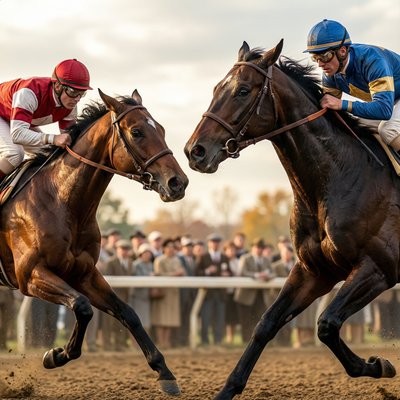
Seabiscuit vs. War Admiral (The Gaze)

    A hyper-realistic, high-resolution photograph capturing the apex of the 1938 match race between Seabiscuit and War Admiral.

    Focus: The composition is tight, showing both horses running neck-and-neck, dominating the frame. The camera angle is side-on and slightly low, emphasizing their size and muscle. The critical focus is on the space between the horses' heads as they are running stride for stride.

    Details: War Admiral (the dark bay) should show determination and slight surprise, with his head stretched out. Seabiscuit (the smaller bay) should display his characteristic "game" look—intense, focused, and seemingly looking directly into War Admiral's eyes (or toward his rival). Both jockeys (Red Pollard or George Woolf for Seabiscuit; Charles Kurtsinger for War Admiral) are visible, leaning low and urging their mounts on.

    Atmosphere: The light should be bright but slightly diffused, suggesting an autumn afternoon at Pimlico. Dust and track debris are kicked up behind them, blurred slightly by the horses' tremendous speed. The image must convey the raw power, intense rivalry, and the exact moment when the smaller horse asserts his dominance.

    Style: Cinematic photography, realistic texture, sharp focus on the horses' eyes and muscle definition.
A triptych oil painting, presented as three heavily framed, connected panels in the dramatic, tenebrism style of Baroque masters like Caravaggio. The overall atmosphere is one of supernatural, oppressive darkness and violent chaos.

The Left Panel shows the penitent thief on his cross, body twisted in pain but his face turned toward the center panel with a look of sorrowful acceptance. A faint, supernatural light illuminates his face against a nearly black sky. Below him, rocks are splitting.

The Center Panel is dominated by Jesus on the cross, head bowed in finality. The sky is a swirling vortex of eclipse darkness, blotting out the sun. The ground beneath the cross is violently cracking open, emitting dust and smoke, with debris caught in mid-air from the earthquake shockwave.

The Right Panel shows the impenitent thief, writhing and screaming against his bonds, his face contorted in rage looking away from the center. He is almost swallowed by the shadows. The cross appears unstable as the cliffside crumbles beneath it. The entire triptych has a rich, dark color palette of deep browns, blacks, and muted crimson, textured with visible, frantic brushstrokes.
Volume 1 – Chapter 1: “Running Away”

Story Points:
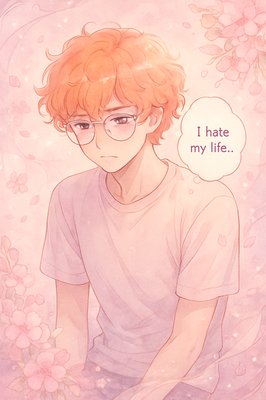
Ji Hun is bored and unhappy with his life in the band “Forever.” Inner thoughts reveal his frustration and desire to escape.
He decides to run away; changes his appearance with a ginger curly wig and glasses to hide his identity.

Ji Hun sneaks out, but security guards notice him and start chasing him.

While running, he accidentally bumps into Min Joon, a girl with long curly black hair, wearing a hoodie and baggy jeans. They fall on the ground.

Min Joon helps him up and insists on taking him to her home to relax.

She offers him tea and biscuits; they start talking. Ji Hun lies and says his name is “Jin” and that he is an accountant.

He notices posters of his band “Forever” in her room and realizes she is a fan. Min Joon praises Ji Hun’s voice, making him shy.

Ji Hun talks about never enjoying life; Min Joon promises to teach him how to enjoy life.

Ji Hun hesitates, worried about being recognized, but she reassures him. He agrees to go with her.

Min Joon prepares to take him outside, setting up the transition to Chapter 2 (car ride and amusement park).

Page/Panel Flow Suggestions:

Pages 1–3: Ji Hun’s frustration, morning in the band dorm, decision to escape.

Pages 4–5: Ji Hun changing disguise.

Pages 6–8: Running and being chased by security guards.

Pages 9–12: Collision with Min Joon, first meeting.

Pages 13–16: Min Joon taking him home, tea and biscuits scene.

Pages 17–20: Conversation about Ji Hun’s unhappiness, Min Joon promising to show him joy.
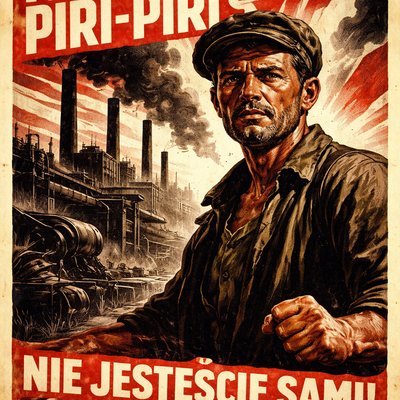
A dramatic Soviet-style propaganda poster.
Depict a poor, sad working-class man in worn clothes, with a tired but dignified expression on his face. He stands in the foreground, slightly turned toward the viewer.
In the background: a large industrial factory with smokestacks, heavy machinery, and dark smoke rising into the sky.
The atmosphere is serious, emotional, and ideological — showing hardship, struggle, and hope for liberation.
Strong socialist realism style inspired by classic USSR propaganda posters from the 1930s–1950s.
Bold shapes, high contrast, limited color palette (red, black, beige, muted yellow).
Sharp lines, heroic composition, dramatic lighting.
Add a bold propaganda slogan in clear, vintage typography:
“Proletariusze Piri-Piri — nie jesteście sami!”
The text should be prominent and integrated into the poster design.
No modern elements, no realism photography — illustrated, painterly propaganda art style.
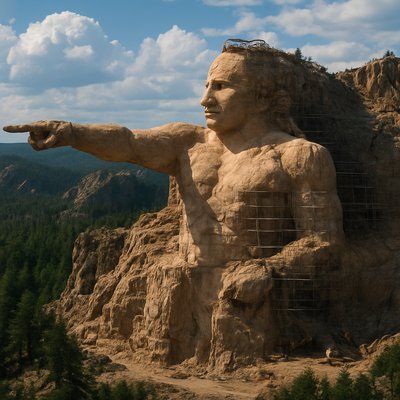
A majestic and inspiring depiction of the Crazy Horse National Memorial, captured from a slightly elevated, wide-angle perspective that emphasizes its immense scale and ongoing construction. The colossal carving of Crazy Horse on his war pony is the dominant feature, shown in its current state of detailed progress, with the iconic outstretched arm and pointing finger prominent against the rugged Black Hills. Visible elements of the carving process, such as scaffolding, construction equipment (subtly integrated), or evidence of rock removal, are present, highlighting the monumental effort and generations of work involved. The surrounding landscape of the Black Hills is an integral part of the composition, with pine forests, granite formations, and the vast, open sky providing a dramatic and respectful setting. The lighting is strong and clear, perhaps mid-morning or late afternoon sun, casting dramatic shadows that define the contours of the mountain and the carving. The atmosphere conveys a sense of enduring tribute, cultural pride, determination, and the sheer scale of human endeavor dedicated to honoring a legendary figure. The artistic style is a highly realistic, detailed landscape painting or photograph, emphasizing grandeur and reverence
"A solitary and ominous Black Plague Doctor stands in a dimly lit, narrow cobblestone alleyway in a medieval European city. The doctor is clad head-to-toe in their iconic, dark, heavy protective gear: a long, oil-soaked waxed canvas or leather coat, dark gloves, and a wide-brimmed black hat. Their most striking feature, the beaked mask with dark, glass eyeholes, is prominent, creating an eerie, bird-like silhouette that conceals their face entirely. A wooden cane or pointer is held firmly in one gloved hand.

The atmosphere is heavy and foreboding. The background features dark, crumbling stone or timber-framed buildings with shuttered windows, hinting at a city under quarantine. Smoke or mist might subtly swirl around their feet. The lighting is stark and dramatic, perhaps from a distant lantern or a sliver of pale moonlight, casting deep shadows and highlighting the grim details of their attire. The overall mood is one of profound isolation, historical dread, and silent vigilance against an invisible enemy."
Neon-Futurism Digital Art Style, Bioluminescent Sci-Fi Cosmic Setting, Extreme Low-Angle Perspective. A breathtaking shot looking up from the level of the highway, emphasizing the colossal height of the constellation above.

The Rider & Bike Consistency: The lone motorcyclist—in the exact same sleek, armored suit with integrated helmet—is speeding forward on the same hubless "light-cycle" sportbike. The cyan and orange neon wheel rings leave a perfectly straight, vibrant light trail on the road, reflecting off the glossy surface.

The Path (The Ecliptic): The glowing blue laser-grid highway continues into the distance, appearing as a thin line of light compared to the massive figure towering over it.

The Sagittarius Presence: Looming directly over the highway is the colossal, majestic form of Sagittarius, a centaur made of shimmering stardust and golden data-lines. He is positioned so that the highway passes directly between his towering front legs. Above the rider, the centaur’s torso is twisted as he pulls back a massive longbow made of pure white light.

The Action: An arrow of concentrated solar energy is notched in the bow, pointed toward a distant star cluster. The rider is captured in the moment of passing directly beneath the centaur's underbelly, surrounded by the glow of the "horse" body’s starlight.

Atmosphere: The scene is dominated by golden and white light from the centaur, contrasting with the deep indigo of the cosmic void and the sharp cyan of the bike's neon.
Neon-Futurism Digital Art Style, Bioluminescent Sci-Fi Cosmic Setting, Extreme Low-Angle Perspective. A breathtaking shot looking up from the level of the highway, emphasizing the colossal height of the constellation above.

The Rider & Bike Consistency: The lone motorcyclist—in the exact same sleek, armored suit with integrated helmet—is speeding forward on the same hubless "light-cycle" sportbike. The cyan and orange neon wheel rings leave a perfectly straight, vibrant light trail on the road, reflecting off the glossy surface.

The Path (The Ecliptic): The glowing blue laser-grid highway continues into the distance, appearing as a thin line of light compared to the massive figure towering over it.

The Sagittarius Presence: Looming directly over the highway is the colossal, majestic form of Sagittarius, a centaur made of shimmering stardust and golden data-lines. He is positioned so that the highway passes directly between his towering front legs. Above the rider, the centaur’s torso is twisted as he pulls back a massive longbow made of pure white light.

The Action: An arrow of concentrated solar energy is notched in the bow, pointed toward a distant star cluster. The rider is captured in the moment of passing directly beneath the centaur's underbelly, surrounded by the glow of the "horse" body’s starlight.

Atmosphere: The scene is dominated by golden and white light from the centaur, contrasting with the deep indigo of the cosmic void and the sharp cyan of the bike's neon.
Surrealism Art Style, Digital Art Style, a brilliantly vibrant, whimsical, and exaggerated landscape depicting the mythical "Big Rock Candy Mountain." The massive mountain at the center of the scene is composed entirely of striped rock candy, glistening in the eternal sunshine. A cheerful hobo figure, relaxed and smiling, is seen lounging by a sparkling stream of pure lemonade that flows down the mountainside. The landscape is surrounded by giant peppermint stick forests and trees whose leaves are crisp dollar bills. The clouds in the sky are made of whipped cream, and the rain is a sweet syrup. There are prominent features like a cigarette tree, a luscious ham tree, and railroad tracks where the boxcars are always empty and waiting. The colors are hyper-saturated and joyful, rendered with the smooth, detailed clarity of digital art, yet maintaining a dreamlike, slightly absurd quality. Focus intently on the dazzling texture of the candy landscape, the flowing lemonade water, and the utopian, escapist joy of the scene.
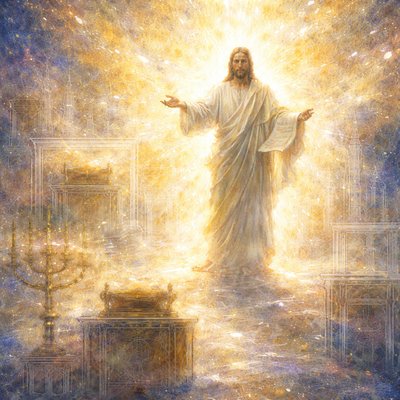
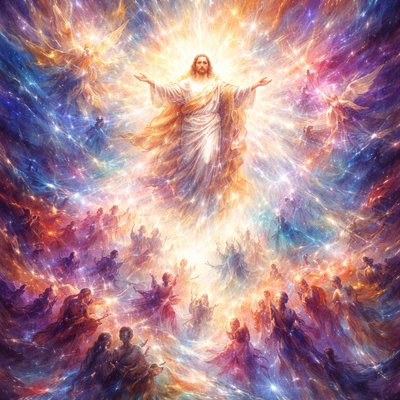
Photorealism Art Style, a profoundly dramatic and intensely luminous image depicting a vision of Heaven seen from the ground. The scene is dominated by a blazing, overwhelming celestial light that is violently breaking through the darkness of the night sky. This light is not the sun, but the pure glory of God, manifesting as swirling gold, brilliant white, and ethereal blue luminescence that seems to pull the viewer upward. A long red-haired woman, wearing simple, flowing heavenly attire, stands below, gazing upward with an expression of ecstatic awe and reverence. She is bathed in the brilliant, otherworldly light streaming down, suggesting the moment of divine revelation where the heavens are torn open. The focus is on the raw, blinding intensity of the divine light, the realistic texture of the woman's awe-struck face, and the vibrant, chaotic energy of the celestial vision, creating a powerful image of a direct, momentary glimpse into the boundless presence of Heaven.
A stunning and spiritually evocative depiction of the traditional Lakota Hoop Dance (or Intertribal Hoop Dance). The central figure is a single, male Hoop Dancer, captured mid-motion, demonstrating incredible agility and grace. He is adorned in vibrant, traditional regalia with intricate beadwork, feathers, and fringes, and is surrounded by a mesmerizing array of hoops, dynamically formed into various shapes and symbols, representing animals, stories, or the sacred circle of life. His face reflects intense focus, reverence, and the deep storytelling inherent in the dance. In the background, partially obscured by a light morning mist or soft haze, the monumental carving of the Crazy Horse Memorial is visible, lending a profound sense of historical continuity, honor, and enduring spirit to the scene. The setting is an open, natural area, perhaps a grassy plain or red rock outcropping, under a clear, early morning sky with the sun just beginning to illuminate the landscape, casting a soft, golden light. The atmosphere is one of dynamic energy, profound cultural pride, and deep spiritual connection to both tradition and the ancestral land. The artistic style is a vivid, realistic painting with a strong sense of movement, capturing the intricate details of the hoops and regalia, against the majestic, stoic presence of the memorial."

Key Considerations Reflected in This Prompt:

    Corrected Dance Name: Clearly states "Lakota Hoop Dance (or Intertribal Hoop Dance)."

    Central Figure: Focuses on a "single, male Hoop Dancer" to highlight the individual skill and artistry.

    Hoops & Symbolism: Emphasizes the "mesmerizing array of hoops, dynamically formed into various shapes and symbols" and their meaning.

    Crazy Horse Memorial Background: Explicitly places the "monumental carving of the Crazy Horse Memorial" in the background, noting its symbolic significance ("historical continuity, honor, and enduring spirit").

    Setting & Lighting: Suggests "early morning mist or soft haze" for the background to give the memorial an ethereal quality, and "soft, golden light" for the dancer.

    Mood: Conveys "dynamic energy, profound cultural pride, and deep spiritual connection."

    Artistic Style: "Vivid, realistic painting with a strong sense of movement.