A Man With A Surprised Look On His Face Art

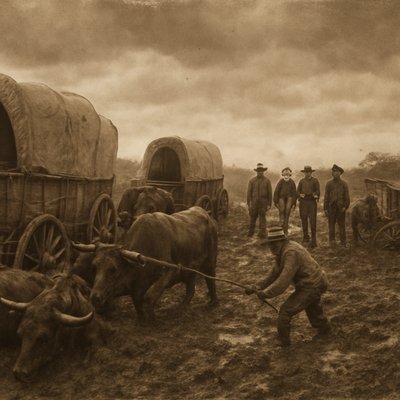
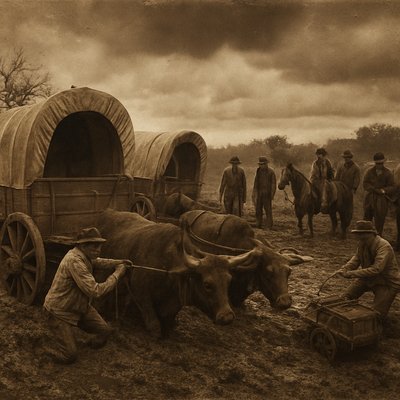
A highly realistic and historically accurate image set in the deep, waterlogged mud of the Texas Cross Timbers (Montague County) in 1840. The scene captures the frustrating moment when the Chihuahua Traders caravan is completely stuck.

Foreground focus is on several heavy, wooden Conestoga freight wagons, mired up to their axles in dark, thick mud. Exhausted oxen are straining and distressed, their drivers in rough frontier attire attempting to free the wheels with ropes and levers.

In the mid-ground, a small group of the American equestrian circus performers stands next to their distinctive, high-quality riding horses, which are visibly more refined than the typical pack animals. The performers are dressed in sturdy but distinct traveling clothes, looking ill-equipped and frustrated by the muddy conditions. One performer is carefully securing a colorful carriage or cart containing unique circus props, struggling to keep it from sinking. The overall mood is one of miserable delay and hardship. Cloudy, oppressive sky; detailed realism; wide-angle shot; dark, moody lighting.
The reverberations of sound in many waters shining with glory. No humans. only waters and brilliant light are to be expressed. But this is to be viewed as looking up from under the water. The reverberations are above the viewer's perspective like Genesis 1:6-8
And they shall amerce him in an hundred shekels of silver, and give them unto the father of the damsel, because he hath brought up an evil name upon a virgin of Israel: and she shall be his wife; he may not put her away all his days. 
(Deuteronomy 22:19 KJV)
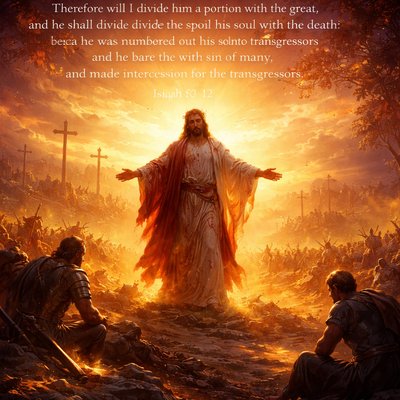
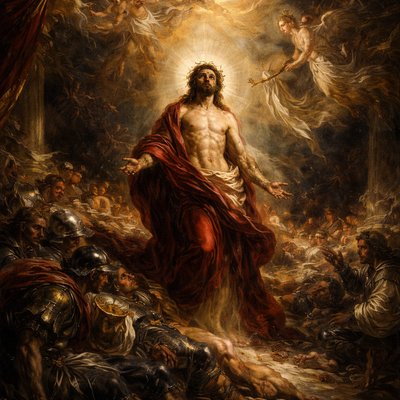
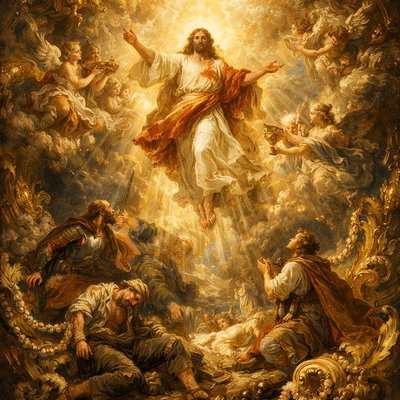
“Therefore will I divide him a portion with the great, and he shall divide the spoil with the strong; because he hath poured out his soul unto death: and he was numbered with the transgressors; and he bare the sin of many, and made intercession for the transgressors.” (Isaiah 53:12, KJV)
Profile with flowing hair
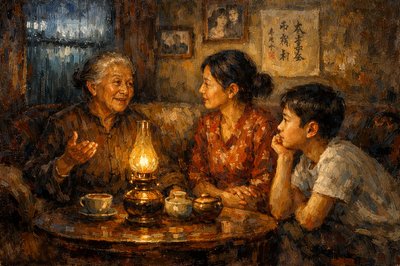
At his Grandmother's house in Penang, while the tropical rain taps softly against the window, Wing Sun, Mother and Grandmother gather in the cozy living room. The room glows with the soft light of an oil lamp, and the walls are adorned with faded photographs and delicate calligraphy. Grandmother’s eyes sparkle as she begins to speak—a voice that carries both the wisdom of her years and the tender care of someone who’s seen many seasons change.  Wing Sun is pensive with anticipation.  What will she say?
Dancer mid-leap
A highly realistic and historically accurate image set in the deep, waterlogged mud of the Texas Cross Timbers (Montague County) in 1840. The scene captures the frustrating moment when the Chihuahua Traders caravan is completely stuck.

Foreground focus is on several heavy, wooden Conestoga freight wagons, mired up to their axles in dark, thick mud. Exhausted oxen are straining and distressed, their drivers in rough frontier attire attempting to free the wheels with ropes and levers.

In the mid-ground, a small group of the American equestrian circus performers stands next to their distinctive, high-quality riding horses, which are visibly more refined than the typical pack animals. The performers are dressed in sturdy but distinct traveling clothes—perhaps featuring slightly tailored jackets or vests—rather than performance costumes, looking ill-equipped and frustrated by the muddy conditions. One performer is carefully securing a small, colorful carriage or cart containing unique circus props, struggling to keep it from sinking. The overall mood is one of miserable delay and hardship. Cloudy, oppressive sky; detailed realism; wide-angle shot; dark, moody lighting.
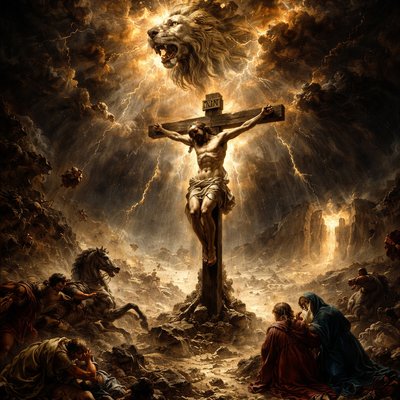
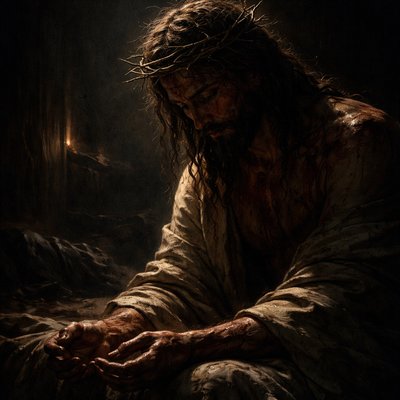
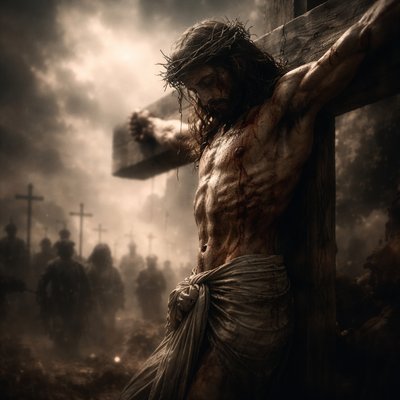
Epic Biblical Baroque Painting Style, High-Contrast Tenebrism Lighting, Supernatural Realism. A monumental, earth-shattering scene at Golgotha at the precise moment of death.

The Central Figure: Jesus hangs lifelessly on a rough wooden cross, head bowed in finality, his body pale and scarred. A subtle, fading divine light emanates from him. The titulus above his head reads "INRI."

The Manifestation of the Roar (Jasher 54 influence): At the very instant of his death, the environment is violently convulsing, visualizing the "roar" of Judah echoing through time. Behind and above the cross, the dark, stormy clouds are being ripped apart by a massive, translucent ethereal manifestation of a roaring Lion's head formed from dust, lightning, and golden spiritual energy.
The Environmental Impact: The ground beneath the cross is cracking open with deep fissures. Massive boulders are shattering into dust mid-air. The temple veil in the distant city background is visibly tearing top-to-bottom.

The Human Reaction: Below the cross, the scene is one of absolute supernatural terror (as described in Jasher). Roman centurions are cowering on the ground, covering their ears, their helmets knocked off. Horses are rearing wildly, throwing their riders. The few followers present (Mary, John) are driven to their knees, not just in grief, but overwhelmed by the physical force of the cosmic event. The lighting is a chaotic mix of deep eclipse shadow and blinding bursts of supernatural golden-red light from the roaring manifestation.
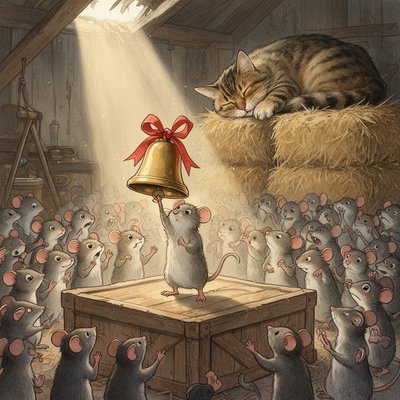
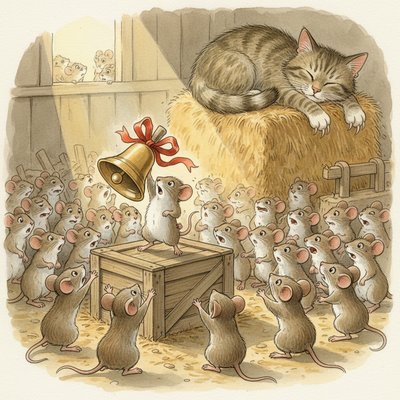
Whimsical Storybook Illustration Style, Warm Color Palette, Soft Textures and Detailed Linework. A wide-angle view of a secret, crowded meeting of dozens of anthropomorphic field mice taking place on an upturned wooden crate in the corner of a cluttered, dusty barn.

The Focal Point (The Plan): In the center of the crate spotlighted by a beam of sunlight coming through a crack in the roof, a small, earnest mouse stands on its hind legs, triumphantly holding aloft a shiny brass sleigh bell tied with a bright red ribbon. The bell looks impossibly large and heavy for the mouse.

The Reaction (The Hesitation): The surrounding crowd of mice is a mix of emotions. Some in the front row are cheering with tiny paws raised. However, many others towards the back are exchanging nervous, sidelong glances, scratching their heads, or looking fearfully over their shoulders.

The Threat (The Reality): In the background, on top of a high stack of hay bales, a giant, fluffy tabby cat is fast asleep. Though sleeping, its size and sharp claws are evident, casting a shadow over the edge of the meeting area. The contrast between the small, shiny bell and the enormous sleeping predator is central to the image.

“Therefore will I divide him a portion with the great, and he shall divide the spoil with the strong; because he hath poured out his soul unto death: and he was numbered with the transgressors; and he bare the sin of many, and made intercession for the transgressors.” (Isaiah 53:12, KJV)
Express without words “Holding faith, and a good conscience; which some having put away concerning faith have made shipwreck: Of whom is Hymenaeus and Alexander; whom I have delivered unto Satan, that they may learn not to blaspheme.” (1 Timothy 1:19-20, KJV)
Whimsical Storybook Illustration Style, Warm Color Palette, Soft Textures and Detailed Linework. A wide-angle view of a secret, crowded meeting of dozens of anthropomorphic field mice taking place on an upturned wooden crate in the corner of a cluttered, dusty barn.

The Focal Point (The Plan): In the center of the crate spotlighted by a beam of sunlight coming through a crack in the roof, a small, earnest mouse stands on its hind legs, triumphantly holding aloft a shiny brass sleigh bell tied with a bright red ribbon. The bell looks impossibly large and heavy for the mouse.

The Reaction (The Hesitation): The surrounding crowd of mice is a mix of emotions. Some in the front row are cheering with tiny paws raised. However, many others towards the back are exchanging nervous, sidelong glances, scratching their heads, or looking fearfully over their shoulders.

The Threat (The Reality): In the background, on top of a high stack of hay bales, a giant, fluffy tabby cat is fast asleep. Though sleeping, its size and sharp claws are evident, casting a shadow over the edge of the meeting area. The contrast between the small, shiny bell and the enormous sleeping predator is central to the image.
“Seek ye the LORD, all ye meek of the earth, which have wrought his judgment; seek righteousness, seek meekness: it may be ye shall be hid in the day of the LORD'S anger.” (Zephaniah 2:3, KJV)
Emoji avocado
“He shall see of the travail of his soul, and shall be satisfied: by his knowledge shall my righteous servant justify many; for he shall bear their iniquities.” (Isaiah 53:11, KJV)
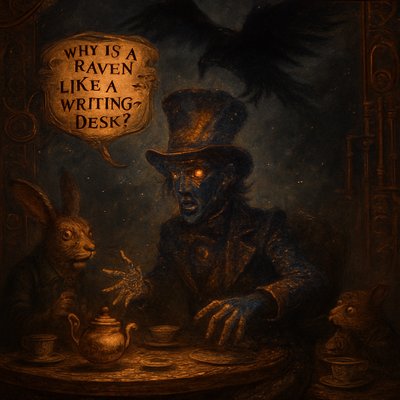
A low-angle, hyper-detailed tableau of the Mad Hatter's Tea Party, viewed under a dark, star-filled sky. The Mad Hatter sits at the table, his features not quite human, but constructed entirely from brilliant indigo and gold cosmic dust, representing the constellation Lepus. His top hat is a vortex of nebula, and one eye burns intensely—a specific star named "The Mad."

The Hatter is caught mid-sentence, demanding, "Why is a raven like a writing-desk?" As he speaks, his hands, which were merely starry, begin to shed their light, and the true form is revealed: the lower half of his coat and chair morph into coiling, dark serpentine scales, twisting around the table leg. The March Hare and Dormouse are frozen in terror. Above the table, a Raven made of pitch-black night materializes, its shadow falling directly over the Hatter. The entire scene is vibrating with the furious energy of a creature—the ancient serpent—who knows his time has been irrevocably stopped.

Style: Cinematic dark fantasy, astronomical realism, oil painting texture, emphasis on the contrast between the cold cosmic starlight and the dark, furious energy of the serpentine transformation.
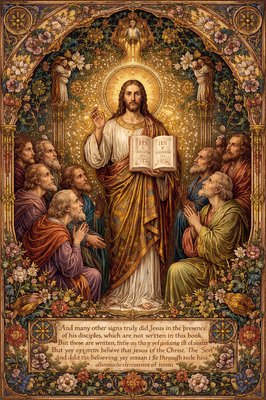
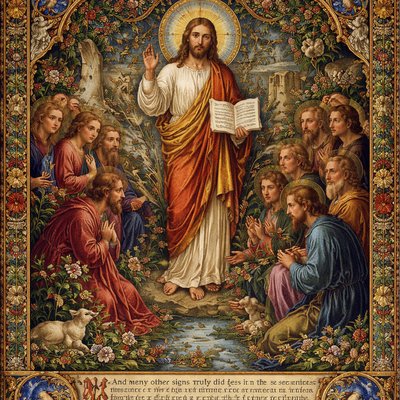
“And many other signs truly did Jesus in the presence of his disciples, which are not written in this book: But these are written, that ye might believe that Jesus is the Christ, the Son of God; and that believing ye might have life through his name.” (John 20:30-31, KJV)
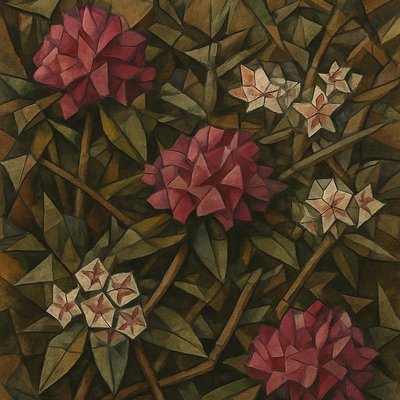
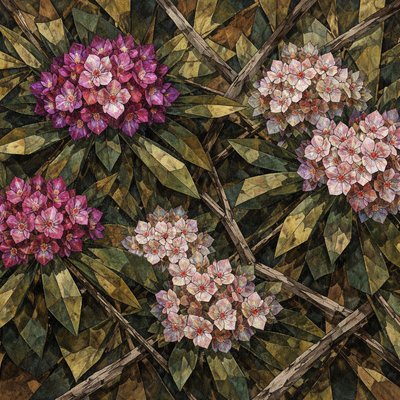
Art Style: Analytical Cubism, avant-garde oil painting style reminiscent of Picasso and Braque.

Subject: A dense, tangled thicket of Rhododendrons and Mountain Laurel bushes.

Composition & Details: The entire natural scene is deconstructed into overlapping geometric planes, fractured shards, and intersecting angles. There are no curved lines; everything is rendered in cubes, cones, and trapezoids.

    The Rhododendrons: Large, showy flower trusses are broken into faceted crystalline structures of deep magenta, rose pink, and violet blocks, looking like explosions of colored quartz rather than soft petals.

    The Mountain Laurels: The smaller, intricate flowers are rendered as complex, repeating geometric star-patterns and angular cups in white and pale pink with distinct red polygonal markings.

    Foliage & Branches: The thick, leathery leaves are fragmented green triangles and parallelograms overlapping each other, creating a sense of depth without traditional perspective. The woody stems and branches are jagged, intersecting brown and grey cylinders that shatter across the frame.
Color & Texture: A palette of muted earth tones—ochre, burnt umber, forest green, and slate grey—contrasted sharply with the jewel-toned facets of the flower colors. The finish should have a heavy, textured oil paint feel with visible palette knife marks and rough brushwork.
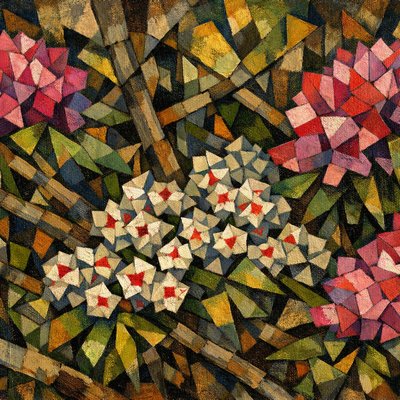
Art Style: Analytical Cubism, avant-garde oil painting style reminiscent of Picasso and Braque.

Subject: A dense, tangled thicket of Rhododendrons and Mountain Laurel bushes.

Composition & Details: The entire natural scene is deconstructed into overlapping geometric planes, fractured shards, and intersecting angles. There are no curved lines; everything is rendered in cubes, cones, and trapezoids.

    The Rhododendrons: Large, showy flower trusses are broken into faceted crystalline structures of deep magenta, rose pink, and violet blocks, looking like explosions of colored quartz rather than soft petals.

    The Mountain Laurels: The smaller, intricate flowers are rendered as complex, repeating geometric star-patterns and angular cups in white and pale pink with distinct red polygonal markings.

    Foliage & Branches: The thick, leathery leaves are fragmented green triangles and parallelograms overlapping each other, creating a sense of depth without traditional perspective. The woody stems and branches are jagged, intersecting brown and grey cylinders that shatter across the frame.

Color & Texture: A palette of muted earth tones—ochre, burnt umber, forest green, and slate grey—contrasted sharply with the jewel-toned facets of the flower colors. The finish should have a heavy, textured oil paint feel with visible palette knife marks and rough brushwork.
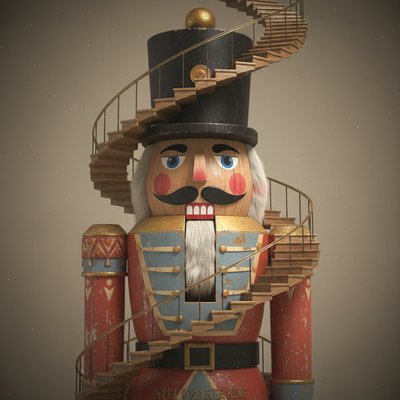
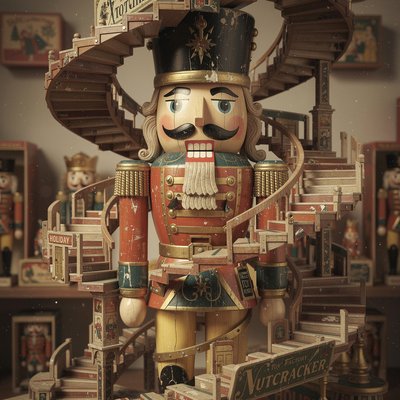
 in the style of M.C. Escher, staircases spiraling up a towering wooden nutcracker soldier with a stern face, mustache, rosy cheeks, hinged jaw, ornate painted uniform with gold trim, tall black hat, polished wooden texture, intricate impossible loops, glowing holiday jewel-toned colors, vibrant reflections, whimsical geometry, cinematic, reflective colors
Artist copying same text until exhaustion
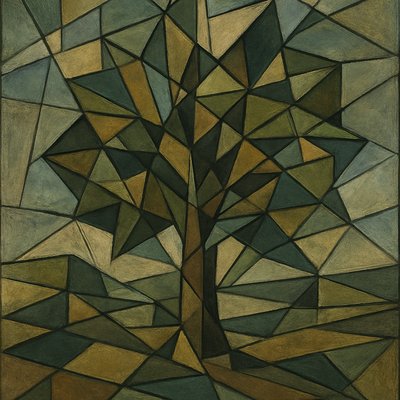
a tree in nature
 in the style of M.C. Escher, staircases spiraling up a towering wooden nutcracker soldier with a stern face, mustache, rosy cheeks, hinged jaw, ornate painted uniform with gold trim, tall black hat, polished wooden texture, intricate impossible loops, glowing holiday jewel-toned colors, vibrant reflections, whimsical geometry, cinematic, reflective colors
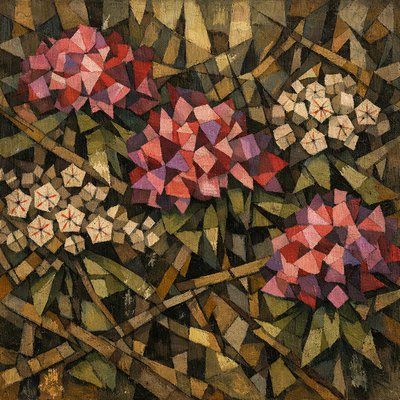
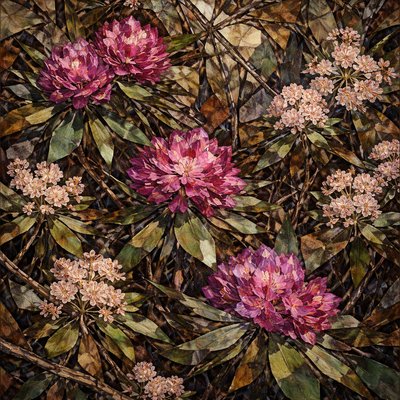
Art Style: Analytical Cubism, avant-garde oil painting style reminiscent of Picasso and Braque.

Subject: A dense, tangled thicket of Rhododendrons and Mountain Laurel bushes.

Composition & Details: The entire natural scene is deconstructed into overlapping geometric planes, fractured shards, and intersecting angles. There are no curved lines; everything is rendered in cubes, cones, and trapezoids.

    The Rhododendrons: Large, showy flower trusses are broken into faceted crystalline structures of deep magenta, rose pink, and violet blocks, looking like explosions of colored quartz rather than soft petals.

    The Mountain Laurels: The smaller, intricate flowers are rendered as complex, repeating geometric star-patterns and angular cups in white and pale pink with distinct red polygonal markings.

    Foliage & Branches: The thick, leathery leaves are fragmented green triangles and parallelograms overlapping each other, creating a sense of depth without traditional perspective. The woody stems and branches are jagged, intersecting brown and grey cylinders that shatter across the frame.

Color & Texture: A palette of muted earth tones—ochre, burnt umber, forest green, and slate grey—contrasted sharply with the jewel-toned facets of the flower colors. The finish should have a heavy, textured oil paint feel with visible palette knife marks and rough brushwork.
Art Style: Analytical Cubism, avant-garde oil painting style reminiscent of Picasso and Braque.

Subject: A dense, tangled thicket of Rhododendrons and Mountain Laurel bushes.

Composition & Details: The entire natural scene is deconstructed into overlapping geometric planes, fractured shards, and intersecting angles. There are no curved lines; everything is rendered in cubes, cones, and trapezoids.

    The Rhododendrons: Large, showy flower trusses are broken into faceted crystalline structures of deep magenta, rose pink, and violet blocks, looking like explosions of colored quartz rather than soft petals.

    The Mountain Laurels: The smaller, intricate flowers are rendered as complex, repeating geometric star-patterns and angular cups in white and pale pink with distinct red polygonal markings.

    Foliage & Branches: The thick, leathery leaves are fragmented green triangles and parallelograms overlapping each other, creating a sense of depth without traditional perspective. The woody stems and branches are jagged, intersecting brown and grey cylinders that shatter across the frame.

Color & Texture: A palette of muted earth tones—ochre, burnt umber, forest green, and slate grey—contrasted sharply with the jewel-toned facets of the flower colors. The finish should have a heavy, textured oil paint feel with visible palette knife marks and rough brushwork.
Art Style: Analytical Cubism, avant-garde oil painting style reminiscent of Picasso and Braque.

Subject: A dense, tangled thicket of Rhododendrons and Mountain Laurel bushes.

Composition & Details: The entire natural scene is deconstructed into overlapping geometric planes, fractured shards, and intersecting angles. There are no curved lines; everything is rendered in cubes, cones, and trapezoids.

    The Rhododendrons: Large, showy flower trusses are broken into faceted crystalline structures of deep magenta, rose pink, and violet blocks, looking like explosions of colored quartz rather than soft petals.

    The Mountain Laurels: The smaller, intricate flowers are rendered as complex, repeating geometric star-patterns and angular cups in white and pale pink with distinct red polygonal markings.

    Foliage & Branches: The thick, leathery leaves are fragmented green triangles and parallelograms overlapping each other, creating a sense of depth without traditional perspective. The woody stems and branches are jagged, intersecting brown and grey cylinders that shatter across the frame.

Color & Texture: A palette of muted earth tones—ochre, burnt umber, forest green, and slate grey—contrasted sharply with the jewel-toned facets of the flower colors. The finish should have a heavy, textured oil paint feel with visible palette knife marks and rough brushwork.
“And many other signs truly did Jesus in the presence of his disciples, which are not written in this book: But these are written, that ye might believe that Jesus is the Christ, the Son of God; and that believing ye might have life through his name.” (John 20:30-31, KJV)
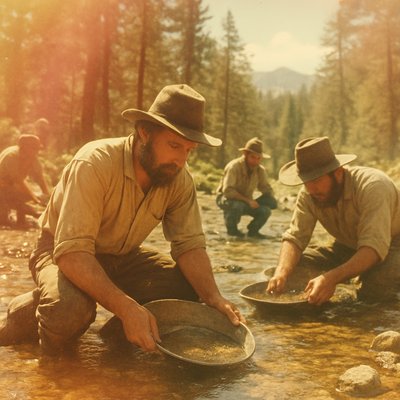
"A group of determined 19th-century gold miners panning for gold in a shallow, rocky stream in the Sierra Nevada mountains during the California Gold Rush. They are wearing rugged, worn clothing and wide-brimmed hats. Sunlight filters through pine trees, casting dappled light on the scene. One miner is intensely focused on his gold pan, while another is sifting through gravel. The water is clear, revealing pebbles and glints of potential gold. The background shows a rugged, forested landscape with distant hills."
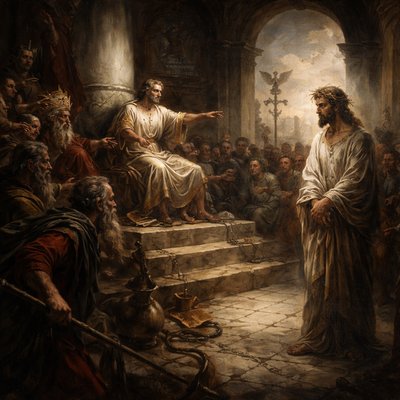
Luke 23:14 (KJV)
14 Said unto them, Ye have brought this man unto me, as one that perverteth the people: and, behold, I, having examined him before you, have found no fault in this man touching those things whereof ye accuse him:
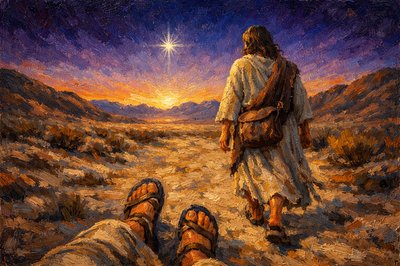
Personal POV scene. Me and Jesus in the desert on a cool morning at daybreak walking toward a bright star. Jesus is wearing old clothes and carrying a satchel. I’m wearing old clothes and sandals just like Him. The air is cool and crisp. The sky is bright blue on the horizon with deep purple fading into black at the upper atmosphere. The air is crisp and clear. It’s like the desert in California looking east toward Arizona. There are desert hills on the north and south sides and mountains in the distance.
a tree in nature
“Therefore will I divide him a portion with the great, and he shall divide the spoil with the strong; because he hath poured out his soul unto death: and he was numbered with the transgressors; and he bare the sin of many, and made intercession for the transgressors.” (Isaiah 53:12, KJV)
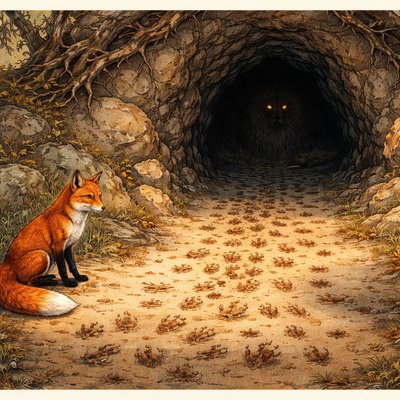
Golden Age Storybook Illustration Style, Rich Watercolor and Ink, Detailed Textures. A narrative scene capturing the tense moment of realization outside a rugged, dark cave entrance hidden among dry rocks and gnarled roots.

The Fox and the Evidence: In the bright, sunlit foreground, a clever, reddish-orange fox sits alertly on its haunches, a safe distance from the cave mouth. Its head is tilted, looking intently at the dusty ground. The dirt path leading directly into the dark cave is a chaotic, heavily trampled mess of hundreds of distinct footprints—deer hooves, rabbit paws, badger claws—all pointing inward. Crucially, the dusty ground leading away from the cave is completely smooth and untouched by return tracks.

The Lion and the Den: The cave entrance is a gaping maw of deep shadow. Deep within the darkness, only the faint, glowing yellow eyes and the vague, gaunt outline of the old lion lying in wait are visible, watching the fox intently. The contrast between the warm sunlight outside and the cold darkness inside is sharp.
In the style of Franz Marc, create a horse startled from his rest. The horse is in a grassy field, fenced, with mountains in the background. The horse is a light tan with dark mane. The horse is sensitive to a coyote nearby, emerging from a stand of Ponderosa pines. The atmosphere is quiet and calm with some morning fog misting around.
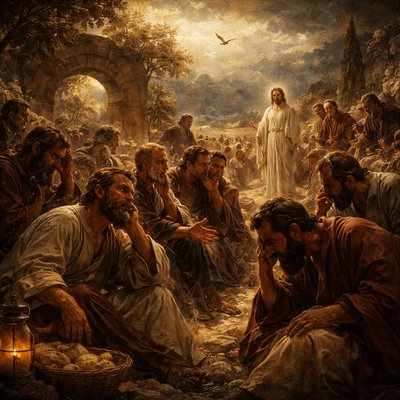
Many therefore of his disciples, when they had heard this, said, This is an hard saying; who can hear it?
John 6:60 (KJV)
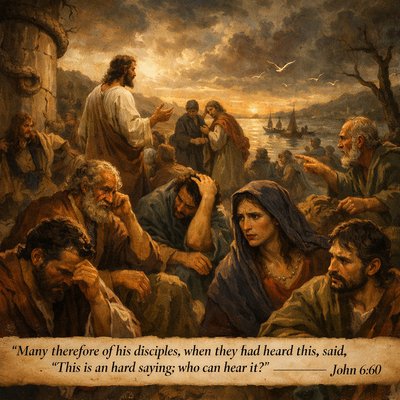
Many therefore of his disciples, when they had heard this, said, This is an hard saying; who can hear it?
John 6:60 (KJV)
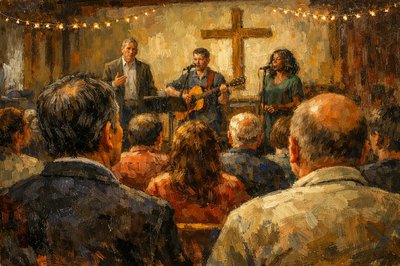
Inside an informal church in London.  Wing Sun's father has been invited to attend with his counterpart from the office.  He doesn't have anything else to do on Sunday morning, so he goes along.  we are standing in the back of the room.  There are many people of different ethnicities, the Pastor is standing up front alongside a worship leader with a guitar, and a young black woman, facing the audience.  The atmosphere is warm and welcoming, but Wing Sun's father feels a little uncomfortable.
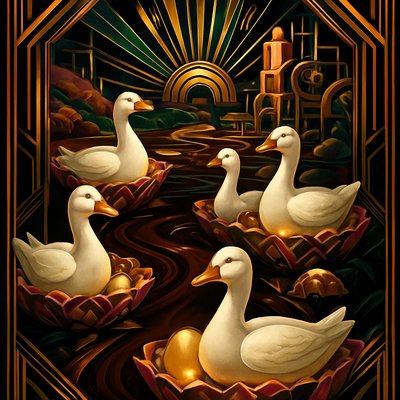
A whimsical and enchanting scene inside Willy Wonka's Chocolate Factory, featuring his extraordinary golden egg-laying geese. Several plump, pristine white geese are perched comfortably in ornate, perhaps slightly absurd, nests made of candy floss or sweet wrappers. Each goose is in the process of laying, or has just laid, a perfectly smooth, shimmering golden egg, which glows with a soft, magical luminescence. The geese themselves have a benevolent, slightly proud expression. The background reveals a fantastical, imaginative section of the factory, with edible landscapes, rivers of chocolate, and machinery built from confectionery. The lighting is soft, warm, and magical, emphasizing the golden glow of the eggs and the fantastical nature of the setting. The overall mood is one of sweet wonder, delight, and a touch of eccentricity."
urban street with city activity
A singer hitting a high note