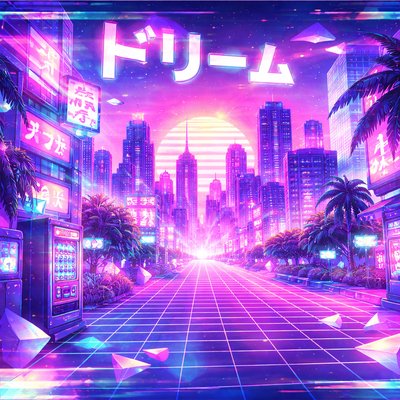
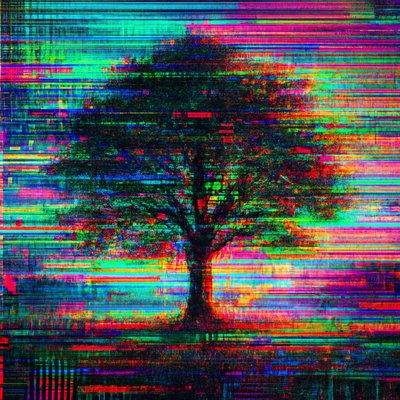
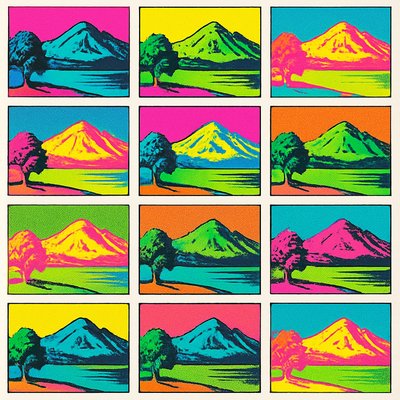
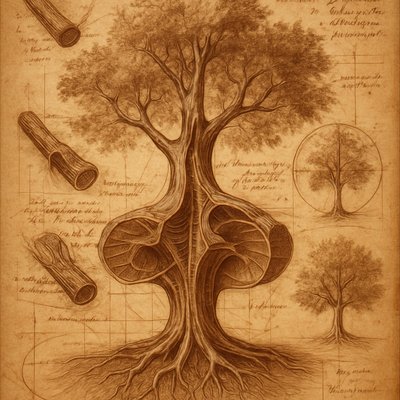
Neon Futurism Digital Art Style, Bioluminescent Sci Fi Cosmic Setting, High Contrast Composition. A Wide, Cinematic View Looking Art

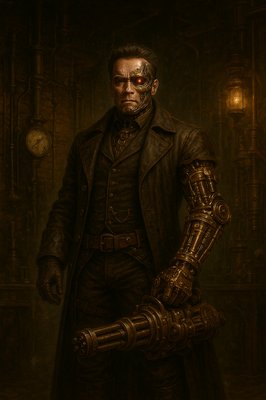
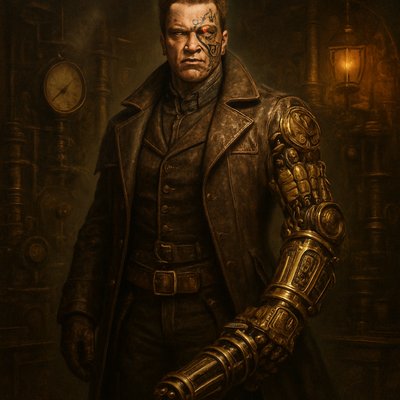
"A dramatic, full-body portrait of Arnold Schwarzenegger as a Steampunk Terminator, standing powerfully in a dimly lit, richly detailed Victorian-era workshop. Arnold's iconic Terminator face is visible, with a glowing red eye, partially obscured by an intricate, metallic eyepatch and visible cybernetic components around his neck and face. He wears a heavy, dark brown leather duster coat over a tailored waistcoat and trousers, all adorned with brass buckles, gears, and leather straps. His left arm is a formidable steampunk prosthetic, crafted from polished brass, copper, and exposed gears, ending in a massive, Gatling-gun-like weapon integrated into the forearm. His right hand wears a finely detailed leather glove with metallic accents. The background of the workshop is filled with vintage machinery, pressure gauges, steam pipes, exposed brick walls, and the soft glow of gas lamps, casting long shadows. Smoke or steam gently drifts through the air, adding to the atmospheric industrial setting. The overall aesthetic is gritty, sophisticated, and perfectly blends the sci-fi elements of the Terminator with the intricate mechanical beauty of steampunk
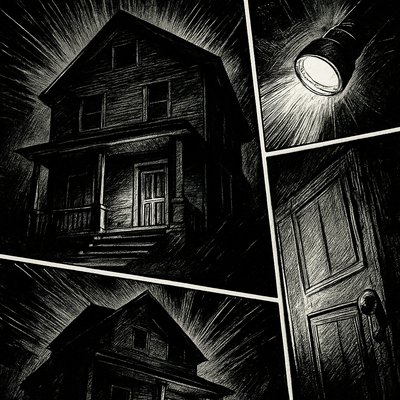
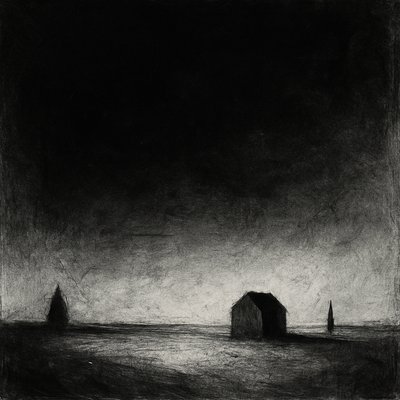
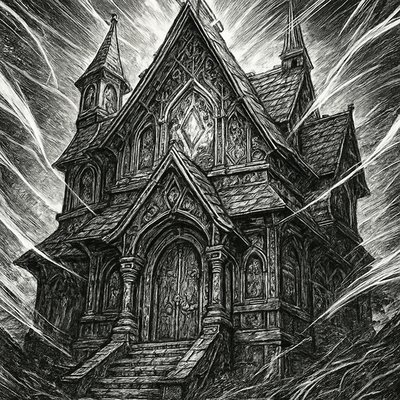
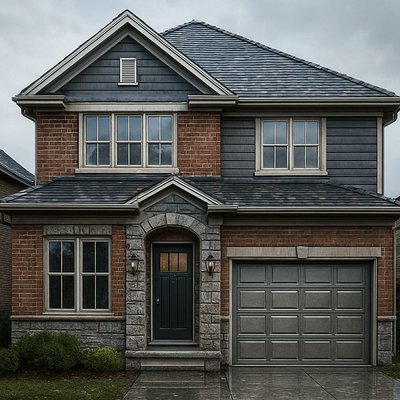
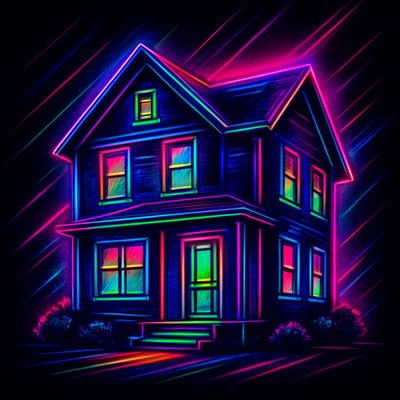
house with front view
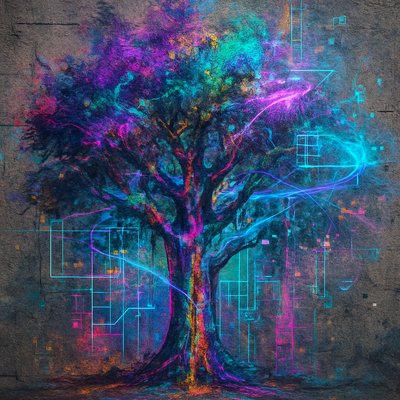
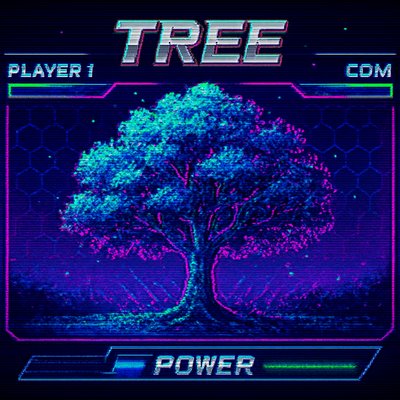
a tree in nature
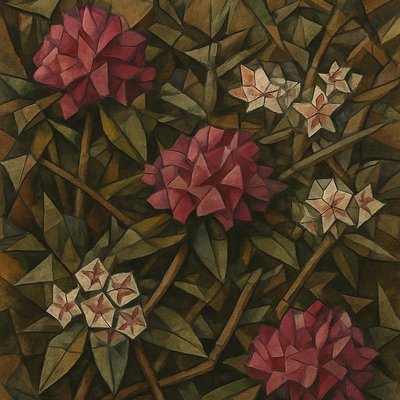
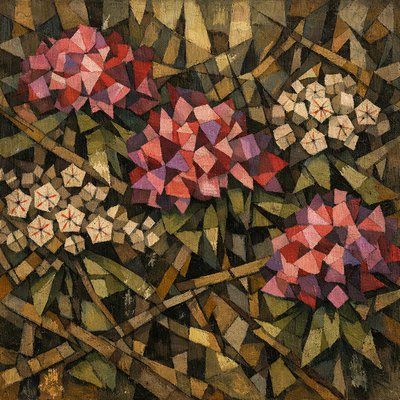
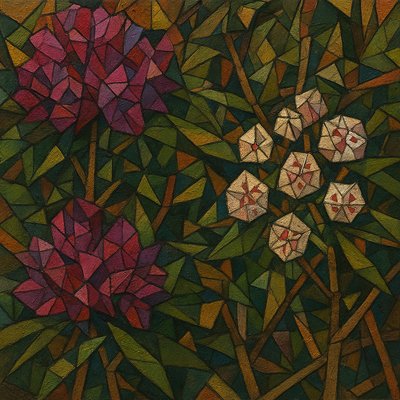
Art Style: Analytical Cubism, avant-garde oil painting style reminiscent of Picasso and Braque.

Subject: A dense, tangled thicket of Rhododendrons and Mountain Laurel bushes.

Composition & Details: The entire natural scene is deconstructed into overlapping geometric planes, fractured shards, and intersecting angles. There are no curved lines; everything is rendered in cubes, cones, and trapezoids.

    The Rhododendrons: Large, showy flower trusses are broken into faceted crystalline structures of deep magenta, rose pink, and violet blocks, looking like explosions of colored quartz rather than soft petals.

    The Mountain Laurels: The smaller, intricate flowers are rendered as complex, repeating geometric star-patterns and angular cups in white and pale pink with distinct red polygonal markings.

    Foliage & Branches: The thick, leathery leaves are fragmented green triangles and parallelograms overlapping each other, creating a sense of depth without traditional perspective. The woody stems and branches are jagged, intersecting brown and grey cylinders that shatter across the frame.
Color & Texture: A palette of muted earth tones—ochre, burnt umber, forest green, and slate grey—contrasted sharply with the jewel-toned facets of the flower colors. The finish should have a heavy, textured oil paint feel with visible palette knife marks and rough brushwork.
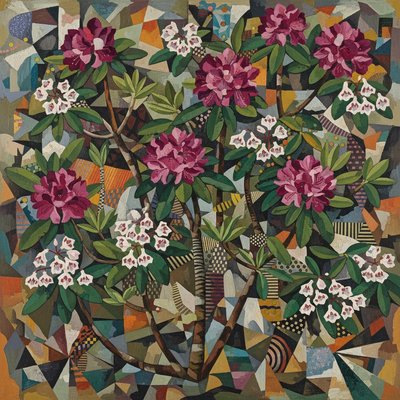
Art Style: Analytical Cubism, avant-garde oil painting style reminiscent of Picasso and Braque.

Subject: A dense, tangled thicket of Rhododendrons and Mountain Laurel bushes.

Composition & Details: The entire natural scene is deconstructed into overlapping geometric planes, fractured shards, and intersecting angles. There are no curved lines; everything is rendered in cubes, cones, and trapezoids.

    The Rhododendrons: Large, showy flower trusses are broken into faceted crystalline structures of deep magenta, rose pink, and violet blocks, looking like explosions of colored quartz rather than soft petals.

    The Mountain Laurels: The smaller, intricate flowers are rendered as complex, repeating geometric star-patterns and angular cups in white and pale pink with distinct red polygonal markings.

    Foliage & Branches: The thick, leathery leaves are fragmented green triangles and parallelograms overlapping each other, creating a sense of depth without traditional perspective. The woody stems and branches are jagged, intersecting brown and grey cylinders that shatter across the frame.

Color & Texture: A palette of muted earth tones—ochre, burnt umber, forest green, and slate grey—contrasted sharply with the jewel-toned facets of the flower colors. The finish should have a heavy, textured oil paint feel with visible palette knife marks and rough brushwork.
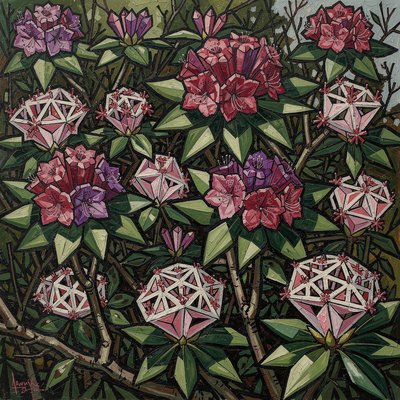
Art Style: Analytical Cubism, avant-garde oil painting style reminiscent of Picasso and Braque.

Subject: A dense, tangled thicket of Rhododendrons and Mountain Laurel bushes.

Composition & Details: The entire natural scene is deconstructed into overlapping geometric planes, fractured shards, and intersecting angles. There are no curved lines; everything is rendered in cubes, cones, and trapezoids.

    The Rhododendrons: Large, showy flower trusses are broken into faceted crystalline structures of deep magenta, rose pink, and violet blocks, looking like explosions of colored quartz rather than soft petals.

    The Mountain Laurels: The smaller, intricate flowers are rendered as complex, repeating geometric star-patterns and angular cups in white and pale pink with distinct red polygonal markings.

    Foliage & Branches: The thick, leathery leaves are fragmented green triangles and parallelograms overlapping each other, creating a sense of depth without traditional perspective. The woody stems and branches are jagged, intersecting brown and grey cylinders that shatter across the frame.

Color & Texture: A palette of muted earth tones—ochre, burnt umber, forest green, and slate grey—contrasted sharply with the jewel-toned facets of the flower colors. The finish should have a heavy, textured oil paint feel with visible palette knife marks and rough brushwork.
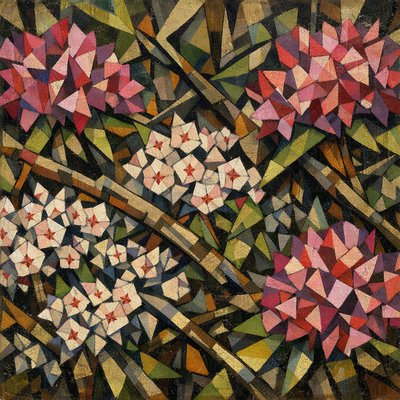
Art Style: Analytical Cubism, avant-garde oil painting style reminiscent of Picasso and Braque.

Subject: A dense, tangled thicket of Rhododendrons and Mountain Laurel bushes.

Composition & Details: The entire natural scene is deconstructed into overlapping geometric planes, fractured shards, and intersecting angles. There are no curved lines; everything is rendered in cubes, cones, and trapezoids.

    The Rhododendrons: Large, showy flower trusses are broken into faceted crystalline structures of deep magenta, rose pink, and violet blocks, looking like explosions of colored quartz rather than soft petals.

    The Mountain Laurels: The smaller, intricate flowers are rendered as complex, repeating geometric star-patterns and angular cups in white and pale pink with distinct red polygonal markings.

    Foliage & Branches: The thick, leathery leaves are fragmented green triangles and parallelograms overlapping each other, creating a sense of depth without traditional perspective. The woody stems and branches are jagged, intersecting brown and grey cylinders that shatter across the frame.

Color & Texture: A palette of muted earth tones—ochre, burnt umber, forest green, and slate grey—contrasted sharply with the jewel-toned facets of the flower colors. The finish should have a heavy, textured oil paint feel with visible palette knife marks and rough brushwork.
Art Style: Analytical Cubism, avant-garde oil painting style reminiscent of Picasso and Braque.

Subject: A dense, tangled thicket of Rhododendrons and Mountain Laurel bushes.

Composition & Details: The entire natural scene is deconstructed into overlapping geometric planes, fractured shards, and intersecting angles. There are no curved lines; everything is rendered in cubes, cones, and trapezoids.

    The Rhododendrons: Large, showy flower trusses are broken into faceted crystalline structures of deep magenta, rose pink, and violet blocks, looking like explosions of colored quartz rather than soft petals.

    The Mountain Laurels: The smaller, intricate flowers are rendered as complex, repeating geometric star-patterns and angular cups in white and pale pink with distinct red polygonal markings.

    Foliage & Branches: The thick, leathery leaves are fragmented green triangles and parallelograms overlapping each other, creating a sense of depth without traditional perspective. The woody stems and branches are jagged, intersecting brown and grey cylinders that shatter across the frame.

Color & Texture: A palette of muted earth tones—ochre, burnt umber, forest green, and slate grey—contrasted sharply with the jewel-toned facets of the flower colors. The finish should have a heavy, textured oil paint feel with visible palette knife marks and rough brushwork.
Art Style: Analytical Cubism, avant-garde oil painting style reminiscent of Picasso and Braque.

Subject: A dense, tangled thicket of Rhododendrons and Mountain Laurel bushes.

Composition & Details: The entire natural scene is deconstructed into overlapping geometric planes, fractured shards, and intersecting angles. There are no curved lines; everything is rendered in cubes, cones, and trapezoids.

    The Rhododendrons: Large, showy flower trusses are broken into faceted crystalline structures of deep magenta, rose pink, and violet blocks, looking like explosions of colored quartz rather than soft petals.

    The Mountain Laurels: The smaller, intricate flowers are rendered as complex, repeating geometric star-patterns and angular cups in white and pale pink with distinct red polygonal markings.

    Foliage & Branches: The thick, leathery leaves are fragmented green triangles and parallelograms overlapping each other, creating a sense of depth without traditional perspective. The woody stems and branches are jagged, intersecting brown and grey cylinders that shatter across the frame.

Color & Texture: A palette of muted earth tones—ochre, burnt umber, forest green, and slate grey—contrasted sharply with the jewel-toned facets of the flower colors. The finish should have a heavy, textured oil paint feel with visible palette knife marks and rough brushwork.
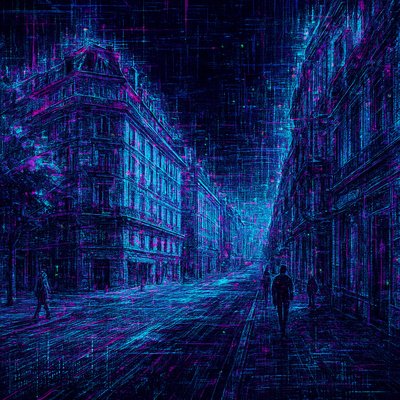
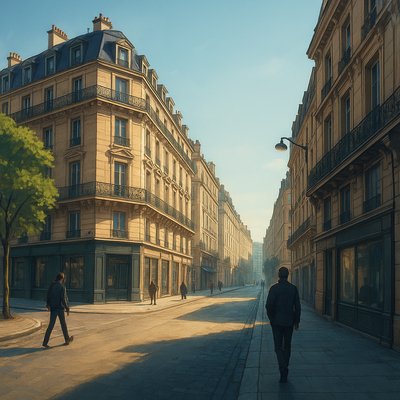
beautiful city
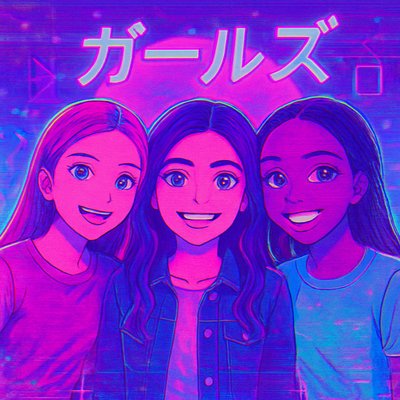
a group of three girls standing next to each other
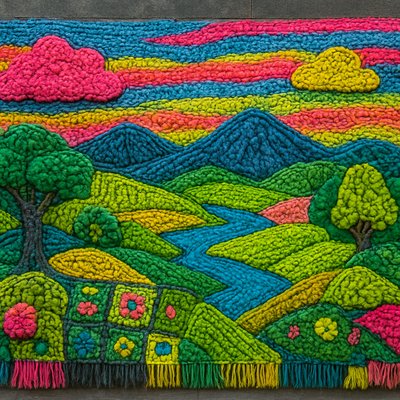
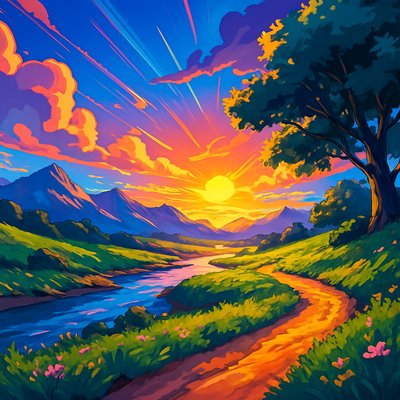
wide landscape with natural scenery
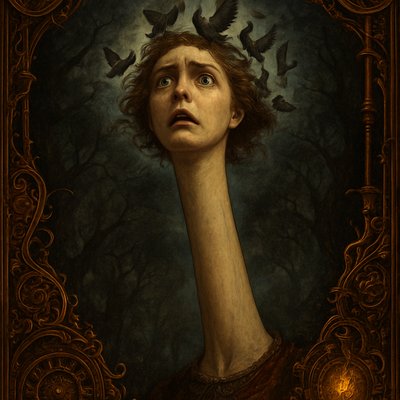
An extreme low-angle perspective shot, looking vertically up toward the sky. Alice’s impossibly long, pale neck stretches out of frame through the dense, gnarled canopy of the dark Wonderland forest. Her head, massive and distorted by the perspective, is visible against a turbulent, twilight sky. Her expression is one of confusion and fear. Small, furious Pigeons swarm her head like bothersome insects. The scene is lit by eerie moonlight filtering through the leaves, emphasizing the dramatic scale and height. Photorealistic fantasy, cinematic 16:9 aspect ratio, volumetric fog, moody atmosphere.
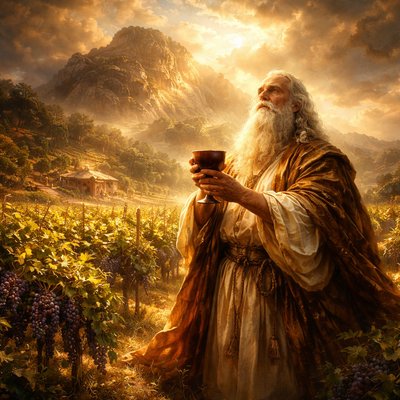
A high-detail cinematic wide shot of Noah, an elderly but robust patriarch with a long white beard and linen robes, standing in a lush vineyard on the slopes of the craggy Mount Lubar. He is holding a clay chalice of deep red wine. In the background, rows of vibrant green grapevines are heavy with purple fruit. The lighting is the golden hour of a Mediterranean sunset, casting long shadows. Ancient stone altars are visible in the distance. 8k resolution, photorealistic, historical epic style.
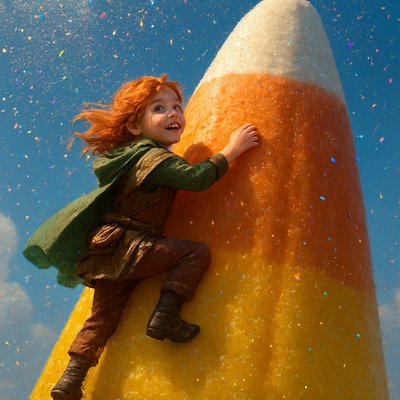
A young red-haired girl in whimsical adventurer clothes, bravely climbing a colossal, mountain-sized candy corn. The candy corn shows detailed white, orange, and yellow segments, towering into a bright, fantastical sky. Shimmering, multi-colored pixie stick dust rains down around her like a magical snowfall, sparkling in the light. She has a determined, joyful expression. Fantasy illustration, vibrant colors, dreamlike setting, epic scale, cinematic lighting."
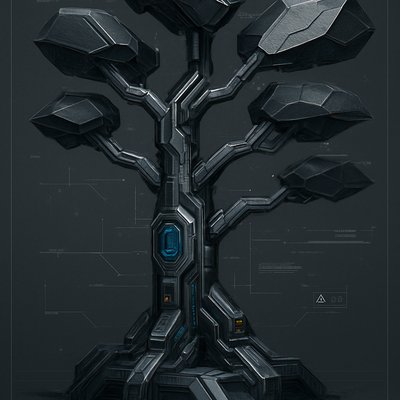
a tree in nature
a group of three girls standing next to each other
wide landscape with natural scenery
a tree in nature
Digital Figurative Art Style Style Transfer Example
a tree in nature
bicyle resting against a wall
wide landscape with natural scenery
house with front view
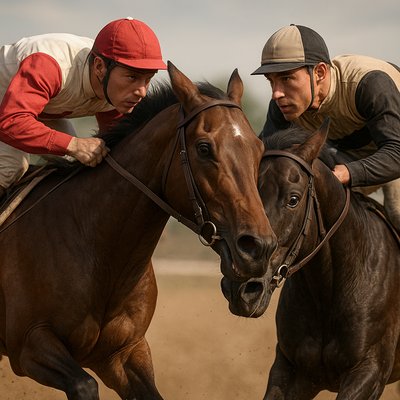
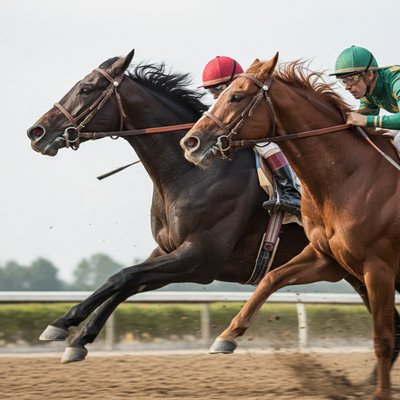
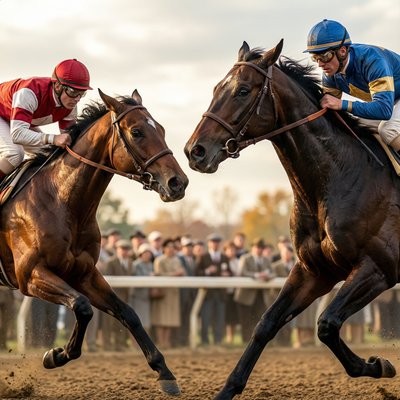
Seabiscuit vs. War Admiral (The Gaze)

    A hyper-realistic, high-resolution photograph capturing the apex of the 1938 match race between Seabiscuit and War Admiral.

    Focus: The composition is tight, showing both horses running neck-and-neck, dominating the frame. The camera angle is side-on and slightly low, emphasizing their size and muscle. The critical focus is on the space between the horses' heads as they are running stride for stride.

    Details: War Admiral (the dark bay) should show determination and slight surprise, with his head stretched out. Seabiscuit (the smaller bay) should display his characteristic "game" look—intense, focused, and seemingly looking directly into War Admiral's eyes (or toward his rival). Both jockeys (Red Pollard or George Woolf for Seabiscuit; Charles Kurtsinger for War Admiral) are visible, leaning low and urging their mounts on.

    Atmosphere: The light should be bright but slightly diffused, suggesting an autumn afternoon at Pimlico. Dust and track debris are kicked up behind them, blurred slightly by the horses' tremendous speed. The image must convey the raw power, intense rivalry, and the exact moment when the smaller horse asserts his dominance.

    Style: Cinematic photography, realistic texture, sharp focus on the horses' eyes and muscle definition.
Seabiscuit vs. War Admiral (The Gaze)

    A hyper-realistic, high-resolution photograph capturing the apex of the 1938 match race between Seabiscuit and War Admiral.

    Focus: The composition is tight, showing both horses running neck-and-neck, dominating the frame. The camera angle is side-on and slightly low, emphasizing their size and muscle. The critical focus is on the space between the horses' heads as they are running stride for stride.

    Details: War Admiral (the dark bay) should show determination and slight surprise, with his head stretched out. Seabiscuit (the smaller bay) should display his characteristic "game" look—intense, focused, and seemingly looking directly into War Admiral's eyes (or toward his rival). Both jockeys (Red Pollard or George Woolf for Seabiscuit; Charles Kurtsinger for War Admiral) are visible, leaning low and urging their mounts on.

    Atmosphere: The light should be bright but slightly diffused, suggesting an autumn afternoon at Pimlico. Dust and track debris are kicked up behind them, blurred slightly by the horses' tremendous speed. The image must convey the raw power, intense rivalry, and the exact moment when the smaller horse asserts his dominance.

    Style: Cinematic photography, realistic texture, sharp focus on the horses' eyes and muscle definition.
Seabiscuit vs. War Admiral (The Gaze)

    A hyper-realistic, high-resolution photograph capturing the apex of the 1938 match race between Seabiscuit and War Admiral.

    Focus: The composition is tight, showing both horses running neck-and-neck, dominating the frame. The camera angle is side-on and slightly low, emphasizing their size and muscle. The critical focus is on the space between the horses' heads as they are running stride for stride.

    Details: War Admiral (the dark bay) should show determination and slight surprise, with his head stretched out. Seabiscuit (the smaller bay) should display his characteristic "game" look—intense, focused, and seemingly looking directly into War Admiral's eyes (or toward his rival). Both jockeys (Red Pollard or George Woolf for Seabiscuit; Charles Kurtsinger for War Admiral) are visible, leaning low and urging their mounts on.

    Atmosphere: The light should be bright but slightly diffused, suggesting an autumn afternoon at Pimlico. Dust and track debris are kicked up behind them, blurred slightly by the horses' tremendous speed. The image must convey the raw power, intense rivalry, and the exact moment when the smaller horse asserts his dominance.

    Style: Cinematic photography, realistic texture, sharp focus on the horses' eyes and muscle definition.
wide landscape with natural scenery
Augmented Reality Contemporary Art Style Style Transfer Example
red haired lady on a Kawasaki Vulcan S
Digital Figurative Art Style Style Transfer Example
house with front view
a tree in nature
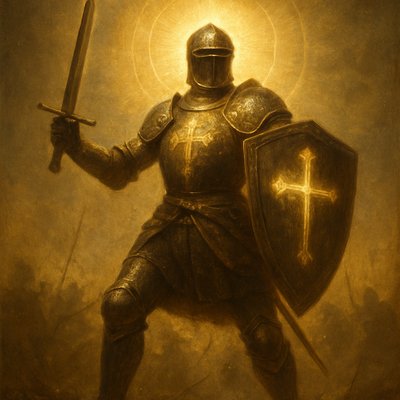
Create a hyper-realistic image with slight surreal elements and extreme detail of a medieval battlefield viewed from a worm's eye perspective, looking up at a fierce warrior in full plate armor, including a visored helmet that obscures his face, standing in a defensive battle stance with a gleaming longsword raised in one hand and a sturdy shield emblazoned with glowing cross emblems in the other, his armor radiating ethereal light from intricate cross motifs.
Semi-Realistic Anime Art Style Style Transfer Example
bicyle resting against a wall
wide landscape with natural scenery
a tree in nature