Distressed White Farm Table Art

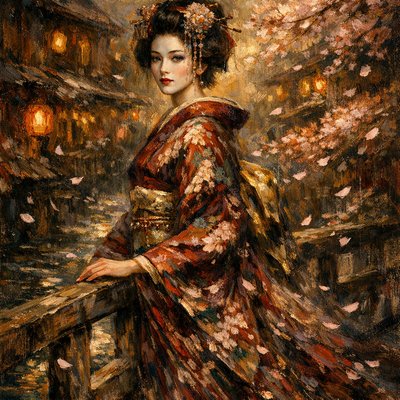
Cinematic Film Style, Romanticism Art Style, a stunningly beautiful and atmospheric portrait of a Geisha in 1930s Kyoto. She is dressed in an exquisite, flowing silk kimono with intricate floral patterns and a wide obi sash. Her face is painted in traditional white makeup with striking red lips and piercing blue-gray eyes. She is standing on a traditional wooden bridge over a stream in Gion, with soft pink cherry blossoms falling around her like snow. The lighting is a warm, golden-hour glow that creates a soft-focus, ethereal background of old wooden teahouses and paper lanterns. Focus on the shimmering texture of the silk, the delicate movement of the blossoms, and a sense of quiet, longing beauty.
Generate a realistic, eye-level photograph of a white 2002 Dodge Ram 2500 pickup truck, specifically a quad cab model, pulling a 33-foot Sunnybrook Sunset Creek travel trailer. The trailer must have distinct, painted aluminum siding. The entire rig is situated in the middle of heavy, slow-moving traffic on Interstate 40 (I-40) in Amarillo, Texas, with other cars and semi-trucks visible all around. The time of day is late afternoon, with the sun casting long shadows, and the sky is clear, typical of the Texas Panhandle. The focus is on the truck and trailer, showing the details of both vehicles amidst the bustling highway environment.
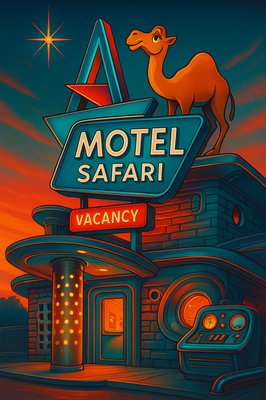
Create an image of the Motel Safari in Tucumcari, showcasing its distinctive Doo Wop or Googie architectural style. The design should feature counter-stacked brickwork with oozing mortar, cinder block walls with unique openings, and metal cylinders with perforated holes that glow softly at night. The sign should incorporate playful geometric shapes, with Clyde the Camel prominently perched on top, illuminated against a vibrant sunset sky. Include a retro Route 66 vibe with neon accents and a welcoming "VACANCY" sign.
Ethereal Digital Art, Cosmic Surrealism, Astrophotography Aesthetic. A breathtaking scene in deep space where the constellation Cygnus physically manifests into a majestic, glowing celestial swan in mid-flight.

The Subject: The swan’s form is composed of swirling blue and violet nebulae, with its feathers shimmering like stardust. The primary stars of the constellation (Deneb at the tail, Albireo at the beak) are rendered as brilliant, multi-pointed white light-bursts that anchor the swan’s anatomy. The body of the swan is translucent, revealing distant spiral galaxies and star clusters through its wings.

The Composition: The swan is flying diagonally across the frame, leaving a trail of shimmering cosmic dust and stardust in its wake. The background is the deep, dark void of the cosmos, populated by millions of pinprick stars and faint, colorful gas clouds.

Lighting & Mood: The light source originates from the swan itself, casting a soft, divine glow on the surrounding space. The mood is transcendent, silent, and awe-inspiring. Every detail, from the "stellar feathers" to the distant nebulae, should be sharp and high-definition.
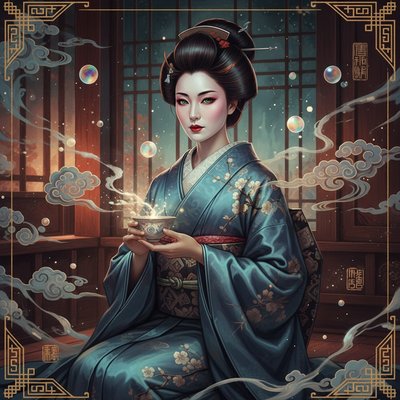
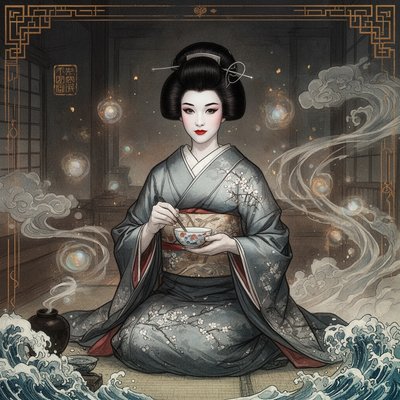
Cinematic Film Style, Traditional Japanese Ukiyo-e Influence, a regal and incredibly poised portrait of the geisha Mameha (inspired by Michelle Yeoh). She is seated in a refined, dimly lit wooden teahouse, her posture perfectly upright and elegant. She wears a heavy silk kimono in peaceful, sophisticated colors like slate blue and silver, with delicate hand-painted motifs of plum blossoms. Her face is a "mask" of white traditional makeup, featuring sharp red lips and wise, observant eyes that convey deep intelligence. She is in the middle of a ritual, perhaps holding a delicate porcelain tea bowl with perfectly choreographed hands. The lighting is soft and atmospheric, catching the shimmer of her silk and the intricate details of her high, lacquered hairstyle adorned with a single, understated silver hairpin. Focus on the feeling of quiet power, impeccable grace, and the stillness of a master artist.
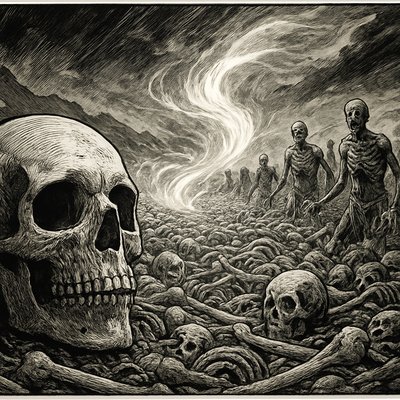
An incredibly detailed and profound scene depicting the Vision of the Dry Bones from Ezekiel 37. The immediate foreground features a stark, highly detailed close-up of a single ancient human skull, its empty eye sockets gazing out, perfectly rendered with realistic bone texture. Beyond this skull, stretching into the mid-ground, a vast, desolate valley is entirely carpeted with an immense, sprawling expanse of countless other ancient, stark white human bones and skulls. A powerful, divine wind (ruach), emanating an ethereal, sacred glow, swirls violently through this boneyard. This divine energy causes the bones to dramatically rattle, shift, and miraculously knit together, forming complete skeletons. Further in the background, some of these skeletons have already begun to rapidly form tendons, flesh, and skin, starting to rise as part of a nascent, colossal army. The sky above is dramatic and ominous, with streaks of divine light breaking through thick clouds. The overall mood is one of overwhelming desolation, followed by the initial, awe-inspiring moments of miraculous transformation and the promise of life."
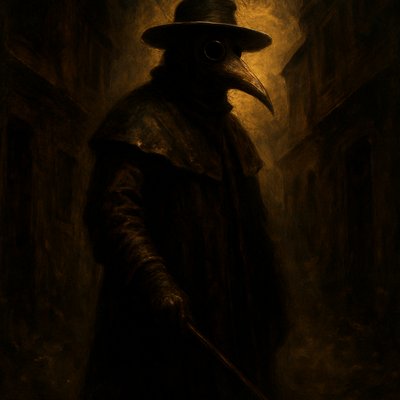
"A solitary and ominous Black Plague Doctor stands in a dimly lit, narrow cobblestone alleyway in a medieval European city. The doctor is clad head-to-toe in their iconic, dark, heavy protective gear: a long, oil-soaked waxed canvas or leather coat, dark gloves, and a wide-brimmed black hat. Their most striking feature, the beaked mask with dark, glass eyeholes, is prominent, creating an eerie, bird-like silhouette that conceals their face entirely. A wooden cane or pointer is held firmly in one gloved hand.

The atmosphere is heavy and foreboding. The background features dark, crumbling stone or timber-framed buildings with shuttered windows, hinting at a city under quarantine. Smoke or mist might subtly swirl around their feet. The lighting is stark and dramatic, perhaps from a distant lantern or a sliver of pale moonlight, casting deep shadows and highlighting the grim details of their attire. The overall mood is one of profound isolation, historical dread, and silent vigilance against an invisible enemy."
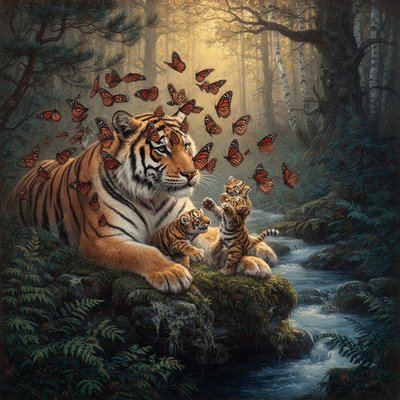
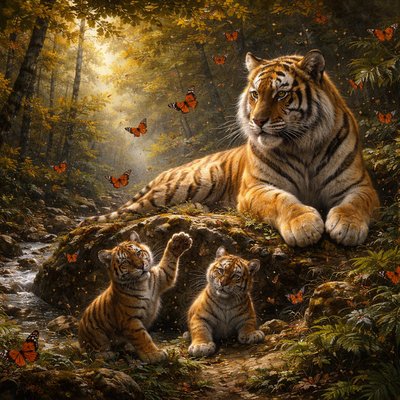
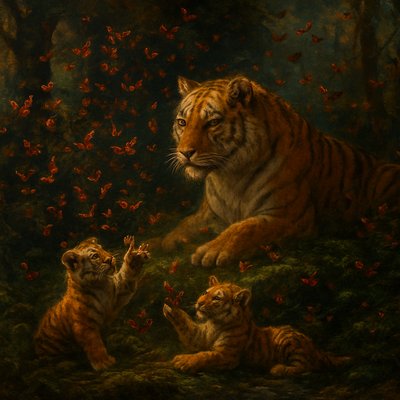
Nature Photography Style, Romantic Naturalism Painting, a breathtaking, incredibly detailed scene deep within the primeval forests of Russia's Amur-Ussuri region. A massive, powerful female Amur Tiger with thick, pale orange and dark striped fur rests on a moss-covered rocky outcrop, watching over her two playful cubs who are batting at the air. The scene is absolutely swarming with hundreds of Red Admiral butterflies (distinct black wings with vibrant orange-red bands and white spots). The butterflies form swirling clouds, landing gently on the tigers' fur, their noses, and the surrounding lush ferns and Korean pine branches. The forest floor is dense with undergrowth, lichen, and a clear, cold stream nearby. The lighting is dappled golden hour sunlight filtering through a canopy of birch and ancient oak trees, creating a magical, serene atmosphere. Focus on the texture of the thick tiger fur and the delicate wings of the butterflies.
Cinematic Film Style, Traditional Japanese Ukiyo-e Influence, a regal and incredibly poised portrait of the geisha Mameha (inspired by Michelle Yeoh). She is seated in a refined, dimly lit wooden teahouse, her posture perfectly upright and elegant. She wears a heavy silk kimono in peaceful, sophisticated colors like slate blue and silver, with delicate hand-painted motifs of plum blossoms. Her face is a "mask" of white traditional makeup, featuring sharp red lips and wise, observant eyes that convey deep intelligence. She is in the middle of a ritual, perhaps holding a delicate porcelain tea bowl with perfectly choreographed hands. The lighting is soft and atmospheric, catching the shimmer of her silk and the intricate details of her high, lacquered hairstyle adorned with a single, understated silver hairpin. Focus on the feeling of quiet power, impeccable grace, and the stillness of a master artist.
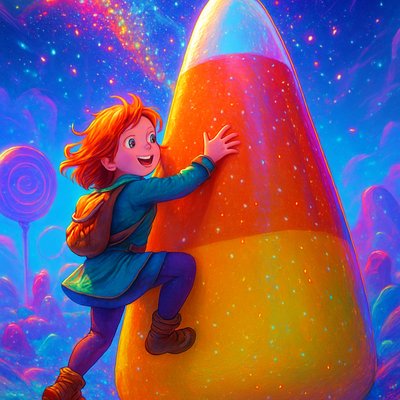
A vibrant, dynamic scene featuring a young red-haired girl, perhaps in whimsical, adventurer-style clothing, bravely climbing a colossal, mountain-sized candy corn. The candy corn itself is detailed with its classic white, orange, and yellow segments, towering majestically into a bright, fantastical sky. Pixie stick dust, shimmering and multi-colored, rains down around her like a magical, sugary snowfall, catching the light. The girl has a determined and joyful expression. The background features other fantastical candy landscape elements, perhaps giant lollipops or gummy bear forests in the distance, but the focus is on the girl and the immense candy corn."
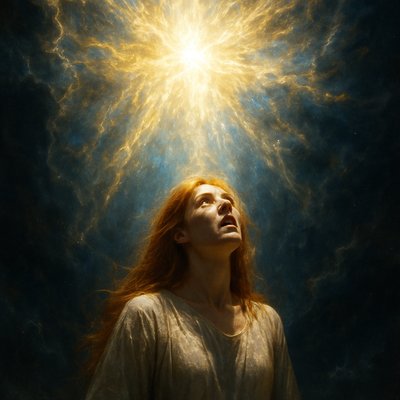
Photorealism Art Style, a profoundly dramatic and intensely luminous image depicting a vision of Heaven seen from the ground. The scene is dominated by a blazing, overwhelming celestial light that is violently breaking through the darkness of the night sky. This light is not the sun, but the pure glory of God, manifesting as swirling gold, brilliant white, and ethereal blue luminescence that seems to pull the viewer upward. A long red-haired woman, wearing simple, flowing heavenly attire, stands below, gazing upward with an expression of ecstatic awe and reverence. She is bathed in the brilliant, otherworldly light streaming down, suggesting the moment of divine revelation where the heavens are torn open. The focus is on the raw, blinding intensity of the divine light, the realistic texture of the woman's awe-struck face, and the vibrant, chaotic energy of the celestial vision, creating a powerful image of a direct, momentary glimpse into the boundless presence of Heaven.
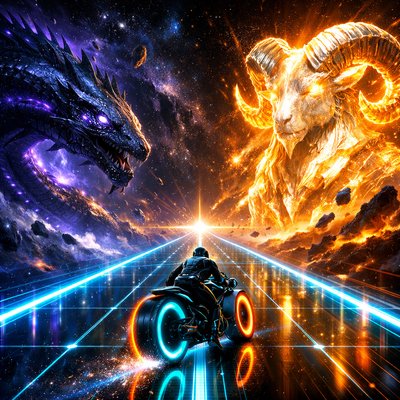
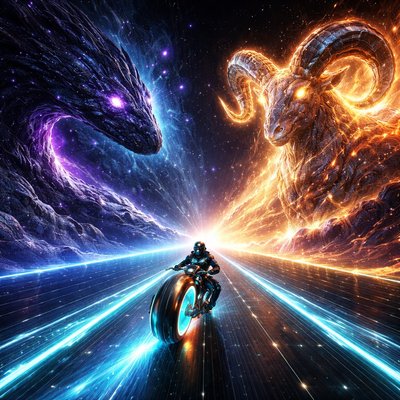
Neon-Futurism Digital Art Style, Bioluminescent Sci-Fi Cosmic Setting, High-Contrast Composition. A wide, cinematic view looking down the infinite highway.

The Rider & Bike Consistency: The lone motorcyclist—in the signature sleek, armored suit and helmet—is speeding forward on the hubless "light-cycle" sportbike. The cyan and orange neon rings of the wheels cast a sharp glow on the road surface as the rider leans forward for maximum speed.

The Path (The Ecliptic Divide): The glowing blue laser-grid highway acts as a clear boundary line, cutting a straight path through a turbulent sector of space.

The Aries Presence (The Right): To the right of the highway towers the colossal, majestic Aries. The ram is a construct of burning white-gold energy and crystalline horns. Its form is noble and steady, radiating a protective, warrior-like light across the path.

The Leviathan Presence (The Left): To the left of the highway, emerging from a dark, swirling indigo nebula, is the massive, mysterious Leviathan. It is a serpentine cosmic entity made of obsidian scales and deep violet bioluminescence, representing the vast unknown of the deep cosmos.

The Action: The rider is perfectly centered between these two titanic forces, representing the balance of courage as they move toward the next horizon.

Atmosphere: A "clash of lights" where the warm gold of the Ram meets the cool violets of the Leviathan, with the rider’s cyan bike acting as the bridge between them.
Neon-Futurism Digital Art Style, Bioluminescent Sci-Fi Cosmic Setting, High-Contrast Composition. A wide, cinematic view looking down the infinite highway.

The Rider & Bike Consistency: The lone motorcyclist—in the signature sleek, armored suit and helmet—is speeding forward on the hubless "light-cycle" sportbike. The cyan and orange neon rings of the wheels cast a sharp glow on the road surface as the rider leans forward for maximum speed.

The Path (The Ecliptic Divide): The glowing blue laser-grid highway acts as a clear boundary line, cutting a straight path through a turbulent sector of space.

The Aries Presence (The Right): To the right of the highway towers the colossal, majestic Aries. The ram is a construct of burning white-gold energy and crystalline horns. Its form is noble and steady, radiating a protective, warrior-like light across the path.

The Leviathan Presence (The Left): To the left of the highway, emerging from a dark, swirling indigo nebula, is the massive, mysterious Leviathan. It is a serpentine cosmic entity made of obsidian scales and deep violet bioluminescence, representing the vast unknown of the deep cosmos.

The Action: The rider is perfectly centered between these two titanic forces, representing the balance of courage as they move toward the next horizon.

Atmosphere: A "clash of lights" where the warm gold of the Ram meets the cool violets of the Leviathan, with the rider’s cyan bike acting as the bridge between them.
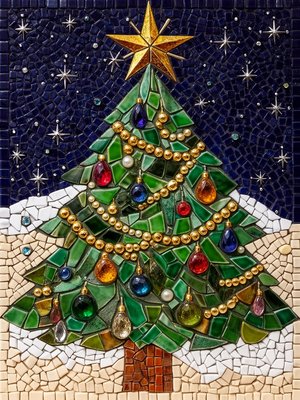
A highly detailed mosaic artwork depicting a classic Christmas tree, intricately composed of mixed tesserae including vibrant smalti glass tiles, sparkling gemstones, metallic gold and silver leaf accents, and opaque ceramic tiles. The tree features layered triangular branches in rich greens with iridescent emerald and forest smalti, adorned with multicolored gemstone ornaments in ruby, sapphire, emerald, and amber hues, metallic gold tiles forming garlands and shimmering highlights, and a radiant golden star at the top crafted from gold smalti and metallic inlays. Subtle opaque white and ivory tiles suggest snow accents, with tiny pearl-like elements for added luminosity. The background is a deep midnight blue with subtle starry specks in silver metallic tiles, evoking a festive night sky. Byzantine-inspired ornate style with tiny irregular tesserae, thin dark grout lines for contrast, hyper-detailed texture, luminous reflections on glass and gems, dimensional depth from raised tiles, photorealistic mosaic rendering, sharp focus, elegant and celebratory composition
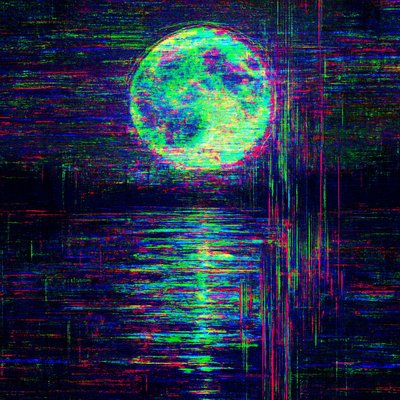
Start with a completely ordinary, even boring photograph of a full moon reflecting over a still lake.
Corrupt it until it no longer resembles its original subject at all, but still somehow feels like it’s haunted by what it used to be. Push the file through at least four different deliberate stages of destruction (e.g. heavy JPEG decay → databend in Audacity → pixel sorting by luminance → extreme RGB channel displacement and offset). Let compression artifacts bloom into impossible colors. Allow entire sections to liquefy and drip downward. Make the metadata scream. The final image should feel like a memory that’s been compressed, encrypted, lost, recovered, and compressed again for twenty years.
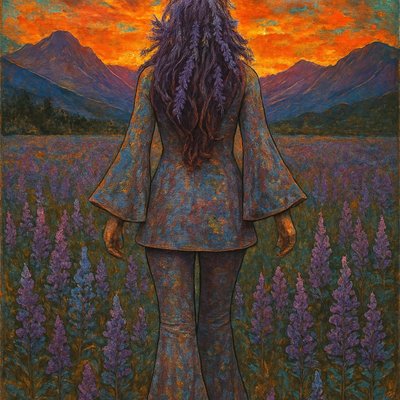
A breathtaking full-body photograph captures a woman from behind, standing in a vast, vibrant field of purple lupin flowers in Glacier National Park. Her long, rich plum purple hair is beautifully intertwined with fresh lupin blooms, forming an ethereal halo. She wears a unique 70s-inspired outfit consisting of shimmering lavender bell-bottom pants and a matching tunic-style top with bell sleeves and a square neckline, flared at the waist, adorned with subtle white horse patterns. The setting sun paints the sky in dramatic hues of fiery orange and deep red, silhouetting the majestic purple mountain ranges in the distance. The scene evokes a sense of wonder, serenity, and a deep connection to the wild beauty of nature, with a magical, almost fantastical feel, within the iconic landscape of Glacier National Park.
A highly detailed mosaic artwork depicting a classic Christmas tree, intricately composed of mixed tesserae including vibrant smalti glass tiles, sparkling gemstones, metallic gold and silver leaf accents, and opaque ceramic tiles. The tree features layered triangular branches in rich greens with iridescent emerald and forest smalti, adorned with multicolored gemstone ornaments in ruby, sapphire, emerald, and amber hues, metallic gold tiles forming garlands and shimmering highlights, and a radiant golden star at the top crafted from gold smalti and metallic inlays. Subtle opaque white and ivory tiles suggest snow accents, with tiny pearl-like elements for added luminosity. The background is a deep midnight blue with subtle starry specks in silver metallic tiles, evoking a festive night sky. Byzantine-inspired ornate style with tiny irregular tesserae, thin dark grout lines for contrast, hyper-detailed texture, luminous reflections on glass and gems, dimensional depth from raised tiles, photorealistic mosaic rendering, sharp focus, elegant and celebratory composition
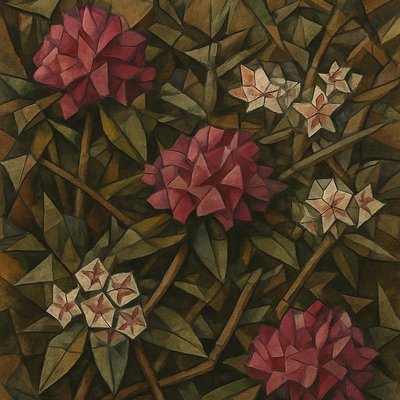
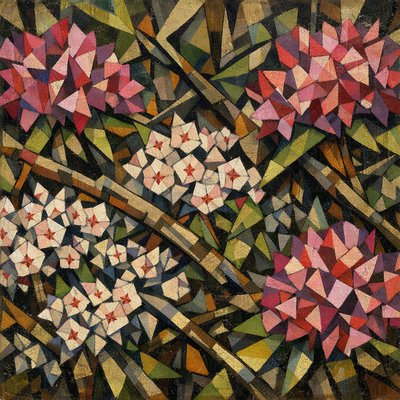
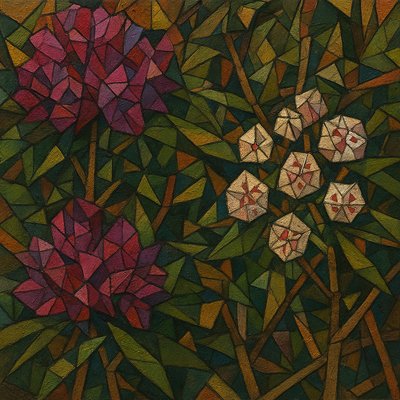
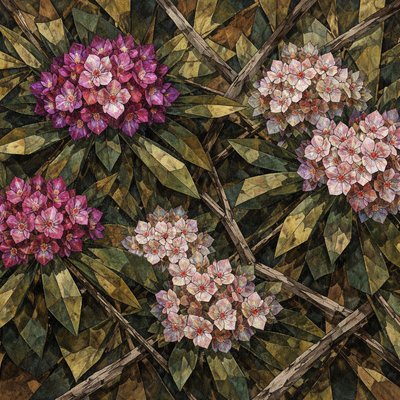
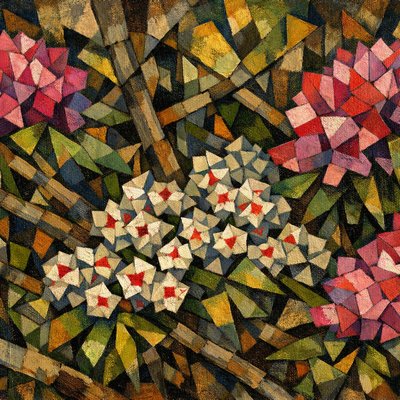
Art Style: Analytical Cubism, avant-garde oil painting style reminiscent of Picasso and Braque.

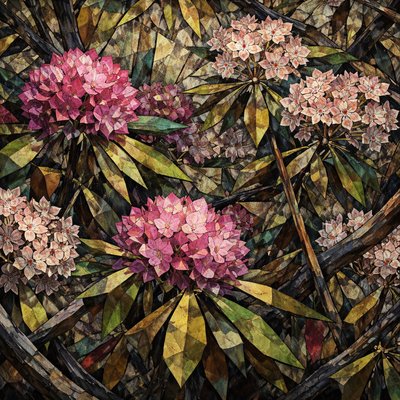
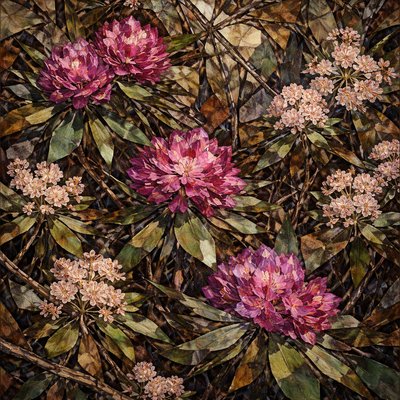
Subject: A dense, tangled thicket of Rhododendrons and Mountain Laurel bushes.

Composition & Details: The entire natural scene is deconstructed into overlapping geometric planes, fractured shards, and intersecting angles. There are no curved lines; everything is rendered in cubes, cones, and trapezoids.

    The Rhododendrons: Large, showy flower trusses are broken into faceted crystalline structures of deep magenta, rose pink, and violet blocks, looking like explosions of colored quartz rather than soft petals.

    The Mountain Laurels: The smaller, intricate flowers are rendered as complex, repeating geometric star-patterns and angular cups in white and pale pink with distinct red polygonal markings.

    Foliage & Branches: The thick, leathery leaves are fragmented green triangles and parallelograms overlapping each other, creating a sense of depth without traditional perspective. The woody stems and branches are jagged, intersecting brown and grey cylinders that shatter across the frame.

Color & Texture: A palette of muted earth tones—ochre, burnt umber, forest green, and slate grey—contrasted sharply with the jewel-toned facets of the flower colors. The finish should have a heavy, textured oil paint feel with visible palette knife marks and rough brushwork.
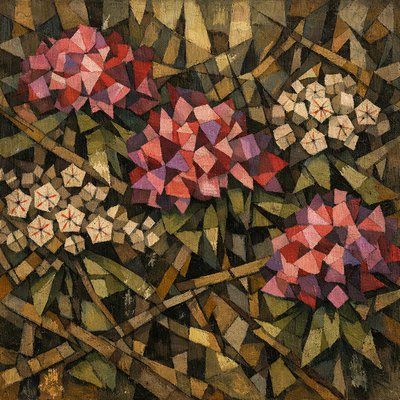
Art Style: Analytical Cubism, avant-garde oil painting style reminiscent of Picasso and Braque.

Subject: A dense, tangled thicket of Rhododendrons and Mountain Laurel bushes.

Composition & Details: The entire natural scene is deconstructed into overlapping geometric planes, fractured shards, and intersecting angles. There are no curved lines; everything is rendered in cubes, cones, and trapezoids.

    The Rhododendrons: Large, showy flower trusses are broken into faceted crystalline structures of deep magenta, rose pink, and violet blocks, looking like explosions of colored quartz rather than soft petals.

    The Mountain Laurels: The smaller, intricate flowers are rendered as complex, repeating geometric star-patterns and angular cups in white and pale pink with distinct red polygonal markings.

    Foliage & Branches: The thick, leathery leaves are fragmented green triangles and parallelograms overlapping each other, creating a sense of depth without traditional perspective. The woody stems and branches are jagged, intersecting brown and grey cylinders that shatter across the frame.

Color & Texture: A palette of muted earth tones—ochre, burnt umber, forest green, and slate grey—contrasted sharply with the jewel-toned facets of the flower colors. The finish should have a heavy, textured oil paint feel with visible palette knife marks and rough brushwork.
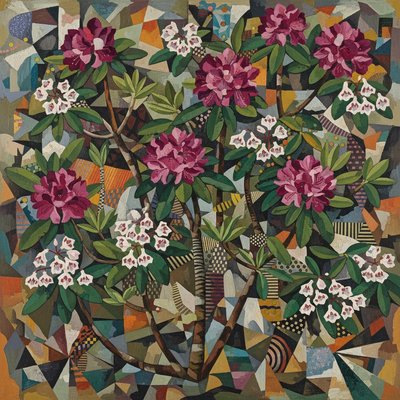
Art Style: Analytical Cubism, avant-garde oil painting style reminiscent of Picasso and Braque.

Subject: A dense, tangled thicket of Rhododendrons and Mountain Laurel bushes.

Composition & Details: The entire natural scene is deconstructed into overlapping geometric planes, fractured shards, and intersecting angles. There are no curved lines; everything is rendered in cubes, cones, and trapezoids.

    The Rhododendrons: Large, showy flower trusses are broken into faceted crystalline structures of deep magenta, rose pink, and violet blocks, looking like explosions of colored quartz rather than soft petals.

    The Mountain Laurels: The smaller, intricate flowers are rendered as complex, repeating geometric star-patterns and angular cups in white and pale pink with distinct red polygonal markings.

    Foliage & Branches: The thick, leathery leaves are fragmented green triangles and parallelograms overlapping each other, creating a sense of depth without traditional perspective. The woody stems and branches are jagged, intersecting brown and grey cylinders that shatter across the frame.

Color & Texture: A palette of muted earth tones—ochre, burnt umber, forest green, and slate grey—contrasted sharply with the jewel-toned facets of the flower colors. The finish should have a heavy, textured oil paint feel with visible palette knife marks and rough brushwork.
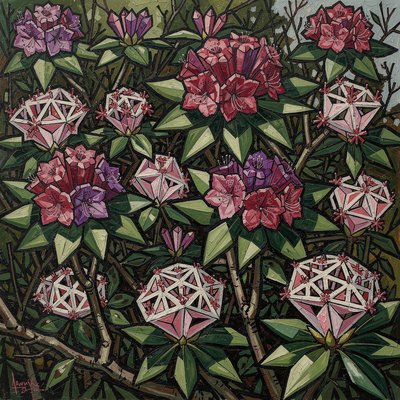
Art Style: Analytical Cubism, avant-garde oil painting style reminiscent of Picasso and Braque.

Subject: A dense, tangled thicket of Rhododendrons and Mountain Laurel bushes.

Composition & Details: The entire natural scene is deconstructed into overlapping geometric planes, fractured shards, and intersecting angles. There are no curved lines; everything is rendered in cubes, cones, and trapezoids.

    The Rhododendrons: Large, showy flower trusses are broken into faceted crystalline structures of deep magenta, rose pink, and violet blocks, looking like explosions of colored quartz rather than soft petals.

    The Mountain Laurels: The smaller, intricate flowers are rendered as complex, repeating geometric star-patterns and angular cups in white and pale pink with distinct red polygonal markings.

    Foliage & Branches: The thick, leathery leaves are fragmented green triangles and parallelograms overlapping each other, creating a sense of depth without traditional perspective. The woody stems and branches are jagged, intersecting brown and grey cylinders that shatter across the frame.

Color & Texture: A palette of muted earth tones—ochre, burnt umber, forest green, and slate grey—contrasted sharply with the jewel-toned facets of the flower colors. The finish should have a heavy, textured oil paint feel with visible palette knife marks and rough brushwork.
Art Style: Analytical Cubism, avant-garde oil painting style reminiscent of Picasso and Braque.

Subject: A dense, tangled thicket of Rhododendrons and Mountain Laurel bushes.

Composition & Details: The entire natural scene is deconstructed into overlapping geometric planes, fractured shards, and intersecting angles. There are no curved lines; everything is rendered in cubes, cones, and trapezoids.

    The Rhododendrons: Large, showy flower trusses are broken into faceted crystalline structures of deep magenta, rose pink, and violet blocks, looking like explosions of colored quartz rather than soft petals.

    The Mountain Laurels: The smaller, intricate flowers are rendered as complex, repeating geometric star-patterns and angular cups in white and pale pink with distinct red polygonal markings.

    Foliage & Branches: The thick, leathery leaves are fragmented green triangles and parallelograms overlapping each other, creating a sense of depth without traditional perspective. The woody stems and branches are jagged, intersecting brown and grey cylinders that shatter across the frame.

Color & Texture: A palette of muted earth tones—ochre, burnt umber, forest green, and slate grey—contrasted sharply with the jewel-toned facets of the flower colors. The finish should have a heavy, textured oil paint feel with visible palette knife marks and rough brushwork.
Art Style: Analytical Cubism, avant-garde oil painting style reminiscent of Picasso and Braque.

Subject: A dense, tangled thicket of Rhododendrons and Mountain Laurel bushes.

Composition & Details: The entire natural scene is deconstructed into overlapping geometric planes, fractured shards, and intersecting angles. There are no curved lines; everything is rendered in cubes, cones, and trapezoids.

    The Rhododendrons: Large, showy flower trusses are broken into faceted crystalline structures of deep magenta, rose pink, and violet blocks, looking like explosions of colored quartz rather than soft petals.

    The Mountain Laurels: The smaller, intricate flowers are rendered as complex, repeating geometric star-patterns and angular cups in white and pale pink with distinct red polygonal markings.

    Foliage & Branches: The thick, leathery leaves are fragmented green triangles and parallelograms overlapping each other, creating a sense of depth without traditional perspective. The woody stems and branches are jagged, intersecting brown and grey cylinders that shatter across the frame.

Color & Texture: A palette of muted earth tones—ochre, burnt umber, forest green, and slate grey—contrasted sharply with the jewel-toned facets of the flower colors. The finish should have a heavy, textured oil paint feel with visible palette knife marks and rough brushwork.
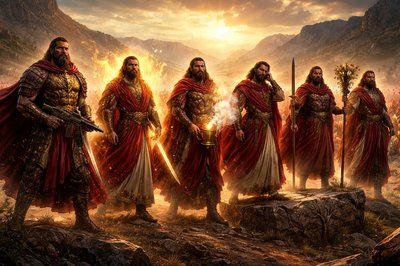
A wide, cinematic shot of six valiant ancient Hebrew warriors, the sons of Tola, standing in a vast desert valley. Each man is dressed in majestic tunics and sashes of deep scarlet, representing the Tola (scarlet worm) dye.Uzzi (My Strength): A massive, hulking commander in bronze-plated leather armor, prominently holding a modern tactical Uzi submachine gun with gold-inlay Hebrew engravings.

Jahmai (God Guards): Wrapped in a shimmering, protective golden aura that glows against his red robes.

Jibsam (Fragrant): Holding a golden censer emitting thick, fragrant clouds of white and scarlet-tinted incense. Shemuel (Heard of God): Posed in a moment of stillness, hand cupped to his ear as a faint golden light enters his mind.

Jeriel (Founded by God): Standing firmly atop a massive, ancient cornerstone carved with kermes oak branches.

Rephaiah (God Heals): Holding a wooden staff entwined with medicinal herbs and blooming red flowers. In the background, a massive army of 22,600 soldiers, all wearing scarlet standards, stretches to the horizon. High-contrast lighting, dramatic sunset, grit and hyper-detail, 8k resolution, biblical epic style. No text or letters on screen.
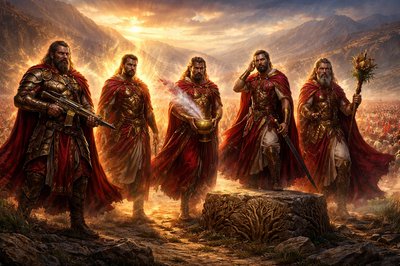
A wide, cinematic shot of six valiant ancient Hebrew warriors, the sons of Tola, standing in a vast desert valley. Each man is dressed in majestic tunics and sashes of deep scarlet, representing the Tola (scarlet worm) dye.Uzzi (My Strength): A massive, hulking commander in bronze-plated leather armor, prominently holding a modern tactical Uzi submachine gun with gold-inlay Hebrew engravings.

Jahmai (God Guards): Wrapped in a shimmering, protective golden aura that glows against his red robes.

Jibsam (Fragrant): Holding a golden censer emitting thick, fragrant clouds of white and scarlet-tinted incense. Shemuel (Heard of God): Posed in a moment of stillness, hand cupped to his ear as a faint golden light enters his mind.

Jeriel (Founded by God): Standing firmly atop a massive, ancient cornerstone carved with kermes oak branches.

Rephaiah (God Heals): Holding a wooden staff entwined with medicinal herbs and blooming red flowers. In the background, a massive army of 22,600 soldiers, all wearing scarlet standards, stretches to the horizon. High-contrast lighting, dramatic sunset, grit and hyper-detail, 8k resolution, biblical epic style. No text or letters on screen. Each man should look unique not cloned.
Art Style: Analytical Cubism, avant-garde oil painting style reminiscent of Picasso and Braque.

Subject: A dense, tangled thicket of Rhododendrons and Mountain Laurel bushes.

Composition & Details: The entire natural scene is deconstructed into overlapping geometric planes, fractured shards, and intersecting angles. There are no curved lines; everything is rendered in cubes, cones, and trapezoids.

    The Rhododendrons: Large, showy flower trusses are broken into faceted crystalline structures of deep magenta, rose pink, and violet blocks, looking like explosions of colored quartz rather than soft petals.

    The Mountain Laurels: The smaller, intricate flowers are rendered as complex, repeating geometric star-patterns and angular cups in white and pale pink with distinct red polygonal markings.

    Foliage & Branches: The thick, leathery leaves are fragmented green triangles and parallelograms overlapping each other, creating a sense of depth without traditional perspective. The woody stems and branches are jagged, intersecting brown and grey cylinders that shatter across the frame.

Color & Texture: A palette of muted earth tones—ochre, burnt umber, forest green, and slate grey—contrasted sharply with the jewel-toned facets of the flower colors. The finish should have a heavy, textured oil paint feel with visible palette knife marks and rough brushwork.
Art Style: Analytical Cubism, avant-garde oil painting style reminiscent of Picasso and Braque.

Subject: A dense, tangled thicket of Rhododendrons and Mountain Laurel bushes.

Composition & Details: The entire natural scene is deconstructed into overlapping geometric planes, fractured shards, and intersecting angles. There are no curved lines; everything is rendered in cubes, cones, and trapezoids.

    The Rhododendrons: Large, showy flower trusses are broken into faceted crystalline structures of deep magenta, rose pink, and violet blocks, looking like explosions of colored quartz rather than soft petals.

    The Mountain Laurels: The smaller, intricate flowers are rendered as complex, repeating geometric star-patterns and angular cups in white and pale pink with distinct red polygonal markings.

    Foliage & Branches: The thick, leathery leaves are fragmented green triangles and parallelograms overlapping each other, creating a sense of depth without traditional perspective. The woody stems and branches are jagged, intersecting brown and grey cylinders that shatter across the frame.

Color & Texture: A palette of muted earth tones—ochre, burnt umber, forest green, and slate grey—contrasted sharply with the jewel-toned facets of the flower colors. The finish should have a heavy, textured oil paint feel with visible palette knife marks and rough brushwork.
Art Style: Analytical Cubism, avant-garde oil painting style reminiscent of Picasso and Braque.

Subject: A dense, tangled thicket of Rhododendrons and Mountain Laurel bushes.

Composition & Details: The entire natural scene is deconstructed into overlapping geometric planes, fractured shards, and intersecting angles. There are no curved lines; everything is rendered in cubes, cones, and trapezoids.

    The Rhododendrons: Large, showy flower trusses are broken into faceted crystalline structures of deep magenta, rose pink, and violet blocks, looking like explosions of colored quartz rather than soft petals.

    The Mountain Laurels: The smaller, intricate flowers are rendered as complex, repeating geometric star-patterns and angular cups in white and pale pink with distinct red polygonal markings.

    Foliage & Branches: The thick, leathery leaves are fragmented green triangles and parallelograms overlapping each other, creating a sense of depth without traditional perspective. The woody stems and branches are jagged, intersecting brown and grey cylinders that shatter across the frame.

Color & Texture: A palette of muted earth tones—ochre, burnt umber, forest green, and slate grey—contrasted sharply with the jewel-toned facets of the flower colors. The finish should have a heavy, textured oil paint feel with visible palette knife marks and rough brushwork.
Art Style: Analytical Cubism, avant-garde oil painting style reminiscent of Picasso and Braque.

Subject: A dense, tangled thicket of Rhododendrons and Mountain Laurel bushes.

Composition & Details: The entire natural scene is deconstructed into overlapping geometric planes, fractured shards, and intersecting angles. There are no curved lines; everything is rendered in cubes, cones, and trapezoids.

    The Rhododendrons: Large, showy flower trusses are broken into faceted crystalline structures of deep magenta, rose pink, and violet blocks, looking like explosions of colored quartz rather than soft petals.

    The Mountain Laurels: The smaller, intricate flowers are rendered as complex, repeating geometric star-patterns and angular cups in white and pale pink with distinct red polygonal markings.

    Foliage & Branches: The thick, leathery leaves are fragmented green triangles and parallelograms overlapping each other, creating a sense of depth without traditional perspective. The woody stems and branches are jagged, intersecting brown and grey cylinders that shatter across the frame.

Color & Texture: A palette of muted earth tones—ochre, burnt umber, forest green, and slate grey—contrasted sharply with the jewel-toned facets of the flower colors. The finish should have a heavy, textured oil paint feel with visible palette knife marks and rough brushwork.
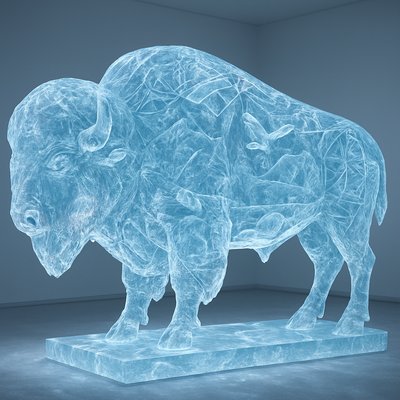
    A breathtaking, full-size artistic sculpture of a standing buffalo, rendered entirely in the style of intricate, luminous glass art, reminiscent of the painted buffalo installations found in West Yellowstone. The Buffalo is standing in the nature of Yellowstone National Park. The buffalo's form is composed of countless individual pieces of vibrant, multifaceted stained glass or fused glass, meticulously cut, arranged, and joined, creating a cohesive and majestic shape.

    Instead of traditional paint, the entire surface of this glass buffalo is adorned with various miniature, finely detailed scenes and patterns etched, painted, or embedded within the glass itself, or created by the unique coloration and texture of the glass pieces. These scenes could depict:

        Western landscapes: Yellowstone's geysers, mountain ranges, pine forests, rivers.

        Wildlife: Elk, bears, wolves, eagles (in glass).

        Native American art motifs: Geometric patterns, symbols, and figures (also rendered in glass).

        Historical moments: Subtle nods to early explorers or iconic figures (stylized in glass).

    The buffalo's interior is subtly illuminated, causing the entire sculpture to glow from within. Light catches every facet of the glass, creating a dazzling play of refracted colors and intricate shadows on the ground around it. The background is a clean, modern art gallery setting with soft, focused lighting, allowing the buffalo to be the sole, radiant centerpiece. The atmosphere is one of awe, wonder, and appreciation for artistic craftsmanship and the spirit of the American West, reimagined through a unique, luminous medium. The artistic style is hyper-realistic, emphasizing the detailed texture, transparency, and brilliant light play inherent in glass art."
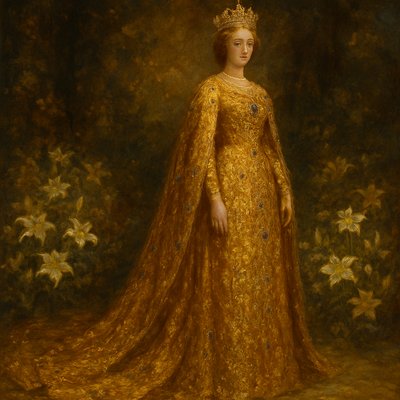
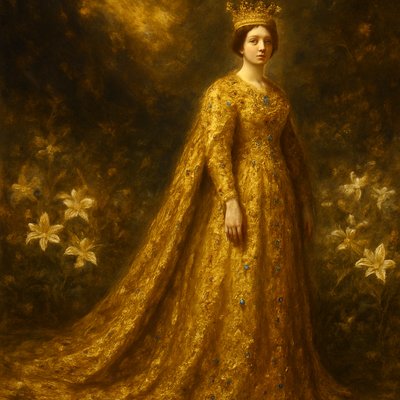
Oil Painting Art Style, Baroque Art Style, a breathtakingly majestic and regal full-length portrait of "The Queen in Gold of Ophir," inspired by Psalm 45. The Queen stands with impeccable grace and royal dignity, her posture radiating quiet power. Her expression is serene, gentle, and profoundly gracious, with a subtle, noble peace. She is adorned in an exquisitely elaborate gown woven entirely from the finest, purest gold of Ophir, which shimmers and gleams with unparalleled brilliance, featuring a magnificent, flowing long train that sweeps gracefully behind her across the ground. Her attire is intricately embellished with countless precious jewels—sapphires, rubies, and emeralds—each sparkling intensely with Baroque dynamism. A delicate yet regal golden crown, also ablaze with light, rests upon her head. The setting is a serene yet grand sacred garden abundant with white and golden lilies, which bloom richly around her feet and extend into the softly focused background. The scene is bathed in dramatic, warm, golden ambient light that creates striking highlights on her golden gown and the lilies, making her and her lavish garments glow amidst the natural beauty. Focus on the unparalleled brilliance, texture, and radiant shine of her golden gown and its sweeping train, the intense sparkle of her jewels, her majestic yet gentle presence, and the luxurious, sacred atmosphere created by the golden light and the symbolic lilies, befitting a queen in God's presence.
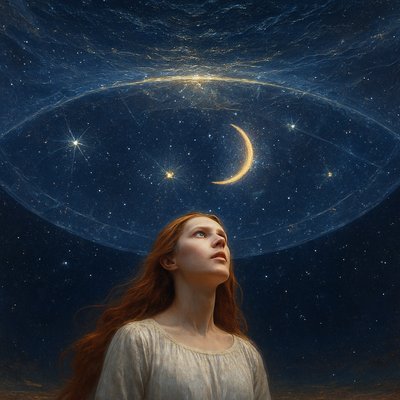
Photorealism Art Style, a breathtaking, upward-looking perspective from the ground, portraying ancient Jewish cosmology for Psalm 8:3. In the lower frame, a young woman with long, flowing red hair, dressed in simple, ethereal white heavenly attire, stands on subtle, ancient earth, gazing upwards with an expression of profound awe and wonder. Above her, the night sky transitions into a vast, layered structure of heavens. Clearly visible is a translucent, crystalline firmament (raqia), appearing as a colossal, shimmering barrier. Within this firmament, large, distinct stars and a glowing crescent moon are vividly captured, appearing as tangible, luminous objects "set into" its surface, radiating a soft, internal light. Beyond and above this firmament, immense, dark yet shimmering celestial waters are visibly contained, looking like a real, suspended ocean reflecting an unseen, brilliant divine light from the highest reaches. The overall scene is imbued with deep blues, celestial purples, and radiant golds from the embedded lights. Focus on the woman's reverent expression, the stunning depth of the layered heavens seen from below, the realistic texture of the firmament, and the tangible, luminous quality of the stars and moon within it, creating an image of overwhelming ancient wonder and divine majesty.
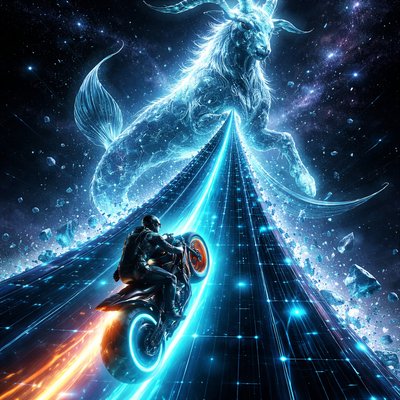
Neon-Futurism Digital Art Style, Bioluminescent Sci-Fi Cosmic Setting, Vertical Composition. A dramatic, steep perspective as the highway shifts from a flat plane into a vertical climb.

The Rider & Bike Consistency: The lone motorcyclist—in the same sleek, armored suit and integrated helmet—is popped into a wheelie or leaning aggressively forward as the hubless "light-cycle" sportbike (with its signature cyan and orange neon rings) begins a steep upward climb. The bike leaves a vibrant, glowing neon trail that looks like a streak of lightning against the dark space.

The Path (The Ecliptic Ridge): The glowing blue laser-grid highway has angled sharply upward, resembling a steep mountain ridge made of transparent data-lines, cutting through a field of floating ice crystals and frozen stardust.

The Capricorn Presence: Looming ahead at the peak of this "mountain" is the colossal, majestic Sea-Goat of Capricorn. Its front half is a powerful goat with massive, curved horns made of glowing white obsidian, and its lower half is a shimmering, bioluminescent fish tail that coils around the highway like a galaxy.

The Atmosphere: The Sea-Goat is rendered in crystalline textures and electric-teal circuitry. As the rider climbs toward it, the background is a cold, deep-space void filled with sharp, diamond-like stars and swirling silver nebulae.

Lighting: The cool teal and silver glow of the Capricorn figure illuminates the rider from above, clashing beautifully with the bike's warm orange accents.
Oil Painting Art Style, Baroque Art Style, a breathtakingly majestic and regal full-length portrait of "The Queen in Gold of Ophir," inspired by Psalm 45. The Queen stands with impeccable grace and royal dignity, her posture radiating quiet power. Her expression is serene, gentle, and profoundly gracious, with a subtle, noble peace. She is adorned in an exquisitely elaborate gown woven entirely from the finest, purest gold of Ophir, which shimmers and gleams with unparalleled brilliance, featuring a magnificent, flowing long train that sweeps gracefully behind her across the ground. Her attire is intricately embellished with countless precious jewels—sapphires, rubies, and emeralds—each sparkling intensely with Baroque dynamism. A delicate yet regal golden crown, also ablaze with light, rests upon her head. The setting is a serene yet grand sacred garden abundant with white and golden lilies, which bloom richly around her feet and extend into the softly focused background. The scene is bathed in dramatic, warm, golden ambient light that creates striking highlights on her golden gown and the lilies, making her and her lavish garments glow amidst the natural beauty. Focus on the unparalleled brilliance, texture, and radiant shine of her golden gown and its sweeping train, the intense sparkle of her jewels, her majestic yet gentle presence, and the luxurious, sacred atmosphere created by the golden light and the symbolic lilies, befitting a queen in God's presence.
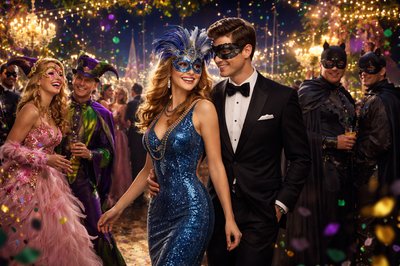
Elegant Mardi Gras party at the Silver Yacht Club in New Orleans at night from Nancy Drew book #81 The Mardi Gras Mystery. Luxurious yacht club deck or ballroom overlooking water, twinkling lights and purple/green/gold decorations, colorful beads and confetti in the air. Teenage detective Nancy Drew in center, reddish-blonde hair, wearing a sparkling blue masquerade gown with feathered mask, beads, and a determined yet smiling expression, dancing or mingling. Ned Nickerson beside her in a dashing tuxedo or masked costume, arm around her. Bess Marvin (blonde, glamorous) in a pink feathered ball gown laughing with George Fayne (short dark hair) in a fun jester or adventurous outfit. Brian Seaton and his father in partial bat-themed costumes with capes and masks nearby. Background: masked guests in elaborate gowns, tuxedos, and festive attire, live jazz band playing trumpets and saxophones, yacht masts or water view, chandeliers or string lights glowing, subtle suspenseful shadows hinting at mystery. Vibrant 1980s Nancy Drew book illustration style, adventurous festive atmosphere, detailed costumes, cinematic lighting with warm golden hues and colorful pops, high energy party scene
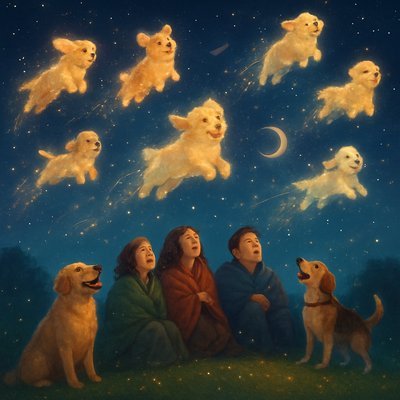
Art Style: A whimsical, magical fantasy photograph with a slight long-exposure effect. The aesthetic should be charming, warm, and full of wonder, like a scene from a high-budget Studio Ghibli film brought to real life.

The Sky (The Shower): The deep, dark night sky is alive with activity. Instead of standard meteor streaks, dozens of glowing, translucent "puppy-meteors" are zooming across the heavens.

The Puppies: They are clearly recognizable as adorable, fluffy puppies—golden retrievers, chunky corgis, fluffy samoyeds, and floppy-eared spaniels.

    Appearance: They emit a soft, warm, bioluminescent glow (golds, creams, and soft blues).

    Motion: They aren't falling tragically; they look playful, soaring and tumbling through space, leaving long, glittering trails of stardust and paw-print sparkles behind them. Let's make sure to include the moon phase we established earlier for continuity! A slender waning crescent moon is visible among the puppy-streaks.

The Foreground Setting: A wide, grassy hill perfect for stargazing.

    The Viewers: A family or group of friends wrapped in cozy blankets are sitting on the grass, looking up with expressions of pure joy and disbelief, pointing at the sky.

    Animal Reaction: On the ground next to them, two real dogs (an earth-bound golden retriever and a beagle) are looking up at the sky, barking happily and wagging their tails wildly at their celestial cousins.

Lighting: The primary light source is the magical, warm glow from the dozens of puppy-meteors streaking overhead, casting soft light on the landscape below.
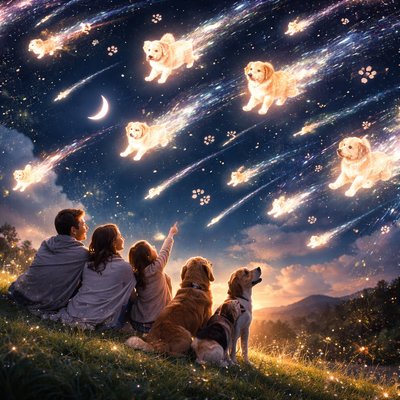
Art Style: A whimsical, magical fantasy photograph with a slight long-exposure effect. The aesthetic should be charming, warm, and full of wonder, like a scene from a high-budget Studio Ghibli film brought to real life.

The Sky (The Shower): The deep, dark night sky is alive with activity. Instead of standard meteor streaks, dozens of glowing, translucent "puppy-meteors" are zooming across the heavens.

The Puppies: They are clearly recognizable as adorable, fluffy puppies—golden retrievers, chunky corgis, fluffy samoyeds, and floppy-eared spaniels.

    Appearance: They emit a soft, warm, bioluminescent glow (golds, creams, and soft blues).

    Motion: They aren't falling tragically; they look playful, soaring and tumbling through space, leaving long, glittering trails of stardust and paw-print sparkles behind them. Let's make sure to include the moon phase we established earlier for continuity! A slender waning crescent moon is visible among the puppy-streaks.

The Foreground Setting: A wide, grassy hill perfect for stargazing.

    The Viewers: A family or group of friends wrapped in cozy blankets are sitting on the grass, looking up with expressions of pure joy and disbelief, pointing at the sky.

    Animal Reaction: On the ground next to them, two real dogs (an earth-bound golden retriever and a beagle) are looking up at the sky, barking happily and wagging their tails wildly at their celestial cousins.

Lighting: The primary light source is the magical, warm glow from the dozens of puppy-meteors streaking overhead, casting soft light on the landscape below.
Art Style: A whimsical, magical fantasy photograph with a slight long-exposure effect. The aesthetic should be charming, warm, and full of wonder, like a scene from a high-budget Studio Ghibli film brought to real life.

The Sky (The Shower): The deep, dark night sky is alive with activity. Instead of standard meteor streaks, dozens of glowing, translucent "puppy-meteors" are zooming across the heavens.

The Puppies: They are clearly recognizable as adorable, fluffy puppies—golden retrievers, chunky corgis, fluffy samoyeds, and floppy-eared spaniels.

    Appearance: They emit a soft, warm, bioluminescent glow (golds, creams, and soft blues).

    Motion: They aren't falling tragically; they look playful, soaring and tumbling through space, leaving long, glittering trails of stardust and paw-print sparkles behind them. Let's make sure to include the moon phase we established earlier for continuity! A slender waning crescent moon is visible among the puppy-streaks.

The Foreground Setting: A wide, grassy hill perfect for stargazing.

    The Viewers: A family or group of friends wrapped in cozy blankets are sitting on the grass, looking up with expressions of pure joy and disbelief, pointing at the sky.

    Animal Reaction: On the ground next to them, two real dogs (an earth-bound golden retriever and a beagle) are looking up at the sky, barking happily and wagging their tails wildly at their celestial cousins.

Lighting: The primary light source is the magical, warm glow from the dozens of puppy-meteors streaking overhead, casting soft light on the landscape below.
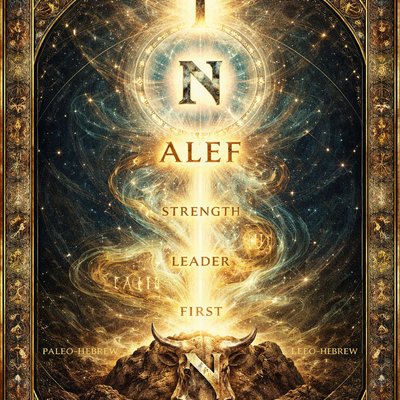
Art Style: A complex, symbolic conceptual illustration blending ancient mysticism with modern schematic design. The aesthetic should feel like an illuminated alchemical manuscript crossed with a celestial blueprint. Textures of aged vellum, carved stone, and glowing divine energy.

Central Composition: A vertical evolutionary flow. At the grounding base, emerging from rough, ancient rock, is the Paleo-Hebrew Aleph symbol (the stylized ox head with horns, looking like an 'A' lying on its side). It is carved deeply, looking primal and strong.

Transition & Meanings: Rising from the Paleo symbol is a swirling vortex of golden and blue light, forming a "pillar of meaning." Within this energy stream, ethereal visual metaphors and text are embedded: ghostly outlines of a powerful ox plowing, a stylized crown representing leadership, and a single radiant beam of light connecting heaven and earth. The English words "STRENGTH," "LEADER," and "FIRST" are written in archaic, glowing script along this rising path.

The Modern Form: At the apex, floating suspended in a sphere of brilliant white light, is the Modern Hebrew letter א (Aleph). It is rendered not just as ink, but as three distinct components of energy (the upper yod, lower yod, and connecting vav) held together in perfect balance, symbolizing divine unity.

Textual Integration:

Floating prominently above the entire composition is the large, glowing number "1".

Bridging the gap between the ancient and modern forms in the center of the image is the word "ALEF" in a bold, timeless font.

Small labels "PALEO-HEBREW" and "MODERN HEBREW" are discreetly placed near their respective symbols.

Overall Mood: Profound, sacred, interconnected, and powerful. The background is a subtle star map with faint sacred geometry lines.