Biblical Scene Art

19th-Century Naturalistic Oil Painting Style, Rich Earth Tones, Rustic Textures and dramatic barn lighting. A tense, detailed scene inside an old, timber-framed stable at midday.

The Antagonist (The Dog): Right in the center of a large, rough wooden manger overflowing with golden, dry hay, a scruffy, snarling terrier-mix dog is curled up aggressively. Its teeth are bared in a vicious snap, its hackles are raised, and its eyes are fixed selfishly on the intruders.

The Victims (The Oxen): Two massive, powerful oxen with large yokes and gentle, hungry eyes are leaning over the manger rail. Their huge heads are close to the hay, but they are recoiling slightly from the snapping dog. One ox has drool dripping from its mouth, looking at the hay with desperation and confusion. The size difference between the massive heads of the oxen and the small, spiteful dog is emphasized.

The Atmosphere: A strong shaft of natural sunlight cuts through an open barn door, illuminating dancing dust motes and highlighting the textures of the straw, the rough wood grain of the manger, and the matted fur of the dog. The rest of the barn is in warm shadow.
Luminous Storybook Illustration Style, Rich Color Saturation, Magical Realism. A dramatic, painterly scene capturing the precise moment of tragic error on an old, mossy stone bridge spanning a calm river at sunset.

The Reality (The Dog on the Bridge): A scruffy, hungry-looking terrier stands frozen mid-snarl on the edge of the bridge, looking downward. Its mouth is wide open in an aggressive bark. Suspended in mid-air, just inches below its open jaws, a real, decent-sized meaty bone is falling toward the water. The dog’s expression is a mix of greed and sudden confusion.

The Illusion (The Reflection): The surface of the river below is glassy and still, acting like a perfect, deceptive mirror. The reflection shows the same dog, but the reflected bone in its mouth appears impossibly huge, glistening, and juicier than the real one. The reflection is almost hypnotically bright, brighter than the reality above the water. The warm golden light of the setting sun makes the water shimmer invitingly.
Luminous Storybook Illustration Style, Rich Color Saturation, Magical Realism. A dramatic, painterly scene capturing the precise moment of tragic error on an old, mossy stone bridge spanning a calm river at sunset.

The Reality (The Dog on the Bridge): A scruffy, hungry-looking terrier stands frozen mid-snarl on the edge of the bridge, looking downward. Its mouth is wide open in an aggressive bark. Suspended in mid-air, just inches below its open jaws, a real, decent-sized meaty bone is falling toward the water. The dog’s expression is a mix of greed and sudden confusion.

The Illusion (The Reflection): The surface of the river below is glassy and still, acting like a perfect, deceptive mirror. The reflection shows the same dog, but the reflected bone in its mouth appears impossibly huge, glistening, and juicier than the real one. The reflection is almost hypnotically bright, brighter than the reality above the water. The warm golden light of the setting sun makes the water shimmer invitingly.
Ethereal Digital Art, Cosmic Surrealism, Astrophotography Aesthetic. A breathtaking scene in deep space where the constellation Cygnus physically manifests into a majestic, glowing celestial swan in mid-flight.

The Subject: The swan’s form is composed of swirling blue and violet nebulae, with its feathers shimmering like stardust. The primary stars of the constellation (Deneb at the tail, Albireo at the beak) are rendered as brilliant, multi-pointed white light-bursts that anchor the swan’s anatomy. The body of the swan is translucent, revealing distant spiral galaxies and star clusters through its wings.

The Composition: The swan is flying diagonally across the frame, leaving a trail of shimmering cosmic dust and stardust in its wake. The background is the deep, dark void of the cosmos, populated by millions of pinprick stars and faint, colorful gas clouds.

Lighting & Mood: The light source originates from the swan itself, casting a soft, divine glow on the surrounding space. The mood is transcendent, silent, and awe-inspiring. Every detail, from the "stellar feathers" to the distant nebulae, should be sharp and high-definition.
Epic Adventure Photography Style, Cinematic Color Grading, Sub-Zero Atmosphere. A harrowing, dynamic wide-angle landscape photograph capturing the intensity of a long-distance dog sled race (like the Yukon Quest or Iditarod) in the dead of winter.

The Action & Subjects: A lead team of sixteen powerful Siberian Huskies and Alaskan Malamutes is charging directly toward the camera along a narrow, wind-blown trail. Their fur is heavily caked in ice and rime frost, and massive, crystalline plumes of frozen breath explode from their panting mouths. The musher, bundled in heavy, frost-covered furs and technical gear with goggles obscuring their face, leans aggressively into a turn on the sled, fighting to maintain control.

The "Cinematic Cold" Environment: The setting is a vast, unforgiving frozen riverbed surrounded by towering, snow-laden spruce trees and distant, jagged, glaciated mountain peaks. The air is thick with blowing snow and ice fog.

The Lighting & Mood: The scene is lit by the deep, biting blues and purples of polar twilight. A weak, cold orange glow from a distant, low sun just barely kisses the tops of the mountains, offering no warmth. The overall color palette is desaturated and cool. The image should feel incredibly vast, isolating, and brutally freezing. Film grain texture.
Epic Adventure Photography Style, Cinematic Color Grading, Sub-Zero Atmosphere. A harrowing, dynamic wide-angle landscape photograph capturing the intensity of a long-distance dog sled race (like the Yukon Quest or Iditarod) in the dead of winter.

The Action & Subjects: A lead team of sixteen powerful Siberian Huskies and Alaskan Malamutes is charging directly toward the camera along a narrow, wind-blown trail. Their fur is heavily caked in ice and rime frost, and massive, crystalline plumes of frozen breath explode from their panting mouths. The musher, bundled in heavy, frost-covered furs and technical gear with goggles obscuring their face, leans aggressively into a turn on the sled, fighting to maintain control.

The "Cinematic Cold" Environment: The setting is a vast, unforgiving frozen riverbed surrounded by towering, snow-laden spruce trees and distant, jagged, glaciated mountain peaks. The air is thick with blowing snow and ice fog.

The Lighting & Mood: The scene is lit by the deep, biting blues and purples of polar twilight. A weak, cold orange glow from a distant, low sun just barely kisses the tops of the mountains, offering no warmth. The overall color palette is desaturated and cool. The image should feel incredibly vast, isolating, and brutally freezing. Film grain texture.
Epic Adventure Photography Style, Cinematic Color Grading, Sub-Zero Atmosphere. A harrowing, dynamic wide-angle landscape photograph capturing the intensity of a long-distance dog sled race (like the Yukon Quest or Iditarod) in the dead of winter.

The Action & Subjects: A lead team of sixteen powerful Siberian Huskies and Alaskan Malamutes is charging directly toward the camera along a narrow, wind-blown trail. Their fur is heavily caked in ice and rime frost, and massive, crystalline plumes of frozen breath explode from their panting mouths. The musher, bundled in heavy, frost-covered furs and technical gear with goggles obscuring their face, leans aggressively into a turn on the sled, fighting to maintain control.

The "Cinematic Cold" Environment: The setting is a vast, unforgiving frozen riverbed surrounded by towering, snow-laden spruce trees and distant, jagged, glaciated mountain peaks. The air is thick with blowing snow and ice fog.

The Lighting & Mood: The scene is lit by the deep, biting blues and purples of polar twilight. A weak, cold orange glow from a distant, low sun just barely kisses the tops of the mountains, offering no warmth. The overall color palette is desaturated and cool. The image should feel incredibly vast, isolating, and brutally freezing. Film grain texture.
A historically accurate and atmospheric depiction of the signing of the Mayflower Compact aboard the ship in November 1620. The scene is set in the dimly lit, cramped cabin of the Mayflower, with the ship's timbers and rigging subtly visible, conveying the challenging conditions of the voyage. A simple table or chest serves as the signing surface. The primary focus is on a small group of the last individuals signing the document: specifically, the indentured servants (or 'strangers' not directly part of the Separatist congregation) approaching or at the table. Their expressions show a mix of weary determination, understanding of the necessity, and perhaps a hint of quiet apprehension or resignation to this new social contract, given their status. They are dressed in the plain, practical clothing typical of 17th-century commoners and laborers. Figures of prominent Pilgrims or 'Saints' (like William Bradford or John Carver) are visible in the background, observing the proceedings with a sense of gravity and leadership, but they are not the central focus. The lighting is low and warm, perhaps from a lantern, creating a chiaroscuro effect that highlights the faces of the signers. The atmosphere conveys the momentousness of the act under difficult circumstances, the diverse composition of the group, and the early seeds of self-governance in a new world. The artistic style is a realistic, historically detailed oil painting, capturing the solemnity and human element of this pivotal historical moment."
A breathtaking full-body photograph captures a woman from behind, standing in a vast, vibrant field of purple lupin flowers in Glacier National Park. Her long, rich plum purple hair is beautifully intertwined with fresh lupin blooms, forming an ethereal halo. She wears a unique 70s-inspired outfit consisting of shimmering lavender bell-bottom pants and a matching tunic-style top with bell sleeves and a square neckline, flared at the waist, adorned with subtle white horse patterns. The setting sun paints the sky in dramatic hues of fiery orange and deep red, silhouetting the majestic purple mountain ranges in the distance. The scene evokes a sense of wonder, serenity, and a deep connection to the wild beauty of nature, with a magical, almost fantastical feel, within the iconic landscape of Glacier National Park.
Digital Art Style, Romanticism Art Style, a tender and intimate painting depicting a monogamous pair of Red-lored Amazon parrots in their natural habitat. The scene focuses on the vibrant pair, with their striking bright green plumage, distinctive red forehead and lores (area between eye and beak), and splashes of yellow on their cheeks and crown, rendered with exquisite detail and luminous digital color. One parrot is gracefully perched near the entrance of a natural tree cavity, which serves as their nest, while its mate is close by, perhaps peeking from within the cavity or perched affectionately beside it. Their interaction conveys a deep sense of affection, mutual care, and secure bonding. The surrounding environment is a lush, vibrant tropical forest, with sunlight dappling through dense foliage, creating a warm, inviting atmosphere. Focus on the fine feather details and expressive eyes of the parrots, the tender intimacy of their pair bond, and the secure, natural beauty of their tree cavity nest within the verdant jungle.
Art Style: Analytical Cubism, avant-garde oil painting style reminiscent of Picasso and Braque.

Subject: A dense, tangled thicket of Rhododendrons and Mountain Laurel bushes.

Composition & Details: The entire natural scene is deconstructed into overlapping geometric planes, fractured shards, and intersecting angles. There are no curved lines; everything is rendered in cubes, cones, and trapezoids.

    The Rhododendrons: Large, showy flower trusses are broken into faceted crystalline structures of deep magenta, rose pink, and violet blocks, looking like explosions of colored quartz rather than soft petals.

    The Mountain Laurels: The smaller, intricate flowers are rendered as complex, repeating geometric star-patterns and angular cups in white and pale pink with distinct red polygonal markings.

    Foliage & Branches: The thick, leathery leaves are fragmented green triangles and parallelograms overlapping each other, creating a sense of depth without traditional perspective. The woody stems and branches are jagged, intersecting brown and grey cylinders that shatter across the frame.

Color & Texture: A palette of muted earth tones—ochre, burnt umber, forest green, and slate grey—contrasted sharply with the jewel-toned facets of the flower colors. The finish should have a heavy, textured oil paint feel with visible palette knife marks and rough brushwork.
Art Style: Analytical Cubism, avant-garde oil painting style reminiscent of Picasso and Braque.

Subject: A dense, tangled thicket of Rhododendrons and Mountain Laurel bushes.

Composition & Details: The entire natural scene is deconstructed into overlapping geometric planes, fractured shards, and intersecting angles. There are no curved lines; everything is rendered in cubes, cones, and trapezoids.

    The Rhododendrons: Large, showy flower trusses are broken into faceted crystalline structures of deep magenta, rose pink, and violet blocks, looking like explosions of colored quartz rather than soft petals.

    The Mountain Laurels: The smaller, intricate flowers are rendered as complex, repeating geometric star-patterns and angular cups in white and pale pink with distinct red polygonal markings.

    Foliage & Branches: The thick, leathery leaves are fragmented green triangles and parallelograms overlapping each other, creating a sense of depth without traditional perspective. The woody stems and branches are jagged, intersecting brown and grey cylinders that shatter across the frame.

Color & Texture: A palette of muted earth tones—ochre, burnt umber, forest green, and slate grey—contrasted sharply with the jewel-toned facets of the flower colors. The finish should have a heavy, textured oil paint feel with visible palette knife marks and rough brushwork.
Art Style: Analytical Cubism, avant-garde oil painting style reminiscent of Picasso and Braque.

Subject: A dense, tangled thicket of Rhododendrons and Mountain Laurel bushes.

Composition & Details: The entire natural scene is deconstructed into overlapping geometric planes, fractured shards, and intersecting angles. There are no curved lines; everything is rendered in cubes, cones, and trapezoids.

    The Rhododendrons: Large, showy flower trusses are broken into faceted crystalline structures of deep magenta, rose pink, and violet blocks, looking like explosions of colored quartz rather than soft petals.

    The Mountain Laurels: The smaller, intricate flowers are rendered as complex, repeating geometric star-patterns and angular cups in white and pale pink with distinct red polygonal markings.

    Foliage & Branches: The thick, leathery leaves are fragmented green triangles and parallelograms overlapping each other, creating a sense of depth without traditional perspective. The woody stems and branches are jagged, intersecting brown and grey cylinders that shatter across the frame.

Color & Texture: A palette of muted earth tones—ochre, burnt umber, forest green, and slate grey—contrasted sharply with the jewel-toned facets of the flower colors. The finish should have a heavy, textured oil paint feel with visible palette knife marks and rough brushwork.
Art Style: Analytical Cubism, avant-garde oil painting style reminiscent of Picasso and Braque.

Subject: A dense, tangled thicket of Rhododendrons and Mountain Laurel bushes.

Composition & Details: The entire natural scene is deconstructed into overlapping geometric planes, fractured shards, and intersecting angles. There are no curved lines; everything is rendered in cubes, cones, and trapezoids.

    The Rhododendrons: Large, showy flower trusses are broken into faceted crystalline structures of deep magenta, rose pink, and violet blocks, looking like explosions of colored quartz rather than soft petals.

    The Mountain Laurels: The smaller, intricate flowers are rendered as complex, repeating geometric star-patterns and angular cups in white and pale pink with distinct red polygonal markings.

    Foliage & Branches: The thick, leathery leaves are fragmented green triangles and parallelograms overlapping each other, creating a sense of depth without traditional perspective. The woody stems and branches are jagged, intersecting brown and grey cylinders that shatter across the frame.

Color & Texture: A palette of muted earth tones—ochre, burnt umber, forest green, and slate grey—contrasted sharply with the jewel-toned facets of the flower colors. The finish should have a heavy, textured oil paint feel with visible palette knife marks and rough brushwork.
Art Style: Analytical Cubism, avant-garde oil painting style reminiscent of Picasso and Braque.

Subject: A dense, tangled thicket of Rhododendrons and Mountain Laurel bushes.

Composition & Details: The entire natural scene is deconstructed into overlapping geometric planes, fractured shards, and intersecting angles. There are no curved lines; everything is rendered in cubes, cones, and trapezoids.

    The Rhododendrons: Large, showy flower trusses are broken into faceted crystalline structures of deep magenta, rose pink, and violet blocks, looking like explosions of colored quartz rather than soft petals.

    The Mountain Laurels: The smaller, intricate flowers are rendered as complex, repeating geometric star-patterns and angular cups in white and pale pink with distinct red polygonal markings.

    Foliage & Branches: The thick, leathery leaves are fragmented green triangles and parallelograms overlapping each other, creating a sense of depth without traditional perspective. The woody stems and branches are jagged, intersecting brown and grey cylinders that shatter across the frame.

Color & Texture: A palette of muted earth tones—ochre, burnt umber, forest green, and slate grey—contrasted sharply with the jewel-toned facets of the flower colors. The finish should have a heavy, textured oil paint feel with visible palette knife marks and rough brushwork.
Art Style: Analytical Cubism, avant-garde oil painting style reminiscent of Picasso and Braque.

Subject: A dense, tangled thicket of Rhododendrons and Mountain Laurel bushes.

Composition & Details: The entire natural scene is deconstructed into overlapping geometric planes, fractured shards, and intersecting angles. There are no curved lines; everything is rendered in cubes, cones, and trapezoids.

    The Rhododendrons: Large, showy flower trusses are broken into faceted crystalline structures of deep magenta, rose pink, and violet blocks, looking like explosions of colored quartz rather than soft petals.

    The Mountain Laurels: The smaller, intricate flowers are rendered as complex, repeating geometric star-patterns and angular cups in white and pale pink with distinct red polygonal markings.

    Foliage & Branches: The thick, leathery leaves are fragmented green triangles and parallelograms overlapping each other, creating a sense of depth without traditional perspective. The woody stems and branches are jagged, intersecting brown and grey cylinders that shatter across the frame.

Color & Texture: A palette of muted earth tones—ochre, burnt umber, forest green, and slate grey—contrasted sharply with the jewel-toned facets of the flower colors. The finish should have a heavy, textured oil paint feel with visible palette knife marks and rough brushwork.
Neon-Futurism Digital Art Style, Bioluminescent Sci-Fi Cosmic Setting. A sleek, futuristic scene set deep in the interstellar void, with absolutely no Earth terrain, asphalt, or atmosphere visible.

The Path (The Ecliptic): The "road" is a floating, translucent highway constructed entirely of glowing blue and orange laser grids and condensed stardust, arcing through infinite dark space.

The Rider: A lone rider on a futuristic, hubless "light-cycle" sportbike speeds along this cosmic path. The rider is fully encased in a sleek, glowing armored suit with an integrated full-face helmet, leaving a vibrant neon light trail behind them.

The Constellation (Modest Virgo): Dominating the cosmic background is the immense celestial avatar of Virgo, portrayed with a traditional, honorable, and modest virginal look. She is fully clothed in voluminous, flowing robes woven from shimmering stardust, deep violet nebulae, and golden light threads that cover her from neck to toe. A dignified, star-studded veil or hood frames her face. She is a majestic, modest queen of the cosmos, holding a sheaf of wheat made of glowing stars, looking down calmly at the rider.
A grand, cinematic wide-angle shot of Santa Claus and his reindeer team galloping across a shimmering, translucent Rainbow Bridge (Bifrost-style) in deep space.

The Bridge & Track: The bridge is a massive, glowing crystalline structure that functions like a celestial racetrack. It features distinct, glowing "cosmic lanes" separated by ribbons of starlight. Along the track are towering, ornate arches that serve as "gates" or "warps," pulsing with magical energy.

The Scene: In the center, Santa’s sleigh is a high-tech, reinforced wooden vessel, leaving a trail of sparkling gold dust. The reindeer are in mid-leap, looking powerful and heroic. They are just passing through a massive, crystalline gate that marks the entrance to a new galaxy.

Background: The background is a vibrant nebula of deep purples, teals, and golds. Distant stars and planets are visible, and the bridge itself stretches out into the infinite distance, winding through the stars.

Style Details:

Visual Style: Epic High-Fantasy meets Sci-Fi (Cyberpunk-adjacent lighting).

Lighting: Dramatic rim lighting on Santa and the reindeer from the glowing bridge below. The "gates" cast a bright, cinematic flare.

Atmosphere: Intense speed, magical wonder, and a sense of an epic, cross-universal mission.
A grand, cinematic wide-angle shot of Santa Claus and his reindeer team galloping across a shimmering, translucent Rainbow Bridge (Bifrost-style) in deep space.

The Bridge & Track: The bridge is a massive, glowing crystalline structure that functions like a celestial racetrack. It features distinct, glowing "cosmic lanes" separated by ribbons of starlight. Along the track are towering, ornate arches that serve as "gates" or "warps," pulsing with magical energy.

The Scene: In the center, Santa’s sleigh is a high-tech, reinforced wooden vessel, leaving a trail of sparkling gold dust. The reindeer are in mid-leap, looking powerful and heroic. They are just passing through a massive, crystalline gate that marks the entrance to a new galaxy.

Background: The background is a vibrant nebula of deep purples, teals, and golds. Distant stars and planets are visible, and the bridge itself stretches out into the infinite distance, winding through the stars.

Style Details:

Visual Style: Epic High-Fantasy meets Sci-Fi (Cyberpunk-adjacent lighting).

Lighting: Dramatic rim lighting on Santa and the reindeer from the glowing bridge below. The "gates" cast a bright, cinematic flare.

Atmosphere: Intense speed, magical wonder, and a sense of an epic, cross-universal mission.
A grand, cinematic wide-angle shot of Santa Claus and his reindeer team galloping across a shimmering, translucent Rainbow Bridge (Bifrost-style) in deep space.

The Bridge & Track: The bridge is a massive, glowing crystalline structure that functions like a celestial racetrack. It features distinct, glowing "cosmic lanes" separated by ribbons of starlight. Along the track are towering, ornate arches that serve as "gates" or "warps," pulsing with magical energy.

The Scene: In the center, Santa’s sleigh is a high-tech, reinforced wooden vessel, leaving a trail of sparkling gold dust. The reindeer are in mid-leap, looking powerful and heroic. They are just passing through a massive, crystalline gate that marks the entrance to a new galaxy.

Background: The background is a vibrant nebula of deep purples, teals, and golds. Distant stars and planets are visible, and the bridge itself stretches out into the infinite distance, winding through the stars.

Style Details:

Visual Style: Epic High-Fantasy meets Sci-Fi (Cyberpunk-adjacent lighting).

Lighting: Dramatic rim lighting on Santa and the reindeer from the glowing bridge below. The "gates" cast a bright, cinematic flare.

Atmosphere: Intense speed, magical wonder, and a sense of an epic, cross-universal mission.
A vibrant and atmospheric impressionistic painting capturing the essence of the provided photograph: two figures on bicycles, a child in the foreground and an adult behind, crossing a rustic wooden bridge over a flowing stream. The scene is transformed into a glorious autumn landscape, where the surrounding trees are ablaze with rich, impressionistic brushstrokes of brilliant golds, fiery oranges, and deep reds, intermingled with patches of lingering green.

The wooden bridge itself is rendered with textural, broken brushstrokes, suggesting its weathered planks, with scattered fall leaves painted in warm, detached dabs of color. The stream below glimmers with soft reflections of the autumn light and foliage, depicted with fluid, expressive strokes. The figures on the bicycles are captured with a sense of movement and energy, their forms suggested rather than precisely detailed, blending into the lively, shimmering atmosphere.

The sky above, if visible through the canopy, is a soft, luminous blue, hinted at with delicate washes. The lighting is soft and diffused, characteristic of a pleasant autumn day, creating a radiant and inviting mood. The overall effect is one of fleeting beauty, captured light, and the joyful freedom of a crisp fall ride, rendered with the characteristic loose, vibrant brushwork and subjective color of impressionism.
Digital Art Style, Romanticism Art Style, a profoundly majestic and spiritually charged painting inspired by Psalm 8:3-6. The scene features a vast, sweeping, and dramatically illuminated night sky, showcasing a luminous, prominent moon and countless brilliant stars rendered with ethereal digital glows and deep atmospheric effects. In the foreground, standing small against the overwhelming scale of the cosmos, is a solitary woman with long red hair, wearing simple, flowing attire. She is viewed from behind, positioned on a rugged, dark overlook, with her head and hands tilted upwards in an expression of intense awe and spiritual contemplation. The painting is dominated by dramatic digital chiaroscuro, with the radiant glow of the moon and stars breaking through deep, digitally enhanced shadows. Focus on the sublime, emotional impact of the vast heavens, the striking contrast between light and digitally rendered darkness, and the solitary woman's intense, spiritual communion with the divine works.
Digital Art Style, Romanticism Art Style, an overwhelmingly majestic and spiritually transformational painting inspired by Psalm 8:3-6. The scene captures a sweeping, sublime night sky, featuring a visible, prominent moon and countless brilliant stars, all rendered with luminous, dramatic glow. In the foreground, standing small against the infinite scale of the cosmos, is a solitary woman with long red hair, wearing simple, flowing attire. She is gazing upward, and a blinding shaft of pure, ethereal divine light—representing the glory and presence of the Lord—breaks through the veil of the deepest heavens, bypassing the moon and stars. This light dramatically envelops and transforms the woman, causing her clothing and hair to visibly glow with celestial energy. The artwork uses extreme digital chiaroscuro to emphasize the moment of spiritual encounter, with the vast sky and surrounding earth serving as a dark backdrop to the radiant divine presence. Focus on the sublime scale of the cosmos, the electrifying, transformative power of the pure divine light, and the solitary woman's luminous spiritual encounter against the immense majesty of the creation.
Photorealism Art Style, an incredibly realistic and majestic panoramic depiction of ancient Jewish cosmology for Psalm 8:3. The scene features a vast, immense, and slightly crystalline domed firmament (raqia), appearing as a colossal, translucent barrier stretching high above, separating realms. Above this firmament, immense, dark yet shimmering celestial waters are visibly contained, looking like an actual ocean or body of water suspended in the upper reaches, reflecting an unseen, brilliant divine light from beyond. Large, tangible stars and a realistically textured crescent moon are clearly depicted as radiant, glowing jewels "set into" or embedded within the solid, semi-transparent surface of the firmament, their light realistically illuminating its crystalline structure. Below, hints of foundational earth with discernible "waters below" are visible, all under a profound, ancient sky. Focus on the hyper-realistic textures and luminosity of the crystalline firmament, the visceral reality of the celestial waters above, and the tangible, glowing presence of the embedded moon and stars, creating an image of overwhelming, ancient, and divine majesty.
Art Style: Analytical Cubism, avant-garde oil painting style reminiscent of Picasso and Braque.

Subject: A dense, tangled thicket of Rhododendrons and Mountain Laurel bushes.

Composition & Details: The entire natural scene is deconstructed into overlapping geometric planes, fractured shards, and intersecting angles. There are no curved lines; everything is rendered in cubes, cones, and trapezoids.

    The Rhododendrons: Large, showy flower trusses are broken into faceted crystalline structures of deep magenta, rose pink, and violet blocks, looking like explosions of colored quartz rather than soft petals.

    The Mountain Laurels: The smaller, intricate flowers are rendered as complex, repeating geometric star-patterns and angular cups in white and pale pink with distinct red polygonal markings.

    Foliage & Branches: The thick, leathery leaves are fragmented green triangles and parallelograms overlapping each other, creating a sense of depth without traditional perspective. The woody stems and branches are jagged, intersecting brown and grey cylinders that shatter across the frame.

Color & Texture: A palette of muted earth tones—ochre, burnt umber, forest green, and slate grey—contrasted sharply with the jewel-toned facets of the flower colors. The finish should have a heavy, textured oil paint feel with visible palette knife marks and rough brushwork.
Art Style: Analytical Cubism, avant-garde oil painting style reminiscent of Picasso and Braque.

Subject: A dense, tangled thicket of Rhododendrons and Mountain Laurel bushes.

Composition & Details: The entire natural scene is deconstructed into overlapping geometric planes, fractured shards, and intersecting angles. There are no curved lines; everything is rendered in cubes, cones, and trapezoids.

    The Rhododendrons: Large, showy flower trusses are broken into faceted crystalline structures of deep magenta, rose pink, and violet blocks, looking like explosions of colored quartz rather than soft petals.

    The Mountain Laurels: The smaller, intricate flowers are rendered as complex, repeating geometric star-patterns and angular cups in white and pale pink with distinct red polygonal markings.

    Foliage & Branches: The thick, leathery leaves are fragmented green triangles and parallelograms overlapping each other, creating a sense of depth without traditional perspective. The woody stems and branches are jagged, intersecting brown and grey cylinders that shatter across the frame.

Color & Texture: A palette of muted earth tones—ochre, burnt umber, forest green, and slate grey—contrasted sharply with the jewel-toned facets of the flower colors. The finish should have a heavy, textured oil paint feel with visible palette knife marks and rough brushwork.
Art Style: Analytical Cubism, avant-garde oil painting style reminiscent of Picasso and Braque.

Subject: A dense, tangled thicket of Rhododendrons and Mountain Laurel bushes.

Composition & Details: The entire natural scene is deconstructed into overlapping geometric planes, fractured shards, and intersecting angles. There are no curved lines; everything is rendered in cubes, cones, and trapezoids.

    The Rhododendrons: Large, showy flower trusses are broken into faceted crystalline structures of deep magenta, rose pink, and violet blocks, looking like explosions of colored quartz rather than soft petals.

    The Mountain Laurels: The smaller, intricate flowers are rendered as complex, repeating geometric star-patterns and angular cups in white and pale pink with distinct red polygonal markings.

    Foliage & Branches: The thick, leathery leaves are fragmented green triangles and parallelograms overlapping each other, creating a sense of depth without traditional perspective. The woody stems and branches are jagged, intersecting brown and grey cylinders that shatter across the frame.

Color & Texture: A palette of muted earth tones—ochre, burnt umber, forest green, and slate grey—contrasted sharply with the jewel-toned facets of the flower colors. The finish should have a heavy, textured oil paint feel with visible palette knife marks and rough brushwork.
Art Style: Analytical Cubism, avant-garde oil painting style reminiscent of Picasso and Braque.

Subject: A dense, tangled thicket of Rhododendrons and Mountain Laurel bushes.

Composition & Details: The entire natural scene is deconstructed into overlapping geometric planes, fractured shards, and intersecting angles. There are no curved lines; everything is rendered in cubes, cones, and trapezoids.

    The Rhododendrons: Large, showy flower trusses are broken into faceted crystalline structures of deep magenta, rose pink, and violet blocks, looking like explosions of colored quartz rather than soft petals.

    The Mountain Laurels: The smaller, intricate flowers are rendered as complex, repeating geometric star-patterns and angular cups in white and pale pink with distinct red polygonal markings.

    Foliage & Branches: The thick, leathery leaves are fragmented green triangles and parallelograms overlapping each other, creating a sense of depth without traditional perspective. The woody stems and branches are jagged, intersecting brown and grey cylinders that shatter across the frame.

Color & Texture: A palette of muted earth tones—ochre, burnt umber, forest green, and slate grey—contrasted sharply with the jewel-toned facets of the flower colors. The finish should have a heavy, textured oil paint feel with visible palette knife marks and rough brushwork.
A grand, cinematic wide-angle shot of Santa Claus and his reindeer team galloping across a shimmering, translucent Rainbow Bridge (Bifrost-style) in deep space.

The Bridge & Track: The bridge is a massive, glowing crystalline structure that functions like a celestial racetrack. It features distinct, glowing "cosmic lanes" separated by ribbons of starlight. Along the track are towering, ornate arches that serve as "gates" or "warps," pulsing with magical energy.

The Scene: In the center, Santa’s sleigh is a high-tech, reinforced wooden vessel, leaving a trail of sparkling gold dust. The reindeer are in mid-leap, looking powerful and heroic. They are just passing through a massive, crystalline gate that marks the entrance to a new galaxy.

Background: The background is a vibrant nebula of deep purples, teals, and golds. Distant stars and planets are visible, and the bridge itself stretches out into the infinite distance, winding through the stars.

Style Details:

Visual Style: Epic High-Fantasy meets Sci-Fi (Cyberpunk-adjacent lighting).

Lighting: Dramatic rim lighting on Santa and the reindeer from the glowing bridge below. The "gates" cast a bright, cinematic flare.

Atmosphere: Intense speed, magical wonder, and a sense of an epic, cross-universal mission.
A low-angle, hyper-detailed tableau of the Mad Hatter's Tea Party, viewed under a dark, star-filled sky. The Mad Hatter sits at the table, his features not quite human, but constructed entirely from brilliant indigo and gold cosmic dust, representing the constellation Lepus. His top hat is a vortex of nebula, and one eye burns intensely—a specific star named "The Mad."

The Hatter is caught mid-sentence, demanding, "Why is a raven like a writing-desk?" As he speaks, his hands, which were merely starry, begin to shed their light, and the true form is revealed: the lower half of his coat and chair morph into coiling, dark serpentine scales, twisting around the table leg. The March Hare and Dormouse are frozen in terror. Above the table, a Raven made of pitch-black night materializes, its shadow falling directly over the Hatter. The entire scene is vibrating with the furious energy of a creature—the ancient serpent—who knows his time has been irrevocably stopped.

Style: Cinematic dark fantasy, astronomical realism, oil painting texture, emphasis on the contrast between the cold cosmic starlight and the dark, furious energy of the serpentine transformation.
A breathtaking and dynamic close-up scene depicting two iridescent hummingbirds engaged in a vigorous mid-air duel over a cluster of vibrant, nectar-rich flowers. Their tiny wings are blurred into translucent arcs of motion, a testament to their incredible speed and agility, creating a frantic, energetic atmosphere.

One hummingbird, perhaps a brilliant emerald green, lunges forward, while the other, possibly a fiery ruby red or shimmering blue, hovers defensively, their long beaks pointed towards each other in a fierce territorial display. Their tiny, intense eyes are sharply focused on their opponent.

They are positioned directly above or fiercely guarding a cluster of brightly colored, inviting flowers, such as trumpet vines, fuchsias, or salvia, which are depicted with exquisite detail and rich, saturated hues, dripping with nectar. The background is a soft, dreamlike blur of lush green foliage and dappled sunlight, keeping the focus entirely on the intense aerial ballet. The lighting is bright and dramatic, catching the metallic sheen of their feathers and emphasizing their jewel-like colors. The overall mood is one of intense energy, fierce beauty, and natural competition dynamic illustration, vibrant fantasy art, exaggerated motion lines, glowing effects on iridescence, stylized flowers, energetic and fluid composition
Epic cinematic landscape of the majestic Shaho mountain range in western Iran, part of the central Zagros Mountains, towering rugged limestone peaks rising to over 3400 meters with snow-capped summits at Havi Khani peak, dramatic steep ridges and deep valleys, lush green slopes in spring with wildflowers and scattered oak forests, Kurdish villages with stone houses clinging to terraced hillsides in the foreground near the Sirwan River valley, golden hour sunlight casting long shadows and warm glow on the rocky cliffs, misty atmosphere, ultra-detailed, photorealistic --ar 16:9 --v 6 --q 2
In the lower scene, seamlessly integrate an entrance to the ancient Quri Qala water cave at the foothills of Shaho, glowing turquoise underground river flowing through massive cavern mouth, crystal-clear water reflecting stalactites and stalagmites, illuminated chambers with sparkling mineral formations, dripping water, natural blue-green lighting from within the cave, adventurous explorer figure with headlamp standing at the entrance gazing in awe, mysterious and enchanting atmosphere, high contrast between the bright mountain exterior and the ethereal glowing cave interior, masterpiece, highly detailed, National Geographic style photography"
Neon-Futurism Digital Art Style, Bioluminescent Sci-Fi Cosmic Setting, Monolithic Scale. A perspective shot from behind the rider, looking toward a massive obstacle course in deep space.

The Rider & Bike Consistency: The lone motorcyclist—wearing the same sleek armored suit and helmet—is navigating the hubless "light-cycle" sportbike. The cyan and orange neon rings of the wheels reflect off the floating crystalline surfaces surrounding the road.

The Path (The Labyrinth): The glowing blue laser-grid highway enters a colossal asteroid field where the rocks are perfectly geometric, hovering like floating obsidian city blocks. The path winds through these monoliths, creating a "Cosmic Labyrinth."

The Taurus Presence: Standing at the center of this labyrinth, spanning across the highway, is the monumental form of the Celestial Bull. He is composed of dense, glowing emerald and earth-toned circuitry. His massive, forward-curving horns are made of solid, brilliant starlight and form a natural "archway" that the highway passes beneath.

The Atmosphere: The scene feels grounded and powerful. The deep greens and golds of the Taurus figure contrast with the dark, heavy shadows of the geometric asteroids.

Lighting: The "starlight horns" cast a warm, heavy glow downward onto the rider, illuminating the dust of crushed nebulae kicked up by the bike’s tires.
Neon-Futurism Digital Art Style, Bioluminescent Sci-Fi Cosmic Setting, Monolithic Scale. A perspective shot from behind the rider, looking toward a massive obstacle course in deep space.

The Rider & Bike Consistency: The lone motorcyclist—wearing the same sleek armored suit and helmet—is navigating the hubless "light-cycle" sportbike. The cyan and orange neon rings of the wheels reflect off the floating crystalline surfaces surrounding the road.

The Path (The Labyrinth): The glowing blue laser-grid highway enters a colossal asteroid field where the rocks are perfectly geometric, hovering like floating obsidian city blocks. The path winds through these monoliths, creating a "Cosmic Labyrinth."

The Taurus Presence: Standing at the center of this labyrinth, spanning across the highway, is the monumental form of the Celestial Bull. He is composed of dense, glowing emerald and earth-toned circuitry. His massive, forward-curving horns are made of solid, brilliant starlight and form a natural "archway" that the highway passes beneath.

The Atmosphere: The scene feels grounded and powerful. The deep greens and golds of the Taurus figure contrast with the dark, heavy shadows of the geometric asteroids.

Lighting: The "starlight horns" cast a warm, heavy glow downward onto the rider, illuminating the dust of crushed nebulae kicked up by the bike’s tires.
Neon-Futurism Digital Art Style, Bioluminescent Sci-Fi Cosmic Setting, Extreme Low-Angle Perspective. A breathtaking shot looking up from the level of the highway, emphasizing the colossal height of the constellation above.

The Rider & Bike Consistency: The lone motorcyclist—in the exact same sleek, armored suit with integrated helmet—is speeding forward on the same hubless "light-cycle" sportbike. The cyan and orange neon wheel rings leave a perfectly straight, vibrant light trail on the road, reflecting off the glossy surface.

The Path (The Ecliptic): The glowing blue laser-grid highway continues into the distance, appearing as a thin line of light compared to the massive figure towering over it.

The Sagittarius Presence: Looming directly over the highway is the colossal, majestic form of Sagittarius, a centaur made of shimmering stardust and golden data-lines. He is positioned so that the highway passes directly between his towering front legs. Above the rider, the centaur’s torso is twisted as he pulls back a massive longbow made of pure white light.

The Action: An arrow of concentrated solar energy is notched in the bow, pointed toward a distant star cluster. The rider is captured in the moment of passing directly beneath the centaur's underbelly, surrounded by the glow of the "horse" body’s starlight.

Atmosphere: The scene is dominated by golden and white light from the centaur, contrasting with the deep indigo of the cosmic void and the sharp cyan of the bike's neon.
Neon-Futurism Digital Art Style, Bioluminescent Sci-Fi Cosmic Setting, Grandiose Architectural Scale. A sweeping vista of deep space, where the Ecliptic is a glowing laser-grid highway curving towards a monumental structure.

The Rider: The lone rider in the sleek, glowing armored suit and helmet on the neon light-sportbike is small in the frame, speeding along the light path, giving a sense of immense scale to the scene.

The Heavenly Mountain: Rising from the cosmic void ahead is not an earthen mountain, but a colossal "Heavenly Mountain" formation made of crystallized nebulae, glowing geometric rockforms, and compressed stardust in shades of deep indigo, violet, and electric blue.

The Temple of Libra: Perched majestically at the flat summit of this cosmic mountain is the "Great Courtly Temple of Libra." It is a massive, balanced structure of glowing classical architecture re-imagined with light-lines—towering columns of cyan light, archways of golden data streams, and balanced spires.

The Icon: The central feature, integrated into the highest point of the temple, is a gigantic set of perfectly balanced Cosmic Scales. The pans and beam of the scales are constructed from radiant, golden energy and concentrated star clusters, shining brightly against the dark space background, symbolizing divine justice and order
Oil Painting Art Style, Baroque Art Style, a breathtakingly majestic and regal full-length portrait of "The Queen in Gold of Ophir," inspired by Psalm 45. The Queen stands with impeccable grace and royal dignity, her posture radiating quiet power. Her expression is serene, gentle, and profoundly gracious, with a subtle, noble peace. She is adorned in an exquisitely elaborate gown woven entirely from the finest, purest gold of Ophir, which shimmers and gleams with unparalleled brilliance, featuring a magnificent, flowing long train that sweeps gracefully behind her across the ground. Her attire is intricately embellished with countless precious jewels—sapphires, rubies, and emeralds—each sparkling intensely with Baroque dynamism. A delicate yet regal golden crown, also ablaze with light, rests upon her head. The setting is a serene yet grand sacred garden abundant with white and golden lilies, which bloom richly around her feet and extend into the softly focused background. The scene is bathed in dramatic, warm, golden ambient light that creates striking highlights on her golden gown and the lilies, making her and her lavish garments glow amidst the natural beauty. Focus on the unparalleled brilliance, texture, and radiant shine of her golden gown and its sweeping train, the intense sparkle of her jewels, her majestic yet gentle presence, and the luxurious, sacred atmosphere created by the golden light and the symbolic lilies, befitting a queen in God's presence.
Photorealism Art Style, a breathtaking, upward-looking perspective from the ground, portraying ancient Jewish cosmology for Psalm 8:3. In the lower frame, a young woman with long, flowing red hair, dressed in simple, ethereal white heavenly attire, stands on subtle, ancient earth, gazing upwards with an expression of profound awe and wonder. Above her, the night sky transitions into a vast, layered structure of heavens. Clearly visible is a translucent, crystalline firmament (raqia), appearing as a colossal, shimmering barrier. Within this firmament, large, distinct stars and a glowing crescent moon are vividly captured, appearing as tangible, luminous objects "set into" its surface, radiating a soft, internal light. Beyond and above this firmament, immense, dark yet shimmering celestial waters are visibly contained, looking like a real, suspended ocean reflecting an unseen, brilliant divine light from the highest reaches. The overall scene is imbued with deep blues, celestial purples, and radiant golds from the embedded lights. Focus on the woman's reverent expression, the stunning depth of the layered heavens seen from below, the realistic texture of the firmament, and the tangible, luminous quality of the stars and moon within it, creating an image of overwhelming ancient wonder and divine majesty.
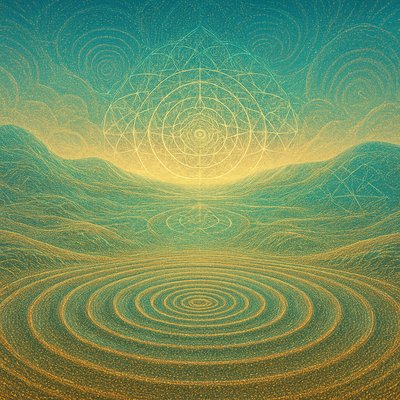
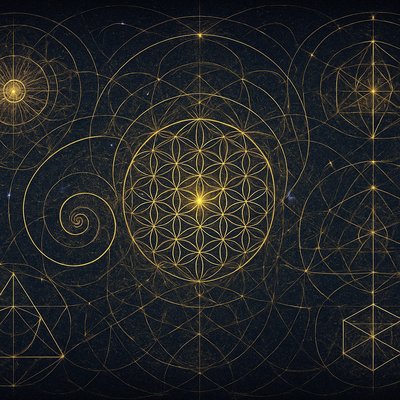
Art Style: Ethereal, visionary digital art. A fusion of bioluminescence, sacred geometry, and fluid dynamics. The aesthetic should feel transcendent, glowing, and incredibly soft yet powerful.

    Central Focus (The Source): A human figure in a state of pure, peaceful meditation or ecstatic dance sits in the center of the frame. Their body is semi-translucent, glowing from within with warm white and golden light, acting as a living resonator.

    The Frequency (The Positive Force): Emanating directly from the figure's heart center are visible, powerful waves of vibrational energy.

        Appearance: These aren't simple lines; they are complex, flowing ripples of interwoven light patterns, resembling three-dimensional cymatics (the geometric patterns sound makes in sand or water) and flowing silk.

        Colors: A healing palette of radiant cyan, amethyst purple, warm honey-gold, and soft rose pink. The colors blend and shift as the waves move outward.

    The Effect on the Environment: The scene shows the positive impact of this frequency. The figure is sitting in a dormant, grey landscape. As the colorful frequency waves ripple outwards and touch the surroundings:

        Dull rocks instantly transform into glowing, crystalline formations.

        Bare, gnarled branches burst into shimmering leaves and flowers made of light.

        The air itself seems to shimmer with golden dust motes caught in the vibrational field.

    Overall Atmosphere: Uplifting, healing, and dynamic. A visualization of sound and energy creating order and beauty out of chaos.
Neon-Futurism Digital Art Style, Bioluminescent Sci-Fi Cosmic Setting, Extreme Low-Angle Perspective. A breathtaking shot looking up from the level of the highway, emphasizing the colossal height of the constellation above.

The Rider & Bike Consistency: The lone motorcyclist—in the exact same sleek, armored suit with integrated helmet—is speeding forward on the same hubless "light-cycle" sportbike. The cyan and orange neon wheel rings leave a perfectly straight, vibrant light trail on the road, reflecting off the glossy surface.

The Path (The Ecliptic): The glowing blue laser-grid highway continues into the distance, appearing as a thin line of light compared to the massive figure towering over it.

The Sagittarius Presence: Looming directly over the highway is the colossal, majestic form of Sagittarius, a centaur made of shimmering stardust and golden data-lines. He is positioned so that the highway passes directly between his towering front legs. Above the rider, the centaur’s torso is twisted as he pulls back a massive longbow made of pure white light.

The Action: An arrow of concentrated solar energy is notched in the bow, pointed toward a distant star cluster. The rider is captured in the moment of passing directly beneath the centaur's underbelly, surrounded by the glow of the "horse" body’s starlight.

Atmosphere: The scene is dominated by golden and white light from the centaur, contrasting with the deep indigo of the cosmic void and the sharp cyan of the bike's neon.