And Be Not Drunk With Wine, Wherein Is Excess; But Be Filled With The Spirit; Speaking To Yourselves In Psalms And Hymns And Art

And be not drunk with wine, wherein is excess; but be filled with the Spirit; Speaking to yourselves in psalms and hymns and spiritual songs, singing and making melody in your heart to the Lord; Giving thanks always for all things unto God and the Father in the name of our Lord Jesus Christ; 
(Ephesians 5:18-20 KJV)
And be not drunk with wine, wherein is excess; but be filled with the Spirit; Speaking to yourselves in psalms and hymns and spiritual songs, singing and making melody in your heart to the Lord; Giving thanks always for all things unto God and the Father in the name of our Lord Jesus Christ; 
(Ephesians 5:18-20 KJV) Do not use words but only images to interpret the passage.
The sacrifices of God are a broken spirit: a broken and a contrite heart, O God, thou wilt not despise.” (Psalms 51:17, KJV)
“The sacrifices of God are a broken spirit: a broken and a contrite heart, O God, thou wilt not despise.” (Psalms 51:17, KJV)
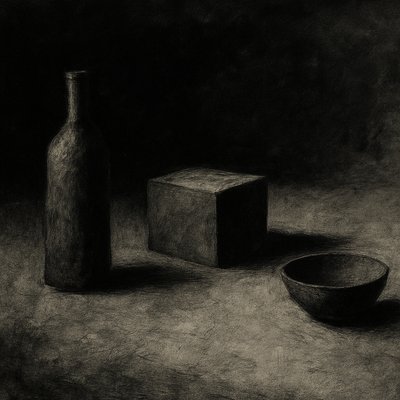
Guitar with wine bottle and newspaper
“The Jews then murmured at him, because he said, I am the bread which came down from heaven.” (John 6:41, KJV)
Do not put bread in the picture but rather the setting is Jesus teaching in synagogue in Capernaum with the people looking disgruntled, some whispering to eat other and perhaps someone standing and speaking out to Jesus.
A cinematic, hyper-realistic shot of a person standing in a serene, sun-drenched meadow at dawn. They have their eyes closed and a peaceful, joyful expression, with hands gently placed over their heart. A soft, radiant golden light emanates from within their chest, symbolizing the Spirit. In the deep shadows behind them, a dark, dusty wine goblet sits forgotten and untouched. Swirling, ethereal ribbons of light—resembling flowing musical staves—dance in the air around them. Warm atmosphere, divine glow, 8k resolution, highly detailed, no text, no words.
Do not use words to create the idea:

“Keep me as the apple of the eye, hide me under the shadow of thy wings,” (Psalms 17:8, KJV)

“As for me, I will behold thy face in righteousness: I shall be satisfied, when I awake, with thy likeness.” (Psalms 17:15, KJV)
“The sacrifices of God are a broken spirit: a broken and a contrite heart, O God, thou wilt not despise.” (Psalms 51:17, KJV)
Inside an informal church in Kuala Lumpur.  Wing Sun and his father and mother, along with Siu Zi, his friend from school are there together.  We are standing in the back of the room, and there are many more people than there were in the London church.  There are people of different ethnicities, but mostly Chinese Malaysian.  The Pastor, a Chinese man, is standing up front speaking to the congregation, facing them.  The atmosphere is hot and sweaty, with ceiling fans running, but still welcoming, Wing Sun is happy that his family is together and also that his friend Siu Zi, who he has just learned is a Christian, can be there too.
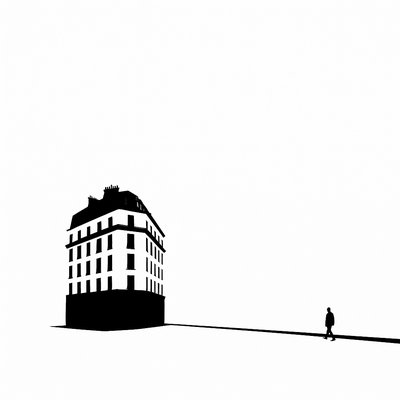
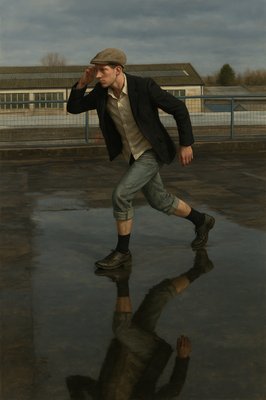
I have a little shadow that goes in and out with me,
And what can be the use of him is more than
I can see.
He is very, very like me from the heels up to the head;
And I see him jump before me, when I jump into my bed.
The funniest thing about him is the way he likes to grow—
Not at all like proper children, which is always very slow;
For he sometimes shoots up taller like an india-rubber ball,
And he sometimes goes so little that there’s none of him at all.
He hasn’t got a notion of how children ought to play,
And can only make a fool of me in every sort of way.
He stays so close behind me, he’s a coward you can see;
I’d think shame to stick to nursie as that shadow sticks to me!
One morning, very early, before the sun was up,
I rose and found the shining dew on every buttercup;
But my lazy little shadow, like an arrant sleepy-head,
Had stayed at home behind me and was fast asleep in bed.
“Therefore will not we fear, though the earth be removed, and though the mountains be carried into the midst of the sea; Though the waters thereof roar and be troubled, though the mountains shake with the swelling thereof. Selah. There is a river, the streams whereof shall make glad the city of God, the holy place of the tabernacles of the most High. God is in the midst of her; she shall not be moved: God shall help her, and that right early.” (Psalms 46:2-5, KJV)
Create a psychedelic album cover for a psydub album, inspired by Globular's The Messenger of the Resonator, but rendered in the style of alcohol-based markers. The artwork features a central figure resembling a cosmic shaman or resonator, surrounded by swirling, vibrant energy patterns. The figure is adorned with intricate, mandala-like designs and fractal elements, emitting waves of sound and light that ripple outward. The background features a surreal landscape with glowing, otherworldly plants, twisting vines, and floating orbs, all painted with vivid, blended colors like deep purples, neon blues, and bright greens. The alcohol marker style adds a hand-drawn texture with visible strokes and smooth gradients, creating a lively, organic feel. The sky is filled with swirling galaxies and cosmic resonances, merging with the figure's energy. The album title and artist name appear in a flowing, trippy font, subtly integrated into the design. The overall vibe is mystical, meditative, and cosmic, reflecting the spiritual journey and sound exploration typical of Globular's style
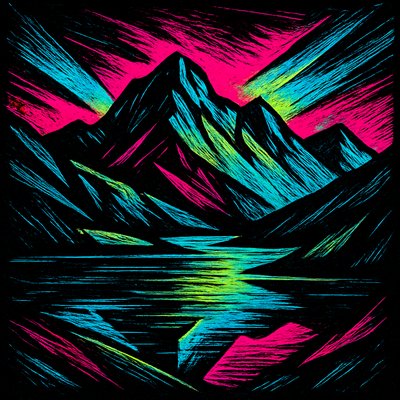
“Therefore will not we fear, though the earth be removed, and though the mountains be carried into the midst of the sea; Though the waters thereof roar and be troubled, though the mountains shake with the swelling thereof. Selah. There is a river, the streams whereof shall make glad the city of God, the holy place of the tabernacles of the most High. God is in the midst of her; she shall not be moved: God shall help her, and that right early.” (Psalms 46:2-5, KJV) Do not use any Temple or religious building. Create only the landscape
Create a psychedelic album cover for a psydub album, inspired by Globular's The Messenger of the Resonator, but rendered in the style of alcohol-based markers. The artwork features a central figure resembling a cosmic shaman or resonator, surrounded by swirling, vibrant energy patterns. The figure is adorned with intricate, mandala-like designs and fractal elements, emitting waves of sound and light that ripple outward. The background features a surreal landscape with glowing, otherworldly plants, twisting vines, and floating orbs, all painted with vivid, blended colors like deep purples, neon blues, and bright greens. The alcohol marker style adds a hand-drawn texture with visible strokes and smooth gradients, creating a lively, organic feel. The sky is filled with swirling galaxies and cosmic resonances, merging with the figure's energy. The album title and artist name appear in a flowing, trippy font, subtly integrated into the design. The overall vibe is mystical, meditative, and cosmic, reflecting the spiritual journey and sound exploration typical of Globular's style
Woe unto them that call evil good, and good evil; that put darkness for light, and light for darkness; that put bitter for sweet, and sweet for bitter!

"The world is in greater peril from those who tolerate or encourage evil than from those who actually commit it."

DO NOT PUT WORDS IN THE IMAGE
A giant grouper fish, over a coral reef in the ocean, professional photography, extreme detail (
Psalms 124:1-6 KJVA  A Song of degrees of David. If it had not been the LORD who was on our side, now may Israel say;  (2)  If it had not been the LORD who was on our side, when men rose up against us:  (3)  Then they had swallowed us up quick, when their wrath was kindled against us:  (4)  Then the waters had overwhelmed us, the stream had gone over our soul:  (5)  Then the proud waters had gone over our soul.  (6)  Blessed be the LORD, who hath not given us as a prey to their teeth.
A high-detail cinematic wide shot of Noah, an elderly but robust patriarch with a long white beard and linen robes, standing in a lush vineyard on the slopes of the craggy Mount Lubar. He is holding a clay chalice of deep red wine. In the background, rows of vibrant green grapevines are heavy with purple fruit. The lighting is the golden hour of a Mediterranean sunset, casting long shadows. Ancient stone altars are visible in the distance. 8k resolution, photorealistic, historical epic style.
Do not use words to create the idea:

“Keep me as the apple of the eye, hide me under the shadow of thy wings,” (Psalms 17:8, KJV)

“As for me, I will behold thy face in righteousness: I shall be satisfied, when I awake, with thy likeness.” (Psalms 17:15, KJV)
Southeast Asia.  Modern day.  The damaged and the broken ones; all rooted in the past,
	live life the way it always was, from their first day to their last.
	Motes of dust in beams of light, in the darkness of this day,
	we tip the hat and give a nod, for the truth we can’t convey.

	Everything is real, but nothing matters, anyway.
	Where life is only what must be, from the cradle to the grave.
	Everyone does what they can:  Nothing less, but sure no more. 
	Tip the hat and give a nod to the ones who’ve gone before.
	We tip our hats and give the nod to the world we’ve all ignored
This day, though, I hiked another autumn wood.  Eastern Europe ancient; overgrown.  So thick the view was dark at just a few feet off the path.  All red and yellow; orange and brown, a million trees, each one in blazing preparation for long, frozen winter.  I cannot but recall my friend’s words, lasting long, though he did not, and the instant truth that follows.  Looking upward at the fiery canopy, matched against the bright cerulean sky beyond, I embrace autumn!  Winter surely comes one day, but spring beyond.  I have a winter to prepare for, but it is not yet.
“The LORD looked down from heaven upon the children of men, to see if there were any that did understand, and seek God.” (Psalms 14:2, KJV)
Forasmuch then as the children are partakers of flesh and blood, he also himself likewise took part of the same; that through death he might destroy him that had the power of death, that is, the devil; And deliver them who through fear of death were all their lifetime subject to bondage. For verily he took not on him the nature of angels; but he took on him the seed of Abraham. Wherefore in all things it behoved him to be made like unto his brethren, that he might be a merciful and faithful high priest in things pertaining to God, to make reconciliation for the sins of the people. For in that he himself hath suffered being tempted, he is able to succour them that are tempted. 
(Hebrews 2:14-18 KJV)
And this is the Father's will which hath sent me, that of all which he hath given me I should lose nothing, but should raise it up again at the last day.
(John 6:39 KJV)
And this is the Father's will which hath sent me, that of all which he hath given me I should lose nothing, but should raise it up again at the last day.
(John 6:39 KJV)
“And there was one Anna, a prophetess, the daughter of Phanuel, of the tribe of Aser: she was of a great age, and had lived with an husband seven years from her virginity; And she was a widow of about fourscore and four years, which departed not from the temple, but served God with fastings and prayers night and day. And she coming in that instant gave thanks likewise unto the Lord, and spake of him to all them that looked for redemption in Jerusalem.” (Luke 2:36-38, KJV)
Create with a photorealistic expression
And this is the Father's will which hath sent me, that of all which he hath given me I should lose nothing, but should raise it up again at the last day.
(John 6:39 KJV)
And this is the Father's will which hath sent me, that of all which he hath given me I should lose nothing, but should raise it up again at the last day.
(John 6:39 KJV)
And this is the Father's will which hath sent me, that of all which he hath given me I should lose nothing, but should raise it up again at the last day.
(John 6:39 KJV)
And this is the Father's will which hath sent me, that of all which he hath given me I should lose nothing, but should raise it up again at the last day.
(John 6:39 KJV)
Digital Art Style, Romanticism Art Style, a profoundly joyful and beautifully vibrant painting inspired by Psalm 16:11, "You make known to me the path of life; you will fill me with joy in your presence, with eternal pleasures at your right hand." The scene features a pair of exquisitely detailed Peach-faced Lovebirds, with their iconic bright peach faces, vivid green bodies, and touches of blue on their rumps. They are perched affectionately close together on a blossoming branch, their expressions conveying deep contentment and joy. Behind them, a softly glowing, ethereal 'path' of light winds gently through a lush, vibrant, and abundant natural landscape, illuminated by a warm, radiant, divine light that bathes the entire scene. The environment is rich with blooming flowers and verdant foliage, suggesting a place of eternal pleasure and divine presence. Focus intently on the vibrant, luminous colors of the Lovebirds, their tender, joyful interaction, and the glowing, symbolic 'path of life' that permeates the harmonious and blissful atmosphere
And this is the Father's will which hath sent me, that of all which he hath given me I should lose nothing, but should raise it up again at the last day.
(John 6:39 KJV) Focus on graves opened and joyous youthful looking people coming forth.
“And as they were eating, Jesus took bread, and blessed it, and brake it, and gave it to the disciples, and said, Take, eat; this is my body. And he took the cup, and gave thanks, and gave it to them, saying, Drink ye all of it; For this is my blood of the new testament, which is shed for many for the remission of sins. But I say unto you, I will not drink henceforth of this fruit of the vine, until that day when I drink it new with you in my Father's kingdom.” (Matthew 26:26-29, KJV)
A low-angle, hyper-detailed tableau of the Mad Hatter's Tea Party, viewed under a dark, star-filled sky. The Mad Hatter sits at the table, his features not quite human, but constructed entirely from brilliant indigo and gold cosmic dust, representing the constellation Lepus. His top hat is a vortex of nebula, and one eye burns intensely—a specific star named "The Mad."

The Hatter is caught mid-sentence, demanding, "Why is a raven like a writing-desk?" As he speaks, his hands, which were merely starry, begin to shed their light, and the true form is revealed: the lower half of his coat and chair morph into coiling, dark serpentine scales, twisting around the table leg. The March Hare and Dormouse are frozen in terror. Above the table, a Raven made of pitch-black night materializes, its shadow falling directly over the Hatter. The entire scene is vibrating with the furious energy of a creature—the ancient serpent—who knows his time has been irrevocably stopped.

Style: Cinematic dark fantasy, astronomical realism, oil painting texture, emphasis on the contrast between the cold cosmic starlight and the dark, furious energy of the serpentine transformation.
“And as they were eating, Jesus took bread, and blessed it, and brake it, and gave it to the disciples, and said, Take, eat; this is my body. And he took the cup, and gave thanks, and gave it to them, saying, Drink ye all of it; For this is my blood of the new testament, which is shed for many for the remission of sins. But I say unto you, I will not drink henceforth of this fruit of the vine, until that day when I drink it new with you in my Father's kingdom.” (Matthew 26:26-29, KJV) Use Matzo style bread
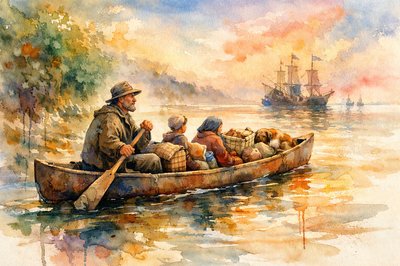
A historically accurate and atmospheric depiction of the signing of the Mayflower Compact aboard the ship in November 1620. The scene is set in the dimly lit, cramped cabin of the Mayflower, with the ship's timbers and rigging subtly visible, conveying the challenging conditions of the voyage. A simple table or chest serves as the signing surface. The primary focus is on a small group of the last individuals signing the document: specifically, the indentured servants (or 'strangers' not directly part of the Separatist congregation) approaching or at the table. Their expressions show a mix of weary determination, understanding of the necessity, and perhaps a hint of quiet apprehension or resignation to this new social contract, given their status. They are dressed in the plain, practical clothing typical of 17th-century commoners and laborers. Figures of prominent Pilgrims or 'Saints' (like William Bradford or John Carver) are visible in the background, observing the proceedings with a sense of gravity and leadership, but they are not the central focus. The lighting is low and warm, perhaps from a lantern, creating a chiaroscuro effect that highlights the faces of the signers. The atmosphere conveys the momentousness of the act under difficult circumstances, the diverse composition of the group, and the early seeds of self-governance in a new world. The artistic style is a realistic, historically detailed oil painting, capturing the solemnity and human element of this pivotal historical moment."
John 8:12 (KJV)
12 Then spake Jesus again unto them, saying, I am the light of the world: he that followeth me shall not walk in darkness, but shall have the light of life.
“Lift up your heads, O ye gates; even lift them up, ye everlasting doors; and the King of glory shall come in.” (Psalms 24:9, KJV)
“The LORD looked down from heaven upon the children of men, to see if there were any that did understand, and seek God.” (Psalms 14:2, KJV)
Renaissance Painting Art Style, a solemn and reverent group of ancient Israelites, including elderly men and women, walking purposefully. Each carries beautifully crafted clay jars or alabaster flasks filled with pure, clear, golden oil of pressed olives. The oil shimmers with an ethereal clarity within the translucent vessels. They are making their way along a dusty path in the Tabernacle courtyard, with glimpses of the Tabernacle structure in the background. The light is soft and warm, casting gentle shadows and highlighting the dignified expressions on their faces and the humble, yet sacred, nature of their offering. Focus on the rich textures of their simple linen garments, the liquid clarity and glow of the olive oil, and the devotional atmosphere of their task.