“And Unto Sarah He Said, Behold, I Have Given Thy Brother A Thousand Pieces Of Silver: Behold, He Is To Thee A Covering Of The Art

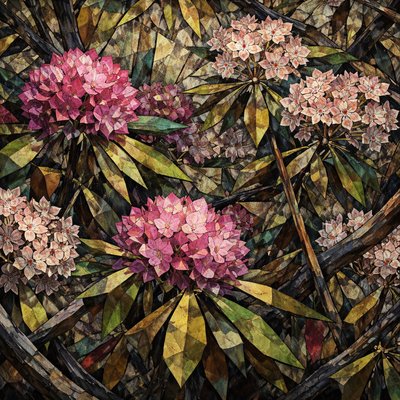
Art Style: Analytical Cubism, avant-garde oil painting style reminiscent of Picasso and Braque.

Subject: A dense, tangled thicket of Rhododendrons and Mountain Laurel bushes.

Composition & Details: The entire natural scene is deconstructed into overlapping geometric planes, fractured shards, and intersecting angles. There are no curved lines; everything is rendered in cubes, cones, and trapezoids.

    The Rhododendrons: Large, showy flower trusses are broken into faceted crystalline structures of deep magenta, rose pink, and violet blocks, looking like explosions of colored quartz rather than soft petals.

    The Mountain Laurels: The smaller, intricate flowers are rendered as complex, repeating geometric star-patterns and angular cups in white and pale pink with distinct red polygonal markings.

    Foliage & Branches: The thick, leathery leaves are fragmented green triangles and parallelograms overlapping each other, creating a sense of depth without traditional perspective. The woody stems and branches are jagged, intersecting brown and grey cylinders that shatter across the frame.
Color & Texture: A palette of muted earth tones—ochre, burnt umber, forest green, and slate grey—contrasted sharply with the jewel-toned facets of the flower colors. The finish should have a heavy, textured oil paint feel with visible palette knife marks and rough brushwork.
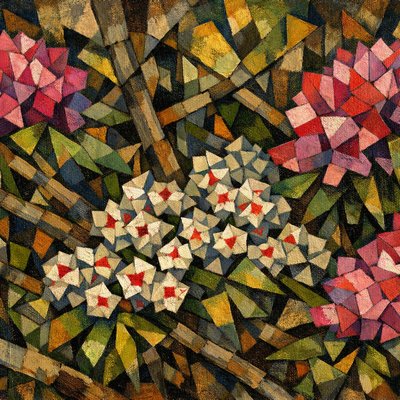
Art Style: Analytical Cubism, avant-garde oil painting style reminiscent of Picasso and Braque.

Subject: A dense, tangled thicket of Rhododendrons and Mountain Laurel bushes.

Composition & Details: The entire natural scene is deconstructed into overlapping geometric planes, fractured shards, and intersecting angles. There are no curved lines; everything is rendered in cubes, cones, and trapezoids.

    The Rhododendrons: Large, showy flower trusses are broken into faceted crystalline structures of deep magenta, rose pink, and violet blocks, looking like explosions of colored quartz rather than soft petals.

    The Mountain Laurels: The smaller, intricate flowers are rendered as complex, repeating geometric star-patterns and angular cups in white and pale pink with distinct red polygonal markings.

    Foliage & Branches: The thick, leathery leaves are fragmented green triangles and parallelograms overlapping each other, creating a sense of depth without traditional perspective. The woody stems and branches are jagged, intersecting brown and grey cylinders that shatter across the frame.
Color & Texture: A palette of muted earth tones—ochre, burnt umber, forest green, and slate grey—contrasted sharply with the jewel-toned facets of the flower colors. The finish should have a heavy, textured oil paint feel with visible palette knife marks and rough brushwork.
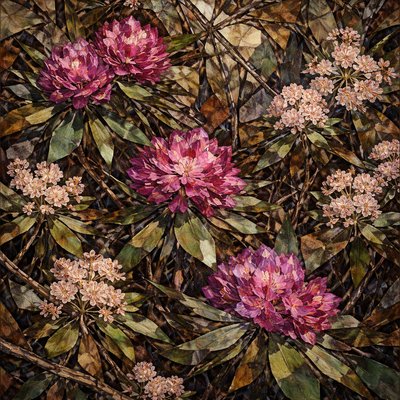
Art Style: Analytical Cubism, avant-garde oil painting style reminiscent of Picasso and Braque.

Subject: A dense, tangled thicket of Rhododendrons and Mountain Laurel bushes.

Composition & Details: The entire natural scene is deconstructed into overlapping geometric planes, fractured shards, and intersecting angles. There are no curved lines; everything is rendered in cubes, cones, and trapezoids.

    The Rhododendrons: Large, showy flower trusses are broken into faceted crystalline structures of deep magenta, rose pink, and violet blocks, looking like explosions of colored quartz rather than soft petals.

    The Mountain Laurels: The smaller, intricate flowers are rendered as complex, repeating geometric star-patterns and angular cups in white and pale pink with distinct red polygonal markings.

    Foliage & Branches: The thick, leathery leaves are fragmented green triangles and parallelograms overlapping each other, creating a sense of depth without traditional perspective. The woody stems and branches are jagged, intersecting brown and grey cylinders that shatter across the frame.

Color & Texture: A palette of muted earth tones—ochre, burnt umber, forest green, and slate grey—contrasted sharply with the jewel-toned facets of the flower colors. The finish should have a heavy, textured oil paint feel with visible palette knife marks and rough brushwork.
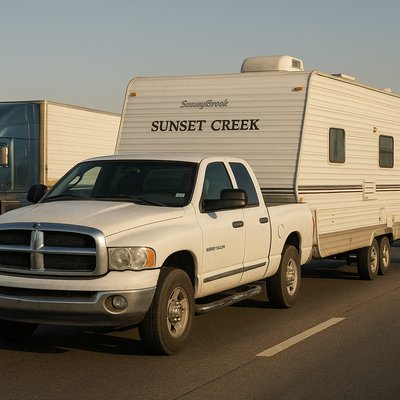
Generate a realistic, eye-level photograph of a white 2002 Dodge Ram 2500 pickup truck, specifically a quad cab model, pulling a 33-foot Sunnybrook Sunset Creek travel trailer. The trailer must have distinct, painted aluminum siding. The entire rig is situated in the middle of heavy, slow-moving traffic on Interstate 40 (I-40) in Amarillo, Texas, with other cars and semi-trucks visible all around. The time of day is late afternoon, with the sun casting long shadows, and the sky is clear, typical of the Texas Panhandle. The focus is on the truck and trailer, showing the details of both vehicles amidst the bustling highway environment.
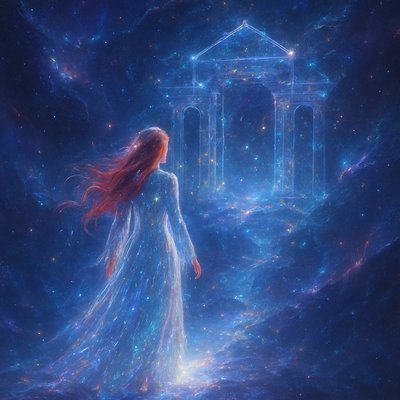
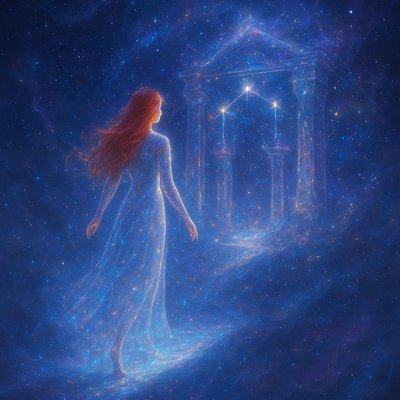
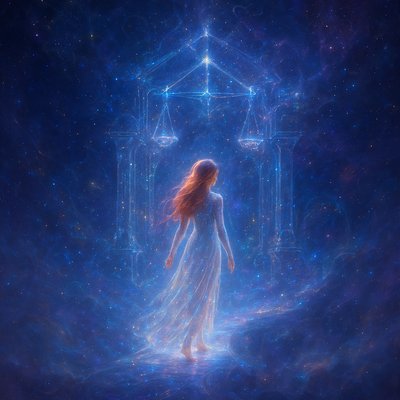
An ethereal and surreal depiction of a figure in a deep dream state, gracefully walking into the heart of the Mountain House constellation, also known as Libra. The figure is a lady with long, flowing red hair, shimmering full length robe  radiating star light. She is stepping off a softly glowing, dream-like pathway or ethereal bridge that extends from a misty, dreamscape foreground into the vastness of space.

    The Mountain House (Libra) constellation is not just stars but appears as a majestic, floating celestial architecture – perhaps as ancient, star-dusted pillars, glowing celestial doorways forming a 'mountain house' structure, built from nebulae and starlight. Within this constellation, gentle cosmic dust, shimmering gas clouds, and distant galaxies are visible, creating a sense of infinite depth.

    The dominant colors are soft blues, purples, and deep indigos of space, interwoven with golden and silver light emanating from the stars and the lady's luminous form and radiant red hair. There's a profound sense of peace, wonder, and weightlessness. The atmosphere is serene and magical, conveying the feeling of transcending physical reality and entering a realm of cosmic balance and ancient wisdom. The artistic style is highly fantastical and painterly, with a focus on glowing effects, subtle transparency, and a dreamlike composition.
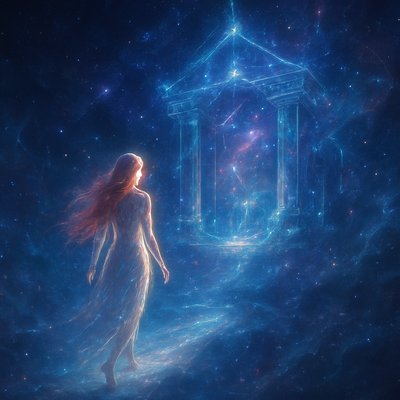
An ethereal and surreal depiction of a figure in a deep dream state, gracefully walking into the heart of the Mountain House constellation, also known as Libra. The figure is a lady with long, flowing red hair, shimmering full length dress radiating star light, suggesting her dream presence. She is stepping off a softly glowing, dream-like pathway or ethereal bridge that extends from a misty, dreamscape foreground into the vastness of space.

    The Mountain House (Libra) constellation is not just stars but appears as a majestic, floating celestial architecture – perhaps as ancient, star-dusted pillars, glowing celestial doorways forming a 'mountain house' structure, built from nebulae and starlight. Within this constellation, gentle cosmic dust, shimmering gas clouds, and distant galaxies are visible, creating a sense of infinite depth.

    The dominant colors are soft blues, purples, and deep indigos of space, interwoven with golden and silver light emanating from the stars and the lady's luminous form and radiant red hair. There's a profound sense of peace, wonder, and weightlessness. The atmosphere is serene and magical, conveying the feeling of transcending physical reality and entering a realm of cosmic balance and ancient wisdom. The artistic style is highly fantastical and painterly, with a focus on glowing effects, subtle transparency, and a dreamlike composition.
An ethereal and surreal depiction of a figure in a deep dream state, gracefully walking into the heart of the Mountain House constellation, also known as Libra. The figure is a lady with long, flowing red hair, luminous, radiating a soft inner light, suggesting her non-physical dream presence. She is stepping off a softly glowing, dream-like pathway or ethereal bridge that extends from a misty, dreamscape foreground into the vastness of space.

    The Mountain House (Libra) constellation is not just stars but appears as a majestic, floating celestial architecture – perhaps as ancient, star-dusted pillars, glowing celestial doorways forming a 'mountain house' structure, built from nebulae and starlight. Within this constellation, gentle cosmic dust, shimmering gas clouds, and distant galaxies are visible, creating a sense of infinite depth.

    The dominant colors are soft blues, purples, and deep indigos of space, interwoven with golden and silver light emanating from the stars and the lady's luminous form and radiant red hair. There's a profound sense of peace, wonder, and weightlessness. The atmosphere is serene and magical, conveying the feeling of transcending physical reality and entering a realm of cosmic balance and ancient wisdom. The artistic style is highly fantastical and painterly, with a focus on glowing effects, subtle transparency, and a dreamlike composition.
An ethereal and surreal depiction of a figure in a deep dream state, gracefully walking into the heart of the Mountain House constellation, also known as Libra. The figure is a lady with long, flowing red hair, translucent and luminous, radiating a soft inner light, suggesting her non-physical dream presence. She is stepping off a softly glowing, dream-like pathway or ethereal bridge that extends from a misty, dreamscape foreground into the vastness of space.

    The Mountain House (Libra) constellation is not just stars but appears as a majestic, floating celestial architecture – perhaps as ancient, star-dusted pillars, glowing celestial doorways forming a 'mountain house' structure, built from nebulae and starlight. Within this constellation, gentle cosmic dust, shimmering gas clouds, and distant galaxies are visible, creating a sense of infinite depth.

    The dominant colors are soft blues, purples, and deep indigos of space, interwoven with golden and silver light emanating from the stars and the lady's luminous form and radiant red hair. There's a profound sense of peace, wonder, and weightlessness. The atmosphere is serene and magical, conveying the feeling of transcending physical reality and entering a realm of cosmic balance and ancient wisdom. The artistic style is highly fantastical and painterly, with a focus on glowing effects, subtle transparency, and a dreamlike composition.
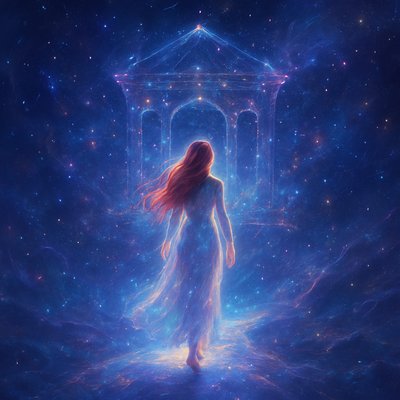
An ethereal and surreal depiction of a figure in a deep dream state, gracefully walking into the heart of the Mountain House constellation, also known as Libra. The figure is a lady with long, flowing red hair, luminous shimmering full length dress radiating a soft inner light, suggesting her non-physical dream presence. She is stepping off a softly glowing, dream-like pathway or ethereal bridge that extends from a misty, dreamscape foreground into the vastness of space.

    The Mountain House (Libra) constellation is not just stars but appears as a majestic, floating celestial architecture – perhaps as ancient, star-dusted pillars, glowing celestial doorways forming a 'mountain house' structure, built from nebulae and starlight. Within this constellation, gentle cosmic dust, shimmering gas clouds, and distant galaxies are visible, creating a sense of infinite depth.

    The dominant colors are soft blues, purples, and deep indigos of space, interwoven with golden and silver light emanating from the stars and the lady's luminous form and radiant red hair. There's a profound sense of peace, wonder, and weightlessness. The atmosphere is serene and magical, conveying the feeling of transcending physical reality and entering a realm of cosmic balance and ancient wisdom. The artistic style is highly fantastical and painterly, with a focus on glowing effects, subtle transparency, and a dreamlike composition.
An ethereal and surreal depiction of a figure in a deep dream state, gracefully walking into the heart of the Mountain House constellation, also known as Libra. The figure is a lady with long, flowing red hair, luminous shimmering full length dress radiating a soft inner light, suggesting her non-physical dream presence. She is stepping off a softly glowing, dream-like pathway or ethereal bridge that extends from a misty, dreamscape foreground into the vastness of space.

    The Mountain House (Libra) constellation is not just stars but appears as a majestic, floating celestial architecture – perhaps as ancient, star-dusted pillars, glowing celestial doorways forming a 'mountain house' structure, built from nebulae and starlight. Within this constellation, gentle cosmic dust, shimmering gas clouds, and distant galaxies are visible, creating a sense of infinite depth.

    The dominant colors are soft blues, purples, and deep indigos of space, interwoven with golden and silver light emanating from the stars and the lady's luminous form and radiant red hair. There's a profound sense of peace, wonder, and weightlessness. The atmosphere is serene and magical, conveying the feeling of transcending physical reality and entering a realm of cosmic balance and ancient wisdom. The artistic style is highly fantastical and painterly, with a focus on glowing effects, subtle transparency, and a dreamlike composition.
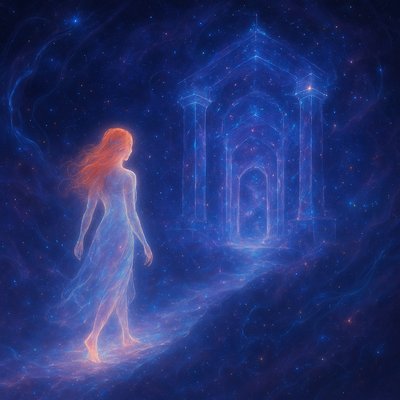
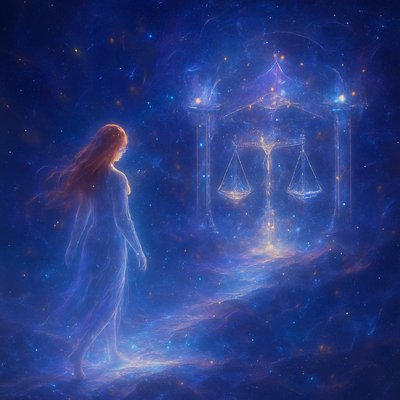
An ethereal and surreal depiction of a figure in a deep dream state, gracefully walking into the heart of the Mountain House constellation, also known as Libra. The figure is a lady with long, flowing red hair, translucent and luminous, radiating a soft inner light, suggesting her non-physical dream presence. She is stepping off a softly glowing, dream-like pathway or ethereal bridge that extends from a misty, dreamscape foreground into the vastness of space.

    The Mountain House (Libra) constellation is not just stars but appears as a majestic, floating celestial architecture – perhaps as ancient, star-dusted pillars, balanced cosmic scales, or glowing celestial doorways forming a 'mountain house' structure, built from nebulae and starlight. Within this constellation, gentle cosmic dust, shimmering gas clouds, and distant galaxies are visible, creating a sense of infinite depth.

    The dominant colors are soft blues, purples, and deep indigos of space, interwoven with golden and silver light emanating from the stars and the lady's luminous form and radiant red hair. There's a profound sense of peace, wonder, and weightlessness. The atmosphere is serene and magical, conveying the feeling of transcending physical reality and entering a realm of cosmic balance and ancient wisdom. The artistic style is highly fantastical and painterly, with a focus on glowing effects, subtle transparency, and a dreamlike composition.
An ethereal and surreal depiction of a figure in a deep dream state, gracefully walking into the heart of the Mountain House constellation, also known as Libra. The figure is a lady with long, flowing red hair, translucent and luminous, radiating a soft inner light, suggesting her non-physical dream presence. She is stepping off a softly glowing, dream-like pathway or ethereal bridge that extends from a misty, dreamscape foreground into the vastness of space.

    The Mountain House (Libra) constellation is not just stars but appears as a majestic, floating celestial architecture – perhaps as ancient, star-dusted pillars, balanced cosmic scales, or glowing celestial doorways forming a 'mountain house' structure, built from nebulae and starlight. Within this constellation, gentle cosmic dust, shimmering gas clouds, and distant galaxies are visible, creating a sense of infinite depth.

    The dominant colors are soft blues, purples, and deep indigos of space, interwoven with golden and silver light emanating from the stars and the lady's luminous form and radiant red hair. There's a profound sense of peace, wonder, and weightlessness. The atmosphere is serene and magical, conveying the feeling of transcending physical reality and entering a realm of cosmic balance and ancient wisdom. The artistic style is highly fantastical and painterly, with a focus on glowing effects, subtle transparency, and a dreamlike composition.
A candid, tender photograph of a person lying sick in a dimly lit, cozy bedroom, buried under a heavy quilt with only their pale face showing, eyes closed in sleep. Tissues and medicine bottles clutter a bedside table. Curled tightly against their chest is a fluffy calico cat that has a pair of small, detailed, feathered angel wings folded against its back. The cat is asleep too. Soft, natural light streams from a window to the left. Film grain.
Generate a realistic, eye-level photograph of a white 2002 Dodge Ram 2500 pickup truck, specifically a quad cab model, pulling a 33-foot Sunnybrook Sunset Creek travel trailer. The trailer must have distinct, painted aluminum siding. The entire rig is situated in the middle of heavy, slow-moving traffic on Interstate 40 (I-40) in Amarillo, Texas, with other cars and semi-trucks visible all around. The time of day is late afternoon, with the sun casting long shadows, and the sky is clear, typical of the Texas Panhandle. The focus is on the truck and trailer, showing the details of both vehicles amidst the bustling highway environment.
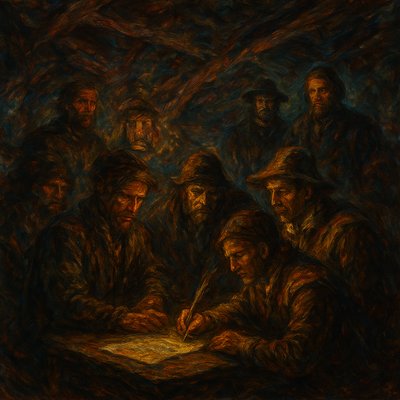
A historically accurate and atmospheric depiction of the signing of the Mayflower Compact aboard the ship in November 1620. The scene is set in the dimly lit, cramped cabin of the Mayflower, with the ship's timbers and rigging subtly visible, conveying the challenging conditions of the voyage. A simple table or chest serves as the signing surface. The primary focus is on a small group of the last individuals signing the document: specifically, the indentured servants (or 'strangers' not directly part of the Separatist congregation) approaching or at the table. Their expressions show a mix of weary determination, understanding of the necessity, and perhaps a hint of quiet apprehension or resignation to this new social contract, given their status. They are dressed in the plain, practical clothing typical of 17th-century commoners and laborers. Figures of prominent Pilgrims or 'Saints' (like William Bradford or John Carver) are visible in the background, observing the proceedings with a sense of gravity and leadership, but they are not the central focus. The lighting is low and warm, perhaps from a lantern, creating a chiaroscuro effect that highlights the faces of the signers. The atmosphere conveys the momentousness of the act under difficult circumstances, the diverse composition of the group, and the early seeds of self-governance in a new world. The artistic style is a realistic, historically detailed oil painting, capturing the solemnity and human element of this pivotal historical moment."
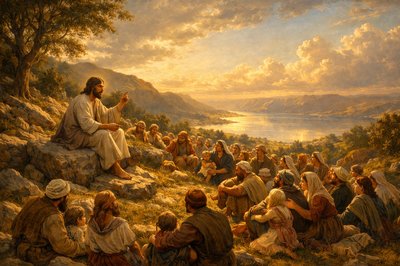
First century Palestine.  Jesus sits on a rock on a hillside teaching a large group of His disciples.  The Sermon on the Mount.  Jesus wears a plain robe like most ordinary men.  Jesus' face is kind, but intense, as He teaches. The other people are mostly peasants, farmers, and tradesmen.  There are also women present, wearing plain, everyday clothing.  Some couples have also brought their children.  The Sea of Galilee shines in the far distance.
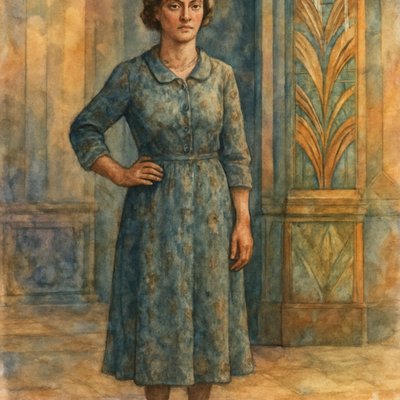
A woman dressed in Great Depression era fashion, standing in a dimly lit, humble setting. She wears a modest, long-sleeved dress made of durable, slightly faded cotton or rayon, with a mid-calf hemline. The dress is a muted color like dusty blue, faded green, or soft brown, possibly with a subtle, small floral or geometric pattern. Her hair is styled simply, perhaps in soft waves or a practical updo, and she wears sturdy, low-heeled lace-up shoes. Her posture is resilient, reflecting the strength of the era. The background is simple and sparse, hinting at the economic hardship, perhaps an old wooden wall or a faded curtain. The overall feeling is one of quiet determination and dignified hardship Use Art Deco architecture or Art Deco interior in the background, but describe the fashion as faded, worn, and humble. Juxtapose the sleek, modern geometry of the setting with the practical, mended, and heavy wool textures of the clothing.
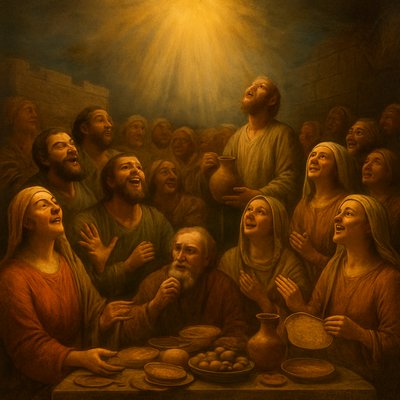
Renaissance Painting Art Style, Symbolism Art Style, a profoundly joyful and uplifting painting inspired by Nehemiah 8:10, emphasizing "the joy of the Lord is your strength." The scene depicts a vibrant, bustling gathering of diverse ancient Israelites, engaged in a communal feast and celebration. People of all ages are shown with radiant, happy faces, some laughing heartily, others sharing food and drinks, and many with expressions of deep, peaceful contentment and spiritual upliftment. A few figures have their heads tilted upwards or hands gently raised, as if receiving a subtle, warm, golden divine light that bathes the scene, emanating from above and symbolizing the presence and strength of the Lord. The setting is an outdoor gathering, perhaps near a restored wall or a communal square, filled with rich textures of food, drink, and colorful garments. The atmosphere is one of shared delight, spiritual renewal, and unbreakable strength. Focus on the authentic, diverse expressions of joy on each individual's face, the sense of vibrant community and shared celebration, and the ethereal, empowering golden light that symbolizes the Lord's strength.
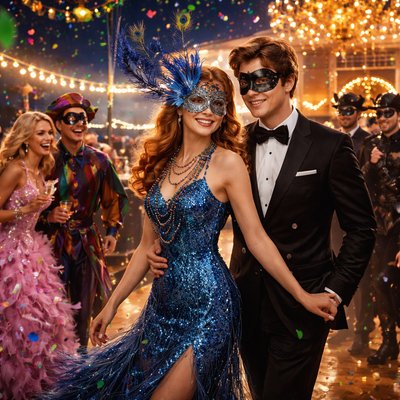
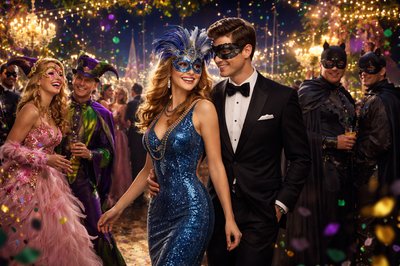
Elegant Mardi Gras party at the Silver Yacht Club in New Orleans at night from Nancy Drew book #81 The Mardi Gras Mystery. Luxurious yacht club deck or ballroom overlooking water, twinkling lights and purple/green/gold decorations, colorful beads and confetti in the air. Teenage detective Nancy Drew in center, reddish-blonde hair, wearing a sparkling blue masquerade gown with feathered mask, beads, and a determined yet smiling expression, dancing or mingling. Ned Nickerson beside her in a dashing tuxedo or masked costume, arm around her. Bess Marvin (blonde, glamorous) in a pink feathered ball gown laughing with George Fayne (short dark hair) in a fun jester or adventurous outfit. Brian Seaton and his father in partial bat-themed costumes with capes and masks nearby. Background: masked guests in elaborate gowns, tuxedos, and festive attire, live jazz band playing trumpets and saxophones, yacht masts or water view, chandeliers or string lights glowing, subtle suspenseful shadows hinting at mystery. Vibrant 1980s Nancy Drew book illustration style, adventurous festive atmosphere, detailed costumes, cinematic lighting with warm golden hues and colorful pops, high energy party scene
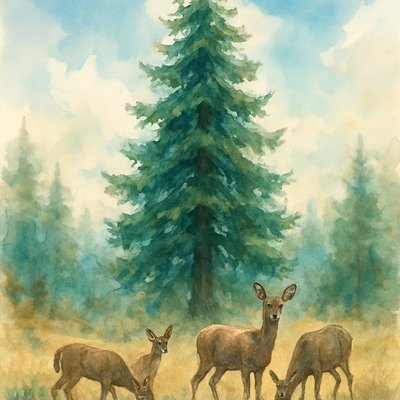
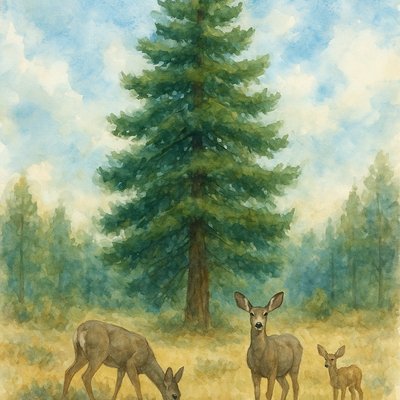
A serene and majestic watercolor painting, capturing the essence of a grand, towering evergreen tree (like the dominant one in the provided image) standing proudly in a sun-dappled, open forest glade. The tree's deep green needles are rendered with varying washes, showcasing its immense height and full, tiered branches that reach towards a partly cloudy, bright blue sky.

In the foreground and around the base of this glorious tree, two or three graceful mule deer are depicted. One might be grazing peacefully, another looking up towards the viewer with its large, expressive ears, and a fawn possibly tucked nearby. Their coats are rendered in soft, earthy watercolor tones of grey-brown, with delicate highlights and shading to suggest their gentle forms and distinctive white rumps and tails.

The surrounding landscape features a subtle ground cover of dry grasses and scattered undergrowth, characteristic of a high-desert or mountain forest floor, painted with soft, blended washes of ochre, sage green, and light brown. The sky above is a classic watercolor blend of soft blues and wispy white clouds. The overall mood is one of tranquil natural beauty, quiet majesty, and a harmonious coexistence of wildlife and ancient trees, rendered with the flowing, luminous quality of watercolor art
Elegant Mardi Gras party at the Silver Yacht Club in New Orleans at night from Nancy Drew book #81 The Mardi Gras Mystery. Luxurious yacht club deck or ballroom overlooking water, twinkling lights and purple/green/gold decorations, colorful beads and confetti in the air. Teenage detective Nancy Drew in center, reddish-blonde hair, wearing a sparkling blue masquerade gown with feathered mask, beads, and a determined yet smiling expression, dancing or mingling. Ned Nickerson beside her in a dashing tuxedo or masked costume, arm around her. Bess Marvin (blonde, glamorous) in a pink feathered ball gown laughing with George Fayne (short dark hair) in a fun jester or adventurous outfit. Brian Seaton and his father in partial bat-themed costumes with capes and masks nearby. Background: masked guests in elaborate gowns, tuxedos, and festive attire, live jazz band playing trumpets and saxophones, yacht masts or water view, chandeliers or string lights glowing, subtle suspenseful shadows hinting at mystery. Vibrant 1980s Nancy Drew book illustration style, adventurous festive atmosphere, detailed costumes, cinematic lighting with warm golden hues and colorful pops, high energy party scene
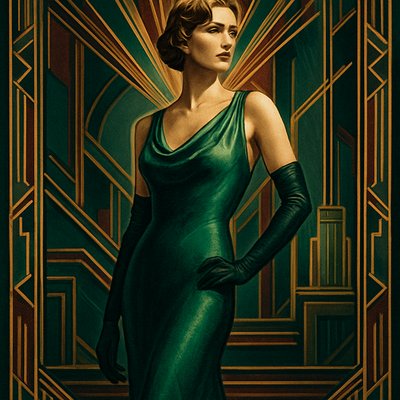
A statuesque woman in high-fashion 1930s glamour, strong Art Deco aesthetic. She wears a bias-cut evening gown of shimmering emerald green silk satin, featuring an elongated, sleek silhouette and a dramatic cowl neck. Her hair is styled in soft, sculpted finger waves. She wears long elegant gloves. The background is a sophisticated Art Deco interior with geometric patterns and polished chrome details, under dramatic lighting. Cinematic photography, classic Hollywood portraiture, hyperrealistic, vintage chic, elegant allure."
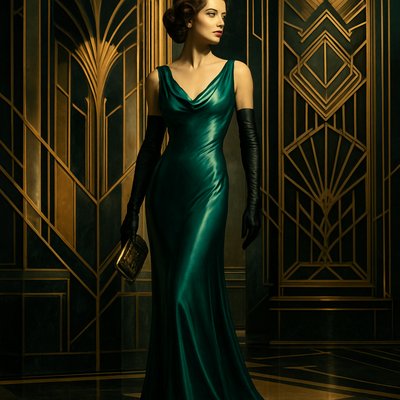
A statuesque woman dressed in high-fashion 1930s Great Depression era glamour, imbued with a strong Art Deco aesthetic. She stands confidently, showcasing a bias-cut evening gown of shimmering silk or satin in a rich jewel tone (e.g., emerald green, sapphire blue, ruby red, or metallic silver/gold). The gown features an elongated, sleek silhouette, perhaps a dramatic cowl neck, a plunging back, or subtle shoulder pads. Her hair is styled in soft, sculpted finger waves. She wears elegant, long gloves and carries a small, decorative clutch bag. The background is a sophisticated Art Deco interior, perhaps with geometric patterns, polished chrome details, and ambient, dramatic lighting, or she stands against a backdrop of Art Deco skyscraper architecture. The overall mood is one of sophistication, elegance, and timeless allure."
A historically accurate and deeply somber depiction of the immediate aftermath of the Wounded Knee Massacre in December 1890. The scene captures the desolate, snow-covered landscape of the Pine Ridge Reservation. Focus on the fallen Lakota men, women, and children, scattered across the snow, their bodies still and tragic. A few surviving individuals are shown in postures of profound grief or shock, perhaps tending to the wounded. The distant presence of U.S. soldiers, heavily armed, stands as a stark and cold counterpoint to the devastation. The atmosphere is one of profound sorrow, loss, and the brutal silence of winter. The lighting is cold and muted, emphasizing the harshness of the environment and the tragedy of the event. The artistic style should be a realistic, painterly approach, evoking the historical period with unflinching honesty but without graphic sensationalism. The intent is to serve as a memorial to the victims and a historical testament to the tragic event."
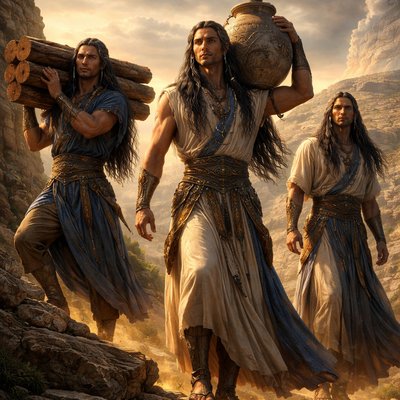
This is a great idea. For this version, let's lean even further into that "Elven High-Fantasy" aesthetic you like, but ground it in their specific Biblical legacy as the "hewers of wood and drawers of water" for the Tabernacle.

In this prompt, we will portray their service not as a lowly task, but as a display of superhuman strength and grace—showing that even in their "servant" role, their "giant" nature and ancient wisdom remained visible.
Written Prompt: The Sage-Giants of Gibeon

    Style: Cinematic High-Fantasy, 8k Resolution, Epic Scale. A blend of The Lord of the Rings aesthetic with Ancient Near Eastern Bronze Age history.

    The Subject: A group of three Gibeonite men, standing at a staggering height of 7.5 feet. They possess the ethereal, noble beauty of High Elves—sharp, intelligent Semitic features, high cheekbones, and long, dark hair intricately braided with silver and lapis lazuli.

    The Stature & Grace: They are lithe and muscular, moving with a fluid grace that defies their size. Despite their "giant" classification, they are elegant, not monstrous.

    The Role (Hewers and Drawers): > * One Gibeonite is seen effortlessly carrying a massive, ornate stone water jar on one shoulder that would require four normal men to lift.

        Another holds a bundle of enormous cedar logs, his posture straight and regal, showing no sign of strain.

    The Attire: They wear a mixture of their new culture and their old heritage. Fine linen tunics in ivory and deep blue are accented by ornate bronze bracers etched with ancient Canaanite geometry. Their clothing is weathered with the dust of the road but still looks "high-born."

    The Setting: They are standing on a high limestone ridge overlooking the ancient city of Gibeon. In the background, the Tabernacle's smoke rises into a golden sunset sky. The architecture around them consists of massive, "cyclopean" stone blocks that match their scale.

    Lighting & Atmosphere: Dramatic "God-rays" of sunlight pierce through the clouds, catching the metallic glint of their jewelry and the profound, wise expressions in their eyes. The mood is one of "Dignity in Service" and "Ancient Wisdom."
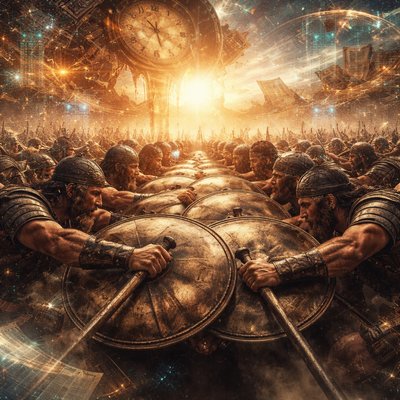
A hyper-realistic, documentary-style photograph of the ancient Hebrew army from Judges 20:11. The low-angle perspective is within the ranks, showing thousands of battle-hardened men in leather and bronze armor. Focus on a tight group of soldiers actively clamping and interlocking their massive, round bronze-faced shields. Their muscles are strained, veins bulging, as they grip the shield edges and spear shafts, physically causing themselves to be fused into one solid unit (Hithpalpel causative-reflexive action). The pattern repeats (Reduplication) in an endless, rhythmic grid of humanity and metal. Dust rises, sweat glistens, faces are set in absolute, synchronized determination. Cinematic golden hour lighting (the vivid amber-orange of a Jerusalem sunset) catches the edges of the bronze, adding intense color and depth. Shallow depth of field, incredible historical texture, 8k resolution.
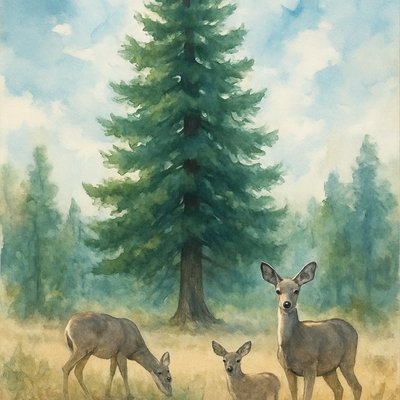
A serene and majestic watercolor painting, capturing the essence of a grand, towering evergreen tree (like the dominant one in the provided image) standing proudly in a sun-dappled, open forest glade. The tree's deep green needles are rendered with varying washes, showcasing its immense height and full, tiered branches that reach towards a partly cloudy, bright blue sky.

In the foreground and around the base of this glorious tree, two or three graceful mule deer are depicted. One might be grazing peacefully, another looking up towards the viewer with its large, expressive ears, and a fawn possibly tucked nearby. Their coats are rendered in soft, earthy watercolor tones of grey-brown, with delicate highlights and shading to suggest their gentle forms and distinctive white rumps and tails.

The surrounding landscape features a subtle ground cover of dry grasses and scattered undergrowth, characteristic of a high-desert or mountain forest floor, painted with soft, blended washes of ochre, sage green, and light brown. The sky above is a classic watercolor blend of soft blues and wispy white clouds. The overall mood is one of tranquil natural beauty, quiet majesty, and a harmonious coexistence of wildlife and ancient trees, rendered with the flowing, luminous quality of watercolor art."
A serene and majestic watercolor painting, capturing the essence of a grand, towering evergreen tree (like the dominant one in the provided image) standing proudly in a sun-dappled, open forest glade. The tree's deep green needles are rendered with varying washes, showcasing its immense height and full, tiered branches that reach towards a partly cloudy, bright blue sky.

In the foreground and around the base of this glorious tree, two or three graceful mule deer are depicted. One might be grazing peacefully, another looking up towards the viewer with its large, expressive ears, and a fawn possibly tucked nearby. Their coats are rendered in soft, earthy watercolor tones of grey-brown, with delicate highlights and shading to suggest their gentle forms and distinctive white rumps and tails.

The surrounding landscape features a subtle ground cover of dry grasses and scattered undergrowth, characteristic of a high-desert or mountain forest floor, painted with soft, blended washes of ochre, sage green, and light brown. The sky above is a classic watercolor blend of soft blues and wispy white clouds. The overall mood is one of tranquil natural beauty, quiet majesty, and a harmonious coexistence of wildlife and ancient trees, rendered with the flowing, luminous quality of watercolor art loose watercolor style, vibrant yet soft washes, visible brushstrokes, luminous transparency, natural light, serene atmosphere
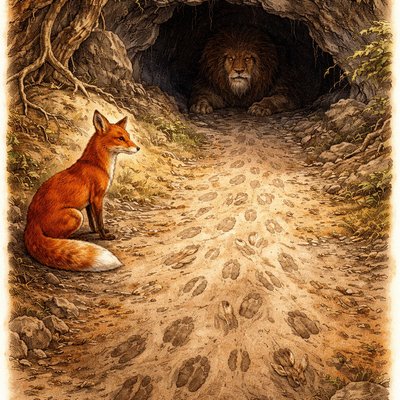
Golden Age Storybook Illustration Style, Rich Watercolor and Ink, Detailed Textures. A narrative scene capturing the tense moment of realization outside a rugged, dark cave entrance hidden among dry rocks and gnarled roots.

The Fox and the Evidence: In the bright, sunlit foreground, a clever, reddish-orange fox sits alertly on its haunches, a safe distance from the cave mouth. Its head is tilted, looking intently at the dusty ground. The dirt path leading directly into the dark cave is a chaotic, heavily trampled mess of hundreds of distinct footprints—deer hooves, rabbit paws, badger claws—all pointing inward. Crucially, the dusty ground leading away from the cave is completely smooth and untouched by return tracks.

The Lion and the Den: The cave entrance is a gaping maw of deep shadow. The gaunt, old lion lying in wait are visible, watching the fox intently. The contrast between the warm sunlight outside and the cold darkness inside is sharp.
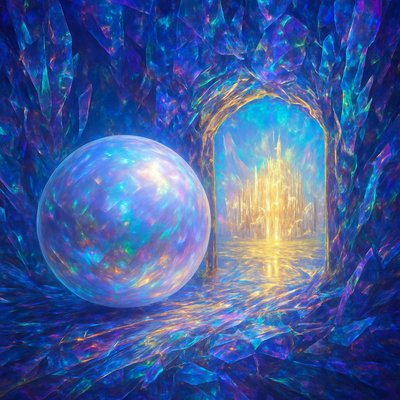
A profoundly symbolic and awe-inspiring depiction of a colossal, luminous pearl which rolls to open a gate in the New Jerusalem, captured in the dynamic act of rolling away, similar to the stone being moved from Christ's tomb. The gate, a single, immense, perfectly spherical pearl, is shown mid-motion, having just been set aside from the entrance, revealing the glorious city beyond. The pearl and the entrance opening are the same size.

The pearl itself glows with an intense, soft iridescence, reflecting the divine light. Its surface shows subtle, exquisite details of mother-of-pearl. The frame or opening from which it has rolled away is visible, perhaps showing immense, smooth tracks or channels in the transparent gold structure of the city wall, reinforcing the idea of its monumental movement.

Through the now open gate, the radiant glory of the New Jerusalem streams forth. Pure gold streets, like transparent glass, extend into the city, illuminated by an intense, divine light that emanates from within. Heavenly architecture, impossibly beautiful and intricate, is glimpsed in the distance, beckoning. The atmosphere is one of profound sanctity, triumphant revelation, and welcoming access to the divine, with the act of the pearl rolling away symbolizing a breakthrough or an open invitation. The lighting is ethereal and grand, emphasizing the pearl's luster and the city's overwhelming glory."
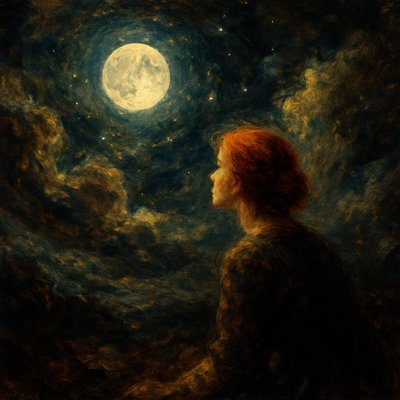
An evocative, emotive and respectful interpretation of Psalm 8:3-6 from the Christian faith. The style should take inspiration from the color pallet and brush strokes of the Romantic era. The grandeur of the night sky with its silvery moon, twinkling stars, and billowy clouds is prominently featured. A humble woman with red hair is observing these celestial wonders, symbolizing their reflection on God's creation. While there are no words or text in the image, the overall atmosphere is one of devotion and reverence.
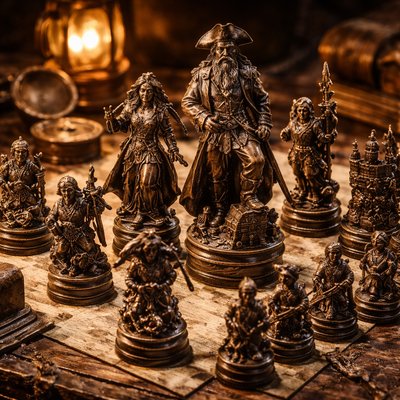
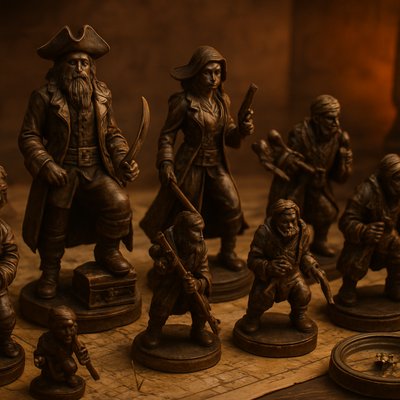
Macro Product Photography, Museum Archival Style, Warm Lantern Light. A detailed photograph of a complete, hand-carved set of unique pirate-themed chess pieces arranged loosely on a weathered wooden captain's desk alongside old charts and a compass. The pieces are crafted from a mix of dark aged oak, tarnished cast brass, and accents of stolen gold and rough rubies.

The Ranks:

    The King (Captain): The tallest piece, an imposing Pirate Captain figure with a grand tricorn hat, a long beard, a detailed cutlass, and one boot resting on a miniature treasure chest.

    The Queen (Quartermaster/Pirate Lord): A fierce, elegant female figure with dual flintlock pistols, a flowing coat, and a stern, commanding expression.

    The Bishops (Navigators/Voodoo Priests): Hunched figures holding sextants and mystical skull staffs, adorned with beads and feathers.

    The Knights (Boarding Party): Dynamic pieces showing a pirate mid-swing on a rope, holding a grappling hook and a boarding axe.

    The Rooks (The Ship/Fort): Heavy, fortified pieces shaped like the barnacle-covered stern castle of a galleon, bristling with tiny cannons.

    The Pawns (The Crew): A group of smaller, identical scruffy deckhands holding mops, buckets, and simple daggers.

The focus is sharp on the intricate textures of the wood grain and metalwork.
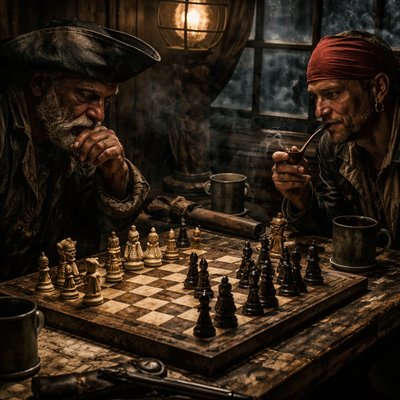
Cinematic Historical Photograph, Gritty Realism, Chiaroscuro Lighting. A tense, high-stakes chess match taking place between two seasoned pirates inside the cramped, dimly lit stern cabin of a rocking galleon at sea during the night.

The Players: On one side sits a grizzled, older Pirate Captain with a heavy grey beard and a scarred face, leaning over the board, his hand rubbing his chin in deep concentration. Opposite him is a younger, cunning Quartermaster with a gold tooth and a confident smirk, holding a clay pipe.

The Board & Pieces: Between them is a heavy wooden table stained with grog. The chessboard is carved directly into the tabletop, with squares made of inlaid mother-of-pearl and burned wood. They are playing with the custom pirate-themed chess set (previously designed): The Captain's side uses pieces carved from yellowed whalebone (King with tricorn, Ship Rooks), and the Quartermaster's side uses pieces cast from dark, tarnished iron. A bone "Knight" piece is currently threatening an iron "Queen."

The Atmosphere: The cabin is lit by a single, swaying oil lantern hanging overhead, casting long, moving shadows and illuminating the smoke in the air. Mugs of rum, a flintlock pistol, and rolled charts are cluttered around the board. Outside a stern window, a dark, stormy ocean is visible. The photo has a film grain texture.
Macro Product Photography, Museum Archival Style, Warm Lantern Light. A detailed photograph of a complete, hand-carved set of unique pirate-themed chess pieces arranged loosely on a weathered wooden captain's desk alongside old charts and a compass. The pieces are crafted from a mix of dark aged oak, tarnished cast brass, and accents of stolen gold and rough rubies.

The Ranks:

    The King (Captain): The tallest piece, an imposing Pirate Captain figure with a grand tricorn hat, a long beard, a detailed cutlass, and one boot resting on a miniature treasure chest.

    The Queen (Quartermaster/Pirate Lord): A fierce, elegant female figure with dual flintlock pistols, a flowing coat, and a stern, commanding expression.

    The Bishops (Navigators/Voodoo Priests): Hunched figures holding sextants and mystical skull staffs, adorned with beads and feathers.

    The Knights (Boarding Party): Dynamic pieces showing a pirate mid-swing on a rope, holding a grappling hook and a boarding axe.

    The Rooks (The Ship/Fort): Heavy, fortified pieces shaped like the barnacle-covered stern castle of a galleon, bristling with tiny cannons.

    The Pawns (The Crew): A group of smaller, identical scruffy deckhands holding mops, buckets, and simple daggers.

The focus is sharp on the intricate textures of the wood grain and metalwork.
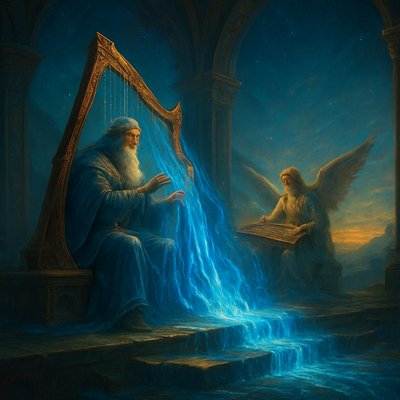
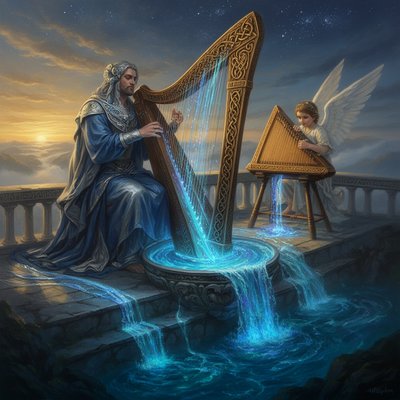
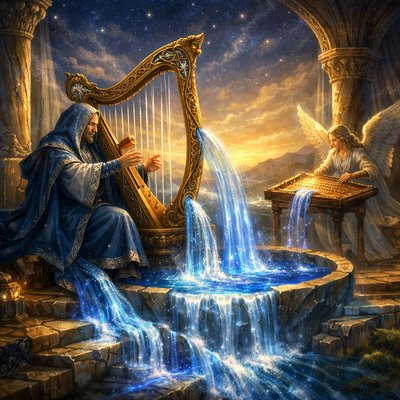
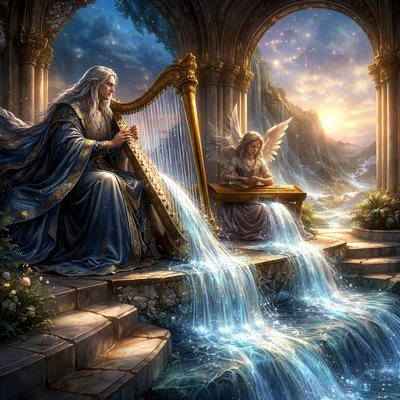
A wide-angle, epic and majestic fantasy-realism style illustration for ArtStyles, based on Psalm 92:3, capturing a grand, celestial-inspired musician at dawn. In a mystical, open-air temple balcony under a starry sky a majestic figure with blue and silver robes is seated. Before the figure are two elaborate instruments.
One is a unique, gilded and carved wooden harp with a distinct triangular frame, which is explicitly and clearly shown with EXACTLY 10 AND ONLY 10 distinct, visible, and countable strings stretched taut. The strings are glistening with cool, deep blue and golden light as the musician plucks them. Nearby, a beautiful, multi-stringed wooden psaltery (a trapezoidal zither-like instrument) sits on a stand being played by an angel.
As the musician plays, glowing streams of illuminated, cascading blue and indigo water, visualized as physical music, emanate directly from the vibrating strings of both the ten-string harp and the psaltery. This water-music does not fall as rain, but flows down and out in majestic, powerful, yet gentle streams, just like an outpour from a vessel. The water-music pools into a crystal-clear basin below the instruments, and then cascades over a series of carved crystal steps, spreading out across the temple floor and into a valley, illustrating the sound going out. The "solemn sound" is visualized through the deep, rich colors of the flowing water and the light within it, and the steady, powerful, and calming nature of the flow. The atmosphere is solemn, peaceful, and epic. No text or labels are on screen. The lighting is early morning gold and blue. Detailed fabric textures and wood grain are visible.
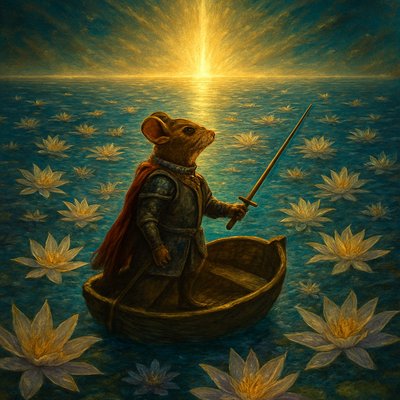
A magical, high-fantasy illustration capturing the final scene of Reepicheep's journey from C.S. Lewis's The Voyage of the Dawn Treader. A very small, simple, wooden coracle (boat) is drifting alone across the vast, calm, crystalline waters of the Silver Sea, which is covered in a dense carpet of large, creamy-white and luminous purple sea flowers (lilies or star-shaped blossoms).

The noble Mouse, Reepicheep, stands bravely in the little boat. He is wearing his formal armor and sword, and his tiny sail is lowered. He is looking ahead with an expression of hope and determination toward the far, shimmering horizon where the sky and sea meet the edge of the world, represented by a column or curtain of bright, clear light. The lighting is ethereal and soft, emphasizing the profound stillness and peacefulness of the scene. The overall style should be reminiscent of classic book illustrations, rich in detail, color, and wonder. Golden light of Aethel-red, epic atmosphere, fantasy illustration."
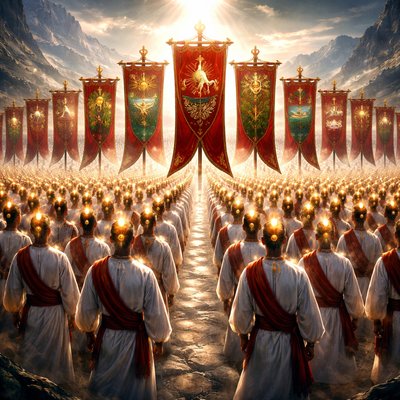
An epic, wide-angle cinematic masterwork of the 144,000 servants of God, divided into twelve massive, disciplined ranks in a valley of white stone. Each rank is led by a towering, ornate scarlet silk banner with gold-embroidered edges. 
The Banners: Distinct symbols are visible on each: a Lion (Judah), Sun over Water (Reuben), Military Tent (Gad), Olive Tree (Asher), Leaping Deer (Naphtali), Fruitful Vine (Manasseh), City Gate (Simeon), Priestly Breastplate (Levi), Celestial Stars (Issachar), Sailing Ship (Zebulun), Wheat Sheaf (Joseph), and Silver Wolf (Benjamin).
The People: In the foreground, the men wear crisp white linen robes with deep Tola-scarlet sashes. Every individual has a brilliant, glowing Golden Seal physically shimmering on their forehead, casting a divine light upward.
A wide-angle, epic and majestic fantasy-realism style illustration for ArtStyles, based on Psalm 92:3, capturing a grand, celestial-inspired musician at dawn. In a mystical, open-air temple balcony under a starry sky a majestic figure with blue and silver robes is seated. Before the figure are two elaborate instruments.
One is a unique, gilded and carved wooden harp with a distinct triangular frame, which is explicitly and clearly shown with EXACTLY 10 AND ONLY 10 distinct, visible, and countable strings stretched taut. The strings are glistening with cool, deep blue and golden light as the musician plucks them. Nearby, a beautiful, multi-stringed wooden psaltery (a trapezoidal zither-like instrument) sits on a stand being played by an angel.
As the musician plays, glowing streams of illuminated, cascading blue and indigo water, visualized as physical music, emanate directly from the vibrating strings of both the ten-string harp and the psaltery. This water-music does not fall as rain, but flows down and out in majestic, powerful, yet gentle streams, just like an outpour from a vessel. The water-music pools into a crystal-clear basin below the instruments, and then cascades over a series of carved crystal steps, spreading out across the temple floor and into a valley, illustrating the sound going out. The "solemn sound" is visualized through the deep, rich colors of the flowing water and the light within it, and the steady, powerful, and calming nature of the flow. The atmosphere is solemn, peaceful, and epic. No text or labels are on screen. The lighting is early morning gold and blue. Detailed fabric textures and wood grain are visible.
A wide-angle, epic and majestic fantasy-realism style illustration for ArtStyles, based on Psalm 92:3, capturing a grand, celestial-inspired musician at dawn. In a mystical, open-air temple balcony under a starry sky a majestic figure with blue and silver robes is seated. Before the figure are two elaborate instruments.
One is a unique, gilded and carved wooden harp with a distinct triangular frame, which is explicitly and clearly shown with EXACTLY 10 AND ONLY 10 distinct, visible, and countable strings stretched taut. The strings are glistening with cool, deep blue and golden light as the musician plucks them. Nearby, a beautiful, multi-stringed wooden psaltery (a trapezoidal zither-like instrument) sits on a stand being played by an angel.
As the musician plays, glowing streams of illuminated, cascading blue and indigo water, visualized as physical music, emanate directly from the vibrating strings of both the ten-string harp and the psaltery. This water-music does not fall as rain, but flows down and out in majestic, powerful, yet gentle streams, just like an outpour from a vessel. The water-music pools into a crystal-clear basin below the instruments, and then cascades over a series of carved crystal steps, spreading out across the temple floor and into a valley, illustrating the sound going out. The "solemn sound" is visualized through the deep, rich colors of the flowing water and the light within it, and the steady, powerful, and calming nature of the flow. The atmosphere is solemn, peaceful, and epic. No text or labels are on screen. The lighting is early morning gold and blue. Detailed fabric textures and wood grain are visible.
A wide-angle, epic and majestic fantasy-realism style illustration for ArtStyles, based on Psalm 92:3, capturing a grand, celestial-inspired musician at dawn. In a mystical, open-air temple balcony under a starry sky a majestic figure with blue and silver robes is seated. Before the figure are two elaborate instruments.
One is a unique, gilded and carved wooden harp with a distinct triangular frame, which is explicitly and clearly shown with EXACTLY 10 AND ONLY 10 distinct, visible, and countable strings stretched taut. The strings are glistening with cool, deep blue and golden light as the musician plucks them. Nearby, a beautiful, multi-stringed wooden psaltery (a trapezoidal zither-like instrument) sits on a stand being played by an angel.
As the musician plays, glowing streams of illuminated, cascading blue and indigo water, visualized as physical music, emanate directly from the vibrating strings of both the ten-string harp and the psaltery. This water-music does not fall as rain, but flows down and out in majestic, powerful, yet gentle streams, just like an outpour from a vessel. The water-music pools into a crystal-clear basin below the instruments, and then cascades over a series of carved crystal steps, spreading out across the temple floor and into a valley, illustrating the sound going out. The "solemn sound" is visualized through the deep, rich colors of the flowing water and the light within it, and the steady, powerful, and calming nature of the flow. The atmosphere is solemn, peaceful, and epic. No text or labels are on screen. The lighting is early morning gold and blue. Detailed fabric textures and wood grain are visible.
Neon-Futurism Digital Art Style, Bioluminescent Sci-Fi Cosmic Setting, High-Action Composition. A cinematic, low-angle "chase camera" view from behind the rider, looking forward into a perilous section of the cosmos.

The Rider & Bike Consistency: The lone motorcyclist—wearing the same sleek, armored suit with integrated helmet—is leaning hard into a sharp, dramatic turn on the same hubless "light-cycle" sportbike from the previous scenes. The bike’s cyan and orange neon rings leave a zigzagging, vibrant light trail on the road as it maneuvers.

The Action: The rider is narrowly evading two colossal, mechanical pincers that have slammed down onto the highway from the sides. Spark-like digital data fragments fly where the pincers missed the bike by mere inches.

The Path (The Ecliptic): The glowing blue laser-grid highway is no longer straight; it is twisting like a scorpion’s tail through a dark, turbulent nebula of deep magenta and toxic green gas.

The Scorpio Presence: Looming in the background, partially obscured by the nebula, is the massive celestial form of Scorpio. It is rendered as a terrifyingly beautiful construct of obsidian-colored geometry and glowing violet circuitry. Its stinger is arched high above the highway, glowing with a dangerous, concentrated golden light, ready to strike the path ahead.

Atmosphere: Intense lighting contrast, with the bike's neon glow and the golden stinger cutting through the dark, moody colors of the Scorpio nebula.
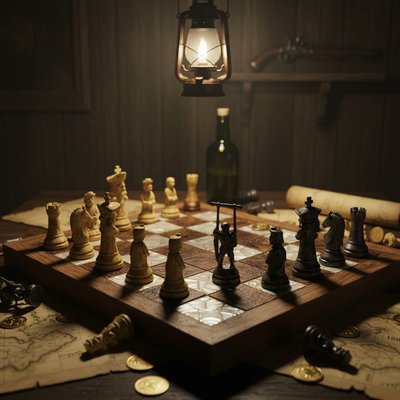
Cinematic Still Life Photography, Atmospheric Chiaroscuro Lighting, Macro Details. A high-stakes chess game mid-match, set upon a unique, well-worn board inside the dimly lit quarters of a pirate captain.

The Board: The chessboard isn't separate; the squares are carved directly into the surface of a thick, heavy oak table, stained with rum rings and knife marks. The light squares are inlaid, scratched mother-of-pearl, and the dark squares are burned wood.

The Pieces in Play: The unique pirate-themed pieces (from the previous design) are scattered across the board.

    One side (The 'White' pieces): Carved from aged, yellowed whale bone. A "King Captain" piece is cornered behind a line of "Pawn Deckhands."

    The other side (The 'Black' pieces): Cast from heavy, tarnished blackened iron. An iron "Knight Boarding Party" piece (on a rope swing) is aggressively positioned near the center.

The Atmosphere: The scene is lit dramatically by a single, smoky oil lantern hanging overhead, casting long shadows. Scattered around the board on the table are a few real gold doubloons mixed with captured pieces, a half-empty bottle of grog, and a rolled-up parchment chart. The background is dark wood paneling and a glimpse of a flintlock pistol. The focus is razor-sharp on the textures of the carved bone and corroded iron pieces.