Wide Landscape With Natural Scenery, No Words Art

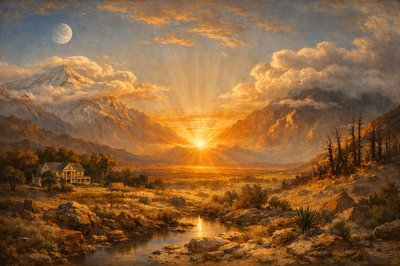
The San Gorgonio Pass, Mt. San Gorgonio) rises in the North, all hoary-frost and granite.  Snake-like clouds adorning her peak, I gaze past the big white house toward her uplifted boulders.
And at the South, Mt. San Jacinto has lost his head in cloud.  Burned bones against a blue sky backdrop.  Between the two, another sunrise gleams and beams of brilliant, white-hot day flash forth:  They accentuate the Sonora desert’s west extreme, and last night’s moon, high up on the left, forgot to go away.
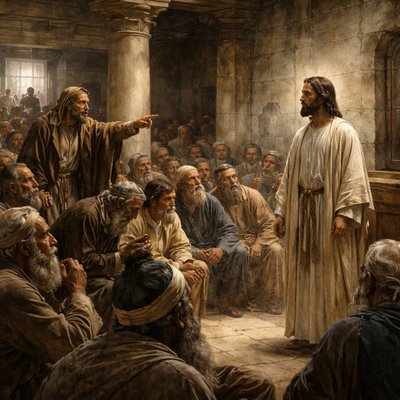
“The Jews then murmured at him, because he said, I am the bread which came down from heaven.” (John 6:41, KJV)
Do not put bread in the picture but rather the setting is Jesus teaching in synagogue in Capernaum with the people looking disgruntled, some whispering to eat other and perhaps someone standing and speaking out to Jesus.
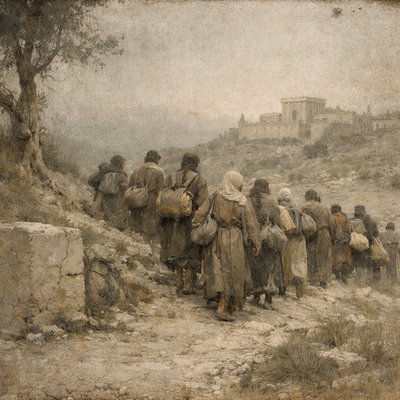
In Old Testament times a group of 12 - 15 Hebrew men and women on pilgrimage ascend a steep road toward Jerusalem and the Temple, headed for the feast of the Passover.  They each carry their own bag, sachel or bedroll.  Anticipation fills the air as the set out on their journey.
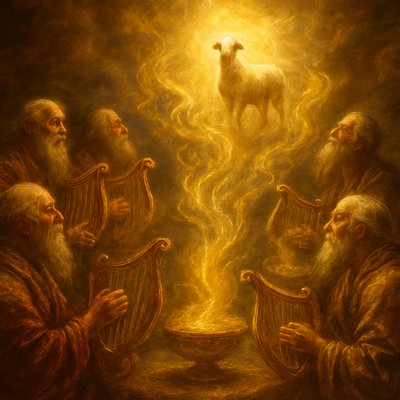
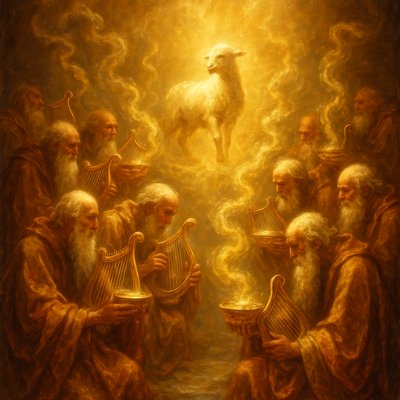
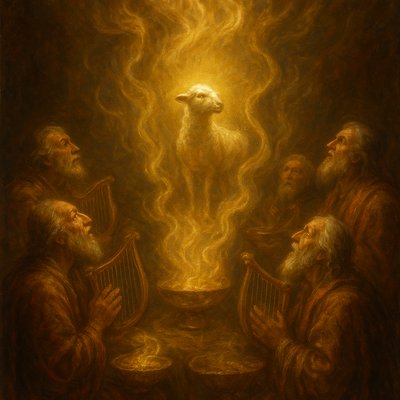
A majestic and reverent scene, directly inspired by Revelation 5:8. A group of elderly, robed figures are kneeling in worship, their faces and attention directed towards a central focal point. Each elder holds a golden harp in one hand and a golden bowl brimming with luminous, swirling incense in the other. The incense, representing the collective prayers of all saints, rises in shimmering, golden tendrils from each bowl, converging and ascending towards the central figure. At the very center of the composition, slightly elevated and bathed in radiant light, stands the Lamb who was slain, embodying divine power and sacrifice, the recipient of all this worship. The atmosphere is ethereal, filled with soft, divine golden light emanating from the incense and the Lamb, emphasizing the precious, sacred, and unified nature of the prayers being offered before Him. Focus on the rich textures of gold, the reverence of the elders, and the radiant presence of the Lamb
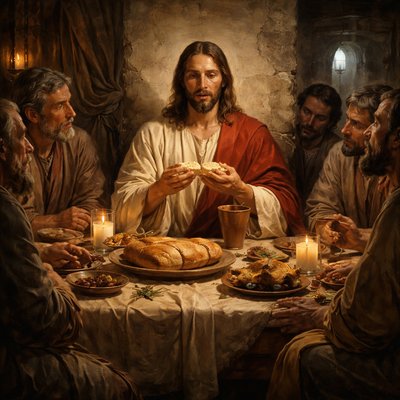
“And as they were eating, Jesus took bread, and blessed it, and brake it, and gave it to the disciples, and said, Take, eat; this is my body. And he took the cup, and gave thanks, and gave it to them, saying, Drink ye all of it; For this is my blood of the new testament, which is shed for many for the remission of sins. But I say unto you, I will not drink henceforth of this fruit of the vine, until that day when I drink it new with you in my Father's kingdom.” (Matthew 26:26-29, KJV)
Out where the river runs wild and free
and only the brave dare row;
where the rapids are deep, and the challenge is fresh
and it takes them where it means to go.
With breakneck speed, grinning into the wind,
standing straight on the bow of their craft,
just a glimpse now and then of those captains you’ll catch
flying by, near capsizing your raft.

They’ve no time for advice to those standing on shore
or to aid the ones just wading out,
for their task is to pilot this current, they think,
and it’s all they can do to stay out of the drink,
and their lives could be gone in the space of a wink
should they lose but a moment to doubt.
Standing tall, they never must doubt!
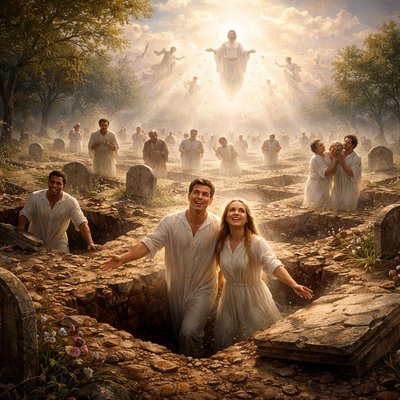
And this is the Father's will which hath sent me, that of all which he hath given me I should lose nothing, but should raise it up again at the last day.
(John 6:39 KJV) Focus on graves opened and joyous youthful looking people coming forth.
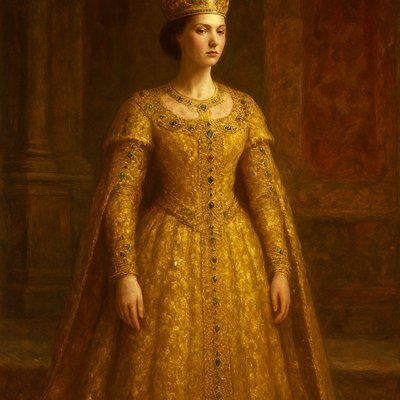
Oil Painting Art Style, a breathtakingly majestic and regal portrait of "The Queen in Gold of Ophir," inspired by Psalm 45. The Queen stands with impeccable grace and royal dignity, her posture radiating quiet power. She is adorned in an exquisitely elaborate gown woven entirely from the finest, purest gold of Ophir, shimmering with incredible richness. Her attire is intricately embellished with countless precious jewels—sapphires, rubies, and emeralds—each catching the light. A delicate yet regal golden crown rests upon her head, complementing her serene and noble expression. The setting is a grand, opulent royal palace chamber, with rich tapestries and polished marble, bathed in warm, golden, ambient light that dramatically illuminates her and her lavish garments. Focus on the unparalleled brilliance and texture of her golden gown, the sparkle of her jewels, her majestic presence, and the luxurious, sacred atmosphere befitting a queen in God's presence.
Stained glass window with natural motifs and curving forms in the art style of Art Nouveau --v 6.1
A majestic and reverent scene, directly inspired by Revelation 5:8. A group of elderly, robed figures are kneeling in worship, their faces and attention directed towards a central focal point. Each elder holds a golden harp in one hand and a golden bowl brimming with luminous, swirling incense in the other. The incense, representing the collective prayers of all saints, rises in shimmering, golden tendrils from each bowl, converging and ascending towards the central figure. At the very center of the composition, slightly elevated and bathed in radiant light, stands the Lamb who was slain, embodying divine power and sacrifice, the recipient of all this worship. The atmosphere is ethereal, filled with soft, divine golden light emanating from the incense and the Lamb, emphasizing the precious, sacred, and unified nature of the prayers being offered before Him. Focus on the rich textures of gold, the reverence of the elders, and the radiant presence of the Lamb
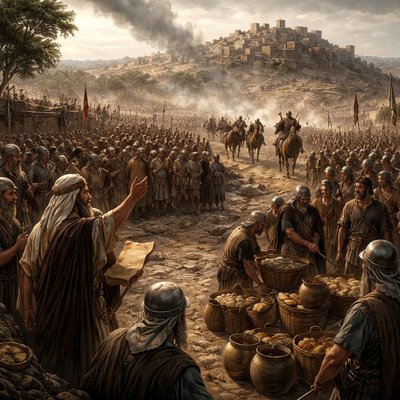
Judges 20:8-12 (KJV)
8 And all the people arose as one man, saying, We will not any of us go to his tent, neither will we any of us turn into his house.
9 But now this shall be the thing which we will do to Gibeah; we will go up by lot against it;
10 And we will take ten men of an hundred throughout all the tribes of Israel, and an hundred of a thousand, and a thousand out of ten thousand, to fetch victual for the people, that they may do, when they come to Gibeah of Benjamin, according to all the folly that they have wrought in Israel.
11 So all the men of Israel were gathered against the city, knit together as one man.
12 And the tribes of Israel sent men through all the tribe of Benjamin, saying, What wickedness is this that is done among you?
Stained glass window with natural motifs and curving forms in the art style of Art Nouveau --v 6.1
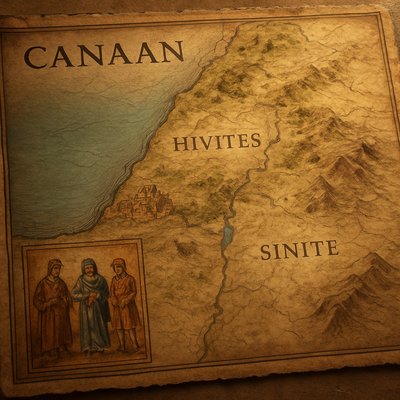
A detailed, ancient-style map of the land of Canaan, with distinct, labeled territories for the Hivites, Arkite, and Sinite people groups. Each territory should have subtle visual cues reflecting their possible historical characteristics or natural environments. For example, the Hivite territory could show some hilly or forested areas, the Arkite territory might feature a coastal city, and the Sinite territory could suggest a more inland or mountainous region. The map should have a weathered, parchment-like texture, with an elegant, old-world font for the labels. In one corner, a small, illuminated manuscript-style illustration could depict three distinct figures, each subtly representing one of the groups, perhaps dressed in period-appropriate attire and engaging in an activity typical of their region. The overall aesthetic should evoke historical scholarship and cartography."
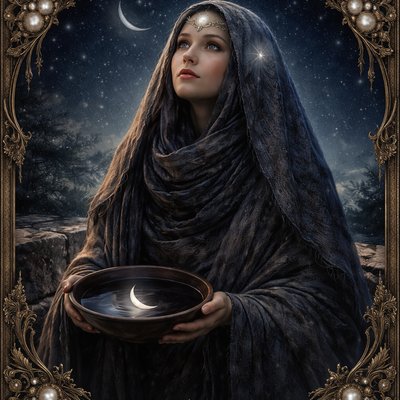
Style: Ethereal Historical Fantasy Portrait. The mood is quiet, reverent, and deeply mystical. Soft, natural moonlight is the primary light source, creating gentle rim-lighting.

The Subject (Asonya): A woman of the ancient, antediluvian world, dressed with profound modesty. She is wrapped in multi-layered, heavy robes of woven wool dyed in deep indigo and charcoal grey that conceal her form. A textured veil covers her hair and frames her face. Her expression is contemplative and gentle, with eyes gazing upward.

The Moon Phase Connection: The current moon phase—a slender, glowing Waning Crescent—is intrinsically tied to her appearance.

    The Headpiece: A clasp made of pale, almost translucent moonstone in the exact shape of the crescent moon secures her veil. It seems to hold an internal, soft luminescence.

    The Projection: A faint, ethereal projection of the crescent moon phase is visible subtly glowing on the fabric of her veil over her forehead, as if starlight is clinging to her.

Action & Setting: She stands on an ancient, wind-worn stone platform used for observing the heavens. In her hands, she holds a simple, dark earthenware bowl filled with still water. The reflection of the actual crescent moon in the sky is perfectly captured in the water she holds.

Atmosphere: The background is a vast, clear night sky filled with countless stars. The air feels old and still.
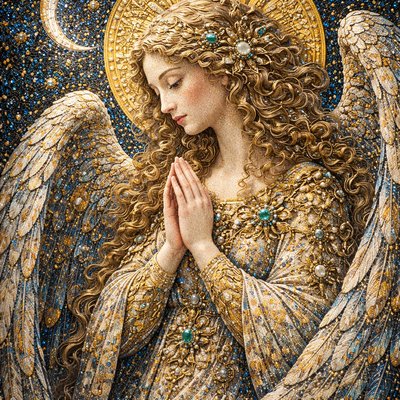
Angelic Woman: A highly detailed photorealistic mosaic artwork in the elegant Art Nouveau style strongly influenced by Gustav Klimt, depicting a serene ethereal angelic female figure in three-quarter profile view from the left, eyes gently closed, calm contemplative expression with subtle blush and red lips, head slightly bowed, hands clasped in prayer over the chest. The entire form--including flawless skin, elaborate voluminous curly hair with flowing organic swirls, large intricate angelic wings, and ornate decorative covering--is intricately composed as a luxurious mixed-material mosaic using tiny irregular tesserae dominated by deep midnight blue and radiant gold tones; vibrant hand-cut smalti glass in midnight blue, sapphire, and luminous gold; abundant sparkling embedded gemstones in lapis, turquoise, and pearl hues; extensive metallic gold leaf accents forming spiral, floral, and whiplash curve patterns; opaque ceramic and marble tiles for subtle texture; and delicate pearl inlays for soft luminosity. Hair and figure feature characteristic Klimt-inspired swirling gold filigree, geometric motifs, and organic curving lines; prominent wings rendered in layered feather-like segments with Art Nouveau flowing forms in gold-outlined midnight blue; radiant golden sunburst halo behind the head enhanced with decorative radial patterns. Vast midnight blue night sky background filled with scattered twinkling stars crafted from pearl and silver inlays and a prominent glowing crescent moon in gold and pearl tesserae, dramatic luminous highlights and iridescent reflections on glass, metals, and gems, slight dimensional depth from raised tiles, thin subtle grout lines for elegant contrast, opulent baroque-infused Art Nouveau hyper-intricate style blending surreal fantasy and symbolic celestial ornamentation, sharp focus, transcendent serene mood
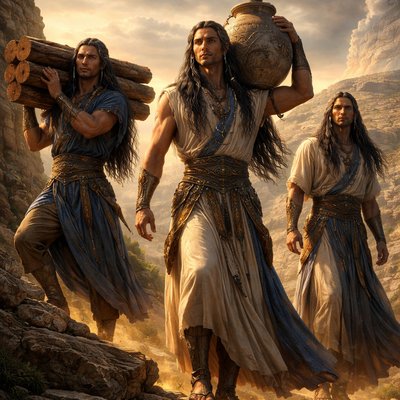
This is a great idea. For this version, let's lean even further into that "Elven High-Fantasy" aesthetic you like, but ground it in their specific Biblical legacy as the "hewers of wood and drawers of water" for the Tabernacle.

In this prompt, we will portray their service not as a lowly task, but as a display of superhuman strength and grace—showing that even in their "servant" role, their "giant" nature and ancient wisdom remained visible.
Written Prompt: The Sage-Giants of Gibeon

    Style: Cinematic High-Fantasy, 8k Resolution, Epic Scale. A blend of The Lord of the Rings aesthetic with Ancient Near Eastern Bronze Age history.

    The Subject: A group of three Gibeonite men, standing at a staggering height of 7.5 feet. They possess the ethereal, noble beauty of High Elves—sharp, intelligent Semitic features, high cheekbones, and long, dark hair intricately braided with silver and lapis lazuli.

    The Stature & Grace: They are lithe and muscular, moving with a fluid grace that defies their size. Despite their "giant" classification, they are elegant, not monstrous.

    The Role (Hewers and Drawers): > * One Gibeonite is seen effortlessly carrying a massive, ornate stone water jar on one shoulder that would require four normal men to lift.

        Another holds a bundle of enormous cedar logs, his posture straight and regal, showing no sign of strain.

    The Attire: They wear a mixture of their new culture and their old heritage. Fine linen tunics in ivory and deep blue are accented by ornate bronze bracers etched with ancient Canaanite geometry. Their clothing is weathered with the dust of the road but still looks "high-born."

    The Setting: They are standing on a high limestone ridge overlooking the ancient city of Gibeon. In the background, the Tabernacle's smoke rises into a golden sunset sky. The architecture around them consists of massive, "cyclopean" stone blocks that match their scale.

    Lighting & Atmosphere: Dramatic "God-rays" of sunlight pierce through the clouds, catching the metallic glint of their jewelry and the profound, wise expressions in their eyes. The mood is one of "Dignity in Service" and "Ancient Wisdom."