Passing Time Art

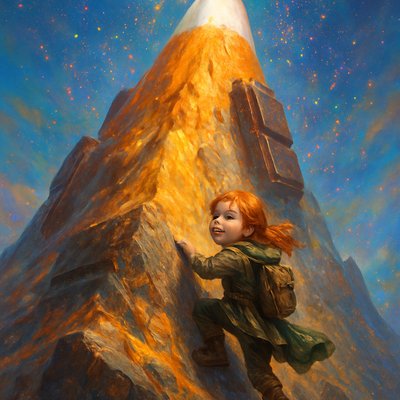
A young red-haired girl in whimsical adventurer gear, bravely climbing a colossal, mountain-sized candy corn. The candy corn mountain has realistic geological features, with crags and steep slopes, made entirely of candy corn, and integrated along its ridges are giant, sculpted chocolate bars. Shimmering, multi-colored pixie stick dust rains down around her like magical snowfall. Determined, joyful expression. Bright, fantastical sky. Hyperrealistic digital painting, fantasy illustration, surreal landscape, epic detailed, cinematic lighting, food art photography." The candy corn is a mountain landscape
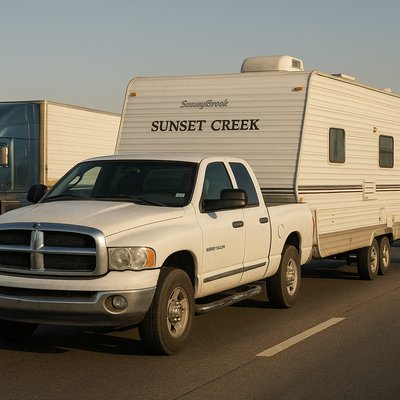
Generate a realistic, eye-level photograph of a white 2002 Dodge Ram 2500 pickup truck, specifically a quad cab model, pulling a 33-foot Sunnybrook Sunset Creek travel trailer. The trailer must have distinct, painted aluminum siding. The entire rig is situated in the middle of heavy, slow-moving traffic on Interstate 40 (I-40) in Amarillo, Texas, with other cars and semi-trucks visible all around. The time of day is late afternoon, with the sun casting long shadows, and the sky is clear, typical of the Texas Panhandle. The focus is on the truck and trailer, showing the details of both vehicles amidst the bustling highway environment.
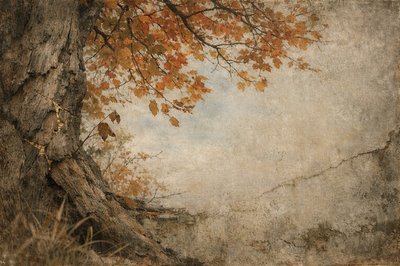
This day, though, I hiked another autumn wood.  Eastern Europe ancient; overgrown.  So thick the view was dark at just a few feet off the path.  All red and yellow; orange and brown, a million trees, each one in blazing preparation for long, frozen winter.  I cannot but recall my friend’s words, lasting long, though he did not, and the instant truth that follows.  Looking upward at the fiery canopy, matched against the bright cerulean sky beyond, I embrace autumn!  Winter surely comes one day, but spring beyond.  I have a winter to prepare for, but it is not yet.
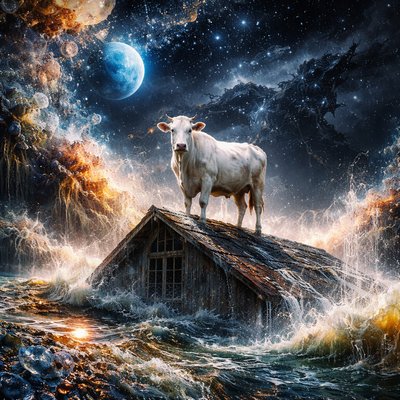
a majestic white cow with soulful eyes stands triumphantly elevated on the slanted, half-submerged rooftop of an old wooden cotton house during an apocalyptic flood, rising chaotic waters swirling violently below like judgment waves from a forgotten deluge. The cow is perfectly balanced and serene amid destruction, symbolizing unexpected divine deliverance from the hangman and chaos. In the stormy, star-filled sky behind, a faint glowing blue Neptune planet hovers near the shadowy, jagged silhouette of Cetus the sea monster constellation lurking in the cosmic void. Moody blues, grungy textures, toxic neon glows on the water, ethereal decay, high contrast dramatic lighting, cinematic wide shot, cyber-grunge atmosphere, intricate details on the cow's fur and the crumbling roof, sense of prophetic hope piercing the darkness
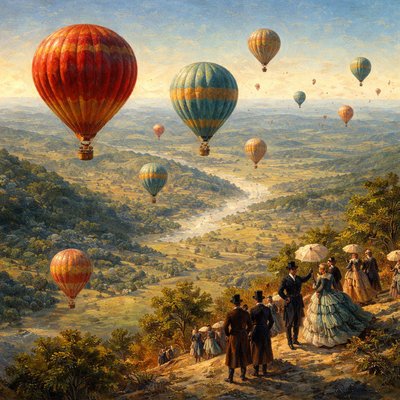
in the style of John Atkinson Grimshaw,
bird’s‑eye view, camera looking downward from a moderate height over hot air balloons rising steadily and moving with the wind through clear blue skies,
subtle curvature of the landscape visible below,
rich jewel‑tone reds, teals, and golds catching warm natural sunlight, realistic wind‑driven motion, natural directional flow, a hillside overlook below with small groups of people watching the balloons, holding umbrellas for shade, wearing Victorian‑style clothing,
long tailored coats, layered skirts, high collars,
grounded composition, realistic atmospheric depth, cinematic painterly
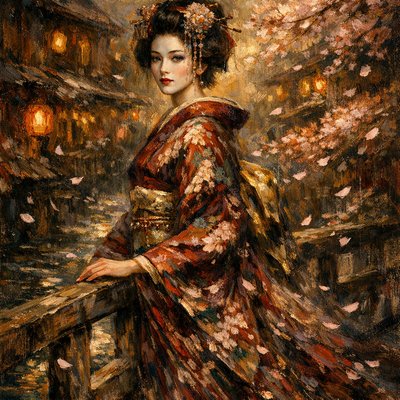
Cinematic Film Style, Romanticism Art Style, a stunningly beautiful and atmospheric portrait of a Geisha in 1930s Kyoto. She is dressed in an exquisite, flowing silk kimono with intricate floral patterns and a wide obi sash. Her face is painted in traditional white makeup with striking red lips and piercing blue-gray eyes. She is standing on a traditional wooden bridge over a stream in Gion, with soft pink cherry blossoms falling around her like snow. The lighting is a warm, golden-hour glow that creates a soft-focus, ethereal background of old wooden teahouses and paper lanterns. Focus on the shimmering texture of the silk, the delicate movement of the blossoms, and a sense of quiet, longing beauty.
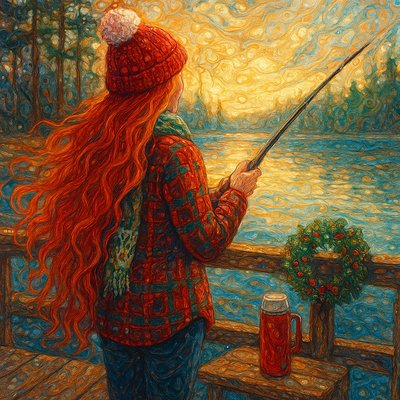
A realistic and peaceful image of a 56-year-old woman fishing on the shores of Lake Livingston, Texas, during the Christmas season. She has very long, vibrant red hair that flows all the way down to her waist, gently moving in the breeze.

She is standing on a wooden dock or sitting in a comfortable chair by the water, surrounded by the tall pine trees characteristic of East Texas. The weather is cool but pleasant (Texas winter). She is wearing cozy holiday-themed attire, such as a warm plaid flannel shirt in red and green, a festive scarf, or a beanie. Maybe there is a small Christmas wreath on the railing of the dock or a thermos of hot cocoa nearby. The lake is calm and reflects the soft winter sun. The lighting is warm and golden. High quality, photorealistic, serene atmosphere.
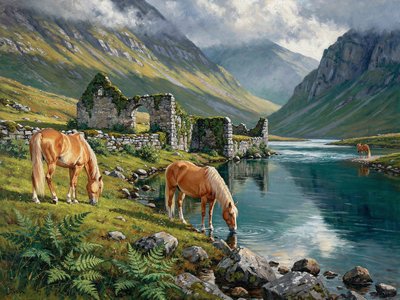
Seamless triptych artwork, continuous scene flowing left to right, left panel shows a palomino horse in the foreground on the far left side of the scene walking down a grassy slope toward a reflective teal-blue river in the Scottish Highlands with rocks and ferns around its hooves, center panel continues the same landscape as the horse now appears in the midground at the center of the scene standing at the river’s edge drinking from the reflective water beside ancient moss-covered stone ruins, right panel continues the scene as the horse appears far away in the distance on the far right side of the scene following the riverbank toward steep mist-covered mountains with dramatic sunlight breaking through the clouds, unified natural palette of greens golds and reflective teal blues, consistent cinematic lighting, shared horizon line, smooth uninterrupted left-to-right visual flow with no panel separation.
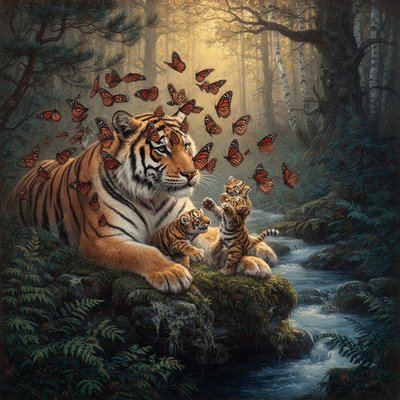
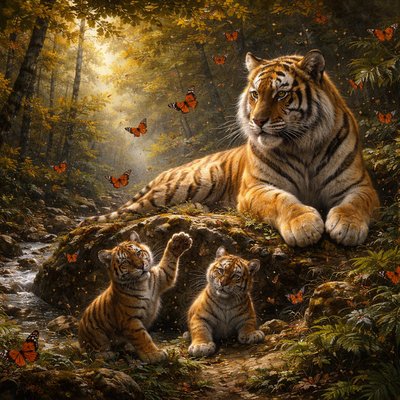
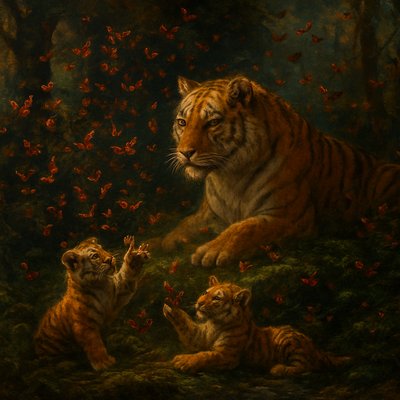
Nature Photography Style, Romantic Naturalism Painting, a breathtaking, incredibly detailed scene deep within the primeval forests of Russia's Amur-Ussuri region. A massive, powerful female Amur Tiger with thick, pale orange and dark striped fur rests on a moss-covered rocky outcrop, watching over her two playful cubs who are batting at the air. The scene is absolutely swarming with hundreds of Red Admiral butterflies (distinct black wings with vibrant orange-red bands and white spots). The butterflies form swirling clouds, landing gently on the tigers' fur, their noses, and the surrounding lush ferns and Korean pine branches. The forest floor is dense with undergrowth, lichen, and a clear, cold stream nearby. The lighting is dappled golden hour sunlight filtering through a canopy of birch and ancient oak trees, creating a magical, serene atmosphere. Focus on the texture of the thick tiger fur and the delicate wings of the butterflies.
A triptych set of three drawings, continuous scene flowing left to right, left panel shows a palomino horse in the foreground on the far left side of the scene walking down a grassy slope toward a reflective teal-blue river in the Scottish Highlands with rocks and ferns around its hooves.
Center panel continues the same landscape as the horse now appears in the midground at the center of the scene standing at the river’s edge drinking from the reflective water beside ancient moss-covered stone ruins.
Right panel continues the scene as the horse appears far away in the distance on the far right side of the scene following the riverbank toward steep mist-covered mountains with dramatic sunlight breaking through the clouds, unified natural palette of greens golds and reflective teal blues, consistent cinematic lighting, shared horizon line, smoothf uninterrupted left-to-right visual flow with no panel separation.
Seamless triptych artwork with no dividing lines or borders, continuous scene flowing left to right, left panel shows a palomino horse in the foreground on the far left side of the scene walking down a grassy slope toward a reflective teal-blue river in the Scottish Highlands with rocks and ferns around its hooves, center panel continues the same landscape as the horse now appears in the midground at the center of the scene standing at the river’s edge drinking from the reflective water beside ancient moss-covered stone ruins, right panel continues the scene as the horse appears far away in the distance on the far right side of the scene following the riverbank toward steep mist-covered mountains with dramatic sunlight breaking through the clouds, unified natural palette of greens golds and reflective teal blues, consistent cinematic lighting, shared horizon line, smooth uninterrupted left-to-right visual flow with no panel separation.
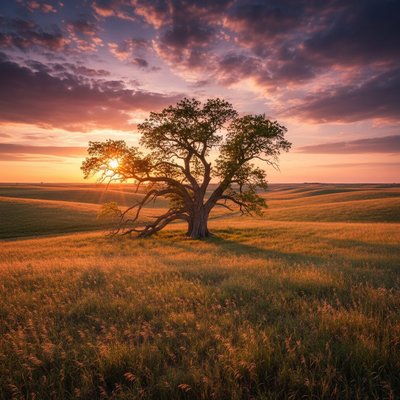
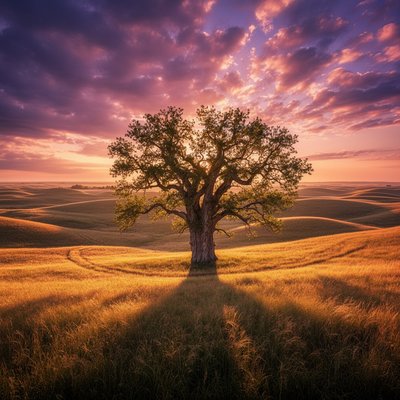
Epic Landscape Photography Style, Wide-Angle Lens, Golden Hour Lighting. A profound, sweeping photograph of a single, colossal ancient Eastern Cottonwood tree standing isolated in the center of a vast expanse of the Nebraska rolling highlands (Sandhills).

The Tree: It is massive and gnarled, a true sentinel of the plains, with a thick, deeply fissured trunk and sprawling, asymmetrical branches shaped by years of constant wind.

The Environment: The surrounding landscape is a sea of undulating, gentle hills covered in knee-high mixed-grass prairie that glows coppery-gold and sage-green in the late afternoon light. The grasses are visibly swaying in the breeze. A faint, winding dirt track leads toward the horizon.

The Sky & Light: The sky is immense and dramatic, taking up two-thirds of the frame, filled with textured cumulus clouds catching the brilliant oranges, deep purples, and soft pinks of the sunset. The light is warm, casting long shadows across the folds of the hills. The mood is quiet, vast, and solitary.
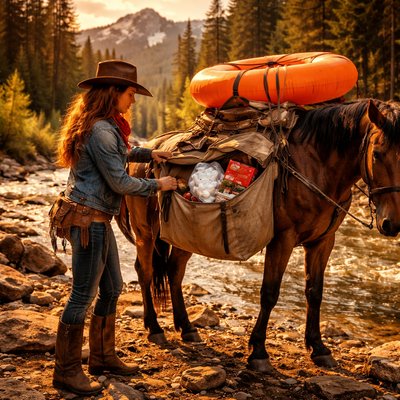
Cinematic Nature Photography, Americana Style, Golden Hour Lighting. A candid, detailed shot of an authentic cowgirl with long red hair in a worn leather hat, denim jacket, and dusty boots. She is standing beside a sturdy pack horse in a rocky creek bed, actively stuffing, rugged canvas panniers.

The details of the load are clear: A large bag of jumbo marshmallows and a red box of graham crackers are peeking out of one open saddlebag, next to chocolate bars. Strapped awkwardly to the very top of the pack saddle with ropes is a large, bright orange inflatable river tube.

The environment is stunning Colorado high country: Towering ponderosa pines and aspen trees line a rushing clear mountain river. Rugged, snow-capped Rocky Mountain peaks rise in the background under a rich blue sky. The light is warm and late-afternoon, catching the dust in the air and the textures of the horse's coat and the leather gear.
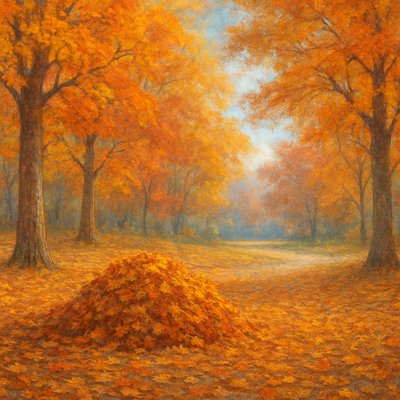
A tranquil and inviting autumn landscape based, depicting a park-like setting with large trees and a central pile of fallen leaves. The trees framing the foreground and extending into the middle ground are now in their full, glorious fall colors, displaying a rich tapestry of brilliant yellows, deep oranges, fiery reds, and warm russets.

The ground is generously covered with a soft, thick carpet of fallen autumn leaves, rendered in various warm hues. A prominent, neatly gathered pile of raked leaves sits in the middle ground, inviting curiosity or play, with its textures and colors clearly visible. In the background, hints of a path or road gently wind through more fall foliage, suggesting a peaceful stroll.

The sky above is a soft, clear autumn blue, allowing warm, diffused sunlight to filter through the canopy, casting gentle shadows and highlighting the vibrant colors of the leaves both on the trees and on the ground. The overall mood is one of serene autumnal beauty, crisp air, and the pleasant, nostalgic feeling of a beautiful fall day in a park."
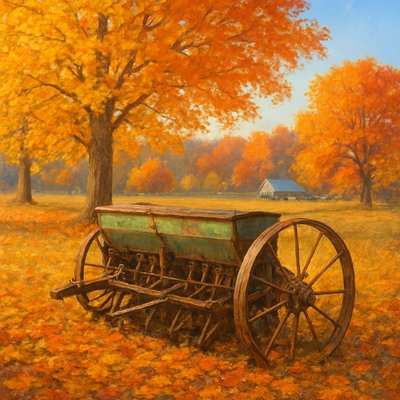
A serene and rustic autumn landscape based on the provided image, featuring an aged farm implement (a seeder or planter) in the foreground. The old machinery retains its weathered green and rust colors but is now positioned amidst a carpet of vibrant fallen autumn leaves in shades of gold, orange, and russet.

The large, leafy trees in the middle ground, which were green in the original image, are now transformed into glorious specimens of fall foliage, displaying brilliant yellows, fiery oranges, and deep reds. The distant field shows hints of freshly turned earth or dry, golden stubble. In the background, the small house with the blue roof remains, nestled amongst a dense forest that is also ablaze with autumn colors.

The sky is a clear, bright autumn blue, with warm, golden sunlight characteristic of a pleasant fall day, casting gentle shadows and highlighting the rich textures of the old equipment, the tree bark, and the colorful leaves. The overall mood is one of peaceful rural charm, autumnal beauty, and the quiet dignity of farm life as the seasons change.
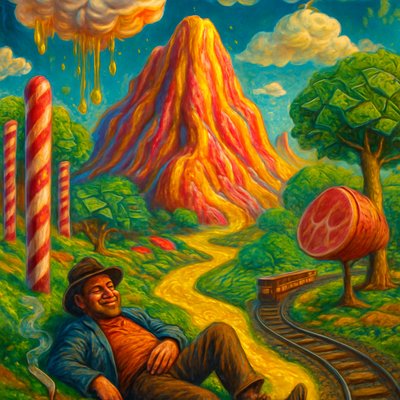
Surrealism Art Style, Digital Art Style, a brilliantly vibrant, whimsical, and exaggerated landscape depicting the mythical "Big Rock Candy Mountain." The massive mountain at the center of the scene is composed entirely of striped rock candy, glistening in the eternal sunshine. A cheerful hobo figure, relaxed and smiling, is seen lounging by a sparkling stream of pure lemonade that flows down the mountainside. The landscape is surrounded by giant peppermint stick forests and trees whose leaves are crisp dollar bills. The clouds in the sky are made of whipped cream, and the rain is a sweet syrup. There are prominent features like a cigarette tree, a luscious ham tree, and railroad tracks where the boxcars are always empty and waiting. The colors are hyper-saturated and joyful, rendered with the smooth, detailed clarity of digital art, yet maintaining a dreamlike, slightly absurd quality. Focus intently on the dazzling texture of the candy landscape, the flowing lemonade water, and the utopian, escapist joy of the scene.
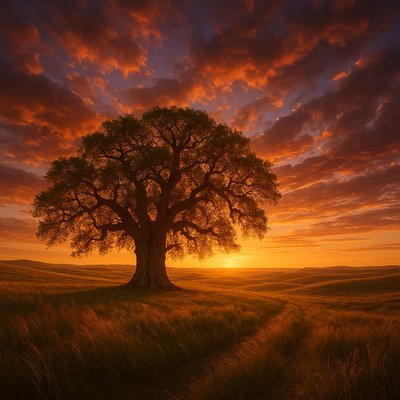
Epic Landscape Photography Style, Wide-Angle Lens, Golden Hour Lighting. A profound, sweeping photograph of a single, colossal ancient Eastern Cottonwood tree standing isolated in the center of a vast expanse of the Nebraska rolling highlands (Sandhills).

The Tree: It is massive and gnarled, a true sentinel of the plains, with a thick, deeply fissured trunk and sprawling, asymmetrical branches shaped by years of constant wind.

The Environment: The surrounding landscape is a sea of undulating, gentle hills covered in knee-high mixed-grass prairie that glows coppery-gold and sage-green in the late afternoon light. The grasses are visibly swaying in the breeze. A faint, winding dirt track leads toward the horizon.

The Sky & Light: The sky is immense and dramatic, taking up two-thirds of the frame, filled with textured cumulus clouds catching the brilliant oranges, deep purples, and soft pinks of the sunset. The light is warm, casting long shadows across the folds of the hills. The mood is quiet, vast, and solitary.
Epic Landscape Photography Style, Wide-Angle Lens, Golden Hour Lighting. A profound, sweeping photograph of a single, colossal ancient Eastern Cottonwood tree standing isolated in the center of a vast expanse of the Nebraska rolling highlands (Sandhills).

The Tree: It is massive and gnarled, a true sentinel of the plains, with a thick, deeply fissured trunk and sprawling, asymmetrical branches shaped by years of constant wind.

The Environment: The surrounding landscape is a sea of undulating, gentle hills covered in knee-high mixed-grass prairie that glows coppery-gold and sage-green in the late afternoon light. The grasses are visibly swaying in the breeze. A faint, winding dirt track leads toward the horizon.

The Sky & Light: The sky is immense and dramatic, taking up two-thirds of the frame, filled with textured cumulus clouds catching the brilliant oranges, deep purples, and soft pinks of the sunset. The light is warm, casting long shadows across the folds of the hills. The mood is quiet, vast, and solitary.
Epic Landscape Photography Style, Wide-Angle Lens, Golden Hour Lighting. A profound, sweeping photograph of a single, colossal ancient Eastern Cottonwood tree standing isolated in the center of a vast expanse of the Nebraska rolling highlands (Sandhills).

The Tree: It is massive and gnarled, a true sentinel of the plains, with a thick, deeply fissured trunk and sprawling, asymmetrical branches shaped by years of constant wind.

The Environment: The surrounding landscape is a sea of undulating, gentle hills covered in knee-high mixed-grass prairie that glows coppery-gold and sage-green in the late afternoon light. The grasses are visibly swaying in the breeze. A faint, winding dirt track leads toward the horizon.

The Sky & Light: The sky is immense and dramatic, taking up two-thirds of the frame, filled with textured cumulus clouds catching the brilliant oranges, deep purples, and soft pinks of the sunset. The light is warm, casting long shadows across the folds of the hills. The mood is quiet, vast, and solitary.
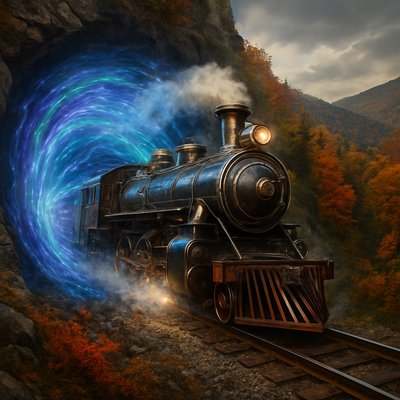
Photorealism Art Style, a magnificent, life-sized, vintage steam train (reminiscent of the "Time Train" from Back to the Future Part III, complete with futuristic modifications and gleaming brass accents) is captured in a dynamic moment, aggressively bursting forth from a shimmering, swirling spacetime continuum portal or wormhole. The portal glows with ethereal blues, purples, and electric greens, distorting the air around it. The train's front half has already emerged, with steam and sparks flying, as it dramatically enters through the mouth of a dark, natural rock tunnel nestled deep within the lush, rugged Appalachian Mountains. The surrounding mountain landscape is ablaze with vibrant fall foliage in stunning hues of deep red, fiery orange, and brilliant gold, mixed with green evergreens, under a slightly overcast, dramatic sky. Focus on the hyper-realistic details of the steam train, the dynamic, energetic effects of the spacetime portal, and the authentic textures of the Appalachian rock and the rich autumn leaves, all illuminated by the contrasting light of the portal and the natural environment.
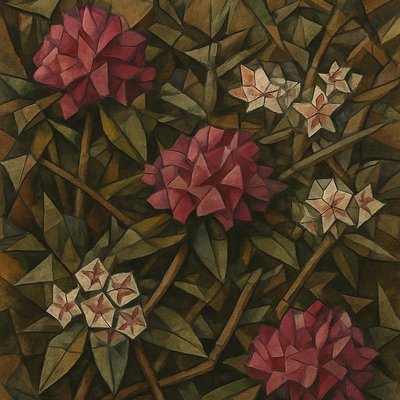
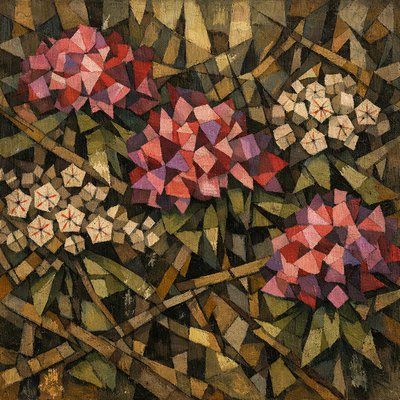
Art Style: Analytical Cubism, avant-garde oil painting style reminiscent of Picasso and Braque.

Subject: A dense, tangled thicket of Rhododendrons and Mountain Laurel bushes.

Composition & Details: The entire natural scene is deconstructed into overlapping geometric planes, fractured shards, and intersecting angles. There are no curved lines; everything is rendered in cubes, cones, and trapezoids.

    The Rhododendrons: Large, showy flower trusses are broken into faceted crystalline structures of deep magenta, rose pink, and violet blocks, looking like explosions of colored quartz rather than soft petals.

    The Mountain Laurels: The smaller, intricate flowers are rendered as complex, repeating geometric star-patterns and angular cups in white and pale pink with distinct red polygonal markings.

    Foliage & Branches: The thick, leathery leaves are fragmented green triangles and parallelograms overlapping each other, creating a sense of depth without traditional perspective. The woody stems and branches are jagged, intersecting brown and grey cylinders that shatter across the frame.

Color & Texture: A palette of muted earth tones—ochre, burnt umber, forest green, and slate grey—contrasted sharply with the jewel-toned facets of the flower colors. The finish should have a heavy, textured oil paint feel with visible palette knife marks and rough brushwork.
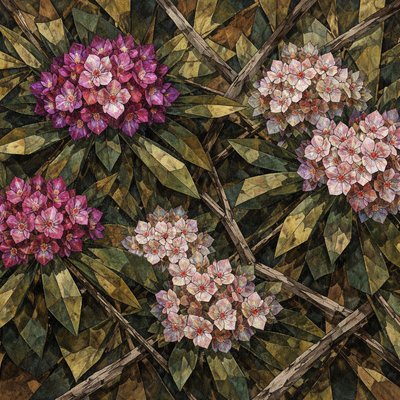
Art Style: Analytical Cubism, avant-garde oil painting style reminiscent of Picasso and Braque.

Subject: A dense, tangled thicket of Rhododendrons and Mountain Laurel bushes.

Composition & Details: The entire natural scene is deconstructed into overlapping geometric planes, fractured shards, and intersecting angles. There are no curved lines; everything is rendered in cubes, cones, and trapezoids.

    The Rhododendrons: Large, showy flower trusses are broken into faceted crystalline structures of deep magenta, rose pink, and violet blocks, looking like explosions of colored quartz rather than soft petals.

    The Mountain Laurels: The smaller, intricate flowers are rendered as complex, repeating geometric star-patterns and angular cups in white and pale pink with distinct red polygonal markings.

    Foliage & Branches: The thick, leathery leaves are fragmented green triangles and parallelograms overlapping each other, creating a sense of depth without traditional perspective. The woody stems and branches are jagged, intersecting brown and grey cylinders that shatter across the frame.

Color & Texture: A palette of muted earth tones—ochre, burnt umber, forest green, and slate grey—contrasted sharply with the jewel-toned facets of the flower colors. The finish should have a heavy, textured oil paint feel with visible palette knife marks and rough brushwork.
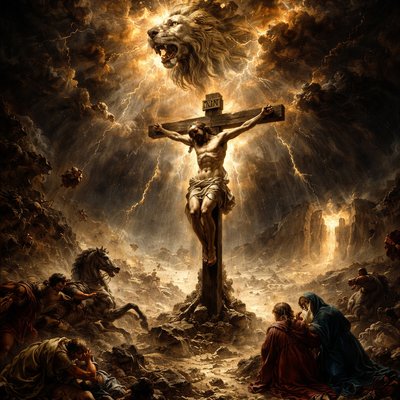
Epic Biblical Baroque Painting Style, High-Contrast Tenebrism Lighting, Supernatural Realism. A monumental, earth-shattering scene at Golgotha at the precise moment of death.

The Central Figure: Jesus hangs lifelessly on a rough wooden cross, head bowed in finality, his body pale and scarred. A subtle, fading divine light emanates from him. The titulus above his head reads "INRI."

The Manifestation of the Roar (Jasher 54 influence): At the very instant of his death, the environment is violently convulsing, visualizing the "roar" of Judah echoing through time. Behind and above the cross, the dark, stormy clouds are being ripped apart by a massive, translucent ethereal manifestation of a roaring Lion's head formed from dust, lightning, and golden spiritual energy.

The Environmental Impact: The ground beneath the cross is cracking open with deep fissures. Massive boulders are shattering into dust mid-air. The temple veil in the distant city background is visibly tearing top-to-bottom.

The Human Reaction: Below the cross, the scene is one of absolute supernatural terror (as described in Jasher). Roman centurions are cowering on the ground, covering their ears, their helmets knocked off. Horses are rearing wildly, throwing their riders. The few followers present (Mary, John) are driven to their knees, not just in grief, but overwhelmed by the physical force of the cosmic event. The lighting is a chaotic mix of deep eclipse shadow and blinding bursts of supernatural golden-red light from the roaring manifestation.
Art Style: Analytical Cubism, avant-garde oil painting style reminiscent of Picasso and Braque.

Subject: A dense, tangled thicket of Rhododendrons and Mountain Laurel bushes.

Composition & Details: The entire natural scene is deconstructed into overlapping geometric planes, fractured shards, and intersecting angles. There are no curved lines; everything is rendered in cubes, cones, and trapezoids.

    The Rhododendrons: Large, showy flower trusses are broken into faceted crystalline structures of deep magenta, rose pink, and violet blocks, looking like explosions of colored quartz rather than soft petals.

    The Mountain Laurels: The smaller, intricate flowers are rendered as complex, repeating geometric star-patterns and angular cups in white and pale pink with distinct red polygonal markings.

    Foliage & Branches: The thick, leathery leaves are fragmented green triangles and parallelograms overlapping each other, creating a sense of depth without traditional perspective. The woody stems and branches are jagged, intersecting brown and grey cylinders that shatter across the frame.

Color & Texture: A palette of muted earth tones—ochre, burnt umber, forest green, and slate grey—contrasted sharply with the jewel-toned facets of the flower colors. The finish should have a heavy, textured oil paint feel with visible palette knife marks and rough brushwork.
A low-angle, hyper-detailed tableau of the Mad Hatter's Tea Party, viewed under a dark, star-filled sky. The Mad Hatter sits at the table, his features not quite human, but constructed entirely from brilliant indigo and gold cosmic dust, representing the constellation Lepus. His top hat is a vortex of nebula, and one eye burns intensely—a specific star named "The Mad."

The Hatter is caught mid-sentence, demanding, "Why is a raven like a writing-desk?" As he speaks, his hands, which were merely starry, begin to shed their light, and the true form is revealed: the lower half of his coat and chair morph into coiling, dark serpentine scales, twisting around the table leg. The March Hare and Dormouse are frozen in terror. Above the table, a Raven made of pitch-black night materializes, its shadow falling directly over the Hatter. The entire scene is vibrating with the furious energy of a creature—the ancient serpent—who knows his time has been irrevocably stopped.

Style: Cinematic dark fantasy, astronomical realism, oil painting texture, emphasis on the contrast between the cold cosmic starlight and the dark, furious energy of the serpentine transformation.
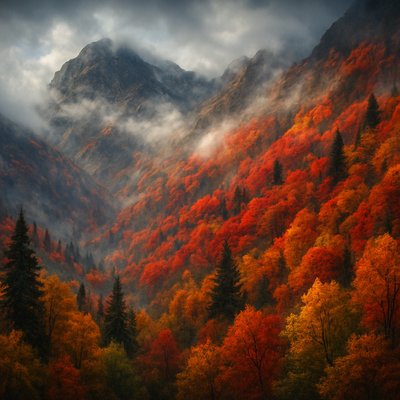
A breathtaking and intensely dramatic cinematic landscape photograph based on the provided image of a mountain valley. The scene captures a majestic mountainside vibrant with dramatized autumn foliage, showcasing an explosion of rich, saturated reds, fiery oranges, and brilliant golds across the slopes. Interspersed among the deciduous trees are towering dark green evergreens, providing a striking contrast against the warm fall colors.

Wisps of ethereal mist or low-hanging clouds cling to the upper reaches and valleys of the mountain, adding depth and a sense of mystique. The sky above, partially visible, shows patches of dramatic, cloud-dappled blue peeking through, hinting at a powerful natural setting. The foreground features a mix of vibrant green and gold trees, framing the grand scale of the mountain.

The image uses vibrant color grading and dramatic contrast to enhance the luminosity and intensity of the fall colors, making them truly pop. The lighting is rich and moody, highlighting textures on the rocky cliffs and the varied foliage. The overall mood is one of awe-inspiring natural beauty, epic scale, and profound autumnal splendor, rendered with the high visual impact of a cinematic scene."
Temporary land art installation documenting passage of time in the art style of Land Art --v 6.1
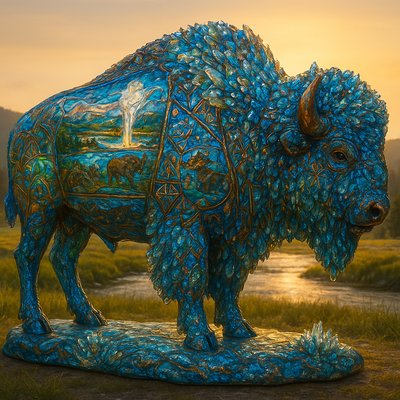
    A breathtaking, full-size artistic sculpture of a standing buffalo, rendered entirely in the style of intricate, luminous glass art, reminiscent of the painted buffalo installations. The buffalo's majestic form is composed of countless individual pieces of vibrant, multifaceted stained glass or fused glass, meticulously cut, arranged, and joined.

    The entire surface of this glass buffalo is adorned with various miniature, finely detailed scenes and patterns etched, painted, or embedded within the glass itself, or created by the unique coloration and texture of the glass pieces. These scenes depict:

        Iconic Yellowstone landscapes: Old Faithful erupting in miniature, the Grand Canyon of the Yellowstone, geothermal pools.

        Local wildlife: Elk, bears, wolves, eagles (all rendered in the glass medium).

        Native American art motifs: Geometric patterns, symbols, and figures (also within the glass).

    The buffalo's interior is subtly illuminated, causing the entire sculpture to glow from within, acting as a beacon of art and nature. Light catches every facet of the glass, creating a dazzling play of refracted colors that project intricate patterns onto the surrounding natural environment.

    The setting is the glory of Yellowstone National Park, specifically an expansive, iconic vista. Perhaps in a verdant meadow with distant geysers steaming, or near a crystal-clear river. The morning sun, bright and golden, backlights the buffalo, intensifying its inner glow and creating a dramatic contrast with the rugged, natural beauty of the park. The atmosphere is one of awe, harmony between art and nature, and a profound celebration of the spirit of the American West. The artistic style is hyper-realistic, emphasizing the detailed texture, transparency, and brilliant light play inherent in glass art, seamlessly integrated into a vibrant, natural landscape.
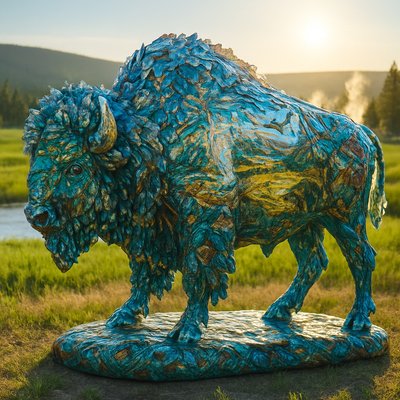
    A breathtaking, full-size artistic sculpture of a standing buffalo, rendered entirely in the style of intricate, luminous glass art, reminiscent of the painted buffalo installations found in West Yellowstone art shows. The buffalo's form is composed of countless individual pieces of vibrant, multifaceted stained glass or fused glass, meticulously cut, arranged, and joined, creating a cohesive and majestic shape.

    Instead of traditional paint, the entire surface of this glass buffalo is adorned with various miniature, finely detailed scenes and patterns etched, painted, or embedded within the glass itself, or created by the unique coloration and texture of the glass pieces. These scenes could depict:

        Western landscapes: Yellowstone's geysers, mountain ranges, pine forests, rivers.

        Wildlife: Elk, bears, wolves, eagles (in glass).

        Native American art motifs: Geometric patterns, symbols, and figures (also rendered in glass).

        Historical moments: Subtle nods to early explorers or iconic figures (stylized in glass).

    The buffalo's interior is subtly illuminated, causing the entire sculpture to glow from within. Light catches every facet of the glass, creating a dazzling play of refracted colors and intricate shadows on the ground around it. The background is a clean, modern art gallery setting with soft, focused lighting, allowing the buffalo to be the sole, radiant centerpiece. The atmosphere is one of awe, wonder, and appreciation for artistic craftsmanship and the spirit of the American West, reimagined through a unique, luminous medium. The artistic style is hyper-realistic, emphasizing the detailed texture, transparency, and brilliant light play inherent in glass art."
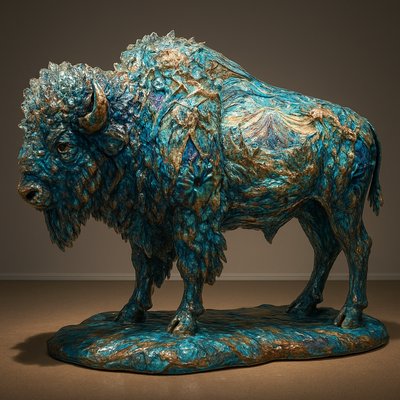
    A breathtaking, full-size artistic sculpture of a standing buffalo, rendered entirely in the style of intricate, luminous glass art, reminiscent of the painted buffalo installations. The buffalo's majestic form is composed of countless individual pieces of vibrant, multifaceted stained glass or fused glass, meticulously cut, arranged, and joined.

    The entire surface of this glass buffalo is adorned with various miniature, finely detailed scenes and patterns etched, painted, or embedded within the glass itself, or created by the unique coloration and texture of the glass pieces. These scenes depict:

        Iconic Yellowstone landscapes: Old Faithful erupting in miniature, the Grand Canyon of the Yellowstone, geothermal pools.

        Local wildlife: Elk, bears, wolves, eagles (all rendered in the glass medium).

        Native American art motifs: Geometric patterns, symbols, and figures (also within the glass).

    The buffalo's interior is subtly illuminated, causing the entire sculpture to glow from within, acting as a beacon of art and nature. Light catches every facet of the glass, creating a dazzling play of refracted colors that project intricate patterns onto the surrounding natural environment.

    The setting is the glory of Yellowstone National Park, specifically an expansive, iconic vista. Perhaps in a verdant meadow with distant geysers steaming, or near a crystal-clear river. The morning sun, bright and golden, backlights the buffalo, intensifying its inner glow and creating a dramatic contrast with the rugged, natural beauty of the park. The atmosphere is one of awe, harmony between art and nature, and a profound celebration of the spirit of the American West. The artistic style is hyper-realistic, emphasizing the detailed texture, transparency, and brilliant light play inherent in glass art, seamlessly integrated into a vibrant, natural landscape.

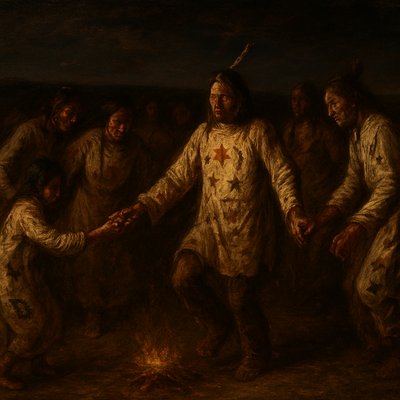
"A historically accurate depiction of a Ghost Dance, focusing on the late 19th-century context, specifically around 1890-1891. The scene shows Lakota (Sioux) or Northern Paiute people (specify one or include elements of both, but avoid anachronisms) participating in the ceremony.

Setting: A vast, open prairie or high desert landscape, under an expansive sky. The time of day could be dusk or night, with a prominent moon or stars, or a bright, clear day. Avoid overtly spiritual or ethereal elements like floating spirits unless explicitly requested for a later, more symbolic iteration. The focus should be on the earthly ceremony.

Participants: A circle of men, women, and children, hand-in-hand, moving in a slow, rhythmic shuffle or circular motion. Their faces show a mixture of devotion, hope, and determination. Some may have expressions of trance or deep concentration.

Attire:

    Ghost Dance Shirts/Dresses: Emphasize the unique Ghost Dance shirts and dresses, which were typically made of muslin or canvas. These garments should feature painted designs such as stars, crescents, birds (especially eagles or crows), buffalo, human figures, or crosses. The designs should appear hand-painted, not mass-produced.

    Hair and Adornments: Participants should have braided hair or wear it long. Some may wear feathers (e.g., eagle or hawk feathers) in their hair. Minimal traditional adornments, as the focus was often on the Ghost Dance shirt itself. Avoid overly elaborate or Hollywood-esque depictions of war bonnets unless relevant to a specific individual and context.

    Footwear: Moccasins or bare feet.

Action/Atmosphere:

    The dancers are moving in a counter-clockwise circle, with a central figure or a small group often leading.

    The overall mood is one of earnest prayer and communal spiritual effort. The dance should convey a sense of hope for renewal and the return of the old ways, rather than aggression or despair.

    There might be a central pole or small fire as a focal point, around which the dance takes place.

    Avoid any signs of direct conflict or violence; the Ghost Dance itself was a non-violent spiritual movement.

Specific Considerations for Accuracy:

    Wovoka's Influence: The teachings of Wovoka (the Northern Paiute prophet) emphasized peace, hard work, and the return of the buffalo and deceased ancestors. The scene should subtly reflect this hopeful, redemptive spirit.

    Regional Variations: If focusing on Lakota, consider their specific interpretations, which sometimes included more imagery related to their warrior traditions on the shirts, but still within the peaceful framework of the dance.

    Respectful Portrayal: Ensure the depiction is respectful and avoids any stereotypical or caricatured representations of Indigenous people. Focus on their human dignity and spiritual sincerity.
Skull with violin and dying roses
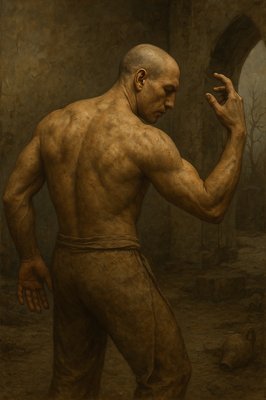
a painting of a man holding a stick in a cave
a man with a shirt on posing for a picture
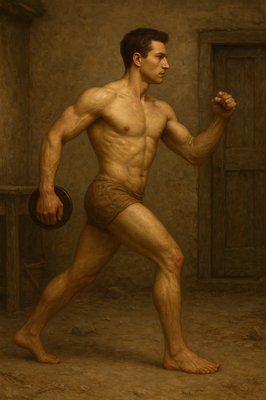
a painting of a man holding a disc
a painting of a man standing in a cave
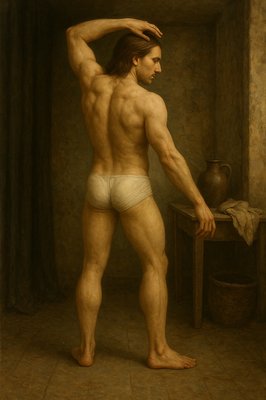
a painting of a man in his underwear