I Will Trust In Him And Not Be Afraid. For The Lord Is My Stronghold And My Sure Defense, * And He Will Be My Art

A breathtaking and surreal scene of vibrant Aspen trees in full autumn splendor, encased within a massive, crystal-clear, life-size glass bubble, reminiscent of a hyperrealistic snow globe. The glass bubble is perfectly spherical and transparent, allowing an unobstructed view into its contained world.

Inside the bubble, a fierce autumn wind is whipping through the Aspen trees, which are ablaze with brilliant golden, yellow, and orange leaves. Countless individual leaves are detached from the branches and are swirling dynamically in a vibrant vortex around the tree trunks, creating a beautiful, chaotic dance. Some leaves cling to the ground, while others are caught in mid-air, a riot of color against the pale, smooth bark of the Aspens. The ground inside the bubble is covered in a thick carpet of fallen, colorful leaves.

The exterior of the glass bubble reflects and subtly distorts a serene, autumnal mountain landscape or clear blue sky, emphasizing its pristine, contained nature. The lighting is bright and ethereal, perfectly illuminating the vibrant leaf colors and the transparency of the glass, highlighting the dynamic movement within. The overall mood is one of encapsulated beauty, powerful natural forces held in exquisite suspension, and serene wonder."
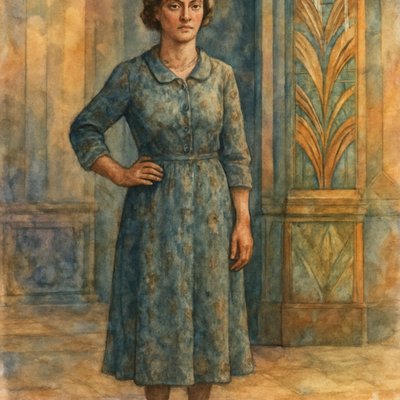
A woman dressed in Great Depression era fashion, standing in a dimly lit, humble setting. She wears a modest, long-sleeved dress made of durable, slightly faded cotton or rayon, with a mid-calf hemline. The dress is a muted color like dusty blue, faded green, or soft brown, possibly with a subtle, small floral or geometric pattern. Her hair is styled simply, perhaps in soft waves or a practical updo, and she wears sturdy, low-heeled lace-up shoes. Her posture is resilient, reflecting the strength of the era. The background is simple and sparse, hinting at the economic hardship, perhaps an old wooden wall or a faded curtain. The overall feeling is one of quiet determination and dignified hardship Use Art Deco architecture or Art Deco interior in the background, but describe the fashion as faded, worn, and humble. Juxtapose the sleek, modern geometry of the setting with the practical, mended, and heavy wool textures of the clothing.
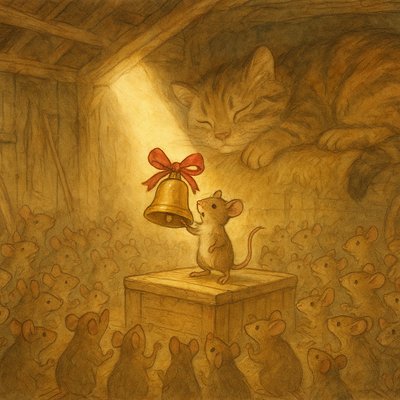
Whimsical Storybook Illustration Style, Warm Color Palette, Soft Textures and Detailed Linework. A wide-angle view of a secret, crowded meeting of dozens of anthropomorphic field mice taking place on an upturned wooden crate in the corner of a cluttered, dusty barn.

The Focal Point (The Plan): In the center of the crate spotlighted by a beam of sunlight coming through a crack in the roof, a small, earnest mouse stands on its hind legs, triumphantly holding aloft a shiny brass sleigh bell tied with a bright red ribbon. The bell looks impossibly large and heavy for the mouse.

The Reaction (The Hesitation): The surrounding crowd of mice is a mix of emotions. Some in the front row are cheering with tiny paws raised. However, many others towards the back are exchanging nervous, sidelong glances, scratching their heads, or looking fearfully over their shoulders.

The Threat (The Reality): In the background, looming massively over the entire scene on top of a high stack of hay bales, a giant, fluffy tabby cat is fast asleep. Though sleeping, its size and sharp claws are evident, casting a shadow over the edge of the meeting area. The contrast between the small, shiny bell and the enormous sleeping predator is central to the image.
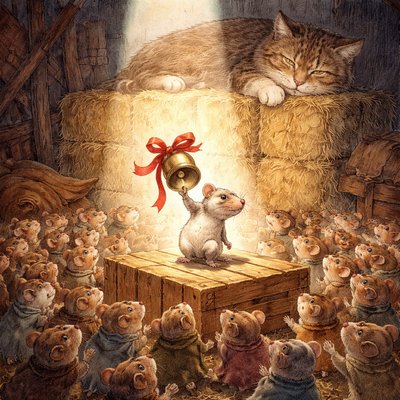
Whimsical Storybook Illustration Style, Warm Color Palette, Soft Textures and Detailed Linework. A wide-angle view of a secret, crowded meeting of dozens of anthropomorphic field mice taking place on an upturned wooden crate in the corner of a cluttered, dusty barn.

The Focal Point (The Plan): In the center of the crate spotlighted by a beam of sunlight coming through a crack in the roof, a small, earnest mouse stands on its hind legs, triumphantly holding aloft a shiny brass sleigh bell tied with a bright red ribbon. The bell looks impossibly large and heavy for the mouse.

The Reaction (The Hesitation): The surrounding crowd of mice is a mix of emotions. Some in the front row are cheering with tiny paws raised. However, many others towards the back are exchanging nervous, sidelong glances, scratching their heads, or looking fearfully over their shoulders.

The Threat (The Reality): In the background, looming massively over the entire scene on top of a high stack of hay bales, a giant, fluffy tabby cat is fast asleep. Though sleeping, its size and sharp claws are evident, casting a shadow over the edge of the meeting area. The contrast between the small, shiny bell and the enormous sleeping predator is central to the image.
A koi pond seen from above, orange and white koi fish swimming among lily pads, clear water with subtle ripples, fallen cherry blossom petals floating on the surface, dappled sunlight
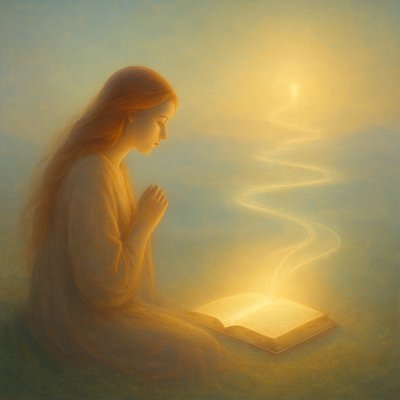
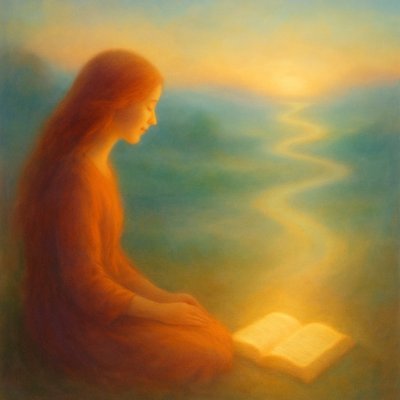
profound image representing the verse Psalm 119:15. The scene depicts a solitary lady with flowing, long red hair, in a posture of deep contemplation or meditation. She is seated or kneeling in a peaceful, natural setting – perhaps on a gentle hillside overlooking a tranquil landscape, by a calm body of water, or within a serene garden. Her expression is focused and reverent.

Before her, or subtly integrated into the scene, is an ancient scroll or open book, glowing with a soft, ethereal light, symbolizing God's precepts. Her posture and gaze are directed towards this source of wisdom, with a clear sense of 'fixing her eyes' on its profound truth.

Extending from the scroll/book, or subtly woven into the distant landscape, are luminous, ethereal pathways or guiding lights, representing 'Your ways' (God's ways). These pathways are clear and inviting, leading towards a bright, hopeful horizon, symbolizing divine guidance and understanding. The atmosphere is tranquil and reflective, bathed in soft, warm, golden light (perhaps dawn or dusk), signifying clarity and spiritual insight. The overall mood is one of peace, deep wisdom, divine guidance, and focused devotion, rendered with a beautiful, luminous quality."
profound image representing the verse Psalm 119:15. The scene depicts a solitary lady with flowing, long red hair, in a posture of deep contemplation or meditation. She is seated or kneeling in a peaceful, natural setting – perhaps on a gentle hillside overlooking a tranquil landscape, by a calm body of water, or within a serene garden. Her expression is focused and reverent.

Before her, or subtly integrated into the scene, is an ancient scroll or open book, glowing with a soft, ethereal light, symbolizing God's precepts. Her posture and gaze are directed towards this source of wisdom, with a clear sense of 'fixing her eyes' on its profound truth.

Extending from the scroll/book, or subtly woven into the distant landscape, are luminous, ethereal pathways or guiding lights, representing 'Your ways' (God's ways). These pathways are clear and inviting, leading towards a bright, hopeful horizon, symbolizing divine guidance and understanding. The atmosphere is tranquil and reflective, bathed in soft, warm, golden light (perhaps dawn or dusk), signifying clarity and spiritual insight. The overall mood is one of peace, deep wisdom, divine guidance, and focused devotion, rendered with a beautiful, luminous quality."
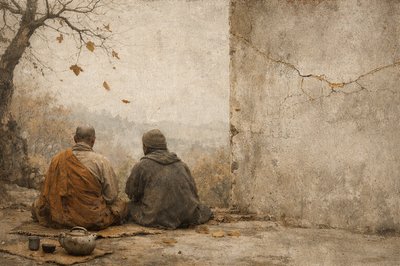
I sat, long ago, on an Asian hill with a Shakya Mundi friend, and watched the autumn leaves fall down from high above, giants in the forest casting off their wakefulness, falling progressively into winter’s long, white sleep. 

“The important thing to know about trees” he said, “is that they are most beautiful in autumn; just before the winter snow.  They live and grow through the entire year just for these brief moments of stunning beauty.  We are like that.” He said, “but we have only one autumn, and a very long winter.”
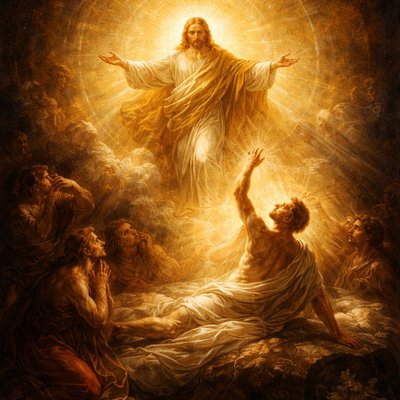
“But all things that are reproved are made manifest by the light: for whatsoever doth make manifest is light. Wherefore he saith, Awake thou that sleepest, and arise from the dead, and Christ shall give thee light.” (Ephesians 5:13-14, KJVA)
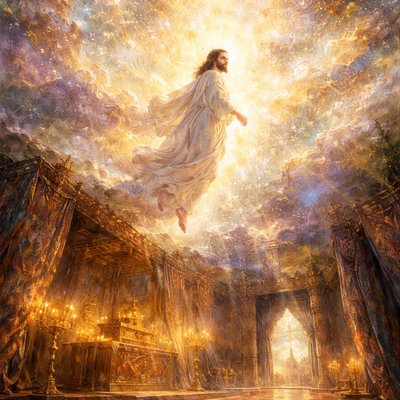
A wide-angle, cinematic masterpiece. The lower portion of the image shows the interior of an ancient, candlelit Tabernacle, detailed with tapestries and hewn stone (the "holy places made with hands"). Above it, the roof dissolves into swirling, luminous, celestial energy and golden light that is boundless ("heaven itself"). The figure of Jesus Christ, radiant with a soft inner light and wearing simple, brilliant white robes, is ascending from the shadowy temple into the infinite light, looking back with compassionate intercessory eyes. Volumetric lighting, grand scale, highly detailed, dramatic atmosphere.
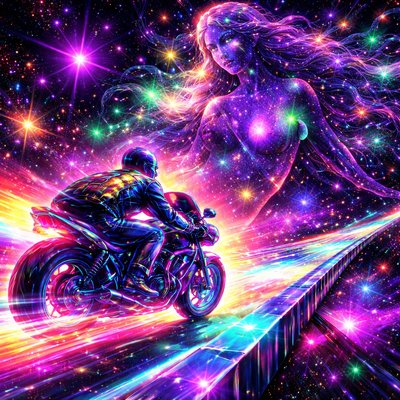
Psychedelic Rotoscope Animation Style, Vibrant Neon Pop-Art, Kinetic 80s Synthwave Aesthetic. A high-energy, multi-colored cosmic chase scene rendered in frenetic, hand-drawn strokes.

The Rider & Bike: The "Take On Me" hero is hunched over his motorcycle, but instead of graphite, he and the bike are composed of glowing electric-blue and hot-pink outlines. His leather jacket shimmers with iridescent "oil-slick" colors. As the bike tears forward, it leaves behind a shimmering rainbow exhaust trail that ribbons across the dark sky.

The Ecliptic & Virgo: They are riding along the Ecliptic, which is depicted as a glowing, multi-colored crystalline highway cutting through space. In the background, the constellation Virgo is a colossal, majestic goddess made of swirling violet nebulae, emerald star-clusters, and golden stardust. Her hair flows like a galactic aurora, filling the frame with a kaleidoscope of saturated colors.

The Atmosphere: The blackness of space is replaced with a deep indigo and magenta gradient, crowded with exploding supernovas, prismatic stars, and neon lens flares. Every line should look like a vibrating, colorful energy stroke, creating a scene that is "loud," bright, and intensely colorful.
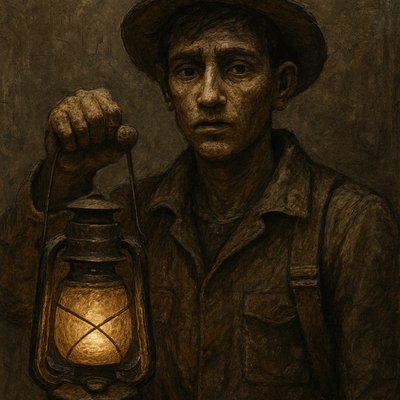
a painting of a man holding a lantern
Social Realism Art Style Style Transfer Example
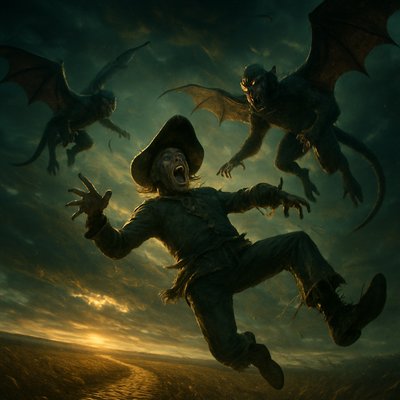
Cinematic Concept Art, High Fantasy Illustration, Wide Angle, Dynamic Lighting "A wide, epic shot of the Wizard of Oz Scarecrow being violently lifted into the air by three menacing, taloned Flying Monkeys descending from a swirling, dark-clouded sky. The Scarecrow is mid-scream, straw is bursting from a tear in his pant leg, and his hat is flying off. The scene is set over a desolate, golden field, with a tiny Yellow Brick Road receding into the distance. Volumetric light rays pierce the storm clouds, highlighting the terror and the tattered fabric of the monkeys' wings. Focal Length 24mm, 8K, highly detailed, dramatic shadow depth."
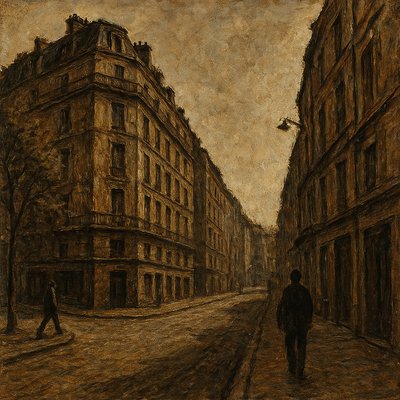
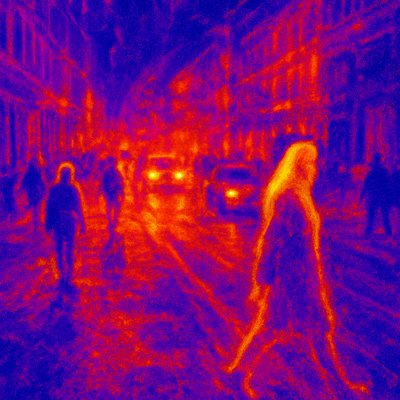
urban street with city activity
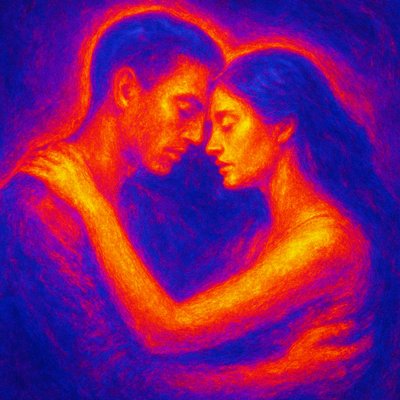
portrait of two people together
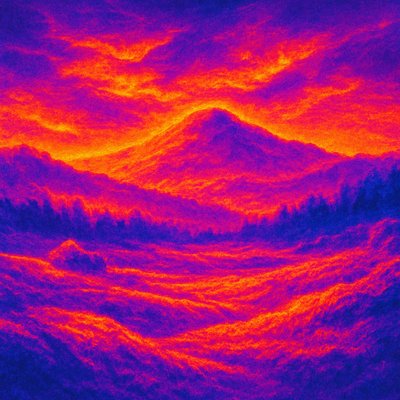
wide landscape with natural scenery
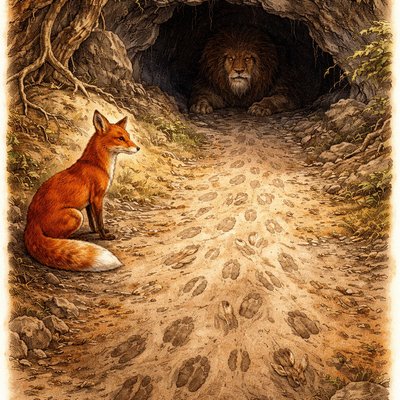
Golden Age Storybook Illustration Style, Rich Watercolor and Ink, Detailed Textures. A narrative scene capturing the tense moment of realization outside a rugged, dark cave entrance hidden among dry rocks and gnarled roots.

The Fox and the Evidence: In the bright, sunlit foreground, a clever, reddish-orange fox sits alertly on its haunches, a safe distance from the cave mouth. Its head is tilted, looking intently at the dusty ground. The dirt path leading directly into the dark cave is a chaotic, heavily trampled mess of hundreds of distinct footprints—deer hooves, rabbit paws, badger claws—all pointing inward. Crucially, the dusty ground leading away from the cave is completely smooth and untouched by return tracks.

The Lion and the Den: The cave entrance is a gaping maw of deep shadow. The gaunt, old lion lying in wait are visible, watching the fox intently. The contrast between the warm sunlight outside and the cold darkness inside is sharp.
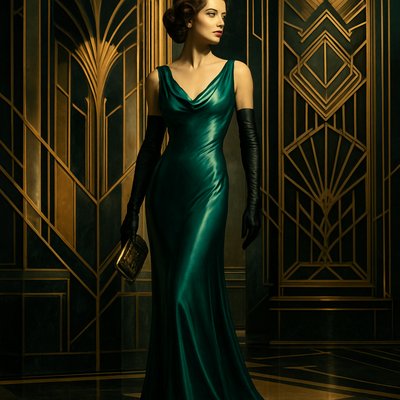
A statuesque woman dressed in high-fashion 1930s Great Depression era glamour, imbued with a strong Art Deco aesthetic. She stands confidently, showcasing a bias-cut evening gown of shimmering silk or satin in a rich jewel tone (e.g., emerald green, sapphire blue, ruby red, or metallic silver/gold). The gown features an elongated, sleek silhouette, perhaps a dramatic cowl neck, a plunging back, or subtle shoulder pads. Her hair is styled in soft, sculpted finger waves. She wears elegant, long gloves and carries a small, decorative clutch bag. The background is a sophisticated Art Deco interior, perhaps with geometric patterns, polished chrome details, and ambient, dramatic lighting, or she stands against a backdrop of Art Deco skyscraper architecture. The overall mood is one of sophistication, elegance, and timeless allure."
Neon-Futurism Digital Art Style, Bioluminescent Sci-Fi Cosmic Setting. A sleek, futuristic scene set deep in the interstellar void, with absolutely no Earth terrain, asphalt, or atmosphere visible. The Path (The Ecliptic): The "road" is a floating, translucent highway constructed entirely of glowing blue and orange laser grids and condensed stardust, arcing through infinite dark space. The Rider: A lone rider on a futuristic, hubless "light-cycle" sportbike speeds along this cosmic path. The rider is fully encased in a sleek, glowing armored suit with an integrated full-face helmet, leaving a vibrant neon light trail behind them. The Constellation (Abstract Libra Scales as Archway): Dominating the cosmic background and towering directly overhead is the immense celestial symbol of Libra: a pair of perfectly balanced, monumental golden scales made of glowing stars, luminous energy threads, and shimmering stardust. The scales' beam forms a grand, arched gateway structure high above, with the two pans hanging symmetrically on either side like massive portals or wings of equilibrium. The floating cosmic highway arcs directly under this uplifted arched scale structure, so the rider speeds beneath the balanced beam and between the hanging pans as if passing through the gateway of harmony and justice. No humanoid figure is present—only the majestic, abstract scales as the central cosmic emblem, radiating soft silver, deep indigo, and golden light against the nebula-filled void. The rider approaches and passes under the archway calmly and serenely.
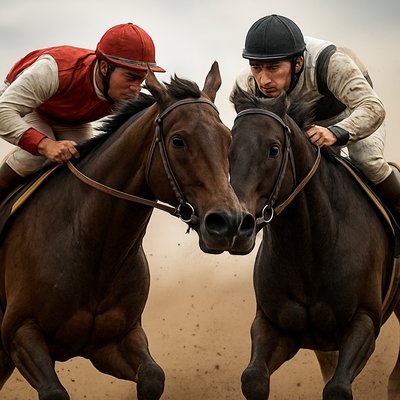
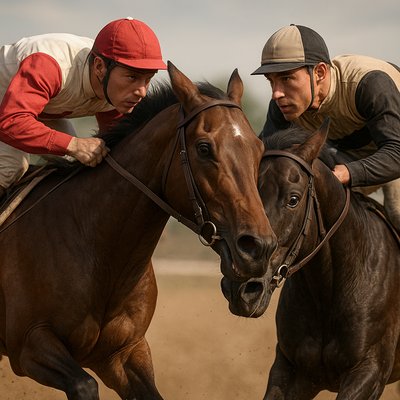
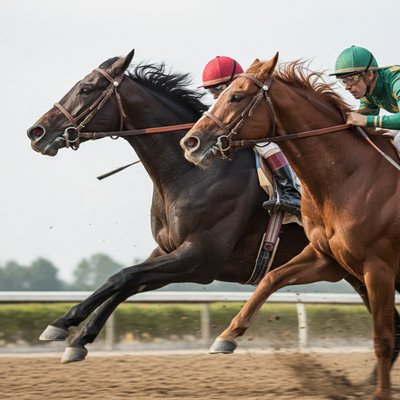
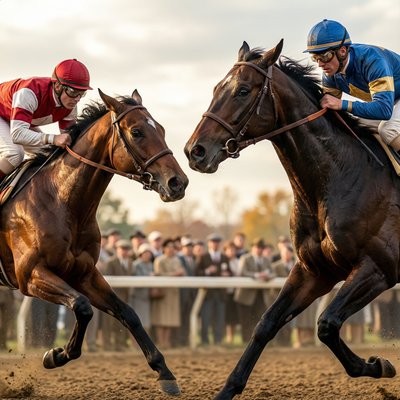
Seabiscuit vs. War Admiral (The Gaze)

    A hyper-realistic, high-resolution photograph capturing the apex of the 1938 match race between Seabiscuit and War Admiral.

    Focus: The composition is tight, showing both horses running neck-and-neck, dominating the frame. The camera angle is side-on and slightly low, emphasizing their size and muscle. The critical focus is on the space between the horses' heads as they are running stride for stride.

    Details: War Admiral (the dark bay) should show determination and slight surprise, with his head stretched out. Seabiscuit (the smaller bay) should display his characteristic "game" look—intense, focused, and seemingly looking directly into War Admiral's eyes (or toward his rival). Both jockeys (Red Pollard or George Woolf for Seabiscuit; Charles Kurtsinger for War Admiral) are visible, leaning low and urging their mounts on.

    Atmosphere: The light should be bright but slightly diffused, suggesting an autumn afternoon at Pimlico. Dust and track debris are kicked up behind them, blurred slightly by the horses' tremendous speed. The image must convey the raw power, intense rivalry, and the exact moment when the smaller horse asserts his dominance.

    Style: Cinematic photography, realistic texture, sharp focus on the horses' eyes and muscle definition.
Seabiscuit vs. War Admiral (The Gaze)

    A hyper-realistic, high-resolution photograph capturing the apex of the 1938 match race between Seabiscuit and War Admiral.

    Focus: The composition is tight, showing both horses running neck-and-neck, dominating the frame. The camera angle is side-on and slightly low, emphasizing their size and muscle. The critical focus is on the space between the horses' heads as they are running stride for stride.

    Details: War Admiral (the dark bay) should show determination and slight surprise, with his head stretched out. Seabiscuit (the smaller bay) should display his characteristic "game" look—intense, focused, and seemingly looking directly into War Admiral's eyes (or toward his rival). Both jockeys (Red Pollard or George Woolf for Seabiscuit; Charles Kurtsinger for War Admiral) are visible, leaning low and urging their mounts on.

    Atmosphere: The light should be bright but slightly diffused, suggesting an autumn afternoon at Pimlico. Dust and track debris are kicked up behind them, blurred slightly by the horses' tremendous speed. The image must convey the raw power, intense rivalry, and the exact moment when the smaller horse asserts his dominance.

    Style: Cinematic photography, realistic texture, sharp focus on the horses' eyes and muscle definition.
Seabiscuit vs. War Admiral (The Gaze)

    A hyper-realistic, high-resolution photograph capturing the apex of the 1938 match race between Seabiscuit and War Admiral.

    Focus: The composition is tight, showing both horses running neck-and-neck, dominating the frame. The camera angle is side-on and slightly low, emphasizing their size and muscle. The critical focus is on the space between the horses' heads as they are running stride for stride.

    Details: War Admiral (the dark bay) should show determination and slight surprise, with his head stretched out. Seabiscuit (the smaller bay) should display his characteristic "game" look—intense, focused, and seemingly looking directly into War Admiral's eyes (or toward his rival). Both jockeys (Red Pollard or George Woolf for Seabiscuit; Charles Kurtsinger for War Admiral) are visible, leaning low and urging their mounts on.

    Atmosphere: The light should be bright but slightly diffused, suggesting an autumn afternoon at Pimlico. Dust and track debris are kicked up behind them, blurred slightly by the horses' tremendous speed. The image must convey the raw power, intense rivalry, and the exact moment when the smaller horse asserts his dominance.

    Style: Cinematic photography, realistic texture, sharp focus on the horses' eyes and muscle definition.
Seabiscuit vs. War Admiral (The Gaze)

    A hyper-realistic, high-resolution photograph capturing the apex of the 1938 match race between Seabiscuit and War Admiral.

    Focus: The composition is tight, showing both horses running neck-and-neck, dominating the frame. The camera angle is side-on and slightly low, emphasizing their size and muscle. The critical focus is on the space between the horses' heads as they are running stride for stride.

    Details: War Admiral (the dark bay) should show determination and slight surprise, with his head stretched out. Seabiscuit (the smaller bay) should display his characteristic "game" look—intense, focused, and seemingly looking directly into War Admiral's eyes (or toward his rival). Both jockeys (Red Pollard or George Woolf for Seabiscuit; Charles Kurtsinger for War Admiral) are visible, leaning low and urging their mounts on.

    Atmosphere: The light should be bright but slightly diffused, suggesting an autumn afternoon at Pimlico. Dust and track debris are kicked up behind them, blurred slightly by the horses' tremendous speed. The image must convey the raw power, intense rivalry, and the exact moment when the smaller horse asserts his dominance.

    Style: Cinematic photography, realistic texture, sharp focus on the horses' eyes and muscle definition.
Art Style: Ethereal, visionary digital art. A fusion of bioluminescence, sacred geometry, and fluid dynamics. The aesthetic should feel transcendent, glowing, and incredibly soft yet powerful.

    Central Focus (The Source): A human figure in a state of pure, peaceful meditation or ecstatic dance sits in the center of the frame. Their body is semi-translucent, glowing from within with warm white and golden light, acting as a living resonator.

    The Frequency (The Positive Force): Emanating directly from the figure's heart center are visible, powerful waves of vibrational energy.

        Appearance: These aren't simple lines; they are complex, flowing ripples of interwoven light patterns, resembling three-dimensional cymatics (the geometric patterns sound makes in sand or water) and flowing silk.

        Colors: A healing palette of radiant cyan, amethyst purple, warm honey-gold, and soft rose pink. The colors blend and shift as the waves move outward.

    The Effect on the Environment: The scene shows the positive impact of this frequency. The figure is sitting in a dormant, grey landscape. As the colorful frequency waves ripple outwards and touch the surroundings:

        Dull rocks instantly transform into glowing, crystalline formations.

        Bare, gnarled branches burst into shimmering leaves and flowers made of light.

        The air itself seems to shimmer with golden dust motes caught in the vibrational field.

    Overall Atmosphere: Uplifting, healing, and dynamic. A visualization of sound and energy creating order and beauty out of chaos.
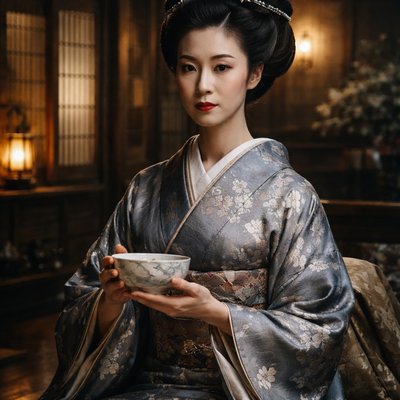
Cinematic Film Style, Traditional Japanese Ukiyo-e Influence, a regal and incredibly poised portrait of the geisha Mameha (inspired by Michelle Yeoh). She is seated in a refined, dimly lit wooden teahouse, her posture perfectly upright and elegant. She wears a heavy silk kimono in peaceful, sophisticated colors like slate blue and silver, with delicate hand-painted motifs of plum blossoms. Her face is a "mask" of white traditional makeup, featuring sharp red lips and wise, observant eyes that convey deep intelligence. She is in the middle of a ritual, perhaps holding a delicate porcelain tea bowl with perfectly choreographed hands. The lighting is soft and atmospheric, catching the shimmer of her silk and the intricate details of her high, lacquered hairstyle adorned with a single, understated silver hairpin. Focus on the feeling of quiet power, impeccable grace, and the stillness of a master artist.
A woman dressed in Great Depression era fashion, standing in a dimly lit, humble setting. She wears a modest, long-sleeved dress made of durable, slightly faded cotton or rayon, with a mid-calf hemline. The dress is a muted color like dusty blue, faded green, or soft brown, possibly with a subtle, small floral or geometric pattern. Her hair is styled simply, perhaps in soft waves or a practical updo, and she wears sturdy, low-heeled lace-up shoes. Her posture is resilient, reflecting the strength of the era. The background is simple and sparse, hinting at the economic hardship, perhaps an old wooden wall or a faded curtain. The overall feeling is one of quiet determination and dignified hardship
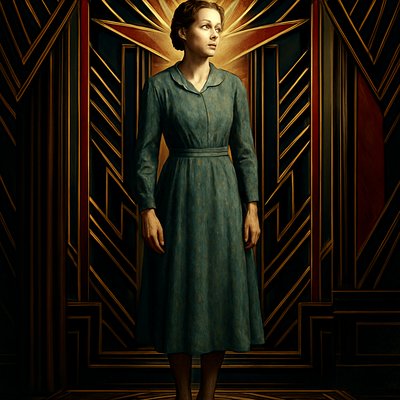
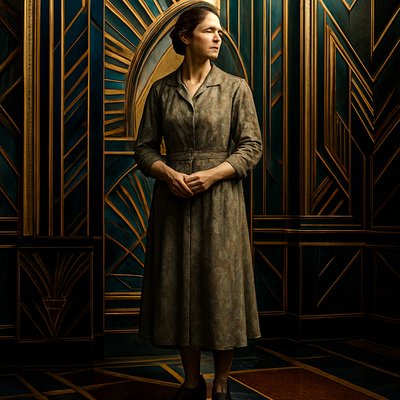
A woman dressed in Great Depression era fashion, standing in a dimly lit, humble setting. She wears a modest, long-sleeved dress made of durable, slightly faded cotton or rayon, with a mid-calf hemline. The dress is a muted color like dusty blue, faded green, or soft brown, possibly with a subtle, small floral or geometric pattern. Her hair is styled simply, perhaps in soft waves or a practical updo, and she wears sturdy, low-heeled lace-up shoes. Her posture is resilient, reflecting the strength of the era. The background is simple and sparse, hinting at the economic hardship, perhaps an old wooden wall or a faded curtain. The overall feeling is one of quiet determination and dignified hardship Use Art Deco architecture or Art Deco interior in the background, but describe the fashion as faded, worn, and humble. Juxtapose the sleek, modern geometry of the setting with the practical, mended, and heavy wool textures of the clothing.
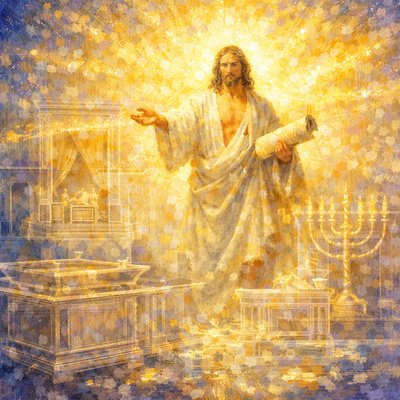
A surrealist, double-exposure art piece. In the foreground, there are translucent, architect’s blueprint lines and ghostly outlines of the ancient Temple altars, lampstands, and the Holy of Holies (representing the "figures of the true"). Overlapping and far superior to them, Jesus Christ stands before an blinding, warm, golden divine presence (representing the "presence of God"). He is actively gesturing forward, presenting a scroll or his own wounds on behalf of unseen people ("for us"). Transcendent, ethereal, glowing edges, minimal color palette of gold, white, and midnight blue.
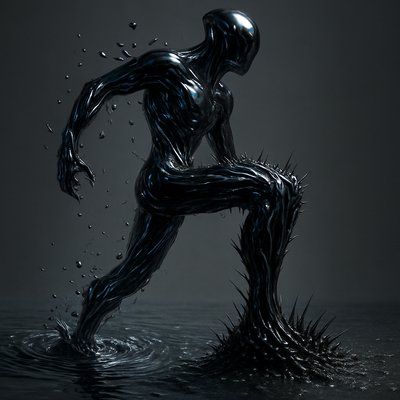
A surreal sculpture of a humanoid shape made of magnetic liquid metal, caught in a state of transformation, ArtStyle liquid metal. The composition is split between water and land. On the water side, the entity's leg is a vortex of water and metal swirling together, zero gravity liquid droplets rising up. On the land side, the other leg creates heavy, thick strands of magnetic fluid stretching and snapping as it steps onto the terrain, pulling the ocean with it. Intense texture of ferrofluid spikes and smooth metallic curves. Dramatic shadows, wet surface rendering, hyper-realistic physics.
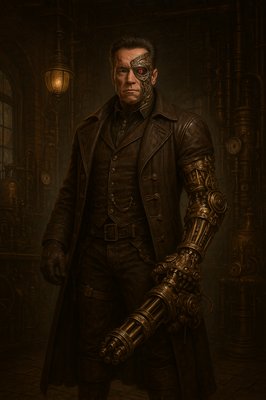
"A dramatic, full-body portrait of Arnold Schwarzenegger as a Steampunk Terminator, standing powerfully in a richly detailed Victorian-era workshop. Arnold's iconic Terminator face is visible, with a glowing red eye, partially obscured by an intricate, metallic eyepatch and visible cybernetic components around his neck and face. He wears a heavy, dark brown leather duster coat over a tailored waistcoat and trousers, all adorned with brass buckles, gears, and leather straps. His left arm is a formidable steampunk prosthetic, crafted from polished brass, copper, and exposed gears, ending in a massive, Gatling-gun-like weapon integrated into the forearm. His right hand wears a finely detailed leather glove with metallic accents. The background of the workshop is filled with vintage machinery, pressure gauges, steam pipes, exposed brick walls, and the soft glow of gas lamps. Smoke or steam gently drifts through the air, adding to the atmospheric industrial setting. The overall aesthetic is gritty, sophisticated, and perfectly blends the sci-fi elements of the Terminator with the intricate mechanical beauty of steampunk
urban street with city activity
Low-poly geometric portrait of a cat's head facing slightly to the right, divided vertically down the center into two contrasting color halves. The left half features cool blue tones ranging from deep navy to light cyan in angular polygonal facets, with a large blue eye, black pupil, and subtle white highlight. The right half uses warm orange, brown, and golden yellow shades in similar triangular and polygonal shapes, with a vibrant green eye, black pupil, and white highlight. Thin white whiskers extend from the muzzle on both sides. Solid medium-gray background. Style: minimalist vector art, faceted like origami or crystal, high contrast, no outlines except subtle edges, symmetrical split for a duality theme.
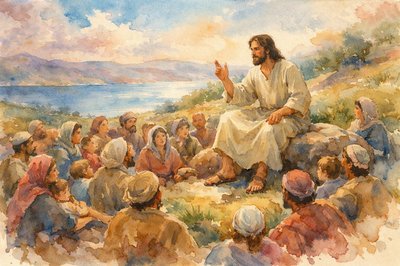
First century Palestine.  Jesus sits on a rock on a hillside teaching a large group of His disciples.  The Sermon on the Mount.  Jesus wears a plain robe like most ordinary men.  Jesus' face is kind, but intense, as He teaches. The other people are mostly peasants, farmers, and tradesmen.  There are also women present, wearing plain, everyday clothing.  Some couples have also brought their children.  The Sea of Galilee shines in the far distance.
"A high-energy, candid photo of the three people from the reference image—a woman with long red hair wearing a headband, an older man with white hair, and a young boy in a lime green shirt—engaged in a joyful balloon fight inside their cozy RV. Lot of colorful balloons (red, blue, and purple) are captured mid-air, appearing slightly blurred to show motion. The family is laughing, with the boy reaching up to swat a balloon and the man playfully dodging one. The interior of the RV is bright with natural light coming through the windows, showing wood cabinetry and a comfortable dinette area. The scene is full of warmth, action, and genuine family connection."
a heartwarming scene under a decorated Christmas tree. Two fluffy kittens, one a ginger tabby and the other a calico, are joyfully playing in a chaotic pile of discarded Christmas wrapping paper, ribbons, and bows. The ginger kitten is tangled in a long piece of shiny red and green paper, batting at a curled ribbon. The calico kitten is pouncing from inside a torn open cardboard gift box, surrounded by crumpled tissue paper. Torn pieces of colorful wrapping paper (gold foil, snowman patterns, stripes) and empty gift tags are scattered everywhere on a plush rug. The Christmas tree above them is glowing with warm fairy lights and decorated with traditional ornaments. The background is a cozy living room with a fireplace. Sharp focus on the kittens' playful expressions and the texture of the crumpled paper.
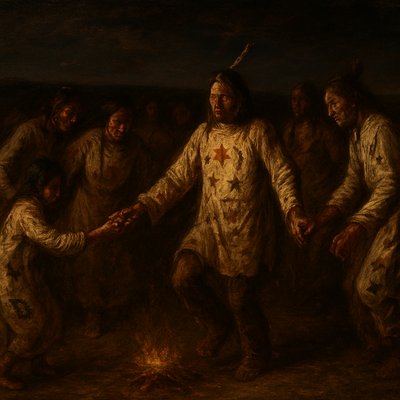
"A historically accurate depiction of a Ghost Dance, focusing on the late 19th-century context, specifically around 1890-1891. The scene shows Lakota (Sioux) or Northern Paiute people (specify one or include elements of both, but avoid anachronisms) participating in the ceremony.

Setting: A vast, open prairie or high desert landscape, under an expansive sky. The time of day could be dusk or night, with a prominent moon or stars, or a bright, clear day. Avoid overtly spiritual or ethereal elements like floating spirits unless explicitly requested for a later, more symbolic iteration. The focus should be on the earthly ceremony.

Participants: A circle of men, women, and children, hand-in-hand, moving in a slow, rhythmic shuffle or circular motion. Their faces show a mixture of devotion, hope, and determination. Some may have expressions of trance or deep concentration.

Attire:

    Ghost Dance Shirts/Dresses: Emphasize the unique Ghost Dance shirts and dresses, which were typically made of muslin or canvas. These garments should feature painted designs such as stars, crescents, birds (especially eagles or crows), buffalo, human figures, or crosses. The designs should appear hand-painted, not mass-produced.

    Hair and Adornments: Participants should have braided hair or wear it long. Some may wear feathers (e.g., eagle or hawk feathers) in their hair. Minimal traditional adornments, as the focus was often on the Ghost Dance shirt itself. Avoid overly elaborate or Hollywood-esque depictions of war bonnets unless relevant to a specific individual and context.

    Footwear: Moccasins or bare feet.

Action/Atmosphere:

    The dancers are moving in a counter-clockwise circle, with a central figure or a small group often leading.

    The overall mood is one of earnest prayer and communal spiritual effort. The dance should convey a sense of hope for renewal and the return of the old ways, rather than aggression or despair.

    There might be a central pole or small fire as a focal point, around which the dance takes place.

    Avoid any signs of direct conflict or violence; the Ghost Dance itself was a non-violent spiritual movement.

Specific Considerations for Accuracy:

    Wovoka's Influence: The teachings of Wovoka (the Northern Paiute prophet) emphasized peace, hard work, and the return of the buffalo and deceased ancestors. The scene should subtly reflect this hopeful, redemptive spirit.

    Regional Variations: If focusing on Lakota, consider their specific interpretations, which sometimes included more imagery related to their warrior traditions on the shirts, but still within the peaceful framework of the dance.

    Respectful Portrayal: Ensure the depiction is respectful and avoids any stereotypical or caricatured representations of Indigenous people. Focus on their human dignity and spiritual sincerity.
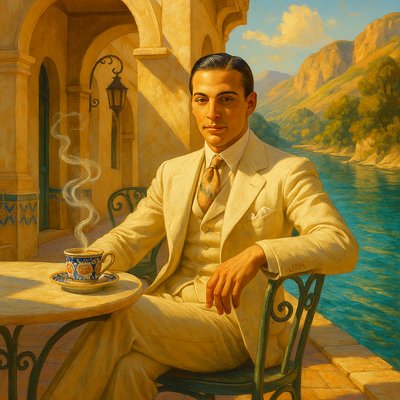
cinematic, vibrant scene of Rudolph Valentino in his youthful prime, seated at a French-style outdoor café table beside a clear, highly reflective teal-blue stream in the Italian mountains. He is strikingly handsome with smooth Mediterranean features, youthful charm, and a confident presence. He wears a tailored cream linen suit with a crisp white shirt, a silk cravat in soft pastel tones, and polished leather shoes. His hair is sleek and perfectly styled in a classic 1920s fashion, evoking timeless elegance. On the table rests a delicate porcelain coffee cup of fine Italian china, painted with intricate cobalt blue, gold, and crimson patterns. Steam rises gracefully from the cup, curling upward like ethereal ribbons, catching the sunlight in cinematic detail. The atmosphere glows with radiant, vibrant colors teal waters shimmering, golden mountain light illuminating the scene, reflections dance across the café table. No dark overlay, only luminous tones and crisp clarity.
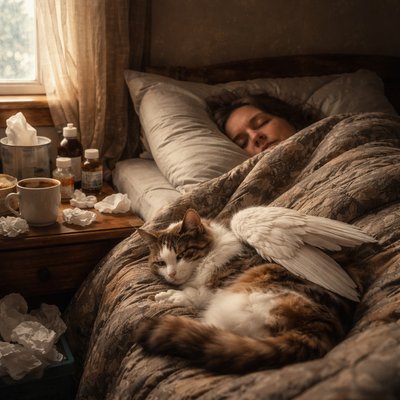
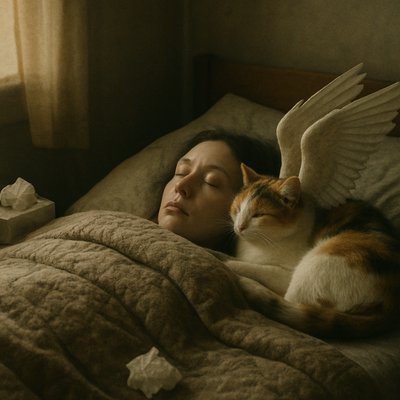
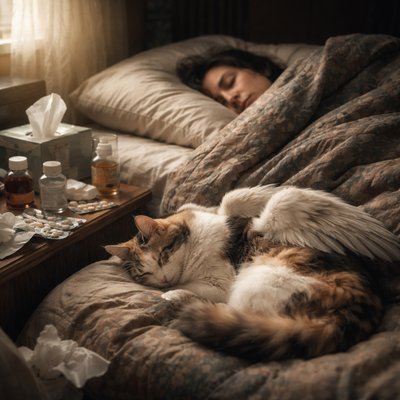
A candid, tender photograph of a person lying sick in a dimly lit, cozy bedroom, buried under a heavy quilt with only their pale face showing, eyes closed in sleep. Tissues and medicine bottles clutter a bedside table. Curled beside is a fluffy calico cat that has a pair of feathered angel wings. The cat is asleep too. Soft, natural light streams from a window to the left. Film grain.
A candid, tender photograph of a person lying sick in a dimly lit, cozy bedroom, buried under a heavy quilt with only their pale face showing, eyes closed in sleep. Tissues and medicine bottles clutter a bedside table. Curled beside the person in bed is a fluffy calico cat that has a pair of feathered angel wings. The cat is asleep too. Soft, natural light streams from a window to the left. Film grain.
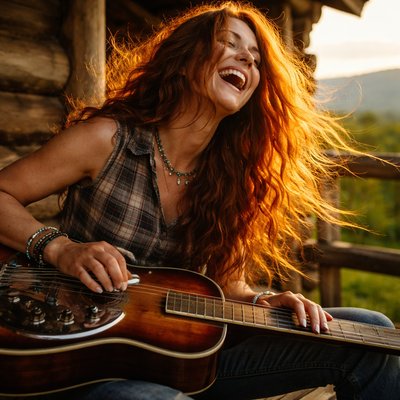
Cinematic Documentary Photography, Warm Analog Film Grain, Golden Hour Backlighting. A high-energy, joyful shot of a young Appalachian woman with a mane of long, fiery red hair playing a dobro resonator guitar on a weathered log cabin porch.

The Action & "Lively" Feel: She is seated with the guitar flat across her lap, caught in a moment of pure musical passion, her head tilted back in a laugh. Her long red hair is swirling around her face, catching the orange sunset light like glowing copper.

The Slide Detail: Her left hand is firmly gripping a heavy, polished chrome steel tone bar (slide), gliding it masterfully across the strings. The bar is a focal point, catching a brilliant glint of sunlight as it creates a soulful, sliding resonance. Her right hand is a blur of motion, using metal fingerpicks to pluck the strings near the bridge.

The Environment: The dobro's signature round metal resonator plate reflects the rustic porch and the sky. In the background, the hazy, rolling blue ridges of the Appalachian mountains stretch toward a soft, dusky horizon. The atmosphere is rustic, authentic, and vibrating with sound.
A candid, tender photograph of a person lying sick in a dimly lit, cozy bedroom, buried under a heavy quilt with only their pale face showing, eyes closed in sleep. Tissues and medicine bottles clutter a bedside table. Curled beside the person in bed is a fluffy calico cat that has a pair of feathered angel wings. The cat is asleep too. Soft, natural light streams from a window to the left. Film grain.