Battle Mech In Urban Combat Art

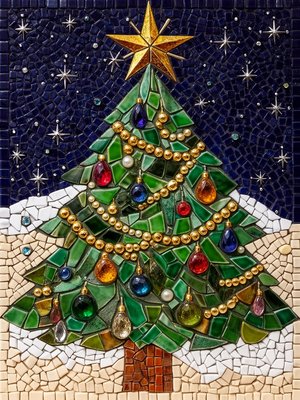
A highly detailed mosaic artwork depicting a classic Christmas tree, intricately composed of mixed tesserae including vibrant smalti glass tiles, sparkling gemstones, metallic gold and silver leaf accents, and opaque ceramic tiles. The tree features layered triangular branches in rich greens with iridescent emerald and forest smalti, adorned with multicolored gemstone ornaments in ruby, sapphire, emerald, and amber hues, metallic gold tiles forming garlands and shimmering highlights, and a radiant golden star at the top crafted from gold smalti and metallic inlays. Subtle opaque white and ivory tiles suggest snow accents, with tiny pearl-like elements for added luminosity. The background is a deep midnight blue with subtle starry specks in silver metallic tiles, evoking a festive night sky. Byzantine-inspired ornate style with tiny irregular tesserae, thin dark grout lines for contrast, hyper-detailed texture, luminous reflections on glass and gems, dimensional depth from raised tiles, photorealistic mosaic rendering, sharp focus, elegant and celebratory composition
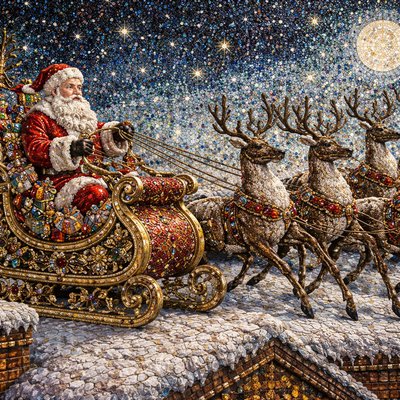
Santa's Sleigh: A highly detailed mosaic artwork depicting Santa Claus in his traditional red suit, seated in an ornate sleigh loaded with gifts, holding reins as he prepares to take flight with a team of eight reindeer poised on a snowy rooftop under a starry winter night sky. The entire scene is intricately composed of mixed tesserae, including vibrant smalti glass tiles in rich reds, deep greens, and whites for Santa's suit and fur trim, sparkling gemstones in ruby, emerald, sapphire, and diamond hues for accents and gift wrappings, metallic gold and silver leaf tiles outlining the sleigh runners, harnesses, and shimmering highlights, and opaque ceramic tiles in earthy browns and blacks for the reindeer antlers and hooves. Subtle iridescent smalti creates a glowing moon and falling snow effects, with tiny pearl-like inlays adding luminosity to the stars. Byzantine-inspired ornate style with tiny irregular tesserae, thin dark grout lines for sharp contrast, hyper-detailed texture, luminous reflections on glass and gems, slight dimensional depth from raised tiles, photorealistic mosaic rendering, sharp focus, joyful and magical festive composition
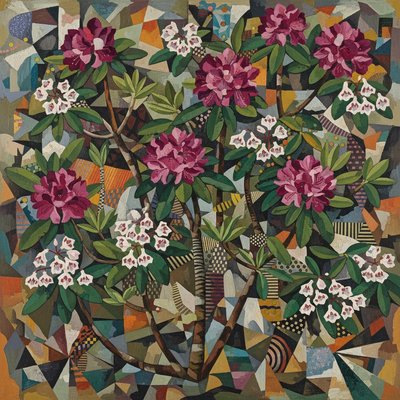
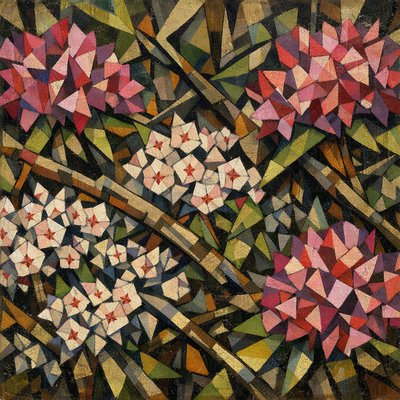
Art Style: Analytical Cubism, avant-garde oil painting style reminiscent of Picasso and Braque.

Subject: A dense, tangled thicket of Rhododendrons and Mountain Laurel bushes.

Composition & Details: The entire natural scene is deconstructed into overlapping geometric planes, fractured shards, and intersecting angles. There are no curved lines; everything is rendered in cubes, cones, and trapezoids.

    The Rhododendrons: Large, showy flower trusses are broken into faceted crystalline structures of deep magenta, rose pink, and violet blocks, looking like explosions of colored quartz rather than soft petals.

    The Mountain Laurels: The smaller, intricate flowers are rendered as complex, repeating geometric star-patterns and angular cups in white and pale pink with distinct red polygonal markings.

    Foliage & Branches: The thick, leathery leaves are fragmented green triangles and parallelograms overlapping each other, creating a sense of depth without traditional perspective. The woody stems and branches are jagged, intersecting brown and grey cylinders that shatter across the frame.

Color & Texture: A palette of muted earth tones—ochre, burnt umber, forest green, and slate grey—contrasted sharply with the jewel-toned facets of the flower colors. The finish should have a heavy, textured oil paint feel with visible palette knife marks and rough brushwork.
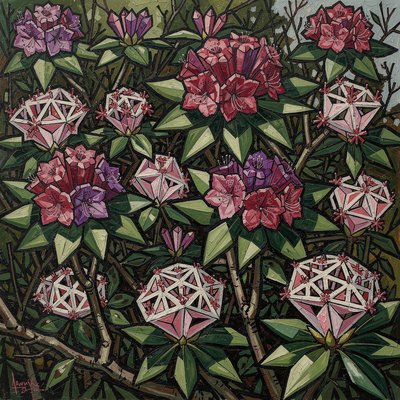
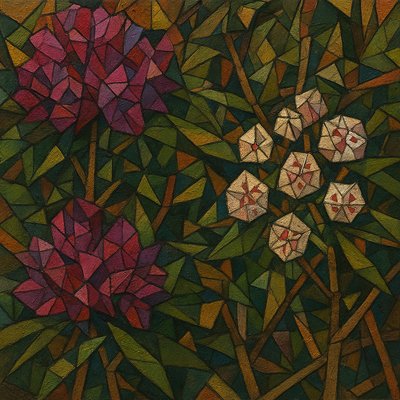
Art Style: Analytical Cubism, avant-garde oil painting style reminiscent of Picasso and Braque.

Subject: A dense, tangled thicket of Rhododendrons and Mountain Laurel bushes.

Composition & Details: The entire natural scene is deconstructed into overlapping geometric planes, fractured shards, and intersecting angles. There are no curved lines; everything is rendered in cubes, cones, and trapezoids.

    The Rhododendrons: Large, showy flower trusses are broken into faceted crystalline structures of deep magenta, rose pink, and violet blocks, looking like explosions of colored quartz rather than soft petals.

    The Mountain Laurels: The smaller, intricate flowers are rendered as complex, repeating geometric star-patterns and angular cups in white and pale pink with distinct red polygonal markings.

    Foliage & Branches: The thick, leathery leaves are fragmented green triangles and parallelograms overlapping each other, creating a sense of depth without traditional perspective. The woody stems and branches are jagged, intersecting brown and grey cylinders that shatter across the frame.

Color & Texture: A palette of muted earth tones—ochre, burnt umber, forest green, and slate grey—contrasted sharply with the jewel-toned facets of the flower colors. The finish should have a heavy, textured oil paint feel with visible palette knife marks and rough brushwork.
Art Style: Analytical Cubism, avant-garde oil painting style reminiscent of Picasso and Braque.

Subject: A dense, tangled thicket of Rhododendrons and Mountain Laurel bushes.

Composition & Details: The entire natural scene is deconstructed into overlapping geometric planes, fractured shards, and intersecting angles. There are no curved lines; everything is rendered in cubes, cones, and trapezoids.

    The Rhododendrons: Large, showy flower trusses are broken into faceted crystalline structures of deep magenta, rose pink, and violet blocks, looking like explosions of colored quartz rather than soft petals.

    The Mountain Laurels: The smaller, intricate flowers are rendered as complex, repeating geometric star-patterns and angular cups in white and pale pink with distinct red polygonal markings.

    Foliage & Branches: The thick, leathery leaves are fragmented green triangles and parallelograms overlapping each other, creating a sense of depth without traditional perspective. The woody stems and branches are jagged, intersecting brown and grey cylinders that shatter across the frame.

Color & Texture: A palette of muted earth tones—ochre, burnt umber, forest green, and slate grey—contrasted sharply with the jewel-toned facets of the flower colors. The finish should have a heavy, textured oil paint feel with visible palette knife marks and rough brushwork.
Art Style: Analytical Cubism, avant-garde oil painting style reminiscent of Picasso and Braque.

Subject: A dense, tangled thicket of Rhododendrons and Mountain Laurel bushes.

Composition & Details: The entire natural scene is deconstructed into overlapping geometric planes, fractured shards, and intersecting angles. There are no curved lines; everything is rendered in cubes, cones, and trapezoids.

    The Rhododendrons: Large, showy flower trusses are broken into faceted crystalline structures of deep magenta, rose pink, and violet blocks, looking like explosions of colored quartz rather than soft petals.

    The Mountain Laurels: The smaller, intricate flowers are rendered as complex, repeating geometric star-patterns and angular cups in white and pale pink with distinct red polygonal markings.

    Foliage & Branches: The thick, leathery leaves are fragmented green triangles and parallelograms overlapping each other, creating a sense of depth without traditional perspective. The woody stems and branches are jagged, intersecting brown and grey cylinders that shatter across the frame.

Color & Texture: A palette of muted earth tones—ochre, burnt umber, forest green, and slate grey—contrasted sharply with the jewel-toned facets of the flower colors. The finish should have a heavy, textured oil paint feel with visible palette knife marks and rough brushwork.
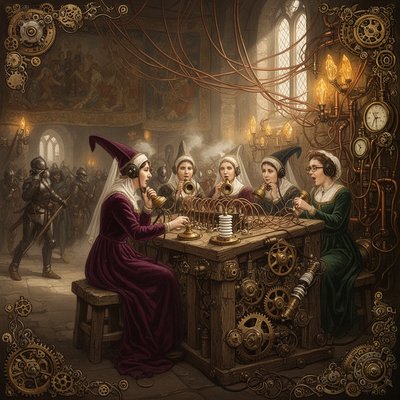
Steampunk Historical Fantasy, Satirical Illustration Style, Cinematic Lighting. A bizarre, anachronistic scene inside a drafty medieval castle great hall (Camelot). A group of noblewomen, dressed in elaborate 6th-century velvet gowns, wimples, and tall pointed hennin hats with veils, are seated on rough wooden stools. They are furiously working a massive, makeshift telephone switchboard operator station.

The Technology: The switchboard is constructed from rough-hewn oak timbers, gleaming brass gears, porcelain insulators, and hundreds of thick, chaotic copper wires that are strung haphazardly across ancient tapestries and stone walls, disappearing out narrow arrow-slit windows.

The Action: The ladies hold bulky, antique Victorian-era earpieces and large brass mouthpieces, plugging heavy cables with oversized jacks into the board with expressions of intense concentration and mild confusion. Knights in armor walk past in the background, looking bewildered. Sunlight streams through gothic windows, illuminating the dust and the clash of eras.
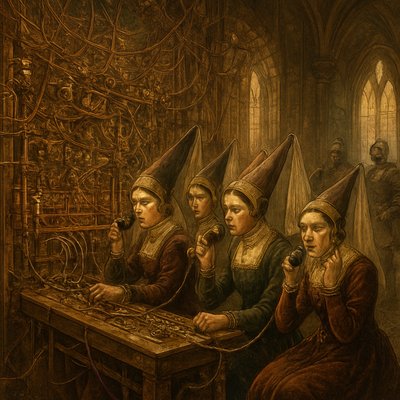
Steampunk Historical Fantasy, Satirical Illustration Style, Cinematic Lighting. A bizarre, anachronistic scene inside a drafty medieval castle great hall (Camelot). A group of noblewomen, dressed in elaborate 6th-century velvet gowns, wimples, and tall pointed hennin hats with veils, are seated on rough wooden stools. They are furiously working a massive, makeshift telephone switchboard operator station.

The Technology: The switchboard is constructed from rough-hewn oak timbers, gleaming brass gears, porcelain insulators, and hundreds of thick, chaotic copper wires that are strung haphazardly across ancient tapestries and stone walls, disappearing out narrow arrow-slit windows.

The Action: The ladies hold bulky, antique Victorian-era earpieces and large brass mouthpieces, plugging heavy cables with oversized jacks into the board with expressions of intense concentration and mild confusion. Knights in armor walk past in the background, looking bewildered. Sunlight streams through gothic windows, illuminating the dust and the clash of eras.
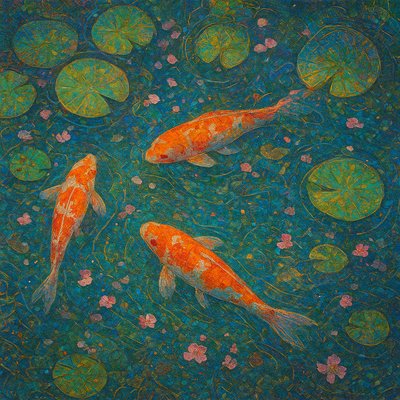
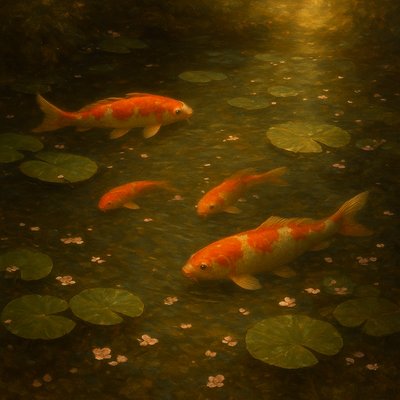
A koi pond seen from above, orange and white koi fish swimming among lily pads, clear water with subtle ripples, fallen cherry blossom petals floating on the surface, dappled sunlight
A highly detailed, cinematic rendering of the colossal "Megamaid" spaceship from Spaceballs in its full, transformed state, hovering menacingly above the Earth.

Scene Focus: The Megamaid is positioned directly over the Earth's atmosphere, its massive vacuum nozzle extended. The nozzle is clearly pointed toward the planet's surface, and the mechanism is beginning to suck air out, creating a visible, swirling vortex.

The 'Firmament' Detail: Render the edge of Earth's atmosphere and sky not as a smooth fade to space, but with a highly stylized, almost cracked or crystalline appearance, suggesting the boundary is a literal "firmament." The vacuum is shown actively piercing this boundary, creating a localized, glowing "window of heaven" effect where the atmosphere is being forcefully breached and pulled into the machine.

Atmosphere: The scene is dark, cold space contrasting sharply with the bright, glowing Earth below and the massive, industrial metallic structure of the Megamaid. The lighting should be dramatic and epic, highlighting the ridiculous scale of the vacuum cleaner poised to steal a planet's air. Include a tiny, distant shot of the Eagle 5 (Winnebago) fleeing the scene.

Style: Photorealistic digital painting, sci-fi parody, emphasizing the immense, over-the-top scale and the comedic contrast between the mundane household item and the cosmic threat.
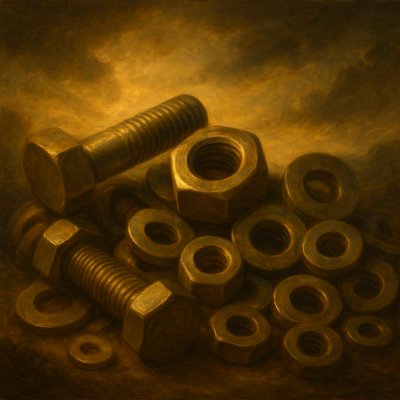
a painting of nuts and bolts on a brown background
a painting of a group of hands holding a book
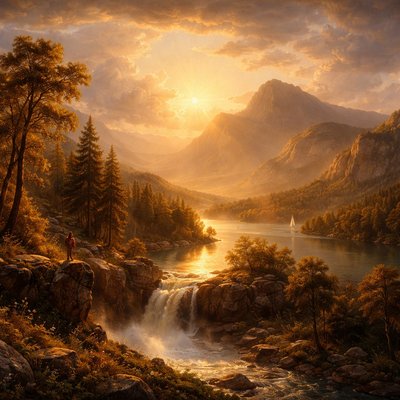
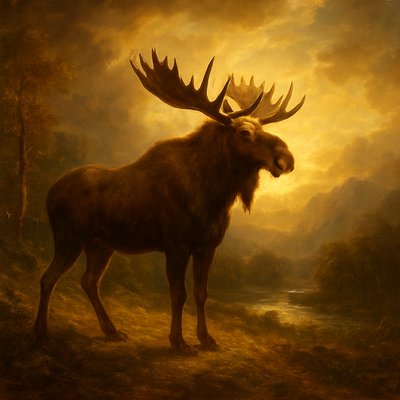
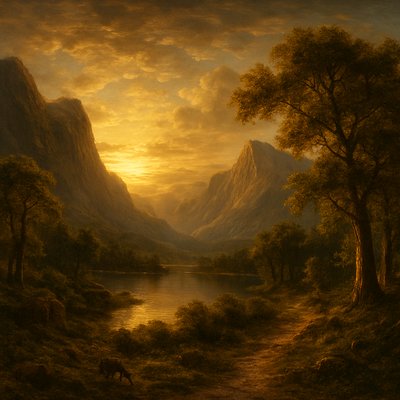
Hudson River School Art Style Style Transfer Example
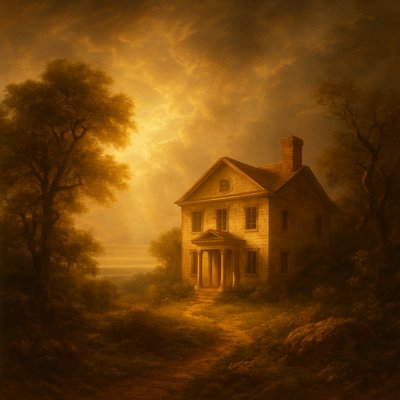
house with front view
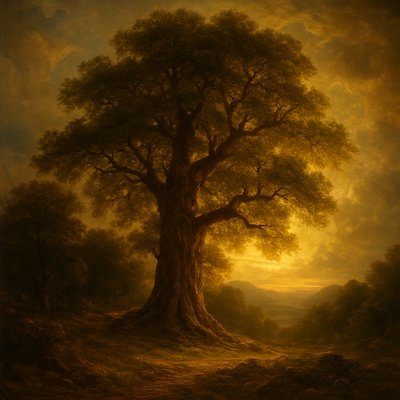
a tree in nature
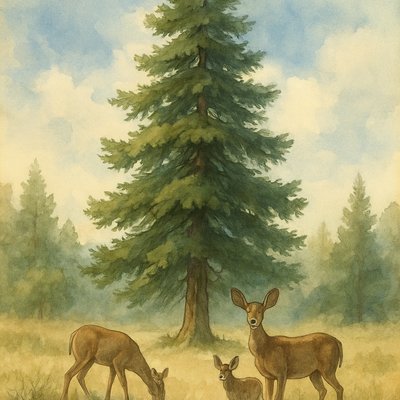
A serene and majestic watercolor painting, capturing the essence of a grand, towering evergreen tree (like the dominant one in the provided image) standing proudly in a sun-dappled, open forest glade. The tree's deep green needles are rendered with varying washes, showcasing its immense height and full, tiered branches that reach towards a partly cloudy, bright blue sky.

Around the base of this glorious tree, two or three graceful mule deer are depicted. One might be grazing peacefully, another looking up towards the viewer with its large, expressive ears, and a fawn possibly tucked nearby. Their coats are rendered in soft, earthy watercolor tones of grey-brown, with delicate highlights and shading to suggest their gentle forms and distinctive white rumps and tails.

The surrounding landscape features a subtle ground cover of dry grasses and scattered undergrowth, characteristic of a high-desert or mountain forest floor, painted with soft, blended washes of ochre, sage green, and light brown. The sky above is a classic watercolor blend of soft blues and wispy white clouds. The overall mood is one of tranquil natural beauty, quiet majesty, and a harmonious coexistence of wildlife and ancient trees, rendered with the flowing, luminous quality of watercolor art."
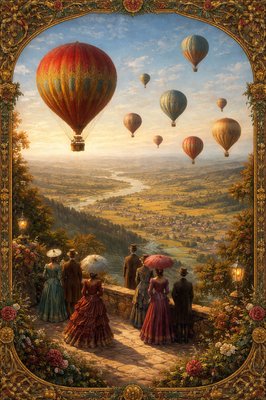
in the style of John Atkinson Grimshaw,
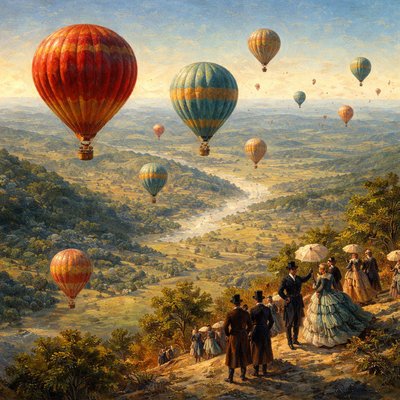
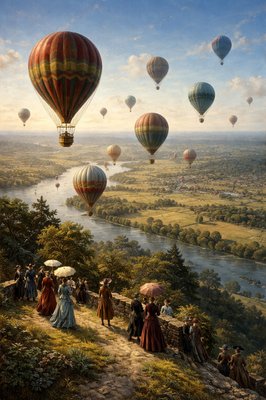
bird’s‑eye view, camera looking downward from a moderate height over hot air balloons rising steadily and moving with the wind through clear blue skies,
subtle curvature of the landscape visible below,
rich jewel‑tone reds, teals, and golds catching warm natural sunlight, realistic wind‑driven motion, natural directional flow, a hillside overlook below with small groups of people watching the balloons, holding umbrellas for shade, wearing Victorian‑style clothing,
long tailored coats, layered skirts, high collars,
grounded composition, realistic atmospheric depth, cinematic painterly
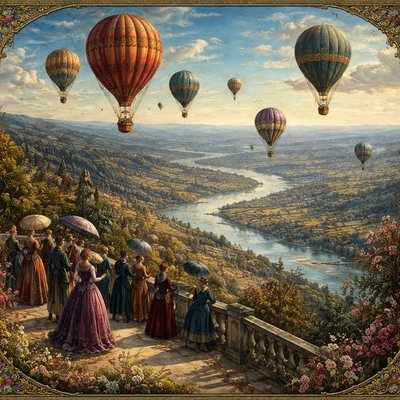
in the style of John Atkinson Grimshaw,
bird’s‑eye view, camera looking downward from a moderate height over hot air balloons rising steadily and moving with the wind through clear blue skies,
subtle curvature of the landscape visible below,
rich jewel‑tone reds, teals, and golds catching warm natural sunlight, realistic wind‑driven motion, natural directional flow, a hillside overlook below with small groups of people watching the balloons, holding umbrellas for shade, wearing Victorian‑style clothing,
long tailored coats, layered skirts, high collars,
grounded composition, realistic atmospheric depth, cinematic painterly
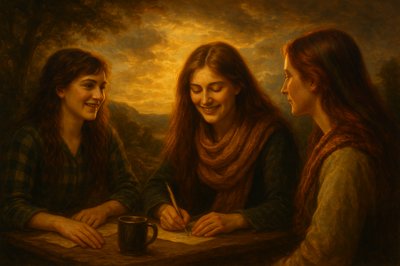
a painting of three women sitting at a table writing
a painting of a man sitting at a table with a laptop
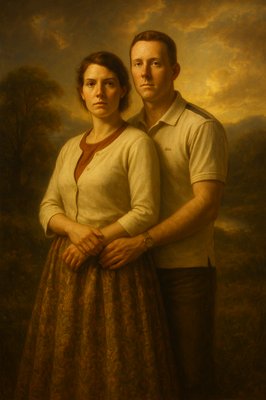
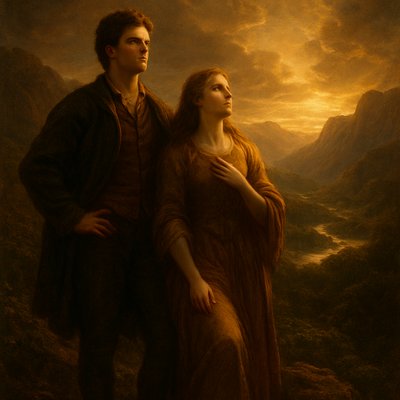
a painting of a man and woman standing next to each other
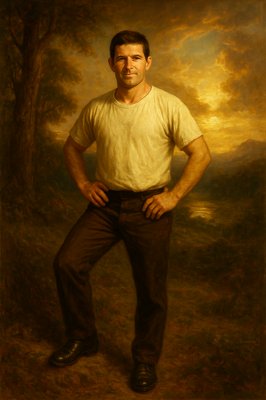
a painting of a man posing for a picture
Hudson River School Art Style Style Transfer Example
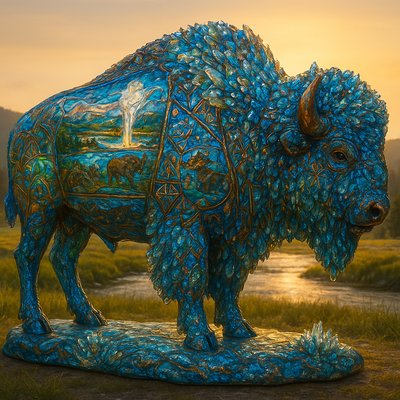
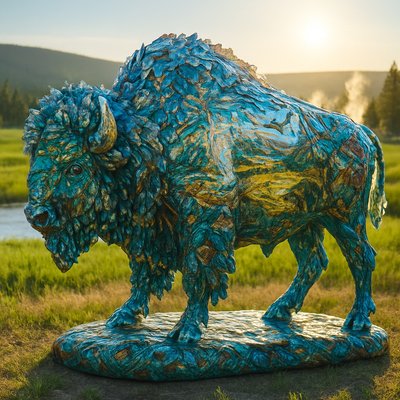
    A breathtaking, full-size artistic sculpture of a standing buffalo, rendered entirely in the style of intricate, luminous glass art, reminiscent of the painted buffalo installations. The buffalo's majestic form is composed of countless individual pieces of vibrant, multifaceted stained glass or fused glass, meticulously cut, arranged, and joined.

    The entire surface of this glass buffalo is adorned with various miniature, finely detailed scenes and patterns etched, painted, or embedded within the glass itself, or created by the unique coloration and texture of the glass pieces. These scenes depict:

        Iconic Yellowstone landscapes: Old Faithful erupting in miniature, the Grand Canyon of the Yellowstone, geothermal pools.

        Local wildlife: Elk, bears, wolves, eagles (all rendered in the glass medium).

        Native American art motifs: Geometric patterns, symbols, and figures (also within the glass).

    The buffalo's interior is subtly illuminated, causing the entire sculpture to glow from within, acting as a beacon of art and nature. Light catches every facet of the glass, creating a dazzling play of refracted colors that project intricate patterns onto the surrounding natural environment.

    The setting is the glory of Yellowstone National Park, specifically an expansive, iconic vista. Perhaps in a verdant meadow with distant geysers steaming, or near a crystal-clear river. The morning sun, bright and golden, backlights the buffalo, intensifying its inner glow and creating a dramatic contrast with the rugged, natural beauty of the park. The atmosphere is one of awe, harmony between art and nature, and a profound celebration of the spirit of the American West. The artistic style is hyper-realistic, emphasizing the detailed texture, transparency, and brilliant light play inherent in glass art, seamlessly integrated into a vibrant, natural landscape.
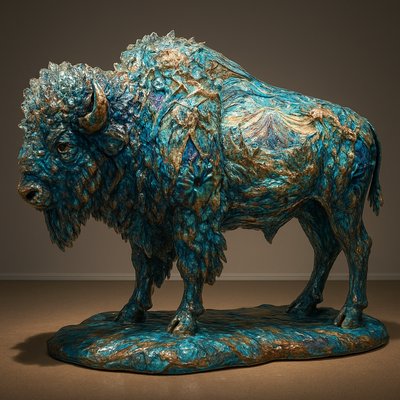
    A breathtaking, full-size artistic sculpture of a standing buffalo, rendered entirely in the style of intricate, luminous glass art, reminiscent of the painted buffalo installations found in West Yellowstone art shows. The buffalo's form is composed of countless individual pieces of vibrant, multifaceted stained glass or fused glass, meticulously cut, arranged, and joined, creating a cohesive and majestic shape.

    Instead of traditional paint, the entire surface of this glass buffalo is adorned with various miniature, finely detailed scenes and patterns etched, painted, or embedded within the glass itself, or created by the unique coloration and texture of the glass pieces. These scenes could depict:

        Western landscapes: Yellowstone's geysers, mountain ranges, pine forests, rivers.

        Wildlife: Elk, bears, wolves, eagles (in glass).

        Native American art motifs: Geometric patterns, symbols, and figures (also rendered in glass).

        Historical moments: Subtle nods to early explorers or iconic figures (stylized in glass).

    The buffalo's interior is subtly illuminated, causing the entire sculpture to glow from within. Light catches every facet of the glass, creating a dazzling play of refracted colors and intricate shadows on the ground around it. The background is a clean, modern art gallery setting with soft, focused lighting, allowing the buffalo to be the sole, radiant centerpiece. The atmosphere is one of awe, wonder, and appreciation for artistic craftsmanship and the spirit of the American West, reimagined through a unique, luminous medium. The artistic style is hyper-realistic, emphasizing the detailed texture, transparency, and brilliant light play inherent in glass art."
    A breathtaking, full-size artistic sculpture of a standing buffalo, rendered entirely in the style of intricate, luminous glass art, reminiscent of the painted buffalo installations. The buffalo's majestic form is composed of countless individual pieces of vibrant, multifaceted stained glass or fused glass, meticulously cut, arranged, and joined.

    The entire surface of this glass buffalo is adorned with various miniature, finely detailed scenes and patterns etched, painted, or embedded within the glass itself, or created by the unique coloration and texture of the glass pieces. These scenes depict:

        Iconic Yellowstone landscapes: Old Faithful erupting in miniature, the Grand Canyon of the Yellowstone, geothermal pools.

        Local wildlife: Elk, bears, wolves, eagles (all rendered in the glass medium).

        Native American art motifs: Geometric patterns, symbols, and figures (also within the glass).

    The buffalo's interior is subtly illuminated, causing the entire sculpture to glow from within, acting as a beacon of art and nature. Light catches every facet of the glass, creating a dazzling play of refracted colors that project intricate patterns onto the surrounding natural environment.
    The setting is the glory of Yellowstone National Park, specifically an expansive, iconic vista. Perhaps in a verdant meadow with distant geysers steaming, or near a crystal-clear river. The morning sun, bright and golden, backlights the buffalo, intensifying its inner glow and creating a dramatic contrast with the rugged, natural beauty of the park. The atmosphere is one of awe, harmony between art and nature, and a profound celebration of the spirit of the American West. The artistic style is hyper-realistic, emphasizing the detailed texture, transparency, and brilliant light play inherent in glass art, seamlessly integrated into a vibrant, natural landscape.
Neon-Futurism Digital Art Style, Bioluminescent Sci-Fi Cosmic Setting, High-Action Composition. A cinematic, low-angle "chase camera" view from behind the rider, looking forward into a perilous section of the cosmos.

The Rider & Bike Consistency: The lone motorcyclist—wearing the same sleek, armored suit with integrated helmet—is leaning hard into a sharp, dramatic turn on the same hubless "light-cycle" sportbike from the previous scenes. The bike’s cyan and orange neon rings leave a zigzagging, vibrant light trail on the road as it maneuvers.

The Action: The rider is narrowly evading two colossal, mechanical pincers that have slammed down onto the highway from the sides. Spark-like digital data fragments fly where the pincers missed the bike by mere inches.

The Path (The Ecliptic): The glowing blue laser-grid highway is no longer straight; it is twisting like a scorpion’s tail through a dark, turbulent nebula of deep magenta and toxic green gas.

The Scorpio Presence: Looming in the background, partially obscured by the nebula, is the massive celestial form of Scorpio. It is rendered as a terrifyingly beautiful construct of obsidian-colored geometry and glowing violet circuitry. Its stinger is arched high above the highway, glowing with a dangerous, concentrated golden light, ready to strike the path ahead.

Atmosphere: Intense lighting contrast, with the bike's neon glow and the golden stinger cutting through the dark, moody colors of the Scorpio nebula.
He came as a witness to testify to the light
animal standing in natural pose
bicyle resting against a wall
portrait of two people together
wide landscape with natural scenery
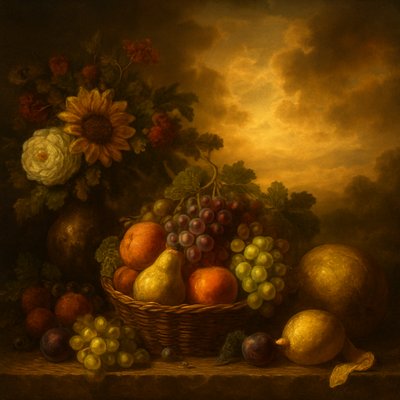
still life arrangement of fruits and flowers
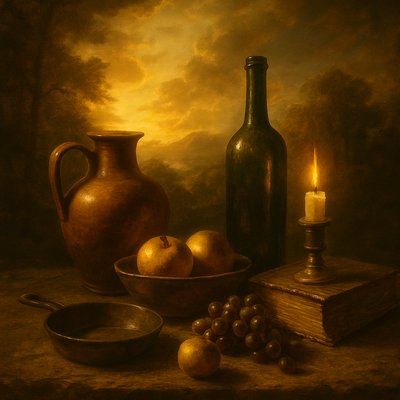
still life with everyday objects
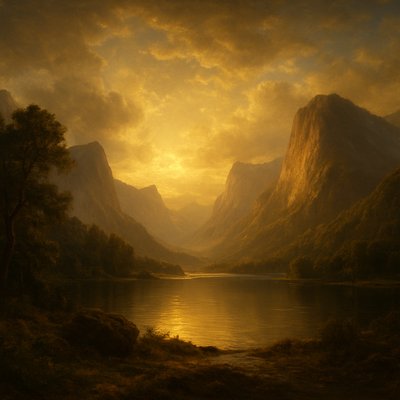
serene landscape with mountains and water
portrait of a person with expressive eyes
in the style of John Atkinson Grimshaw,
bird’s‑eye view, camera looking downward from a moderate height over hot air balloons rising steadily and moving with the wind through clear blue skies,
subtle curvature of the landscape visible below,
rich jewel‑tone reds, teals, and golds catching warm natural sunlight, realistic wind‑driven motion, natural directional flow, a hillside overlook below with small groups of people watching the balloons, holding umbrellas for shade, wearing Victorian‑style clothing,
long tailored coats, layered skirts, high collars,
grounded composition, realistic atmospheric depth, cinematic painterly
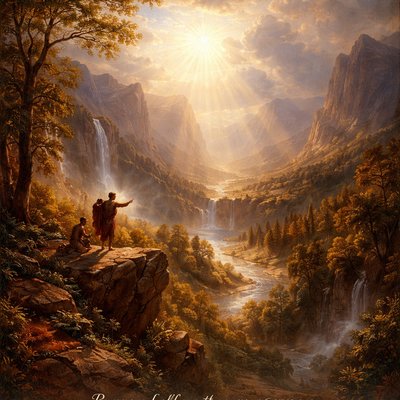
“Nay, in all these things we are more than conquerors through him that loved us.” (Romans 8:37, KJV)
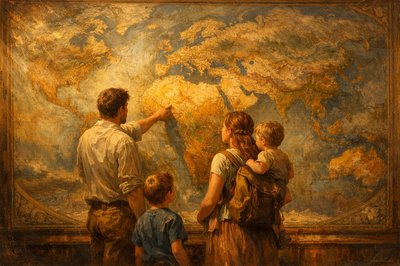
A young couple with two children stand in front of a wall-sized world map, facing the map.  The young father is pointing to somewhere in Africa.  The young mother is wearing a backpack and carrying one of the children on her hip.
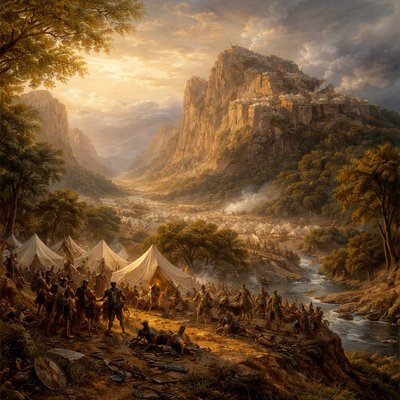
“Who went forth by the way that leadeth to Galgala, and pitched their tents before Masaloth, which is in Arbela, and after they had won it, they slew much people.” (1 Maccabees 9:2, KJVA)
A koi pond seen from above, orange and white koi fish swimming among lily pads, clear water with subtle ripples, fallen cherry blossom petals floating on the surface, dappled sunlight
in the style of John Atkinson Grimshaw,
bird’s‑eye view, camera looking downward from a moderate height over hot air balloons rising steadily and moving with the wind through clear blue skies,
subtle curvature of the landscape visible below,
rich jewel‑tone reds, teals, and golds catching warm natural sunlight, realistic wind‑driven motion, natural directional flow, a hillside overlook below with small groups of people watching the balloons, holding umbrellas for shade, wearing Victorian‑style clothing,
long tailored coats, layered skirts, high collars,
grounded composition, realistic atmospheric depth, cinematic painterly