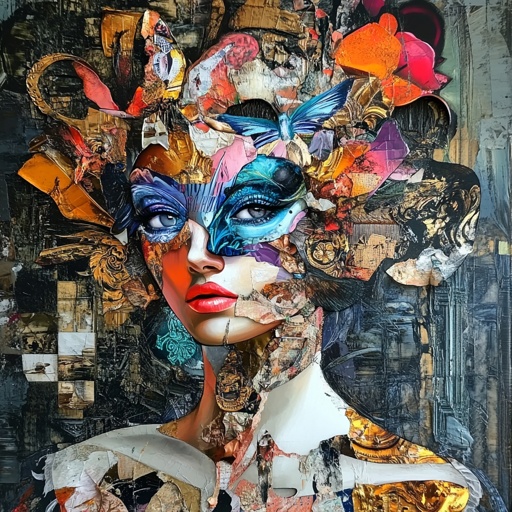
An Abstract Painting Of A Woman's Face Art

a tree in nature
bicyle resting against a wall
portrait of two people together
animal standing in natural pose
wide landscape with natural scenery
bicyle resting against a wall
still life with everyday objects
wide landscape with natural scenery
serene landscape with mountains and water
portrait of a person with expressive eyes
still life arrangement of fruits and flowers
"A historically accurate depiction of a Ghost Dance, focusing on the late 19th-century context, specifically around 1890-1891. The scene shows Lakota (Sioux) or Northern Paiute people (specify one or include elements of both, but avoid anachronisms) participating in the ceremony.

Setting: A vast, open prairie or high desert landscape, under an expansive sky. The time of day could be dusk or night, with a prominent moon or stars, or a bright, clear day. Avoid overtly spiritual or ethereal elements like floating spirits unless explicitly requested for a later, more symbolic iteration. The focus should be on the earthly ceremony.

Participants: A circle of men, women, and children, hand-in-hand, moving in a slow, rhythmic shuffle or circular motion. Their faces show a mixture of devotion, hope, and determination. Some may have expressions of trance or deep concentration.

Attire:

    Ghost Dance Shirts/Dresses: Emphasize the unique Ghost Dance shirts and dresses, which were typically made of muslin or canvas. These garments should feature painted designs such as stars, crescents, birds (especially eagles or crows), buffalo, human figures, or crosses. The designs should appear hand-painted, not mass-produced.

    Hair and Adornments: Participants should have braided hair or wear it long. Some may wear feathers (e.g., eagle or hawk feathers) in their hair. Minimal traditional adornments, as the focus was often on the Ghost Dance shirt itself. Avoid overly elaborate or Hollywood-esque depictions of war bonnets unless relevant to a specific individual and context.

    Footwear: Moccasins or bare feet.

Action/Atmosphere:

    The dancers are moving in a counter-clockwise circle, with a central figure or a small group often leading.

    The overall mood is one of earnest prayer and communal spiritual effort. The dance should convey a sense of hope for renewal and the return of the old ways, rather than aggression or despair.

    There might be a central pole or small fire as a focal point, around which the dance takes place.

    Avoid any signs of direct conflict or violence; the Ghost Dance itself was a non-violent spiritual movement.

Specific Considerations for Accuracy:

    Wovoka's Influence: The teachings of Wovoka (the Northern Paiute prophet) emphasized peace, hard work, and the return of the buffalo and deceased ancestors. The scene should subtly reflect this hopeful, redemptive spirit.

    Regional Variations: If focusing on Lakota, consider their specific interpretations, which sometimes included more imagery related to their warrior traditions on the shirts, but still within the peaceful framework of the dance.

    Respectful Portrayal: Ensure the depiction is respectful and avoids any stereotypical or caricatured representations of Indigenous people. Focus on their human dignity and spiritual sincerity.
a tree in nature
Murmuration Particle Painting Style Transfer Example
Thermochromic Memory Painting Style Transfer Example
Murmuration Particle Painting Style Transfer Example
Thermochromic Memory Painting Style Transfer Example
still life arrangement of fruits and flowers
Christ Pantocrator
Squirrels gathering acorns under an oak tree with fall leaves.
A deep sea jellyfish garden
house with front view
urban street with city activity
bicyle resting against a wall
portrait of two people together
still life with everyday objects
wide landscape with natural scenery
serene landscape with mountains and water
bicyle resting against a wall
animal standing in natural pose
wide landscape with natural scenery
portrait of a person with expressive eyes
still life arrangement of fruits and flowers
Low-poly geometric portrait of a cat's head facing slightly to the right, divided vertically down the center into two contrasting color halves. The left half features cool blue tones ranging from deep navy to light cyan in angular polygonal facets, with a large blue eye, black pupil, and subtle white highlight. The right half uses warm orange, brown, and golden yellow shades in similar triangular and polygonal shapes, with a vibrant green eye, black pupil, and white highlight. Thin white whiskers extend from the muzzle on both sides. Solid medium-gray background. Style: minimalist vector art, faceted like origami or crystal, high contrast, no outlines except subtle edges, symmetrical split for a duality theme.
Cinematic Historical Photograph, Gritty Realism, Chiaroscuro Lighting. A tense, high-stakes chess match taking place between two seasoned pirates inside the cramped, dimly lit stern cabin of a rocking galleon at sea during the night.

The Players: On one side sits a grizzled, older Pirate Captain with a heavy grey beard and a scarred face, leaning over the board, his hand rubbing his chin in deep concentration. Opposite him is a younger, cunning Quartermaster with a gold tooth and a confident smirk, holding a clay pipe.

The Board & Pieces: Between them is a heavy wooden table stained with grog. The chessboard is carved directly into the tabletop, with squares made of inlaid mother-of-pearl and burned wood. They are playing with the custom pirate-themed chess set (previously designed): The Captain's side uses pieces carved from yellowed whalebone (King with tricorn, Ship Rooks), and the Quartermaster's side uses pieces cast from dark, tarnished iron. A bone "Knight" piece is currently threatening an iron "Queen."

The Atmosphere: The cabin is lit by a single, swaying oil lantern hanging overhead, casting long, moving shadows and illuminating the smoke in the air. Mugs of rum, a flintlock pistol, and rolled charts are cluttered around the board. Outside a stern window, a dark, stormy ocean is visible. The photo has a film grain texture.
“For the needy shall not alway be forgotten: the expectation of the poor shall not perish for ever.” (Psalms 9:18, KJV)
A koi pond seen from above, orange and white koi fish swimming among lily pads, clear water with subtle ripples, fallen cherry blossom petals floating on the surface, dappled sunlight
A radiant horse leaping through shimmering woods, golden mane flowing with joy, teal trees echoing calm. Oil paint, heavy impasto, textured strokes, the surface alive with feeling
Metropolis