A Vivid, Dramatic Scene Depicting A Lone Figure Standing Resiliently In The Center Of A Swirling Swarm Of Bees, Their Forms Art

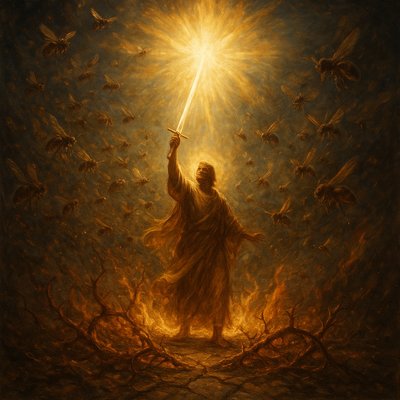
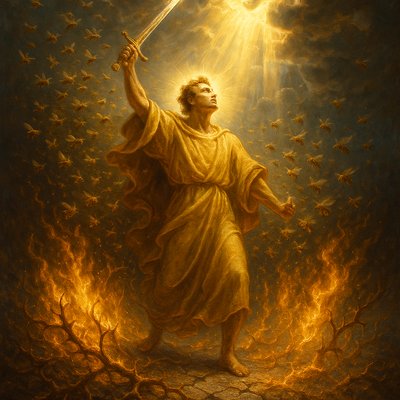
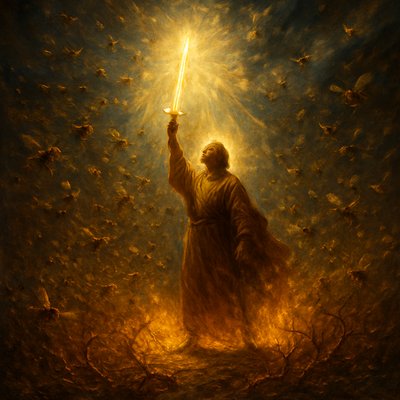
A vivid, dramatic scene depicting a lone figure standing resiliently in the center of a swirling swarm of bees, their forms illuminated by a fiery glow as thorns around them burn brightly, then fade into ash. The figure, clad in simple yet radiant robes, holds a shining sword raised triumphantly, symbolizing divine strength and victory. Behind them, a radiant light bursts forth, representing the presence of the Lord, with beams breaking through a stormy sky. The ground beneath the figure is cracked but stable, showing they were pushed but did not fall. The atmosphere is intense yet hopeful, with a harmonious blend of danger and divine protection, capturing the essence of Psalm 118:12-14--strength, salvation, and triumph through faith. The color palette includes fiery oranges, deep golds, and cool blues to contrast the chaos with divine peace. Ultra-realistic, slightly surreal. Extreme detail.
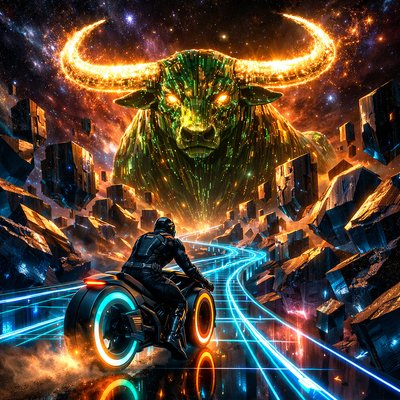
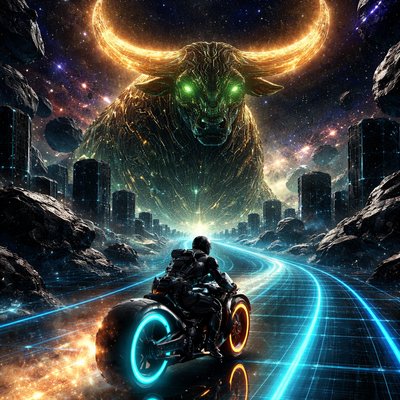
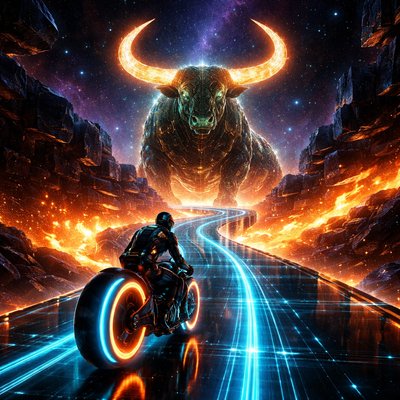
Neon-Futurism Digital Art Style, Bioluminescent Sci-Fi Cosmic Setting, Monolithic Scale. A perspective shot from behind the rider, looking toward a massive obstacle course in deep space.

The Rider & Bike Consistency: The lone motorcyclist—wearing the same sleek armored suit and helmet—is navigating the hubless "light-cycle" sportbike. The cyan and orange neon rings of the wheels reflect off the floating crystalline surfaces surrounding the road.

The Path (The Labyrinth): The glowing blue laser-grid highway enters a colossal asteroid field where the rocks are perfectly geometric, hovering like floating obsidian city blocks. The path winds through these monoliths, creating a "Cosmic Labyrinth."

The Taurus Presence: Standing at the center of this labyrinth, spanning across the highway, is the monumental form of the Celestial Bull. He is composed of dense, glowing emerald and earth-toned circuitry. His massive, forward-curving horns are made of solid, brilliant starlight and form a natural "archway" that the highway passes beneath.

The Atmosphere: The scene feels grounded and powerful. The deep greens and golds of the Taurus figure contrast with the dark, heavy shadows of the geometric asteroids.

Lighting: The "starlight horns" cast a warm, heavy glow downward onto the rider, illuminating the dust of crushed nebulae kicked up by the bike’s tires.
Neon-Futurism Digital Art Style, Bioluminescent Sci-Fi Cosmic Setting, Monolithic Scale. A perspective shot from behind the rider, looking toward a massive obstacle course in deep space.

The Rider & Bike Consistency: The lone motorcyclist—wearing the same sleek armored suit and helmet—is navigating the hubless "light-cycle" sportbike. The cyan and orange neon rings of the wheels reflect off the floating crystalline surfaces surrounding the road.

The Path (The Labyrinth): The glowing blue laser-grid highway enters a colossal asteroid field where the rocks are perfectly geometric, hovering like floating obsidian city blocks. The path winds through these monoliths, creating a "Cosmic Labyrinth."

The Taurus Presence: Standing at the center of this labyrinth, spanning across the highway, is the monumental form of the Celestial Bull. He is composed of dense, glowing emerald and earth-toned circuitry. His massive, forward-curving horns are made of solid, brilliant starlight and form a natural "archway" that the highway passes beneath.

The Atmosphere: The scene feels grounded and powerful. The deep greens and golds of the Taurus figure contrast with the dark, heavy shadows of the geometric asteroids.

Lighting: The "starlight horns" cast a warm, heavy glow downward onto the rider, illuminating the dust of crushed nebulae kicked up by the bike’s tires.
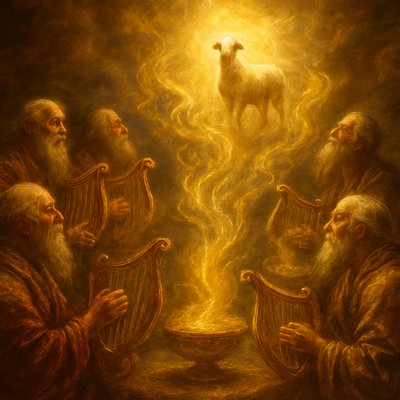
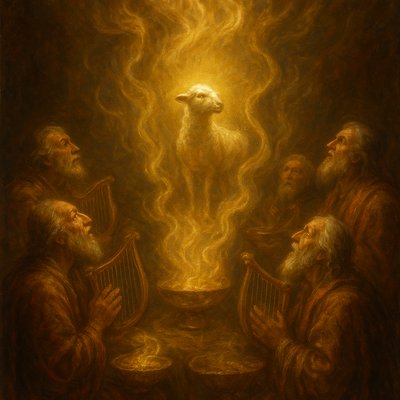
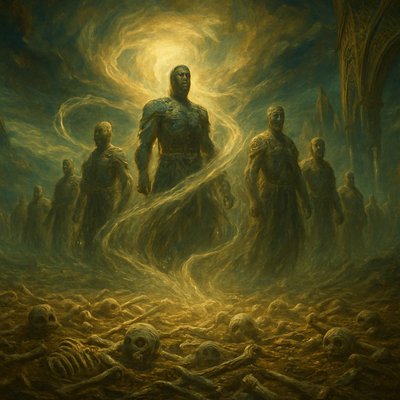
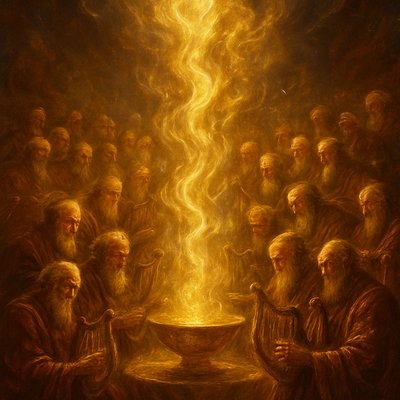
A majestic and reverent scene, directly inspired by Revelation 5:8. A group of elderly, robed figures are kneeling in worship, their faces and attention directed towards a central focal point. Each elder holds a golden harp in one hand and a golden bowl brimming with luminous, swirling incense in the other. The incense, representing the collective prayers of all saints, rises in shimmering, golden tendrils from each bowl, converging and ascending towards the central figure. At the very center of the composition, slightly elevated and bathed in radiant light, stands the Lamb who was slain, embodying divine power and sacrifice, the recipient of all this worship. The atmosphere is ethereal, filled with soft, divine golden light emanating from the incense and the Lamb, emphasizing the precious, sacred, and unified nature of the prayers being offered before Him. Focus on the rich textures of gold, the reverence of the elders, and the radiant presence of the Lamb
Neon-Futurism Digital Art Style, Bioluminescent Sci-Fi Cosmic Setting, Monolithic Scale. A perspective shot from behind the rider, looking toward a massive obstacle course in deep space.

The Rider & Bike Consistency: The lone motorcyclist—wearing the same sleek armored suit and helmet—is navigating the hubless "light-cycle" sportbike. The cyan and orange neon rings of the wheels reflect off the floating crystalline surfaces surrounding the road.

The Path & Eridanus: The glowing blue laser-grid highway winds through floating, geometric obsidian blocks. Weaving alongside and beneath the road is Eridanus, the Celestial River, rendered here as flowing, liquid fire. It isn't smoke or flame, but a stream of molten golden stars and glowing solar plasma that illuminates the dark undersides of the asteroids.

The Taurus Presence: Standing at the center of this labyrinth, spanning across the highway, is the monumental form of the Celestial Bull. He is composed of dense, glowing emerald and earth-toned circuitry. His massive, forward-curving horns are made of solid, brilliant starlight and form a natural "archway" that the highway passes beneath.

The Atmosphere: The scene is a high-contrast masterpiece. The cold, dark shadows of the geometric "city blocks" are cut through by the intense, flowing orange and gold light of the solar river.

Lighting: The "starlight horns" and the "river of fire" create a warm, amber glow that washes over the rider’s armor, contrasting sharply with the cool cyan glow of the bike's wheels.
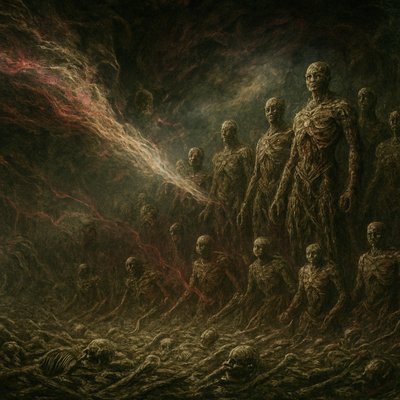
A profound and epic scene depicting the Vision of the Dry Bones from Ezekiel 37. In a desolate, vast valley, countless dry human bones are scattered, stark white and ancient. A powerful, divine wind (ruach) swirls through the valley, imbued with a sacred, ethereal glow, causing the bones to rattle and miraculously knit together. Tendons, flesh, and skin rapidly form over the skeletal structures, transforming them into fully-formed human figures. As the divine breath enters, the figures rise, not as individuals, but as a colossal, awe-inspiring army standing upright, gazing forward with renewed life and purpose. The sky above is dramatic, perhaps with stormy clouds breaking to reveal a divine light. The overall mood is one of miraculous resurrection, immense power, and hopeful restoration."
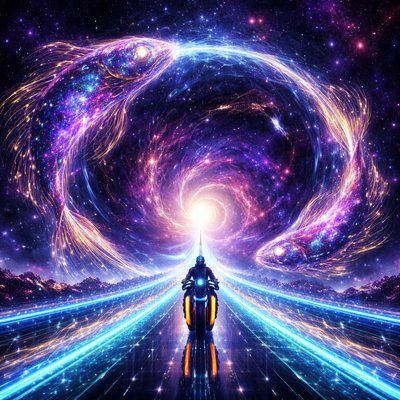
Neon-Futurism Digital Art Style, Bioluminescent Sci-Fi Cosmic Setting, Symmetrical Masterpiece. A breathtaking, wide-angle shot that symbolizes the completion of the celestial cycle.

The Rider & Bike Consistency: The lone motorcyclist—in the iconic sleek, armored suit and integrated helmet—is positioned in the center of the frame. They are riding the hubless "light-cycle" sportbike with its signature cyan and orange glowing wheel rings. The rider is perfectly balanced, speeding forward into the heart of the constellation.

The Path (The Intertwined Ecliptic): The glowing blue laser-grid highway splits into two identical paths that spiral and weave around each other like a strand of DNA. The rider is caught in the moment of transition, centered between the two curving paths of light.

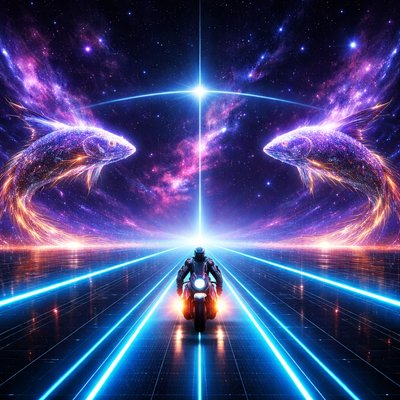
The Pisces Presence: Looming on either side of the highway are two colossal, celestial Fish. These are not organic fish, but majestic constructs of shimmering violet nebulae and intricate golden circuitry. One fish swims upward, the other downward, creating a massive circular motion that frames the entire scene.

The Connection: A glowing "silver cord" made of concentrated starlight connects the two fish, arching over the rider like a bridge of pure energy.

Atmosphere & Finale: The background is a dense, colorful field of galaxies and star clusters in shades of deep plum, electric blue, and soft magenta. The entire scene glows with a harmonious, ethereal light, reflecting off the glossy road and the rider's chrome-finish armor. It is a moment of perfect cosmic equilibrium.
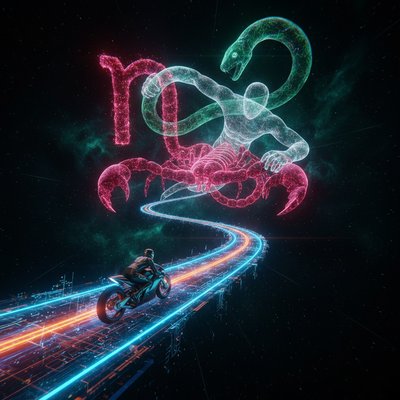
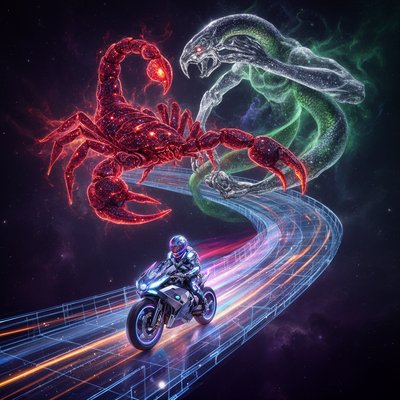
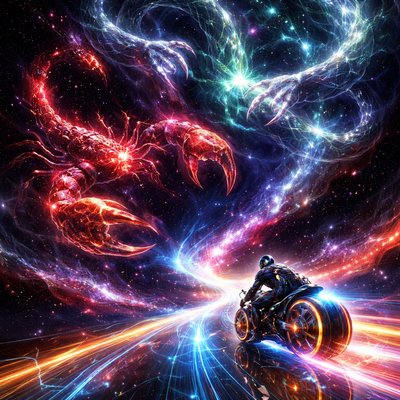
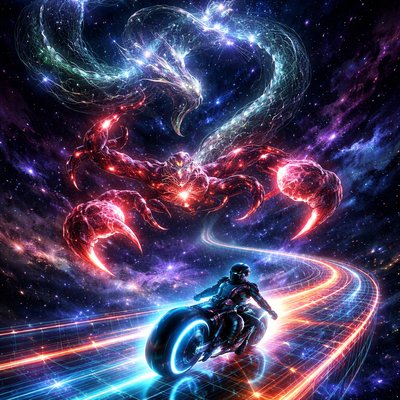
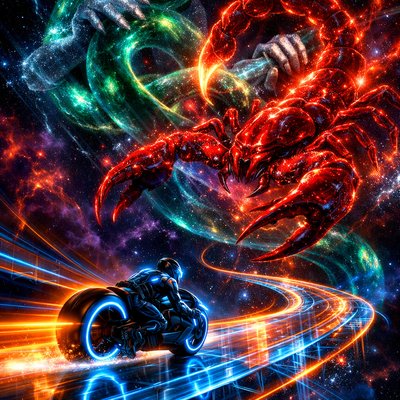
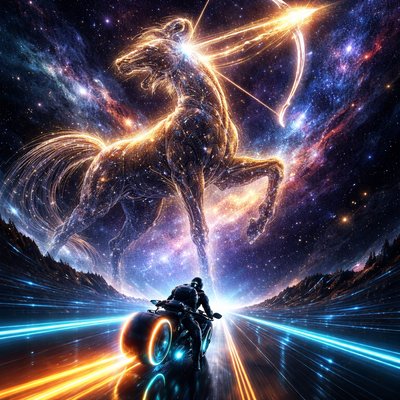
Neon-Futurism Digital Art Style, Bioluminescent Sci-Fi Cosmic Setting. A sleek, futuristic scene set deep in the interstellar void, with absolutely no Earth terrain, asphalt, or atmosphere visible. The Path (The Ecliptic): The "road" is a floating, translucent highway constructed entirely of glowing blue and orange laser grids and condensed stardust, arcing through infinite dark space with dynamic curves. The Rider: A lone rider on a futuristic, hubless "light-cycle" sportbike speeds along this cosmic path at high velocity. The rider is fully encased in a sleek, glowing armored suit with an integrated full-face helmet, leaving a vibrant neon light trail behind them, evading danger with sharp maneuvers. The Constellation (Intense Scorpio and Ophiuchus): Dominating and towering overhead is the immense celestial symbol of Scorpio: a massive, menacing scorpion made of deep crimson glowing stars, luminous energy threads, and bioluminescent nebula plasma, with razor-sharp claws extended and a long curved tail with a glowing stinger poised to strike downward. Directly intertwined and looming even larger above is the abstract form of Ophiuchus, the Serpent Bearer—no full humanoid figure, but represented by powerful restraining arms of shimmering silver and emerald stardust energy that grip and coil around the great serpent (a huge, writhing, translucent serpent of deep green and indigo nebulae). The serpent's body twists through the scene, partially merging with or being restrained from the scorpion's stinger, creating a dramatic overhead struggle. The floating cosmic highway arcs directly under this chaotic overhead clash, so the rider speeds beneath the extended claws of Scorpio while evading their grasp, passing through the shadows of the restrained serpent and Ophiuchus's holding energy as if threading a needle of peril and balance. Radiating intense deep red, crimson, emerald, indigo, and silver lights against the swirling nebula-filled void. Ultra-detailed, cinematic tension, sense of motion and imminent danger.
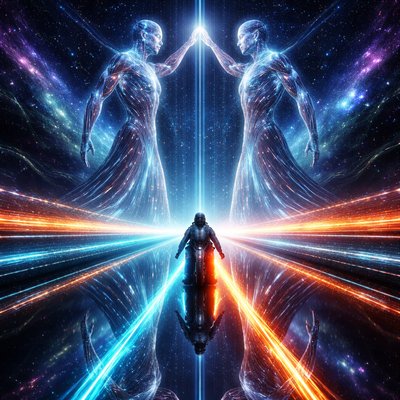
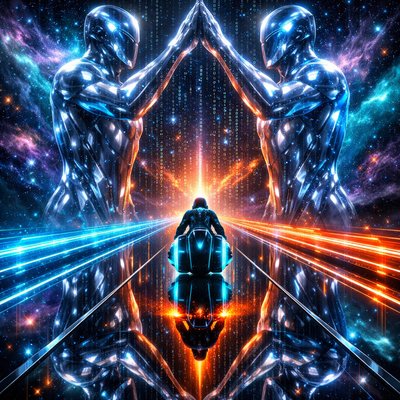
Neon-Futurism Digital Art Style, Bioluminescent Sci-Fi Cosmic Setting, Perfectly Symmetrical Composition. A wide shot looking down a highway that seems to exist in two places at once.

The Rider & Bike Consistency: The lone motorcyclist—in the signature sleek, armored suit and helmet—is centered on the hubless "light-cycle." In this scene, the highway is made of a highly reflective, mirror-like black chrome. As the rider speeds forward, a perfect "ghost" reflection of the bike and rider is visible on the surface below, making it look like two twins are racing tire-to-tire.

The Path (The Dual Ecliptic): The glowing blue laser-grid highway is perfectly straight, but it is flanked by two parallel streams of data-light that pulse in sync, like a heartbeat.

The Gemini Presence: Looming over the path are the colossal Twin Titans. They are rendered as towering figures of translucent silver and electric-blue light. They are positioned facing each other across the highway, their hands nearly touching to form a grand "A-frame" archway over the rider.

The Atmosphere: The space between the Twins is filled with shimmering, binary code "snow" and swirling nebulae in shades of teal and indigo.

The Action: As the rider passes through the center of the Twins, the "ghost" reflection on the road glows with an intense orange light, while the real rider maintains the cyan glow, representing the two sides of a single soul.

Lighting: High-key neon reflections. The silver bodies of the Twins act as mirrors, catching the orange and cyan flashes from the bike and throwing them back across the cosmic void.
Neon-Futurism Digital Art Style, Bioluminescent Sci-Fi Cosmic Setting, Perfectly Symmetrical Composition. A wide shot looking down a highway that seems to exist in two places at once.

The Rider & Bike Consistency: The lone motorcyclist—in the signature sleek, armored suit and helmet—is centered on the hubless "light-cycle." In this scene, the highway is made of a highly reflective, mirror-like black chrome. As the rider speeds forward, a perfect "ghost" reflection of the bike and rider is visible on the surface below, making it look like two twins are racing tire-to-tire.

The Path (The Dual Ecliptic): The glowing blue laser-grid highway is perfectly straight, but it is flanked by two parallel streams of data-light that pulse in sync, like a heartbeat.

The Gemini Presence: Looming over the path are the colossal Twin Titans. They are rendered as towering figures of translucent silver and electric-blue light. They are positioned facing each other across the highway, their hands nearly touching to form a grand "A-frame" archway over the rider.

The Atmosphere: The space between the Twins is filled with shimmering, binary code "snow" and swirling nebulae in shades of teal and indigo.

The Action: As the rider passes through the center of the Twins, the "ghost" reflection on the road glows with an intense orange light, while the real rider maintains the cyan glow, representing the two sides of a single soul.

Lighting: High-key neon reflections. The silver bodies of the Twins act as mirrors, catching the orange and cyan flashes from the bike and throwing them back across the cosmic void.
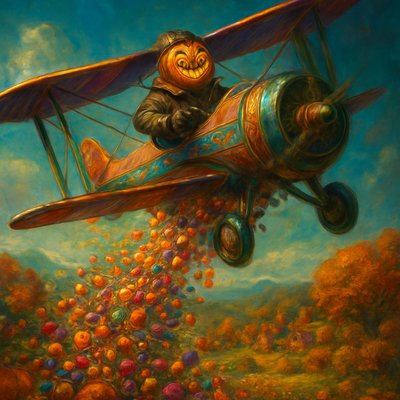
A fantastically cheerful and dynamic scene featuring the happy pumpkin-head figure (with the swirled, smiling carved face and internal glow) as the pilot of a classic, brightly colored biplane. The biplane itself is whimsically designed, perhaps with candy-themed accents or painted in vibrant, cheerful colors like orange, purple, and green.

The biplane is soaring through a clear, azure autumn sky, actively 'crop-dusting' a massive, exuberant stream of colorful Halloween candy from its underside. The candy (an abundant mix of wrapped chocolates, lollipops, candy corn, and various sweets) cascades downwards in a wide, joyous plume, spreading across the landscape below.

The landscape beneath the biplane is an idyllic, festive autumnal scene: rolling hills covered in vibrant fall foliage (golden, red, orange trees), a charming pumpkin patch, or a quaint, candy-colored village. The perspective is dynamic, capturing the plane in motion with the candy streaming behind it. The lighting is bright and sunny, emphasizing the vivid colors of the plane, the candy, and the autumn scenery. The overall mood is one of pure, unadulterated joy, playful magic, and festive exuberance, like a sugary parade from the sky."
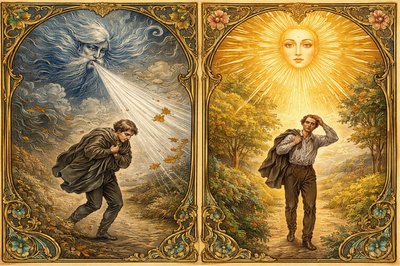
Vintage Art Nouveau Lithograph Style, Highly Decorative Borders, Rich Earth Tones and Gold Leaf. A vertically split "before and after" composition illustrating the classic fable of "The Wind and the Sun."

The Left Side (The Wind's Force): A personified North Wind, depicted as a swirling, ethereal figure made of cold blue and silver clouds with puffed cheeks, blows a jagged, visible blast of air downward. Below, a traveler on a dusty road is hunched over, his face strained, gripping his heavy woolen coat tightly around his chest as the gale whips his hair and sends autumn leaves flying in a chaotic spiral. The colors are cool, muted, and turbulent.

The Right Side (The Sun's Warmth): A personified Sun, depicted as a serene, radiant golden face surrounded by a massive, ornate circular halo of sunbeams, looks down with a gentle smile. Below, the same traveler is standing tall and relaxed on the path. His coat is draped loosely over one arm, his shirt collar is open, and he is wiping a bead of sweat from his forehead. The landscape around him is bathed in warm gold and vibrant greens, with tiny flowers blooming at his feet.

The Framing: The two scenes are separated by an elegant, winding vine border. The overall mood shifts from the frantic, cold energy on the left to the peaceful, overwhelming warmth on the right.
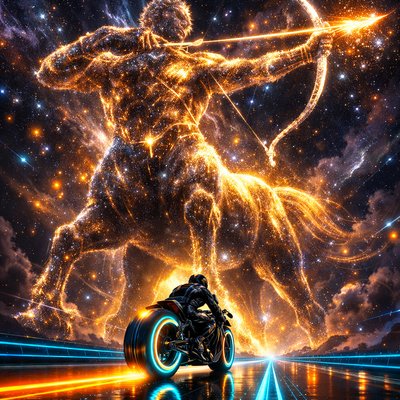
Neon-Futurism Digital Art Style, Bioluminescent Sci-Fi Cosmic Setting, Extreme Low-Angle Perspective. A breathtaking shot looking up from the level of the highway, emphasizing the colossal height of the constellation above.

The Rider & Bike Consistency: The lone motorcyclist—in the exact same sleek, armored suit with integrated helmet—is speeding forward on the same hubless "light-cycle" sportbike. The cyan and orange neon wheel rings leave a perfectly straight, vibrant light trail on the road, reflecting off the glossy surface.

The Path (The Ecliptic): The glowing blue laser-grid highway continues into the distance, appearing as a thin line of light compared to the massive figure towering over it.

The Sagittarius Presence: Looming directly over the highway is the colossal, majestic form of Sagittarius, a centaur made of shimmering stardust and golden data-lines. He is positioned so that the highway passes directly between his towering front legs. Above the rider, the centaur’s torso is twisted as he pulls back a massive longbow made of pure white light.

The Action: An arrow of concentrated solar energy is notched in the bow, pointed toward a distant star cluster. The rider is captured in the moment of passing directly beneath the centaur's underbelly, surrounded by the glow of the "horse" body’s starlight.

Atmosphere: The scene is dominated by golden and white light from the centaur, contrasting with the deep indigo of the cosmic void and the sharp cyan of the bike's neon.
Neon-Futurism Digital Art Style, Bioluminescent Sci-Fi Cosmic Setting, Extreme Low-Angle Perspective. A breathtaking shot looking up from the level of the highway, emphasizing the colossal height of the constellation above.

The Rider & Bike Consistency: The lone motorcyclist—in the exact same sleek, armored suit with integrated helmet—is speeding forward on the same hubless "light-cycle" sportbike. The cyan and orange neon wheel rings leave a perfectly straight, vibrant light trail on the road, reflecting off the glossy surface.

The Path (The Ecliptic): The glowing blue laser-grid highway continues into the distance, appearing as a thin line of light compared to the massive figure towering over it.

The Sagittarius Presence: Looming directly over the highway is the colossal, majestic form of Sagittarius, a centaur made of shimmering stardust and golden data-lines. He is positioned so that the highway passes directly between his towering front legs. Above the rider, the centaur’s torso is twisted as he pulls back a massive longbow made of pure white light.

The Action: An arrow of concentrated solar energy is notched in the bow, pointed toward a distant star cluster. The rider is captured in the moment of passing directly beneath the centaur's underbelly, surrounded by the glow of the "horse" body’s starlight.

Atmosphere: The scene is dominated by golden and white light from the centaur, contrasting with the deep indigo of the cosmic void and the sharp cyan of the bike's neon.
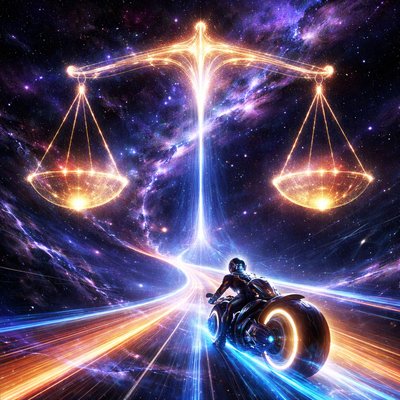
Neon-Futurism Digital Art Style, Bioluminescent Sci-Fi Cosmic Setting. A sleek, futuristic scene set deep in the interstellar void, with absolutely no Earth terrain, asphalt, or atmosphere visible. The Path (The Ecliptic): The "road" is a floating, translucent highway constructed entirely of glowing blue and orange laser grids and condensed stardust, arcing through infinite dark space. The Rider: A lone rider on a futuristic, hubless "light-cycle" sportbike speeds along this cosmic path. The rider is fully encased in a sleek, glowing armored suit with an integrated full-face helmet, leaving a vibrant neon light trail behind them. The Constellation (Abstract Libra Scales as Archway): Dominating the cosmic background and towering directly overhead is the immense celestial symbol of Libra: a pair of perfectly balanced, monumental golden scales made of glowing stars, luminous energy threads, and shimmering stardust. The scales' beam forms a grand, arched gateway structure high above, with the two pans hanging symmetrically on either side like massive portals or wings of equilibrium. The floating cosmic highway arcs directly under this uplifted arched scale structure, so the rider speeds beneath the balanced beam and between the hanging pans as if passing through the gateway of harmony and justice. No humanoid figure is present—only the majestic, abstract scales as the central cosmic emblem, radiating soft silver, deep indigo, and golden light against the nebula-filled void. The rider approaches and passes under the archway calmly and serenely.
Neon-Futurism Digital Art Style, Bioluminescent Sci-Fi Cosmic Setting, Grand Symmetrical Perspective. > The Rider & Bike: The lone motorcyclist in the sleek armored suit is centered on the highway, speeding away from the viewer on the hubless light-cycle. The cyan and orange glow of the bike is the sharpest point of light in the center of the frame.

The Path: The glowing blue laser-grid highway is a straight, infinite line of light that leads directly into the center of the horizon.

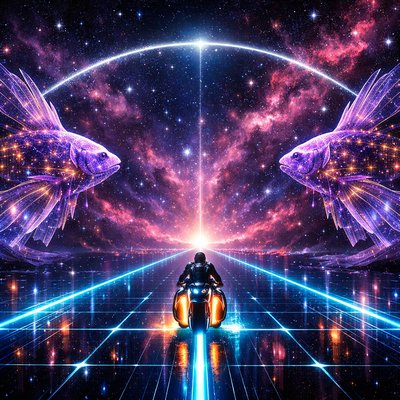
The Pisces Constellation: On the far left and far right sides of the highway, two colossal, ethereal celestial fish are positioned facing away from each other. They are rendered as majestic, crystalline structures made of violet stardust and golden circuitry.

The Composition: The highway passes directly through the vast open space between the two figures. Their large, translucent tail fins fan out like glowing sails on either side of the road, creating a "V" shape that guides the eye toward the center of the cosmos.

The Connection: A thin, radiant silver beam of light connects the two distant figures, arching high above the rider like a celestial wire.

Atmosphere: A serene and vast cosmic void, filled with soft magenta nebulae and shimmering diamond stars, creating a sense of peace and finality at the end of the journey.
Neon-Futurism Digital Art Style, Bioluminescent Sci-Fi Cosmic Setting, Grand Symmetrical Perspective. > The Rider & Bike: The lone motorcyclist in the sleek armored suit is centered on the highway, speeding away from the viewer on the hubless light-cycle. The cyan and orange glow of the bike is the sharpest point of light in the center of the frame.

The Path: The glowing blue laser-grid highway is a straight, infinite line of light that leads directly into the center of the horizon.

The Pisces Constellation: On the far left and far right sides of the highway, two colossal, ethereal celestial fish are positioned facing away from each other. They are rendered as majestic, crystalline structures made of violet stardust and golden circuitry.

The Composition: The highway passes directly through the vast open space between the two figures. Their large, translucent tail fins fan out like glowing sails on either side of the road, creating a "V" shape that guides the eye toward the center of the cosmos.

The Connection: A thin, radiant silver beam of light connects the two distant figures, arching high above the rider like a celestial wire.

Atmosphere: A serene and vast cosmic void, filled with soft magenta nebulae and shimmering diamond stars, creating a sense of peace and finality at the end of the journey.
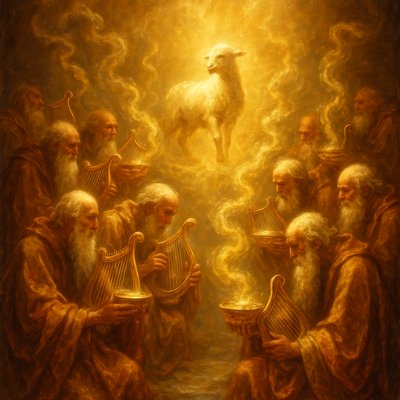
A majestic, ethereal scene depicting golden bowls brimming with luminous, swirling incense. The incense, representing the collective prayers of all saints, rises and coalesces into shimmering, golden tendrils that ascend towards an unseen heavenly throne. The bowls are held by 24 robed, elder-like figures, who are also holding harps, bowing in worship. The atmosphere is reverent and awe-inspiring, filled with soft, warm light emanating from the golden smoke. Emphasize the precious, divine, and unified nature of the prayers.
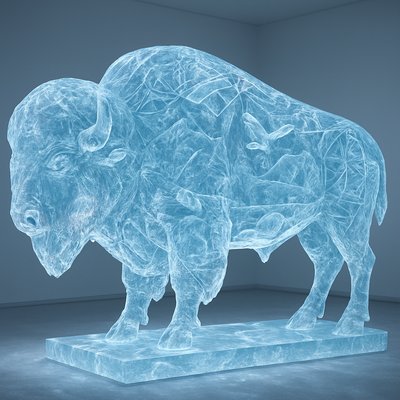
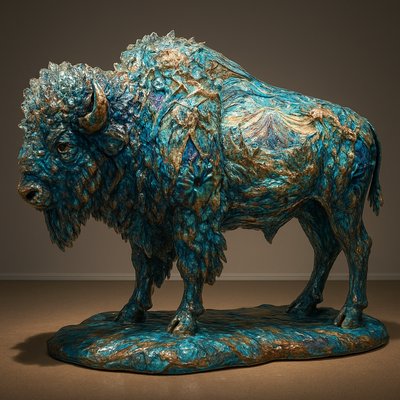
    A breathtaking, full-size artistic sculpture of a standing buffalo, rendered entirely in the style of intricate, luminous glass art, reminiscent of the painted buffalo installations found in West Yellowstone. The Buffalo is standing in the nature of Yellowstone National Park. The buffalo's form is composed of countless individual pieces of vibrant, multifaceted stained glass or fused glass, meticulously cut, arranged, and joined, creating a cohesive and majestic shape.

    Instead of traditional paint, the entire surface of this glass buffalo is adorned with various miniature, finely detailed scenes and patterns etched, painted, or embedded within the glass itself, or created by the unique coloration and texture of the glass pieces. These scenes could depict:

        Western landscapes: Yellowstone's geysers, mountain ranges, pine forests, rivers.

        Wildlife: Elk, bears, wolves, eagles (in glass).

        Native American art motifs: Geometric patterns, symbols, and figures (also rendered in glass).

        Historical moments: Subtle nods to early explorers or iconic figures (stylized in glass).

    The buffalo's interior is subtly illuminated, causing the entire sculpture to glow from within. Light catches every facet of the glass, creating a dazzling play of refracted colors and intricate shadows on the ground around it. The background is a clean, modern art gallery setting with soft, focused lighting, allowing the buffalo to be the sole, radiant centerpiece. The atmosphere is one of awe, wonder, and appreciation for artistic craftsmanship and the spirit of the American West, reimagined through a unique, luminous medium. The artistic style is hyper-realistic, emphasizing the detailed texture, transparency, and brilliant light play inherent in glass art."
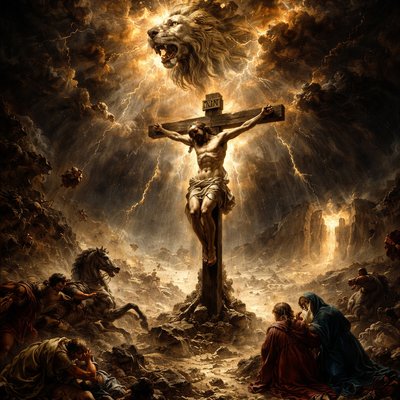
Epic Biblical Baroque Painting Style, High-Contrast Tenebrism Lighting, Supernatural Realism. A monumental, earth-shattering scene at Golgotha at the precise moment of death.

The Central Figure: Jesus hangs lifelessly on a rough wooden cross, head bowed in finality, his body pale and scarred. A subtle, fading divine light emanates from him. The titulus above his head reads "INRI."

The Manifestation of the Roar (Jasher 54 influence): At the very instant of his death, the environment is violently convulsing, visualizing the "roar" of Judah echoing through time. Behind and above the cross, the dark, stormy clouds are being ripped apart by a massive, translucent ethereal manifestation of a roaring Lion's head formed from dust, lightning, and golden spiritual energy.

The Environmental Impact: The ground beneath the cross is cracking open with deep fissures. Massive boulders are shattering into dust mid-air. The temple veil in the distant city background is visibly tearing top-to-bottom.

The Human Reaction: Below the cross, the scene is one of absolute supernatural terror (as described in Jasher). Roman centurions are cowering on the ground, covering their ears, their helmets knocked off. Horses are rearing wildly, throwing their riders. The few followers present (Mary, John) are driven to their knees, not just in grief, but overwhelmed by the physical force of the cosmic event. The lighting is a chaotic mix of deep eclipse shadow and blinding bursts of supernatural golden-red light from the roaring manifestation.
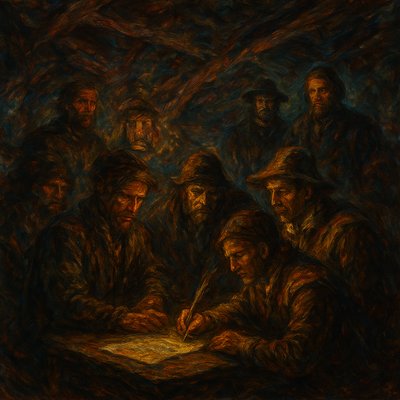
A historically accurate and atmospheric depiction of the signing of the Mayflower Compact aboard the ship in November 1620. The scene is set in the dimly lit, cramped cabin of the Mayflower, with the ship's timbers and rigging subtly visible, conveying the challenging conditions of the voyage. A simple table or chest serves as the signing surface. The primary focus is on a small group of the last individuals signing the document: specifically, the indentured servants (or 'strangers' not directly part of the Separatist congregation) approaching or at the table. Their expressions show a mix of weary determination, understanding of the necessity, and perhaps a hint of quiet apprehension or resignation to this new social contract, given their status. They are dressed in the plain, practical clothing typical of 17th-century commoners and laborers. Figures of prominent Pilgrims or 'Saints' (like William Bradford or John Carver) are visible in the background, observing the proceedings with a sense of gravity and leadership, but they are not the central focus. The lighting is low and warm, perhaps from a lantern, creating a chiaroscuro effect that highlights the faces of the signers. The atmosphere conveys the momentousness of the act under difficult circumstances, the diverse composition of the group, and the early seeds of self-governance in a new world. The artistic style is a realistic, historically detailed oil painting, capturing the solemnity and human element of this pivotal historical moment."
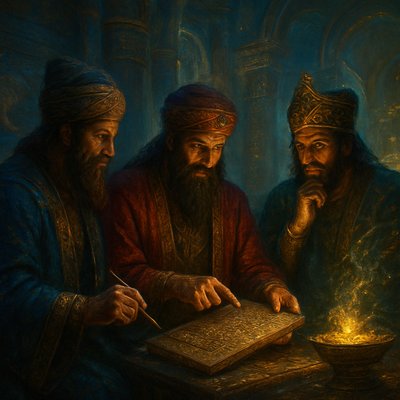
A dramatic, richly detailed scene in the ancient Babylonian royal court. In the foreground, three wise and esteemed Babylonian court magicians (Chaldeans/astrologers) are gathered around a central figure, possibly the king, or intently studying an inscribed clay tablet. They are dressed in opulent, finely woven robes of deep blues, reds, and gold, with elaborate turbans or headwear. Their long, meticulously styled beards and hair indicate their status and wisdom. One magician holds a stylus, another points to intricate cuneiform script on a clay tablet, and the third gazes thoughtfully, perhaps at a celestial chart or into a symbolic brazier. The background reveals the grand, awe-inspiring architecture of the Babylonian palace, with glazed brick walls adorned with depictions of mythical creatures (like the Ishtar Gate lions) and massive, ornate columns. The atmosphere is one of profound intellectual pursuit, ancient wisdom, and mystical interpretation under the watchful eyes of the king. epic fantasy art, cinematic lighting, ultra-detailed, dramatic shadows, mystical glow"
    A breathtaking, full-size artistic sculpture of a standing buffalo, rendered entirely in the style of intricate, luminous glass art, reminiscent of the painted buffalo installations found in West Yellowstone art shows. The buffalo's form is composed of countless individual pieces of vibrant, multifaceted stained glass or fused glass, meticulously cut, arranged, and joined, creating a cohesive and majestic shape.

    Instead of traditional paint, the entire surface of this glass buffalo is adorned with various miniature, finely detailed scenes and patterns etched, painted, or embedded within the glass itself, or created by the unique coloration and texture of the glass pieces. These scenes could depict:

        Western landscapes: Yellowstone's geysers, mountain ranges, pine forests, rivers.

        Wildlife: Elk, bears, wolves, eagles (in glass).

        Native American art motifs: Geometric patterns, symbols, and figures (also rendered in glass).

        Historical moments: Subtle nods to early explorers or iconic figures (stylized in glass).

    The buffalo's interior is subtly illuminated, causing the entire sculpture to glow from within. Light catches every facet of the glass, creating a dazzling play of refracted colors and intricate shadows on the ground around it. The background is a clean, modern art gallery setting with soft, focused lighting, allowing the buffalo to be the sole, radiant centerpiece. The atmosphere is one of awe, wonder, and appreciation for artistic craftsmanship and the spirit of the American West, reimagined through a unique, luminous medium. The artistic style is hyper-realistic, emphasizing the detailed texture, transparency, and brilliant light play inherent in glass art."
A historically accurate and atmospheric depiction of the signing of the Mayflower Compact aboard the ship in November 1620. The scene is set in the dimly lit, cramped cabin of the Mayflower, with the ship's timbers and rigging subtly visible, conveying the challenging conditions of the voyage. A simple table or chest serves as the signing surface. The primary focus is on a small group of the last individuals signing the document: specifically, the indentured servants (or 'strangers' not directly part of the Separatist congregation) approaching or at the table. Their expressions show a mix of weary determination, understanding of the necessity, and perhaps a hint of quiet apprehension or resignation to this new social contract, given their status. They are dressed in the plain, practical clothing typical of 17th-century commoners and laborers. Figures of prominent Pilgrims or 'Saints' (like William Bradford or John Carver) are visible in the background, observing the proceedings with a sense of gravity and leadership, but they are not the central focus. The lighting is low and warm, perhaps from a lantern, creating a chiaroscuro effect that highlights the faces of the signers. The atmosphere conveys the momentousness of the act under difficult circumstances, the diverse composition of the group, and the early seeds of self-governance in a new world. The artistic style is a realistic, historically detailed oil painting, capturing the solemnity and human element of this pivotal historical moment."
A stunning and spiritually evocative depiction of the traditional Lakota Hoop Dance (or Intertribal Hoop Dance). The central figure is a single, male Hoop Dancer, captured mid-motion, demonstrating incredible agility and grace. He is adorned in vibrant, traditional regalia with intricate beadwork, feathers, and fringes, and is surrounded by a mesmerizing array of hoops, dynamically formed into various shapes and symbols, representing animals, stories, or the sacred circle of life. His face reflects intense focus, reverence, and the deep storytelling inherent in the dance. In the background, partially obscured by a light morning mist or soft haze, the monumental carving of the Crazy Horse Memorial is visible, lending a profound sense of historical continuity, honor, and enduring spirit to the scene. The setting is an open, natural area, perhaps a grassy plain or red rock outcropping, under a clear, early morning sky with the sun just beginning to illuminate the landscape, casting a soft, golden light. The atmosphere is one of dynamic energy, profound cultural pride, and deep spiritual connection to both tradition and the ancestral land. The artistic style is a vivid, realistic painting with a strong sense of movement, capturing the intricate details of the hoops and regalia, against the majestic, stoic presence of the memorial."

Key Considerations Reflected in This Prompt:

    Corrected Dance Name: Clearly states "Lakota Hoop Dance (or Intertribal Hoop Dance)."

    Central Figure: Focuses on a "single, male Hoop Dancer" to highlight the individual skill and artistry.

    Hoops & Symbolism: Emphasizes the "mesmerizing array of hoops, dynamically formed into various shapes and symbols" and their meaning.

    Crazy Horse Memorial Background: Explicitly places the "monumental carving of the Crazy Horse Memorial" in the background, noting its symbolic significance ("historical continuity, honor, and enduring spirit").

    Setting & Lighting: Suggests "early morning mist or soft haze" for the background to give the memorial an ethereal quality, and "soft, golden light" for the dancer.

    Mood: Conveys "dynamic energy, profound cultural pride, and deep spiritual connection."

    Artistic Style: "Vivid, realistic painting with a strong sense of movement.
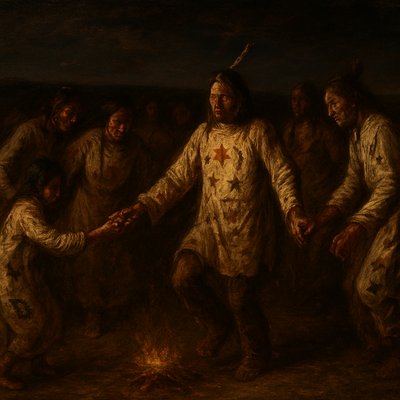
"A historically accurate depiction of a Ghost Dance, focusing on the late 19th-century context, specifically around 1890-1891. The scene shows Lakota (Sioux) or Northern Paiute people (specify one or include elements of both, but avoid anachronisms) participating in the ceremony.

Setting: A vast, open prairie or high desert landscape, under an expansive sky. The time of day could be dusk or night, with a prominent moon or stars, or a bright, clear day. Avoid overtly spiritual or ethereal elements like floating spirits unless explicitly requested for a later, more symbolic iteration. The focus should be on the earthly ceremony.

Participants: A circle of men, women, and children, hand-in-hand, moving in a slow, rhythmic shuffle or circular motion. Their faces show a mixture of devotion, hope, and determination. Some may have expressions of trance or deep concentration.

Attire:

    Ghost Dance Shirts/Dresses: Emphasize the unique Ghost Dance shirts and dresses, which were typically made of muslin or canvas. These garments should feature painted designs such as stars, crescents, birds (especially eagles or crows), buffalo, human figures, or crosses. The designs should appear hand-painted, not mass-produced.

    Hair and Adornments: Participants should have braided hair or wear it long. Some may wear feathers (e.g., eagle or hawk feathers) in their hair. Minimal traditional adornments, as the focus was often on the Ghost Dance shirt itself. Avoid overly elaborate or Hollywood-esque depictions of war bonnets unless relevant to a specific individual and context.

    Footwear: Moccasins or bare feet.

Action/Atmosphere:

    The dancers are moving in a counter-clockwise circle, with a central figure or a small group often leading.

    The overall mood is one of earnest prayer and communal spiritual effort. The dance should convey a sense of hope for renewal and the return of the old ways, rather than aggression or despair.

    There might be a central pole or small fire as a focal point, around which the dance takes place.

    Avoid any signs of direct conflict or violence; the Ghost Dance itself was a non-violent spiritual movement.

Specific Considerations for Accuracy:

    Wovoka's Influence: The teachings of Wovoka (the Northern Paiute prophet) emphasized peace, hard work, and the return of the buffalo and deceased ancestors. The scene should subtly reflect this hopeful, redemptive spirit.

    Regional Variations: If focusing on Lakota, consider their specific interpretations, which sometimes included more imagery related to their warrior traditions on the shirts, but still within the peaceful framework of the dance.
    Respectful Portrayal: Ensure the depiction is respectful and avoids any stereotypical or caricatured representations of Indigenous people. Focus on their human dignity and spiritual sincerity.
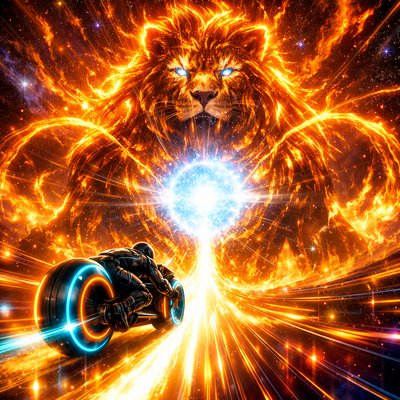
Neon-Futurism Digital Art Style, Bioluminescent Sci-Fi Cosmic Setting, Extreme Focal Point. A high-speed "tunnel-vision" perspective where everything converges on a single, brilliant point of light.

The Rider & Bike Consistency: The lone motorcyclist—in the signature sleek, armored suit and helmet—is leaning dangerously low, pinned to the chassis of the hubless "light-cycle." The bike's cyan and orange neon rings are vibrating with energy as it accelerates toward the center of the frame.

The Path (The Solar Path): The glowing blue laser-grid highway has turned into a golden-white bridge of solid light. It leads directly into the chest of a colossal celestial entity.

The Leo Presence: Looming ahead is the magnificent Celestial Lion, a titan made of burning solar flares and rhythmic orange circuitry. He stands in a regal, powerful stance. At the center of his chest lies Regulus, a massive, pulsating white-blue star that acts as a gateway.

The Action: The highway doesn't stop; it goes straight into the center of Regulus. The rider is seconds away from entering the star's core. Solar prominences and loops of liquid fire arch over the road like a stadium of light.

Atmosphere: Intense heat and majesty. The colors are dominated by deep ambers, fiery oranges, and the blinding white-blue light of the star Regulus.
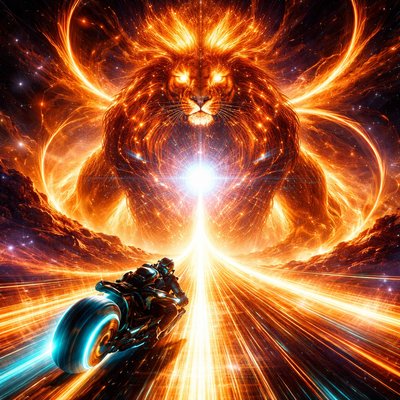
Lighting: The rider is almost a silhouette against the overwhelming brightness of the Lion's heart. Intense "lens flare" and shimmering heat-haze effects blur the edges of the digital grid.
Neon-Futurism Digital Art Style, Bioluminescent Sci-Fi Cosmic Setting, Extreme Focal Point. A high-speed "tunnel-vision" perspective where everything converges on a single, brilliant point of light.

The Rider & Bike Consistency: The lone motorcyclist—in the signature sleek, armored suit and helmet—is leaning dangerously low, pinned to the chassis of the hubless "light-cycle." The bike's cyan and orange neon rings are vibrating with energy as it accelerates toward the center of the frame.
The Path (The Solar Path): The glowing blue laser-grid highway has turned into a golden-white bridge of solid light. It leads directly into the chest of a colossal celestial entity.

The Leo Presence: Looming ahead is the magnificent Celestial Lion, a titan made of burning solar flares and rhythmic orange circuitry. He stands in a regal, powerful stance. At the center of his chest lies Regulus, a massive, pulsating white-blue star that acts as a gateway.

The Action: The highway doesn't stop; it goes straight into the center of Regulus. The rider is seconds away from entering the star's core. Solar prominences and loops of liquid fire arch over the road like a stadium of light.

Atmosphere: Intense heat and majesty. The colors are dominated by deep ambers, fiery oranges, and the blinding white-blue light of the star Regulus.

Lighting: The rider is almost a silhouette against the overwhelming brightness of the Lion's heart. Intense "lens flare" and shimmering heat-haze effects blur the edges of the digital grid.
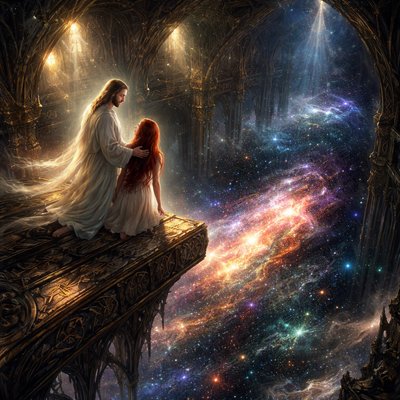
Surrealism Art Style, Fantasy Digital Art Style, a breathtaking and dreamlike scene. Jesus Christ, robed in soft, glowing white light, stands with a girl with long red hair (the dreamer) on massive, ancient wooden and stone cathedral rafters that curve high into a dark upper vault. They are looking downwards over the edge of a thick beam. Below them, there is no floor, only an infinite, swirling cosmic abyss filled with brilliant galaxies, nebulae, and countless glittering stars spread out like a carpet far below. The architecture seems to be floating in space. The lighting is a mix of warm gold from the divine figures and cool blues and purples from the stars below. The mood is one of overwhelming awe and peace.
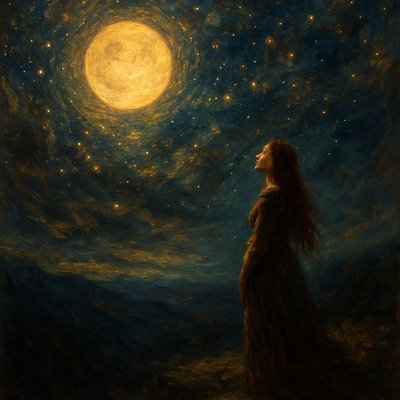
Romanticism Art Style, a profoundly emotional and majestic painting inspired by Psalm 8:3-6. The scene captures a vast, sweeping, and dramatic night sky, filled with an awe-inspiring celestial display of a luminous, prominent moon and countless brilliant stars, depicted with the grandeur and depth characteristic of Romantic landscape painting. In the foreground, set against the overwhelming scale of the cosmos, stands a solitary long red-haired woman, her back partially to the viewer or her face upturned in profound contemplation. She is small in the frame, emphasizing the immense scale, dressed in simple, flowing attire, positioned on a rugged, subtle earthly vantage point like a mountain overlook. Her posture and presence evoke a deep sense of humility, wonder, and spiritual awe at God's creation. The painting is dominated by dramatic chiaroscuro, with the intense glow of the moon and stars piercing through deep, atmospheric shadows. Focus on the sublime scale of the cosmos, the emotional resonance of the human figure contemplating the divine works, and the deep, spiritual awe that pervades the scene, reflecting God's majesty and mindfulness of humanity.
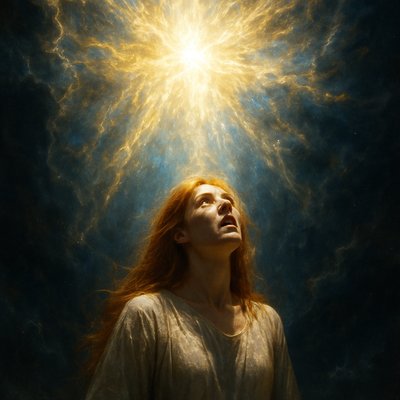
Photorealism Art Style, a profoundly dramatic and intensely luminous image depicting a vision of Heaven seen from the ground. The scene is dominated by a blazing, overwhelming celestial light that is violently breaking through the darkness of the night sky. This light is not the sun, but the pure glory of God, manifesting as swirling gold, brilliant white, and ethereal blue luminescence that seems to pull the viewer upward. A long red-haired woman, wearing simple, flowing heavenly attire, stands below, gazing upward with an expression of ecstatic awe and reverence. She is bathed in the brilliant, otherworldly light streaming down, suggesting the moment of divine revelation where the heavens are torn open. The focus is on the raw, blinding intensity of the divine light, the realistic texture of the woman's awe-struck face, and the vibrant, chaotic energy of the celestial vision, creating a powerful image of a direct, momentary glimpse into the boundless presence of Heaven.
    A breathtaking, full-size artistic sculpture of a standing buffalo, rendered entirely in the style of intricate, luminous glass art, reminiscent of the painted buffalo installations. The buffalo's majestic form is composed of countless individual pieces of vibrant, multifaceted stained glass or fused glass, meticulously cut, arranged, and joined.

    The entire surface of this glass buffalo is adorned with various miniature, finely detailed scenes and patterns etched, painted, or embedded within the glass itself, or created by the unique coloration and texture of the glass pieces. These scenes depict:

        Iconic Yellowstone landscapes: Old Faithful erupting in miniature, the Grand Canyon of the Yellowstone, geothermal pools.

        Local wildlife: Elk, bears, wolves, eagles (all rendered in the glass medium).

        Native American art motifs: Geometric patterns, symbols, and figures (also within the glass).

    The buffalo's interior is subtly illuminated, causing the entire sculpture to glow from within, acting as a beacon of art and nature. Light catches every facet of the glass, creating a dazzling play of refracted colors that project intricate patterns onto the surrounding natural environment.

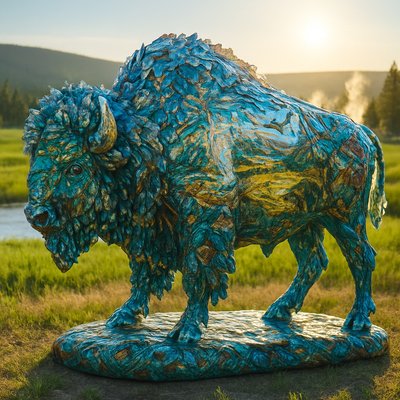
    The setting is the glory of Yellowstone National Park, specifically an expansive, iconic vista. Perhaps in a verdant meadow with distant geysers steaming, or near a crystal-clear river. The morning sun, bright and golden, backlights the buffalo, intensifying its inner glow and creating a dramatic contrast with the rugged, natural beauty of the park. The atmosphere is one of awe, harmony between art and nature, and a profound celebration of the spirit of the American West. The artistic style is hyper-realistic, emphasizing the detailed texture, transparency, and brilliant light play inherent in glass art, seamlessly integrated into a vibrant, natural landscape.
    A breathtaking, full-size artistic sculpture of a standing buffalo, rendered entirely in the style of intricate, luminous glass art, reminiscent of the painted buffalo installations. The buffalo's majestic form is composed of countless individual pieces of vibrant, multifaceted stained glass or fused glass, meticulously cut, arranged, and joined.

    The entire surface of this glass buffalo is adorned with various miniature, finely detailed scenes and patterns etched, painted, or embedded within the glass itself, or created by the unique coloration and texture of the glass pieces. These scenes depict:

        Iconic Yellowstone landscapes: Old Faithful erupting in miniature, the Grand Canyon of the Yellowstone, geothermal pools.

        Local wildlife: Elk, bears, wolves, eagles (all rendered in the glass medium).

        Native American art motifs: Geometric patterns, symbols, and figures (also within the glass).

    The buffalo's interior is subtly illuminated, causing the entire sculpture to glow from within, acting as a beacon of art and nature. Light catches every facet of the glass, creating a dazzling play of refracted colors that project intricate patterns onto the surrounding natural environment.

    The setting is the glory of Yellowstone National Park, specifically an expansive, iconic vista. Perhaps in a verdant meadow with distant geysers steaming, or near a crystal-clear river. The morning sun, bright and golden, backlights the buffalo, intensifying its inner glow and creating a dramatic contrast with the rugged, natural beauty of the park. The atmosphere is one of awe, harmony between art and nature, and a profound celebration of the spirit of the American West. The artistic style is hyper-realistic, emphasizing the detailed texture, transparency, and brilliant light play inherent in glass art, seamlessly integrated into a vibrant, natural landscape.