A Painting Of Three Women Sitting At A Table Writing Art

A triptych oil painting, presented as three heavily framed, connected panels in the dramatic, tenebrism style of Baroque masters like Caravaggio. The overall atmosphere is one of supernatural, oppressive darkness and violent chaos.

The Left Panel shows the penitent thief on his cross, body twisted in pain but his face turned toward the center panel with a look of sorrowful acceptance. A faint, supernatural light illuminates his face against a nearly black sky. Below him, rocks are splitting.

The Center Panel is dominated by Jesus on the cross, head bowed in finality. The sky is a swirling vortex of eclipse darkness, blotting out the sun. The ground beneath the cross is violently cracking open, emitting dust and smoke, with debris caught in mid-air from the earthquake shockwave.

The Right Panel shows the impenitent thief, writhing and screaming against his bonds, his face contorted in rage looking away from the center. He is almost swallowed by the shadows. The cross appears unstable as the cliffside crumbles beneath it. The entire triptych has a rich, dark color palette of deep browns, blacks, and muted crimson, textured with visible, frantic brushstrokes.
A triptych oil painting, presented as three heavily framed, connected panels in the dramatic, tenebrism style of Baroque masters like Caravaggio. The overall atmosphere is one of supernatural, oppressive darkness and violent chaos.

The Left Panel shows the penitent thief on his cross, body twisted in pain but his face turned toward the center panel with a look of sorrowful acceptance. A faint, supernatural light illuminates his face against a nearly black sky. Below him, rocks are splitting.

The Center Panel is dominated by Jesus on the cross, head bowed in finality. The sky is a swirling vortex of eclipse darkness, blotting out the sun. The ground beneath the cross is violently cracking open, emitting dust and smoke, with debris caught in mid-air from the earthquake shockwave.

The Right Panel shows the impenitent thief, writhing and screaming against his bonds, his face contorted in rage looking away from the center. He is almost swallowed by the shadows. The cross appears unstable as the cliffside crumbles beneath it. The entire triptych has a rich, dark color palette of deep browns, blacks, and muted crimson, textured with visible, frantic brushstrokes.
A triptych set of three drawings, continuous scene flowing left to right, left panel shows a palomino horse in the foreground on the far left side of the scene walking down a grassy slope toward a reflective teal-blue river in the Scottish Highlands with rocks and ferns around its hooves.
Center panel continues the same landscape as the horse now appears in the midground at the center of the scene standing at the river’s edge drinking from the reflective water beside ancient moss-covered stone ruins.
Right panel continues the scene as the horse appears far away in the distance on the far right side of the scene following the riverbank toward steep mist-covered mountains with dramatic sunlight breaking through the clouds, unified natural palette of greens golds and reflective teal blues, consistent cinematic lighting, shared horizon line, smoothf uninterrupted left-to-right visual flow with no panel separation.
And behold! He comes with ten thousands of ⌈His⌉ holy ones (1 Enoch 1:9)
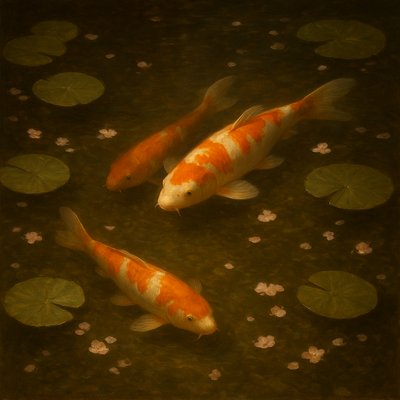
A koi pond seen from above, orange and white koi fish swimming among lily pads, clear water with subtle ripples, fallen cherry blossom petals floating on the surface, dappled sunlight
And behold! He comes with ten thousands of ⌈His⌉ holy ones (1 Enoch 1:9)
 He setteth an end to darkness, and searcheth out all perfection: the stones of darkness, and the shadow of death. From Job 28:3
 He setteth an end to darkness, and searcheth out all perfection: the stones of darkness, and the shadow of death. From Job 28:3
 He (God) setteth an end to darkness, and searcheth out all perfection: the stones of darkness, and the shadow of death. From Job 28:3
A koi pond seen from above, orange and white koi fish swimming among lily pads, clear water with subtle ripples, fallen cherry blossom petals floating on the surface, dappled sunlight
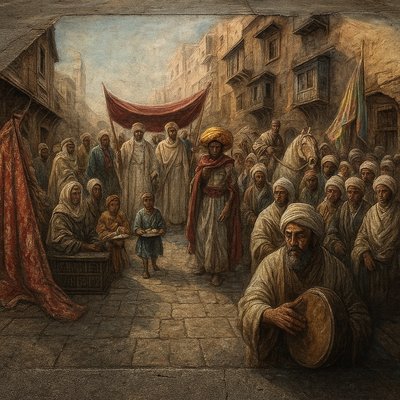
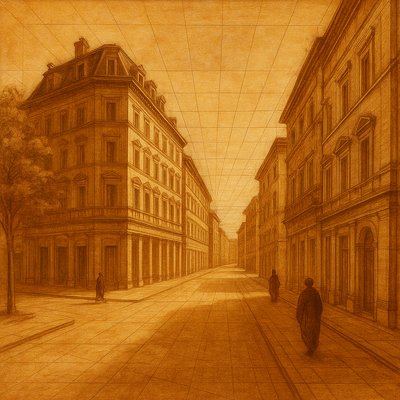
a painting of two people walking down a street
Epic Fantasy Illustration Style, Gritty Cinematic Concept Art, a dynamic, wide-angle action shot of a fierce battle amidst overgrown ancient ruins at twilight. A lone, hardened warrior clad in practical leather and partial plate armor is in a dynamic combat stance, dodging a massive vine strike. They wield a glowing, enchanted battleaxe that burns with orange fire, striking at the creature. The opponent is a colossal, serpentine Botanical Dragon construct made entirely of writhing, thick poison ivy vines, hairy root systems, and dense clusters of glossy, three-pointed leaves. The "dragon" rears up, its maw a tangled mass of thorns and dripping toxic sap, exhaling clouds of yellowish-green poisonous spores. Its eyes glow with a malevolent verdant light. The ground is treacherous swamp and broken stone. The lighting is dramatic and moody, highlighting the oily sheen of the poisonous leaves and the fire of the warrior's weapon. High detail on the plant textures.
Epic Fantasy Illustration Style, Gritty Cinematic Concept Art, a dynamic, wide-angle action shot of a fierce battle amidst overgrown ancient ruins at twilight. A lady warrior with long red hair clad in practical leather and partial plate armor is in a dynamic combat stance, dodging a massive vine strike. They wield a glowing, enchanted battleaxe that burns with orange fire, striking at the creature. The opponent is a colossal, serpentine Botanical Dragon construct made entirely of writhing, thick poison ivy vines, hairy root systems, and dense clusters of glossy, three-pointed leaves. The "dragon" rears up, its maw a tangled mass of thorns and dripping toxic sap, exhaling clouds of yellowish-green poisonous spores. Its eyes glow with a malevolent verdant light. The ground is treacherous swamp and broken stone. The lighting is dramatic and moody, highlighting the oily sheen of the poisonous leaves and the fire of the warrior's weapon. High detail on the plant textures.
 He (God) setteth an end to darkness, and searcheth out all perfection: the stones of darkness, and the shadow of death. From Job 28:3 using a Spiritual figure as a dove to represent the one searching.
 He (God) setteth an end to darkness, and searcheth out all perfection: the stones of darkness, and the shadow of death. From Job 28:3 using a Spiritual figure as a dove to represent the one searching. There are many glowing stones in the darkness and a door representing the shadows of death.
 He (God) setteth an end to darkness, and searcheth out all perfection: the stones of darkness, and the shadow of death. From Job 28:3 using a Spiritual figure as a dove to represent the one searching. There are many glowing stones in the darkness and a door representing the shadows of death.
A koi pond seen from above, orange and white koi fish swimming among lily pads, clear water with subtle ripples, fallen cherry blossom petals floating on the surface, dappled sunlight
A statuesque, heroic portrait of Lady Mary Bailey (the aviator) standing confidently by her small biplane, the De Havilland Moth.

Style: Neoclassical painting emphasizing idealized forms, clear lines, balanced composition, and muted color palettes (such as marble white, deep blues, and sepia tones). The figures and machine should look elegant and timeless, like a heroic ancient myth.
But with the righteous He will make peace.

And will protect the elect,
And mercy shall be upon them.

And they shall all belong to God,
And they shall be prospered,
And they shall ⌈all⌉ be blessed.

⌈And He will help them all⌉,
And light shall appear unto them,
⌈And He will make peace with them⌉.
“Lift up your heads, O ye gates; even lift them up, ye everlasting doors; and the King of glory shall come in.” (Psalms 24:9, KJV)
John 8:12 (KJV)
12 Then spake Jesus again unto them, saying, I am the light of the world: he that followeth me shall not walk in darkness, but shall have the light of life.
A koi pond seen from above, orange and white koi fish swimming among lily pads, clear water with subtle ripples, fallen cherry blossom petals floating on the surface, dappled sunlight
"A historically accurate depiction of a Ghost Dance, focusing on the late 19th-century context, specifically around 1890-1891. The scene shows Lakota (Sioux) or Northern Paiute people (specify one or include elements of both, but avoid anachronisms) participating in the ceremony.

Setting: A vast, open prairie or high desert landscape, under an expansive sky. The time of day could be dusk or night, with a prominent moon or stars, or a bright, clear day. Avoid overtly spiritual or ethereal elements like floating spirits unless explicitly requested for a later, more symbolic iteration. The focus should be on the earthly ceremony.

Participants: A circle of men, women, and children, hand-in-hand, moving in a slow, rhythmic shuffle or circular motion. Their faces show a mixture of devotion, hope, and determination. Some may have expressions of trance or deep concentration.

Attire:

    Ghost Dance Shirts/Dresses: Emphasize the unique Ghost Dance shirts and dresses, which were typically made of muslin or canvas. These garments should feature painted designs such as stars, crescents, birds (especially eagles or crows), buffalo, human figures, or crosses. The designs should appear hand-painted, not mass-produced.

    Hair and Adornments: Participants should have braided hair or wear it long. Some may wear feathers (e.g., eagle or hawk feathers) in their hair. Minimal traditional adornments, as the focus was often on the Ghost Dance shirt itself. Avoid overly elaborate or Hollywood-esque depictions of war bonnets unless relevant to a specific individual and context.

    Footwear: Moccasins or bare feet.

Action/Atmosphere:

    The dancers are moving in a counter-clockwise circle, with a central figure or a small group often leading.

    The overall mood is one of earnest prayer and communal spiritual effort. The dance should convey a sense of hope for renewal and the return of the old ways, rather than aggression or despair.

    There might be a central pole or small fire as a focal point, around which the dance takes place.

    Avoid any signs of direct conflict or violence; the Ghost Dance itself was a non-violent spiritual movement.

Specific Considerations for Accuracy:

    Wovoka's Influence: The teachings of Wovoka (the Northern Paiute prophet) emphasized peace, hard work, and the return of the buffalo and deceased ancestors. The scene should subtly reflect this hopeful, redemptive spirit.

    Regional Variations: If focusing on Lakota, consider their specific interpretations, which sometimes included more imagery related to their warrior traditions on the shirts, but still within the peaceful framework of the dance.
    Respectful Portrayal: Ensure the depiction is respectful and avoids any stereotypical or caricatured representations of Indigenous people. Focus on their human dignity and spiritual sincerity.
Epic Biblical Baroque Painting Style, High-Contrast Tenebrism Lighting, Supernatural Realism. A monumental, earth-shattering scene at Golgotha at the precise moment of death.

The Central Figure: Jesus hangs lifelessly on a rough wooden cross, head bowed in finality, his body pale and scarred. A subtle, fading divine light emanates from him. The titulus above his head reads "INRI."

The Manifestation of the Roar (Jasher 54 influence): At the very instant of his death, the environment is violently convulsing, visualizing the "roar" of Judah echoing through time. Behind and above the cross, the dark, stormy clouds are being ripped apart by a massive, translucent ethereal manifestation of a roaring Lion's head formed from dust, lightning, and golden spiritual energy.
The Environmental Impact: The ground beneath the cross is cracking open with deep fissures. Massive boulders are shattering into dust mid-air. The temple veil in the distant city background is visibly tearing top-to-bottom.

The Human Reaction: Below the cross, the scene is one of absolute supernatural terror (as described in Jasher). Roman centurions are cowering on the ground, covering their ears, their helmets knocked off. Horses are rearing wildly, throwing their riders. The few followers present (Mary, John) are driven to their knees, not just in grief, but overwhelmed by the physical force of the cosmic event. The lighting is a chaotic mix of deep eclipse shadow and blinding bursts of supernatural golden-red light from the roaring manifestation.
The Wizard of Oz Scarecrow, looking surprised and slightly alarmed, as a group of winged flying monkeys descends rapidly from the sky towards him, their taloned feet reaching out. The scene is set in a vibrant, slightly fantastical field with a yellow brick road visible in the distance. Emphasize dynamic motion and the contrast between the playful yet menacing monkeys and the innocent Scarecrow
Oil Painting Art Style, Baroque Art Style, a breathtakingly majestic and regal full-length portrait of "The Queen in Gold of Ophir," inspired by Psalm 45. The Queen stands with impeccable grace and royal dignity, her posture radiating quiet power. Her expression is serene, gentle, and profoundly gracious, with a subtle, noble peace. She is adorned in an exquisitely elaborate gown woven entirely from the finest, purest gold of Ophir, which shimmers and gleams with unparalleled brilliance, featuring a magnificent, flowing long train that sweeps gracefully behind her across the ground. Her attire is intricately embellished with countless precious jewels—sapphires, rubies, and emeralds—each sparkling intensely with Baroque dynamism. A delicate yet regal golden crown, also ablaze with light, rests upon her head. The setting is a serene yet grand sacred garden abundant with white and golden lilies, which bloom richly around her feet and extend into the softly focused background. The scene is bathed in dramatic, warm, golden ambient light that creates striking highlights on her golden gown and the lilies, making her and her lavish garments glow amidst the natural beauty. Focus on the unparalleled brilliance, texture, and radiant shine of her golden gown and its sweeping train, the intense sparkle of her jewels, her majestic yet gentle presence, and the luxurious, sacred atmosphere created by the golden light and the symbolic lilies, befitting a queen in God's presence.
“And there was one Anna, a prophetess, the daughter of Phanuel, of the tribe of Aser: she was of a great age, and had lived with an husband seven years from her virginity; And she was a widow of about fourscore and four years, which departed not from the temple, but served God with fastings and prayers night and day. And she coming in that instant gave thanks likewise unto the Lord, and spake of him to all them that looked for redemption in Jerusalem.” (Luke 2:36-38, KJV)
Create with a photorealistic expression
A hyper-detailed, photorealistic depiction of the High Priest of Israel performing the Feast of Weeks (Pentecost) wave offering. The High Priest is dressed in the complete set of holy vestments: a blue robe with golden bells and pomegranates on the hem, a colorful ephod, and a breastplate with twelve jewels. A golden plate engraved 'HOLINESS TO THE LORD' is tied to his linen mitre. He stands in the Tabernacle courtyard, facing the altar, holding the two leavened loaves of firstfruits and two male lambs high, performing the sacred wave offering ritual. Golden morning light, historically accurate setting, cinematic oil painting style.
Create a hyper-realistic image with slight surreal elements and extreme detail of a medieval battlefield viewed from a worm's eye perspective, looking up at a fierce warrior in full plate armor, including a visored helmet that obscures his face, standing in a defensive battle stance with a gleaming longsword raised in one hand and a sturdy shield emblazoned with glowing cross emblems in the other, his armor radiating ethereal light from intricate cross motifs.
A serene and majestic watercolor painting, capturing the essence of a grand, towering evergreen tree (like the dominant one in the provided image) standing proudly in a sun-dappled, open forest glade. The tree's deep green needles are rendered with varying washes, showcasing its immense height and full, tiered branches that reach towards a partly cloudy, bright blue sky.

Around the base of this glorious tree, two or three graceful mule deer are depicted. One might be grazing peacefully, another looking up towards the viewer with its large, expressive ears, and a fawn possibly tucked nearby. Their coats are rendered in soft, earthy watercolor tones of grey-brown, with delicate highlights and shading to suggest their gentle forms and distinctive white rumps and tails.

The surrounding landscape features a subtle ground cover of dry grasses and scattered undergrowth, characteristic of a high-desert or mountain forest floor, painted with soft, blended washes of ochre, sage green, and light brown. The sky above is a classic watercolor blend of soft blues and wispy white clouds. The overall mood is one of tranquil natural beauty, quiet majesty, and a harmonious coexistence of wildlife and ancient trees, rendered with the flowing, luminous quality of watercolor art."
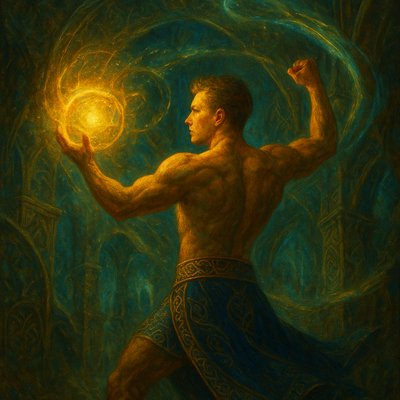
"Uriel, the Angel of Light and Wisdom from the Book of Enoch, a majestic celestial guide, standing amidst swirling cosmic dust and ethereal nebulae. His form radiates intense, pure light. He gestures towards a hidden cosmic mechanism, revealing ancient knowledge, holding a flaming orb of pure light. Robes of deep sapphire blue and radiant gold, adorned with ancient symbols. Serene, knowing face, eyes glimmering with cosmic insight. Behind him, celestial gears and the fiery essence of the sun. Hyperrealistic digital painting, divine luminosity, epic detailed, cinematic lighting, cosmic gradients."
A hyper-detailed, photorealistic depiction of the High Priest of Israel performing the Feast of Weeks (Pentecost) wave offering. The High Priest is dressed in the complete set of holy vestments: a blue robe with golden bells and pomegranates on the hem, a colorful ephod, and a breastplate with twelve jewels. A golden plate engraved 'HOLINESS TO THE LORD' is tied to his linen mitre. He stands in the Tabernacle courtyard, facing the altar, holding the two leavened loaves of firstfruits and two male lambs high, performing the sacred wave offering ritual. Golden morning light, historically accurate setting, cinematic oil painting style.