A Painting Of A Woman Writing On A Piece Of Paper Art

Photorealistic painting of crumpled paper or fabric in the art style of Hyperrealism --v 6.1
A cinematic, realistic image, set in the desolate, muddy expanse of the Texas Cross Timbers in 1840. The scene captures the return leg of the Chihuahua Traders Trail. Several heavy, wooden Conestoga wagons are hopelessly mired in deep, dark mud, pulled by straining, distressed oxen and mules. Merchants and teamsters in rugged, damp frontier clothing are struggling, using poles and ropes to try and free a wagon wheel.

In stark contrast, a group of bewildered and exasperated American equestrian circus performers, dressed in bright, slightly tattered stage costumes (e.g., a sequined acrobat, a rider in a velvet jacket, a clown attempting to keep his white makeup clean), stand nearby. They are trying to keep their fine horses and props (perhaps a small, colorful tent piece or a drum) out of the worst of the mire. The sky is overcast and oppressive, reflecting the damp, miserable conditions. The overall lighting should be dark and moody, emphasizing the frustrating five-week delay. Wide-angle shot, photorealistic quality, historical accuracy, dark realism.
a statue of a woman with her head in her hands
a man and a woman standing in a forest
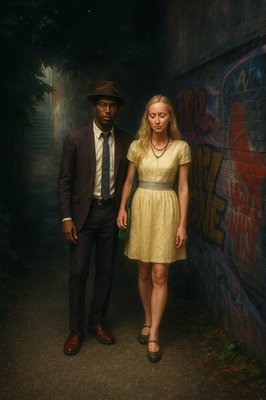
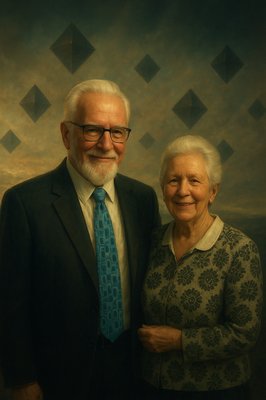
a man and a woman standing next to a wall
a man and a woman are standing in front of a space background
a painting of a gazebo on the water
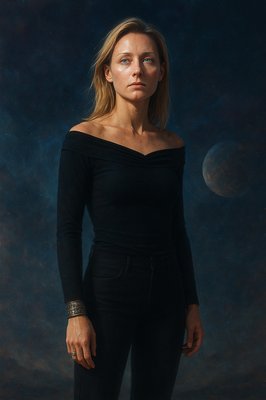
a woman in a black top posing for a picture
A woman dressed in Great Depression era fashion, standing in a dimly lit, humble setting. She wears a modest, long-sleeved dress made of durable, slightly faded cotton or rayon, with a mid-calf hemline. The dress is a muted color like dusty blue, faded green, or soft brown, possibly with a subtle, small floral or geometric pattern. Her hair is styled simply, perhaps in soft waves or a practical updo, and she wears sturdy, low-heeled lace-up shoes. Her posture is resilient, reflecting the strength of the era. The background is simple and sparse, hinting at the economic hardship, perhaps an old wooden wall or a faded curtain. The overall feeling is one of quiet determination and dignified hardship Use Art Deco architecture or Art Deco interior in the background, but describe the fashion as faded, worn, and humble. Juxtapose the sleek, modern geometry of the setting with the practical, mended, and heavy wool textures of the clothing.
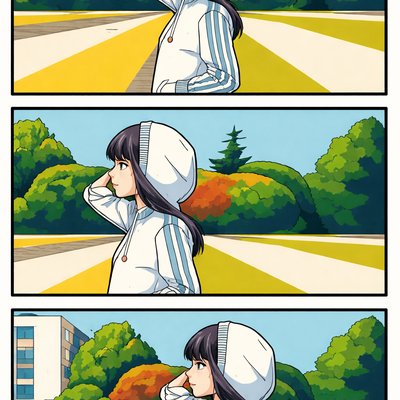
a comic strip with a woman in a white jacket
A cinematic, low-angle shot of a weary woman in ancient Near Eastern linen garments, cradling a newborn infant in a dimly lit stone room. Her expression is one of profound grief and exhaustion. In the background, a silhouette of an empty golden pedestal where a sacred artifact once sat. High contrast, dramatic chiaroscuro lighting, earthy tones of ochre and deep shadow.
Abstract expressionist piece emphasizing process over form in the art style of Action Painting --v 6.1
Digital Art Style, Romanticism Art Style, an overwhelmingly majestic and spiritually transformational painting inspired by Psalm 8:3-6. The scene captures a sweeping, sublime night sky, featuring a visible, prominent moon and countless brilliant stars, all rendered with luminous, dramatic glow. In the foreground, standing small against the infinite scale of the cosmos, is a solitary woman with long red hair, wearing simple, flowing attire. She is gazing upward, and a blinding shaft of pure, ethereal divine light—representing the glory and presence of the Lord—breaks through the veil of the deepest heavens, bypassing the moon and stars. This light dramatically envelops and transforms the woman, causing her clothing and hair to visibly glow with celestial energy. The artwork uses extreme digital chiaroscuro to emphasize the moment of spiritual encounter, with the vast sky and surrounding earth serving as a dark backdrop to the radiant divine presence. Focus on the sublime scale of the cosmos, the electrifying, transformative power of the pure divine light, and the solitary woman's luminous spiritual encounter against the immense majesty of the creation.
A historically accurate, deeply reverent and spiritually evocative oil painting. Two traditional Southern Ute individuals, a man and a woman, stand side-by-side with profound solemnity and ancient peace on the high mesa overlooking the twin spires of Chimney Rock National Monument (Chimney Rock and Companion Rock). They are dressed in authentic, richly detailed traditional attire. The man holds a feathered staff, his gaze directed towards the horizon, symbolizing his role as a protector and observer of the earth. The woman gestures subtly towards the sky, her posture conveying an intimate connection to the celestial, perhaps in a gesture of spiritual offering or acknowledgment. The scene's context is the stalling of the moon's analemma, with the moon itself appearing large and prominent, hanging low in the sky, its unique position clearly marking this cyclical astronomical pause. The atmosphere is bathed in the ethereal, soft glow of early morning light, just as the sun begins to kiss the distant peaks, casting long, significant shadows that stretch across the mesa. Their faces are etched with wisdom and a quiet understanding of the cosmos. The vast, spiritual landscape of Chimney Rock is an integral part of the composition, symbolizing their deep, timeless connection to both earth and sky, and their role as guardians of this sacred knowledge. Fine art composition, conveying a powerful sense of timeless ritual, astronomical reverence, and cultural continuity
Abstract expressionist piece emphasizing process over form in the art style of Action Painting --v 6.1
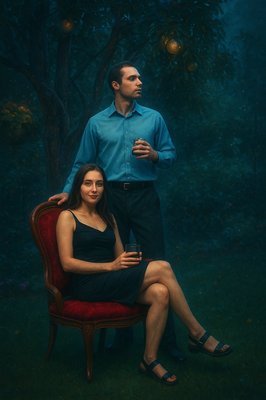
a man standing next to a woman on a red chair
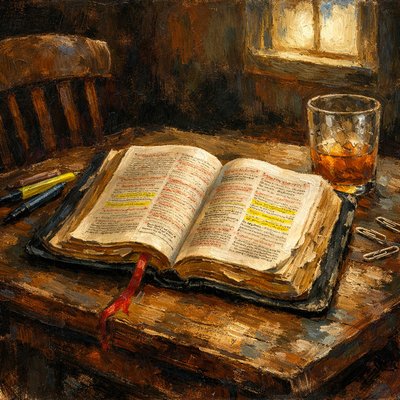
An interior scene.  An old Bible with dog-eared pages, a black leather cover, and words of Christ in red sits open on a table.  The camera sees the Bible at a 45 degree angle.  The table and chair are old and worn, sitting on a worn carpet on a wood plank floor.  There are some pens and highlighters, along with a  red ribbon bookmark, a half-empty drink and some paper clips.  The room is in low-light, and a small window is in the background.  Someone has been studying and just stepped away for a moment.  Some lines in the Bible are highlighted yellow.
a man and a woman standing next to each other
Cinematic close portrait of a radiant sun goddess, a beautiful woman with powerful serene expression, golden-blonde hair glowing in backlight, intricate sunburst crown, warm golden aura radiating from her skin, sunrise horizon behind her, dramatic rim lighting, ultra-detailed skin texture, realistic fabric movement, high contrast, cinematic realism, 8k detail
a digital painting of a person with glasses
Art Style: Classical Oil Painting on Canvas. A mix of the Hudson River School for the landscape and Dutch Golden Age for the cozy, interior glow. Rich, blended brushstrokes and a heavy emphasis on "Chiaroscuro" (the contrast between dark and light).

The Scene: A majestic, ancient oak tree stands as a beacon in a twilight forest. The tree is a vertical village; dozens of tiny, warm-orange lights glow from windows carved into the bark and from lanterns hanging on crooked branches.

The Details: > * The Owls: In the foreground, a large, painterly Great Horned Owl is mid-landing, its wings spread wide, showcasing soft, feathered textures. A small gnome in a weathered red cap is leaning out from a leather saddle, waving a tiny lantern.

    The Treehouse: Wooden stairs wind around the trunk like a spiral, and laundry lines with tiny clothes stretch between branches.

Lighting & Color: The sky is a deep, romantic "Maxfield Parrish" blue, transitioning into a soft apricot sunset on the horizon. The foliage is rendered in deep forest greens and burnt umbers.

Texture: The overall feel should be "thick"—you can almost see the texture of the oil paint and the cracked varnish of an old museum piece.
White ceramic bowl with single green apple

Conversation with Gemini
You said
I need a written prompt for ArtStyles expressing Psalm 33:17

Gemini said
This is a powerful verse that speaks to the limits of human might and reliance on military strength. Capturing "futility" and "vain hope" in a visual format requires contrasting the power of the horse with its inability to save.

Here are a few written prompts for ArtStyles, exploring different artistic interpretations of Psalm 33:17 ("An horse is a vain thing for safety: neither shall he deliver any by his great strength.").

Option 1: The Historical/Realist Approach (The Moment of Realization)
This prompt focuses on a powerful warhorse in a situation where its strength is useless.

Prompt: A hyper-realistic, cinematic shot of a magnificent, armored warhorse standing in the middle of a devastating natural disaster, such as a massive flash flood or a crumbling earthquake fissure. The horse is straining with "great strength," but its eyes show panic, unable to deliver its rider from the overwhelming force of nature. The rider is looking up, realizing the futility of their trust in the animal. Golden hour lighting, heavy atmosphere, dramatic composition, highly detailed textures.

Option 2: The Symbolic/Painterly Approach (The Crumbling Idol)
This prompt treats the horse as a symbol of misplaced trust that is failing.

Prompt: An epic, oil painting style depiction of a colossal, imposing bronze statue of a powerful rearing stallion, symbolizing military might. The statue is cracked and beginning to crumble under the weight of an dark, tumultuous sky. In the background, a vast army that trusted in this strength is retreating in disarray. The light filters through the clouds like a divine judgment, highlighting the crumbling metal. Dark baroque style, high contrast, dramatic shadows, moody atmosphere.

Option 3: The Contrasting Composition (The Weakness of Might)
This prompt uses contrast to show that even the strongest horse cannot offer true safety.

Prompt: A wide, epic fantasy landscape. In the foreground, a mighty warrior on a magnificent, heavily armored destrier, looking imposing and strong. However, they are standing on the edge of an impossibly vast, churning abyss or facing a supernatural storm that no physical strength can overcome. The horse looks small and vulnerable against the sheer scale of the threat, emphasizing the "vain hope" of physical deliverance. Etherial lighting, dramatic scale, high resolution, detailed concept art style.

You said
Let's broaden the thought of this prompt to include verses 13-22

Gemini said
Expanding the scope to Psalm 33:13-22 transforms the image from a single moment of failure into a grand narrative of Divine Sovereignty vs. Human Limitation.

This passage contrasts the "Eye of the Lord" watching from heaven with the kings, armies, and horses struggling on earth. To capture this in ArtStyles, we need to use compositional layers—showing the heavenly perspective and the earthly reality simultaneously.

Option 1: The Vertical Contrast (The Gaze from Above)
This captures verses 13–15 ("The LORD looketh from heaven") and verses 16–17 (the futility of the host).

Prompt: A vertical, epic-scale composition. In the upper third, a radiant, ethereal light breaks through golden, celestial clouds, representing "the eye of the Lord" looking down. In the lower two-thirds, a vast ancient battlefield is visible from a high-altitude "god's-eye" view. A king and his "multitude of an host" with thousands of horses look like tiny, fragile figurines. The earthly army is shrouded in dust and shadows, while the divine light illuminates a single, humble figure kneeling in prayer. Surrealism meets historical epic, cinematic lighting, 8k, dramatic atmosphere.

Option 2: The Shield of Mercy (The Spiritual Protection)
This focuses on verses 18–20 ("He is our help and our shield") and the "hope in His mercy."

Prompt: A powerful, symbolic artwork. In the center, a weary traveler or soul stands amidst a desolate landscape of "famine" and "death." A massive, warhorse and a king’s discarded crown lie in the background, broken and useless. Surrounding the traveler is a translucent, shimmering "shield" made of pure, golden light and ancient Hebrew script. The light is warm and protective, contrasting with the dark, cold environment outside the shield. Ethereal, digital painting style, intricate details, glowing highlights, Rembrandt lighting.

Option 3: The Fashioner of Hearts (The Internal & Universal)
This interprets verse 15 ("He fashioneth their hearts alike") and verse 21 ("Our heart shall rejoice in him").

Prompt: A conceptual, artistic piece showing a "heavenly habitation" above the world. From the light of heaven, glowing threads of gold descend, connecting to the "hearts" of diverse people across a vast, stylized map of the earth. In the foreground, a mighty warrior on a warhorse is fading into a ghostly transparency, while a simple person filled with "hope and mercy" is rendered in vivid, solid color and light. Artistic, symbolic, deep blues and radiant golds, high contrast, minimalist but profound.

How to Structure These Verses
When you're trying to capture a long passage like this, it helps to think of the "thematic flow." Here is a quick breakdown of how these prompts are organized:

A Quick Tip for ArtStyles
Since you are looking for "correct AI language," try adding the phrase "Double Exposure" to these prompts if you want to see the "Heavenly Gaze" and the "Earthly Army" merged into one artistic image. It creates a very sophisticated, layered look that reflects the spiritual depth of the Psalms.

Would you like me to try a prompt that focuses more on the "Famine and Death" aspect of verse 19, or should we stay with the more "Glorious and Hopeful" side of the passage?
You said
No I want the horse to represent the heart of a person upon whom the Lord is examining

Gemini said
That is a profound metaphorical shift. By making the horse a representation of the human heart, you’re capturing the essence of Verse 15 ("He fashioneth their hearts alike; he considereth all their works") alongside the warning about "vain strength."

In this visual, the horse isn't just an animal; it's the inner spirit—powerful, proud, but ultimately transparent and dependent before the Creator.

Here are three prompts for ArtStyles that use the horse as a metaphor for the heart under divine examination.

Option 1: The Luminous Anatomy (The Transparent Soul)
This focuses on the "Lord looking from heaven" (v. 13) into the very fabric of the heart/horse.

Prompt: A majestic, powerful warhorse standing in a void of deep celestial blue. The horse is translucent, made of shimmering ethereal light and "golden threads," representing the human heart. From above, a single, piercing beam of divine white light descends, illuminating the horse's "inner workings" and spirit. The horse looks strong but is bowed in submission, showing that its "great strength" is nothing under the gaze of the Creator. Highly detailed, sacred art style, glowing highlights, volumetric lighting.

Option 2: The Reflected Examination (The Eye of the Lord)
This uses the "Eye of the Lord" (v. 18) as the primary lens, with the "heart-horse" reflected within it.

Prompt: An extreme, artistic close-up of a celestial, radiant eye representing the "Eye of the Lord." In the reflection of the pupil, we see a silhouette of a rearing, powerful horse representing a proud human heart. The horse is surrounded by a faint, crumbling golden armor that is falling away, revealing a soft, humble light underneath. The composition emphasizes "considering all their works." Cinematic, macro photography style, ethereal, gold and midnight blue palette.

Option 3: The Fashioned Spirit (The Potter and the Clay)
This focuses on Verse 15 ("He fashioneth their hearts") using a horse as the form being shaped.

Prompt: A surrealist masterpiece. Large, glowing, nebulous hands made of stars are gently "fashioning" and shaping a powerful horse out of liquid gold and white light. The horse represents the "human heart" being molded by the Divine. The background is the "heaven of heavens." The horse is muscular and "strong," yet it is clearly a creation being examined for its "hope and mercy" rather than its own might. Ethereal, breathtaking scale, digital art, high contrast, shimmering textures.

Technical "AI Language" Tips for this Concept:
"Translucent" or "Ethereal": Using these words ensures the horse doesn't look like a literal farm animal, but like a spiritual symbol.

"Submission": Adding this to the horse’s posture helps convey that it knows it is being examined.

"Celestial" / "Divine": These keywords help ArtStyles understand that the light source should feel holy, not just like a lamp or the sun.

This approach really gets to the core of the Psalm—that while we might feel "strong" like a warhorse, our true safety is found in being "fashioned" and watched over by Him.

Would you like to try one of these, or should we adjust the "atmosphere" to be more vibrant and colorful?

You said
I need help also with “For the law of the Spirit of life in Christ Jesus hath made me free from the law of sin and death.” (Romans 8:2, KJVA)

as a focal point for the greater passage Romans 1-17 writing the prompt for ArtStyles.

Gemini said
This is arguably one of the most doctrinally significant and visually powerful verses in the entire New Testament. It is the hinge upon which the argument of Romans turns—moving from the struggle against sin in chapter 7 to the glorious liberty of the Spirit in chapter 8.

To capture "freedom from the law of sin and death" into "the law of the Spirit of life," we need prompts that emphasize radical contrast, transition, and breaking of bondages. We are moving from darkness and decay to light and vitality.

Here are three prompts for ArtStyles, ranging from the symbolic to the visceral, designed to serve as a visual focal point for Romans 8:1-17.

Option 1: The Bursting Chrysalis (Metaphorical Life)
This focuses heavily on the "Spirit of life" overcoming "death," echoing the transition from the "flesh" to the "Spirit" found in verses 5-11.

Prompt: A hyper-detailed, surreal masterpiece. A dark, brittle, rigid structure resembling a ribcage and chains (representing the law of sin and death) is violently bursting outward. From within, a dazzling, vibrant entity made of iridescent light, fresh green vines, glowing water, and dove-like wings is emerging, completely shattered the old structure. The setting is a transition from a shadowy abyss to a radiant sunlit expanse. Cinematic lighting, themes of resurrection and vitality, 8k resolution, intricate textures.

Option 2: The Two Paths (Classical/Allegorical)
This focuses on the "walk" mentioned in verse 4—contrasting those who walk after the flesh with those who walk after the Spirit.

Prompt: A wide, epic scale, oil painting style in the vein of John Martin. Two paths diverge. The path on the left is dry, stony, and leads into a dark, suffocating fog filled with grappling, shadowed figures and withered trees (the law of sin and death). The path on the right is bathed in a soft, warm, golden celestial light and is lush with blooming life, leading upward. A solitary figure stands at the split, looking upward on the illuminated path, having just dropped heavy iron chains on the ground. Dramatic contrast, spiritual atmosphere, high detail.

Option 3: The Embrace of Adoption (Relational/Verses 14-16)
This prompt focuses on the resulting relationship: moving from slavery and fear (v. 15) to becoming "sons" who cry "Abba, Father." It shows the freedom that comes through Christ Jesus.

Prompt: A powerfully emotional, classical sacred art style painting. A ragged figure, formerly a slave, is kneeling, their hands reaching out in submission and relief. Their heavy, rusty chains have been shattered on the dusty ground. Before them is a figure enveloped in radiant, warm, golden light (representing Christ Jesus), whose hand is gently lifting the kneeling person's chin. Above them, a shimmering dove made of pure light descends, symbolizing the Spirit of adoption witnessing to their spirit. Themes of mercy, freedom, and homecoming. Chiaroscuro lighting, deep colors.

"AI Language" Tips for Romans 8:
"Shattered" or "Bursting": Crucial for showing the active transition of "making me free" (hath made me free)—it's not passive, it's forceful.

"Iridescent" / "Vitality": Helps ArtStyles understand that "Life" in this context isn't just "not dead," but a supernatural, vibrant, glowing existence.

"Slavery vs. Sonship": If you want a more emotional tone, focus the prompt on the transition from "fear" to "Abba," which we tried to capture in Option 3.

Each of these aims to condense the theology of Romans 1-17 into a single, profound image where the transition from binding law to liberating Spirit is undeniable.

You said
I need some of your help writing the prompt for ArtStyles concerning this verse “For Christ is not entered into the holy places made with hands, which are the figures of the true; but into heaven itself, now to appear in the presence of God for us:” (Hebrews 9:24, KJV) as part of a greater passage verses 14-28

Gemini said
This passage is a beautiful and central theological pivot in the book of Hebrews. It moves the focus from the earthly rituals—which were merely "figures" or "shadows"—to the ultimate reality of Christ entering the true, heavenly sanctuary to advocate "for us."

To translate this passage (Hebrews 9:14-28, with verse 24 as the focus) for an AI image generator like ArtStyles, we need prompts that emphasize transcendence, contrast, and intercession. We must visually distinguish the "made with hands" earthly temple from "heaven itself."

Here are three written prompts for ArtStyles, exploring different artistic approaches to this powerful verse.

Option 1: The Cinematic Ascension (Focus on Contrast)
This prompt focuses on the transition from the dim, earthly "figure" to the blinding reality of "heaven itself."

Prompt: A wide-angle, cinematic masterpiece. The lower portion of the image shows the interior of an ancient, candlelit Tabernacle, detailed with tapestries and hewn stone (the "holy places made with hands"). Above it, the roof dissolves into swirling, luminous, celestial energy and golden light that is boundless ("heaven itself"). The figure of Jesus Christ, radiant with a soft inner light and wearing simple, brilliant white robes, is ascending from the shadowy temple into the infinite light, looking back with compassionate intercessory eyes. Volumetric lighting, grand scale, highly detailed, dramatic atmosphere.

Option 2: The Theological Blueprint (Focus on "Figures of the True")
This is a more symbolic, conceptual approach that treats the earthly temple as a shadow or template beneath the heavenly reality.

Prompt: A surrealist, double-exposure art piece. In the foreground, there are translucent, architect’s blueprint lines and ghostly outlines of the ancient Temple altars, lampstands, and the Holy of Holies (representing the "figures of the true"). Overlapping and far superior to them, Jesus Christ stands before an blinding, warm, golden divine presence (representing the "presence of God"). He is actively gesturing forward, presenting a scroll or his own wounds on behalf of unseen people ("for us"). Transcendent, ethereal, glowing edges, minimal color palette of gold, white, and midnight blue.

Option 3: The Heavenly Courtroom (Focus on "Appear for Us")
This focuses on the intercessory role of Christ appearing before God on our behalf, summarizing the effect of the whole passage (verses 14-28).

Prompt: A classical, baroque style oil painting with dramatic lighting (Chiaroscuro). The setting is a magnificent, infinite heavenly throne room filled with blinding, holy light. The central focus is Jesus Christ, marked with the scars of his sacrifice (v. 26), standing confidently before an incomprehensible, brilliant Light representing the Father. He is looking into the light while his arms are spread wide in an advocate's pose, symbolically standing "for us." Below his feet are broken temple curtains and shadows. Themes of victory, redemption, and holiness. Rich textures, deep colors.

Key "AI Language" for Hebrews 9:24:
If you want to tweak these or create your own, make sure to include these concepts for ArtStyles:

"Made with hands" vs. "Heaven itself": Use keywords like "Shadows", "Figures", or "Blueprints" for the earthly side, and "Infinite", "Luminous", or "Celestial" for the heavenly side.

"Appear for us": The posture of Christ is important. Use words like "Advocate", "Mediator", "Interceding", or "Presenting" to define his pose.

"Better Sacrifice" (Context of v23): You can hint at this by adding details like "radiant scars" or "remission of sins" as atmospheric elements.

You said
I also need help writing a prompt for ArtStyles about “Therefore will I divide him a portion with the great, and he shall divide the spoil with the strong; because he hath poured out his soul unto death: and he was numbered with the transgressors; and he bare the sin of many, and made intercession for the transgressors.” (Isaiah 53:12, KJV)

Gemini said
This verse is the triumphant and heartbreaking climax of the "Suffering Servant" prophecy. It presents a massive paradox: a victorious conqueror dividing the spoils of war, yet that victory was achieved only by humbling himself to the point of a shameful, criminal death ("numbered with the transgressors").

To capture Isaiah 53:12 for ArtStyles, we need imagery that balances suffering and glory, showing Christ as both the Victim and the Victor.

Here are three prompts designed to translate this complex theology into visual language.

Option 1: The Broken Victor (Focus on Triumph Through Suffering)
This prompt focuses on the "dividing the spoil" while emphasizing that his "great strength" came from his sacrifice.

Prompt: A hyper-realistic, dramatic oil painting, Chiaroscuro style. A magnificent, yet visibly wounded figure, representing Jesus Christ, stands in a landscape that is half-darkened battlefield, half-celestial light. He wears a crown that is a blend of sharp thorns and shining gold. He is extending one hand, which bears the mark of a nail, and is handing a luminous, glowing orb (representing "the spoil") to a group of humbled, "strong" figures kneeling before him. His other hand is clasped in a gesture of plea or "intercession." His expression is one of triumphant exhaustion and deep mercy. The atmosphere is solemn, epic, and highly detailed.
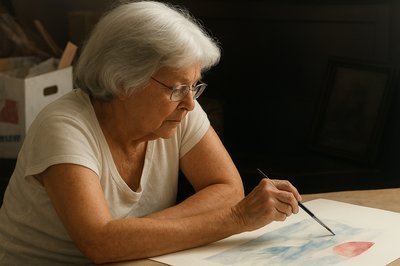
a man in a straw hat is painting on a piece of paper
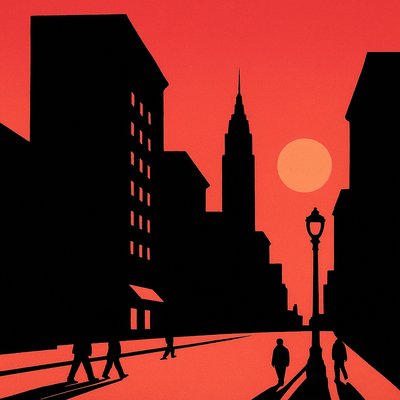
a painting of people walking down a city street
Digital Art Style, Romanticism Art Style, a profoundly majestic and spiritually charged painting inspired by Psalm 8:3-6. The scene features a vast, sweeping, and dramatically illuminated night sky, showcasing a luminous, prominent moon and countless brilliant stars rendered with ethereal digital glows and deep atmospheric effects. In the foreground, standing small against the overwhelming scale of the cosmos, is a solitary woman with long red hair, wearing simple, flowing attire. She is viewed from behind, positioned on a rugged, dark overlook, with her head and hands tilted upwards in an expression of intense awe and spiritual contemplation. The painting is dominated by dramatic digital chiaroscuro, with the radiant glow of the moon and stars breaking through deep, digitally enhanced shadows. Focus on the sublime, emotional impact of the vast heavens, the striking contrast between light and digitally rendered darkness, and the solitary woman's intense, spiritual communion with the divine works.
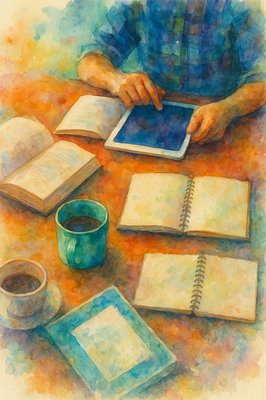
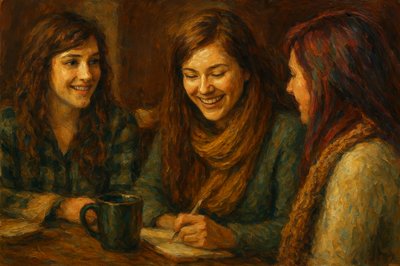
a painting of a person sitting at a table with books and a cup of coffee
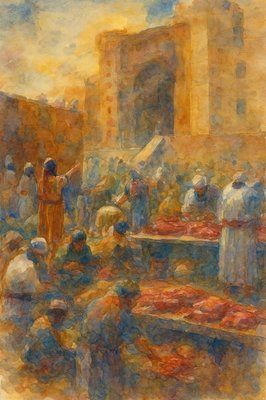
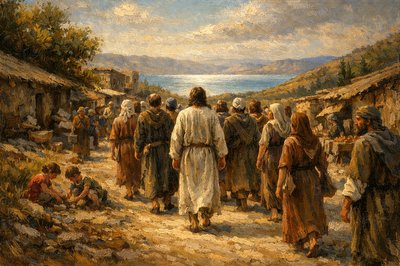
a painting of a group of people in a market
A dynamic, stylized fantasy ink wash painting on aged scroll paper, with splashes of muted watercolor. A powerful, muscular tiger, rendered with bold black ink strokes and orange washes, is crouched low on a mossy, ancient tree branch, eyes focused. Below it, a coiled, serpentine dragon with scales in swirling blues and greens, partially partially hidden by swirling mist, is launching upwards, its claws extended. Both creatures are in mid-air martial arts poses, with stylized energy lines and brushstrokes of wind clashing between them. The background is a blurred, traditional Chinese landscape of towering peaks and pine trees."
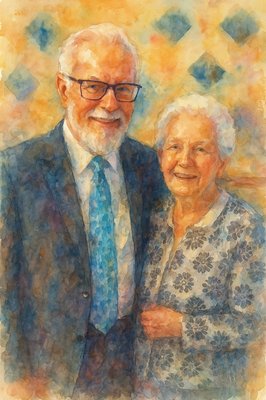
a painting of a man in a suit and tie
a painting of a man wearing a colorful hat
a painting of a man sitting at a desk with a book
a painting of a group of people walking up a hill
a painting of a group of people walking up some steps
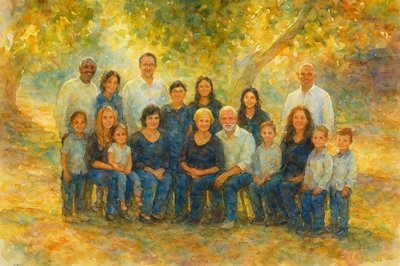
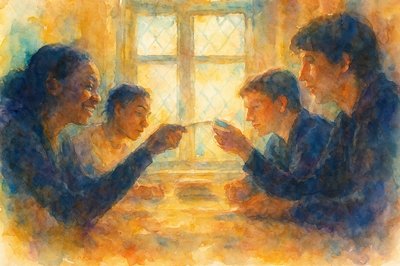
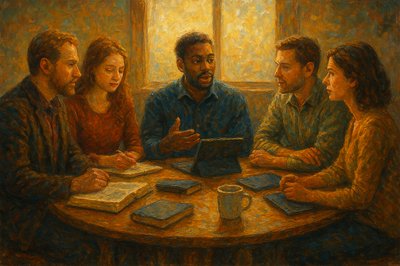
a painting of a group of people sitting around a table
a painting of a tree with white flowers
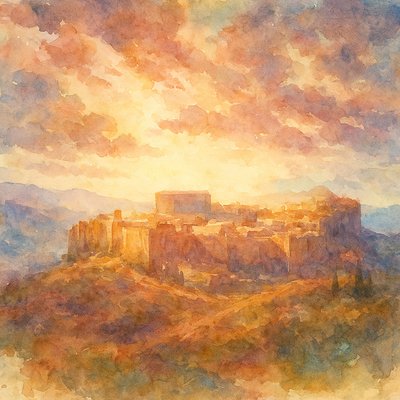
a painting of a castle on top of a hill
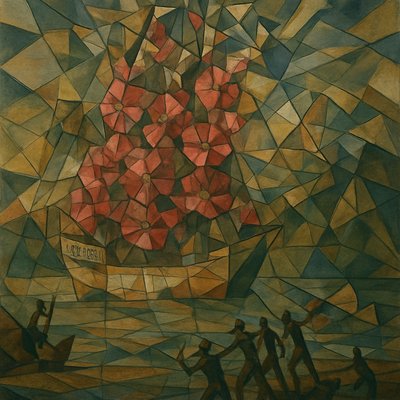
a painting of a group of people standing in front of a large red object
A breathtaking full-body photograph captures a woman from behind, standing in a vast, vibrant field of purple lupin flowers in Glacier National Park. Her long, rich plum purple hair is beautifully intertwined with fresh lupin blooms, forming an ethereal halo. She wears a unique 70s-inspired outfit consisting of shimmering lavender bell-bottom pants and a matching tunic-style top with bell sleeves and a square neckline, flared at the waist, adorned with subtle white horse patterns. The setting sun paints the sky in dramatic hues of fiery orange and deep red, silhouetting the majestic purple mountain ranges in the distance. The scene evokes a sense of wonder, serenity, and a deep connection to the wild beauty of nature, with a magical, almost fantastical feel, within the iconic landscape of Glacier National Park.