A Painting Of A Gold Colored Motorcycle Art

Visionary Art Style, Bioluminescence Art Style, an awe-inspiring, luminous depiction of ancient Jewish cosmology for Psalm 8:3, presented with profound depth and ethereal glow. The central feature is a vast, shimmering, domed firmament (raqia), appearing as a translucent, opalescent boundary stretching across the scene, separating realms. Above this firmament, immense, glowing celestial waters swirl with bioluminescent currents of deep blues, purples, and greens, illuminated by an unseen, brilliant divine light emanating from the highest heavens. Large, radiant stars and a luminous crescent moon are not distant objects, but rather appear as integral, internally glowing bioluminescent entities set within the shimmering surface of the firmament, their light subtly pulsing. Below, hints of foundational earth and the "waters below" are visible, also touched by soft, ethereal glows. The entire scene is alive with vibrant, jewel-toned celestial colors and a sense of boundless, mystical energy. Focus on the layered, translucent quality of the firmament, the dynamic, living glow of the bioluminescent waters and embedded celestial bodies, and an overwhelming sense of ancient, sacred wonder and divine power.
An awe-inspiring and whimsical scene featuring Willy Wonka's Great Glass Wonkavator, soaring through the sky and beyond the confines of Ontario Canada and its flag. The Wonkavator itself is a magnificent, multi-directional glass elevator, transparent and sparkling, with Willy Wonka (wearing his iconic top hat, purple coat, and bowtie) and 2 Canadian ladies looking out with expressions of joy, wonder and excitement. The interior is filled with intricate buttons and levers for controlling its magical flight. The Wonkavator is depicted in mid-flight, ascending above the clouds flying out to the ocean. Below it, the fantastical landscape of Ontario Canada is visible with a large Canadian flay flying over the city. – and various whimsical buildings. Beyond Ontario, a stunning, imaginative sky unfolds, perhaps with floating candy clouds, distant fantastical landmarks, or even glimpses of outer space and planets. The lighting is bright and magical, emphasizing the glass's transparency and the vibrant colors of the world below and beyond. The overall mood is one of boundless adventure, limitless possibilities, and pure, joyful fantasy."
An awe-inspiring and whimsical scene featuring Willy Wonka's Great Glass Wonkavator, soaring through the sky and beyond the confines of Ontario Canada and its flag. The Wonkavator itself is a magnificent, multi-directional glass elevator, transparent and sparkling, with Willy Wonka (wearing his iconic top hat, purple coat, and bowtie) and 2 Canadian ladies looking out with expressions of joy, wonder and excitement. The interior is filled with intricate buttons and levers for controlling its magical flight. The Wonkavator is depicted in mid-flight, ascending above the clouds flying out to the ocean. Below it, the fantastical landscape of Ontario Canada is visible with a large Canadian flay flying over the city. –  and various whimsical buildings. Beyond Ontario, a stunning, imaginative sky unfolds, perhaps with floating candy clouds, distant fantastical landmarks, or even glimpses of outer space and planets. The lighting is bright and magical, emphasizing the glass's transparency and the vibrant colors of the world below and beyond. The overall mood is one of boundless adventure, limitless possibilities, and pure, joyful fantasy."
An awe-inspiring and whimsical scene featuring Willy Wonka's Great Glass Wonkavator, soaring through the sky and beyond the confines of Ontario Canada and its flag. The Wonkavator itself is a magnificent, multi-directional glass elevator, transparent and sparkling, with Willy Wonka (wearing his iconic top hat, purple coat, and bowtie) and 2 Canadian ladies looking out with expressions of joy, wonder and excitement. The interior is filled with intricate buttons and levers for controlling its magical flight. The Wonkavator is depicted in mid-flight, perhaps bursting through the factory roof or ascending above the clouds. Below it, the fantastical landscape of the Chocolate Factory is visible – chocolate rivers, edible gardens, candy cane trees, and various whimsical buildings. Beyond the factory, a stunning, imaginative sky unfolds, perhaps with floating candy clouds, distant fantastical landmarks, or even glimpses of outer space and planets. The lighting is bright and magical, emphasizing the glass's transparency and the vibrant colors of the world below and beyond. The overall mood is one of boundless adventure, limitless possibilities, and pure, joyful fantasy."
An awe-inspiring and whimsical scene featuring Willy Wonka's Great Glass Wonkavator, soaring through the sky and beyond the confines of the chocolate factory. The Wonkavator itself is a magnificent, multi-directional glass elevator, transparent and sparkling, with Willy Wonka (wearing his iconic top hat, purple coat, and bowtie) and a Victorian well dressed lady looking out with expressions of wonder and excitement. The interior is filled with intricate buttons and levers for controlling its magical flight. The Wonkavator is depicted in mid-flight, perhaps bursting through the factory roof or ascending above the clouds. Below it, the fantastical landscape of the Chocolate Factory is visible – chocolate rivers, edible gardens, candy cane trees, and various whimsical buildings. Beyond the factory, a stunning, imaginative sky unfolds, perhaps with floating candy clouds, distant fantastical landmarks, or even glimpses of outer space and planets. The lighting is bright and magical, emphasizing the glass's transparency and the vibrant colors of the world below and beyond. The overall mood is one of boundless adventure, limitless possibilities, and pure, joyful fantasy."
An awe-inspiring and whimsical scene featuring Willy Wonka's Great Glass Wonkavator, soaring through the sky and beyond the confines of the chocolate factory. The Wonkavator itself is a magnificent, multi-directional glass elevator, transparent and sparkling, with Willy Wonka (wearing his iconic top hat, purple coat, and bowtie) and a young happy Victorian well dressed lady looking out with expressions of wonder and excitement. The interior is filled with intricate buttons and levers for controlling its magical flight. The Wonkavator is depicted in mid-flight, perhaps bursting through the factory roof or ascending above the clouds. Below it, the fantastical landscape of the Chocolate Factory is visible – chocolate rivers, edible gardens, candy cane trees, and various whimsical buildings. Beyond the factory, a stunning, imaginative sky unfolds, perhaps with floating candy clouds, distant fantastical landmarks, or even glimpses of outer space and planets. The lighting is bright and magical, emphasizing the glass's transparency and the vibrant colors of the world below and beyond. The overall mood is one of boundless adventure, limitless possibilities, and pure, joyful fantasy."
Steampunk Historical Fantasy, Satirical Illustration Style, Cinematic Lighting. A bizarre, anachronistic scene inside a drafty medieval castle great hall (Camelot). A group of noblewomen, dressed in elaborate 6th-century velvet gowns, wimples, and tall pointed hennin hats with veils, are seated on rough wooden stools. They are furiously working a massive, makeshift telephone switchboard operator station.

The Technology: The switchboard is constructed from rough-hewn oak timbers, gleaming brass gears, porcelain insulators, and hundreds of thick, chaotic copper wires that are strung haphazardly across ancient tapestries and stone walls, disappearing out narrow arrow-slit windows.

The Action: The ladies hold bulky, antique Victorian-era earpieces and large brass mouthpieces, plugging heavy cables with oversized jacks into the board with expressions of intense concentration and mild confusion. Knights in armor walk past in the background, looking bewildered. Sunlight streams through gothic windows, illuminating the dust and the clash of eras.
Steampunk Historical Fantasy, Satirical Illustration Style, Cinematic Lighting. A bizarre, anachronistic scene inside a drafty medieval castle great hall (Camelot). A group of noblewomen, dressed in elaborate 6th-century velvet gowns, wimples, and tall pointed hennin hats with veils, are seated on rough wooden stools. They are furiously working a massive, makeshift telephone switchboard operator station.

The Technology: The switchboard is constructed from rough-hewn oak timbers, gleaming brass gears, porcelain insulators, and hundreds of thick, chaotic copper wires that are strung haphazardly across ancient tapestries and stone walls, disappearing out narrow arrow-slit windows.

The Action: The ladies hold bulky, antique Victorian-era earpieces and large brass mouthpieces, plugging heavy cables with oversized jacks into the board with expressions of intense concentration and mild confusion. Knights in armor walk past in the background, looking bewildered. Sunlight streams through gothic windows, illuminating the dust and the clash of eras.
"A solitary and ominous Black Plague Doctor stands in a dimly lit, narrow cobblestone alleyway in a medieval European city. The doctor is clad head-to-toe in their iconic, dark, heavy protective gear: a long, oil-soaked waxed canvas or leather coat, dark gloves, and a wide-brimmed black hat. Their most striking feature, the beaked mask with dark, glass eyeholes, is prominent, creating an eerie, bird-like silhouette that conceals their face entirely. A wooden cane or pointer is held firmly in one gloved hand.

The atmosphere is heavy and foreboding. The background features dark, crumbling stone or timber-framed buildings with shuttered windows, hinting at a city under quarantine. Smoke or mist might subtly swirl around their feet. The lighting is stark and dramatic, perhaps from a distant lantern or a sliver of pale moonlight, casting deep shadows and highlighting the grim details of their attire. The overall mood is one of profound isolation, historical dread, and silent vigilance against an invisible enemy."
Large canvas with expansive areas of single colors in the art style of Color Field Painting --v 6.1
A highly detailed steampunk fantasy reimagining of Émile Renouf's "The Helping Hand" (1881), where an elderly fisherman with a weathered face, bushy mustache, brass-rimmed goggles perched on his forehead, a leather apron adorned with gears and pouches of tools, and a tricorn hat fitted with a small steam whistle, reaches out to assist a wide-eyed young girl in a frilly Victorian dress modified with corseted bodice, puffed sleeves of oil-stained fabric, and tiny mechanical bird brooch. They stand together in a compact, riveted iron rowboat propelled by a hissing steam engine at the stern, with exposed copper pipes, whirring pistons, and a propeller churning the ethereal, mist-shrouded waves of a fantastical ocean dotted with floating clockwork islands and distant airships billowing smoke. The pair collaboratively hauls a massive, enchanted fishing net woven with glowing aether filaments and brass weights, teeming with bioluminescent mechanical fish hybrids—scales of etched metal and fins like unfolding fans—symbolizing intergenerational ingenuity and wonder. Render in intricate digital art style blending Victorian engraving precision with fantastical whimsy, warm sepia tones accented by burnished golds, verdigris greens, and sparks of arcane blue energy, dramatic chiaroscuro lighting from a setting sun filtered through industrial haze, ultra-detailed textures on leather, rust, and fabric, cinematic composition with dynamic tension in their clasped hands
Large canvas with expansive areas of single colors in the art style of Color Field Painting --v 6.1
Steampunk Historical Fantasy, Satirical Illustration Style, Cinematic Lighting. A bizarre, anachronistic scene inside a drafty medieval castle great hall (Camelot). A group of noblewomen, dressed in elaborate 6th-century velvet gowns, wimples, and tall pointed hennin hats with veils, are seated on rough wooden stools. They are furiously working a massive, makeshift telephone switchboard operator station.

The Technology: The switchboard is constructed from rough-hewn oak timbers, gleaming brass gears, porcelain insulators, and hundreds of thick, chaotic copper wires that are strung haphazardly across ancient tapestries and stone walls, disappearing out narrow arrow-slit windows.

The Action: The ladies hold bulky, antique Victorian-era earpieces and large brass mouthpieces, plugging heavy cables with oversized jacks into the board with expressions of intense concentration and mild confusion. Knights in armor walk past in the background, looking bewildered. Sunlight streams through gothic windows, illuminating the dust and the clash of eras.
Steampunk Historical Fantasy, Satirical Illustration Style, Cinematic Lighting. A bizarre, anachronistic scene inside a drafty medieval castle great hall (Camelot). A group of noblewomen, dressed in elaborate 6th-century velvet gowns, wimples, and tall pointed hennin hats with veils, are seated on rough wooden stools. They are furiously working a massive, makeshift telephone switchboard operator station.

The Technology: The switchboard is constructed from rough-hewn oak timbers, gleaming brass gears, porcelain insulators, and hundreds of thick, chaotic copper wires that are strung haphazardly across ancient tapestries and stone walls, disappearing out narrow arrow-slit windows.

The Action: The ladies hold bulky, antique Victorian-era earpieces and large brass mouthpieces, plugging heavy cables with oversized jacks into the board with expressions of intense concentration and mild confusion. Knights in armor walk past in the background, looking bewildered. Sunlight streams through gothic windows, illuminating the dust and the clash of eras.
"A solitary and ominous Black Plague Doctor stands in a dimly lit, narrow cobblestone alleyway in a medieval European city. The doctor is clad head-to-toe in their iconic, dark, heavy protective gear: a long, oil-soaked waxed canvas or leather coat, dark gloves, and a wide-brimmed black hat. Their most striking feature, the beaked mask with dark, glass eyeholes, is prominent, creating an eerie, bird-like silhouette that conceals their face entirely. A wooden cane or pointer is held firmly in one gloved hand.

The atmosphere is heavy and foreboding. The background features dark, crumbling stone or timber-framed buildings with shuttered windows, hinting at a city under quarantine. Smoke or mist might subtly swirl around their feet. The lighting is stark and dramatic, perhaps from a distant lantern or a sliver of pale moonlight, casting deep shadows and highlighting the grim details of their attire. The overall mood is one of profound isolation, historical dread, and silent vigilance against an invisible enemy."
Photorealism Art Style, a magnificent, life-sized, vintage steam train (reminiscent of the "Time Train" from Back to the Future Part III, complete with futuristic modifications and gleaming brass accents) is captured in a dynamic moment, aggressively bursting forth from a shimmering, swirling spacetime continuum portal or wormhole. The portal glows with ethereal blues, purples, and electric greens, distorting the air around it. The train's front half has already emerged, with steam and sparks flying, as it dramatically enters through the mouth of a dark, natural rock tunnel nestled deep within the lush, rugged Appalachian Mountains. The surrounding mountain landscape is ablaze with vibrant fall foliage in stunning hues of deep red, fiery orange, and brilliant gold, mixed with green evergreens, under a slightly overcast, dramatic sky. Focus on the hyper-realistic details of the steam train, the dynamic, energetic effects of the spacetime portal, and the authentic textures of the Appalachian rock and the rich autumn leaves, all illuminated by the contrasting light of the portal and the natural environment.

A breathtaking full-body photograph captures a woman from behind, standing in a vast, vibrant field of purple lupin flowers in Glacier National Park. Her long, rich plum purple hair is beautifully intertwined with fresh lupin blooms, forming an ethereal halo. She wears a unique 70s-inspired outfit consisting of shimmering lavender bell-bottom pants and a matching tunic-style top with bell sleeves and a square neckline, flared at the waist, adorned with subtle white horse patterns. The setting sun paints the sky in dramatic hues of fiery orange and deep red, silhouetting the majestic purple mountain ranges in the distance. The scene evokes a sense of wonder, serenity, and a deep connection to the wild beauty of nature, with a magical, almost fantastical feel, within the iconic landscape of Glacier National Park.

An awe-inspiring and whimsical scene featuring Willy Wonka's Great Glass Wonkavator, soaring through the sky and beyond the confines of the chocolate factory. The Wonkavator itself is a magnificent, multi-directional glass elevator, transparent and sparkling, with a middle aged Willy Wonka (wearing his iconic top hat, purple coat, and bowtie) and a young Victorian well dressed lady looking out with expressions of joy, wonder and excitement. The interior is filled with intricate buttons and levers for controlling its magical flight. The Wonkavator is depicted in mid-flight, perhaps bursting through the factory roof or ascending above the clouds. Below it, the fantastical landscape of the Chocolate Factory is visible – chocolate rivers, edible gardens, candy cane trees, and various whimsical buildings. Beyond the factory, a stunning, imaginative sky unfolds, perhaps with floating candy clouds, distant fantastical landmarks, or even glimpses of outer space and planets. The lighting is bright and magical, emphasizing the glass's transparency and the vibrant colors of the world below and beyond. The overall mood is one of boundless adventure, limitless possibilities, and pure, joyful fantasy."
An awe-inspiring and whimsical scene featuring Willy Wonka's Great Glass Wonkavator, soaring high above the chocolate factory and ascending into a fantastical sky. The Wonkavator itself is a magnificent, multi-directional glass elevator, transparent and sparkling, with Willy Wonka (in his iconic purple coat and top hat), young Charlie Bucket, and Grandpa Joe clearly visible and enjoying the ride inside. Wonka points excitedly, Charlie looks out with wide-eyed wonder, and Grandpa Joe grins with delight. The interior of the Wonkavator shows intricate, whimsical control panels.

The Wonkavator is depicted in mid-flight, having just burst through the factory roof or rising above the clouds. Below it, the fantastical landscape of the Chocolate Factory is spread out – chocolate rivers, edible gardens, candy cane trees, and various whimsical buildings. Beyond the factory, a stunning, imaginative sky unfolds, filled with floating candy clouds, distant fantastical landmarks, and even glimpses of planets and stars. The lighting is bright and magical, emphasizing the glass's transparency and the vibrant colors of the world below and beyond. The overall mood is one of boundless adventure, limitless possibilities, and pure, joyful fantasy."
Digital Art Style, Romanticism Art Style, a profoundly joyful and beautifully vibrant painting inspired by Psalm 16:11, "You make known to me the path of life; you will fill me with joy in your presence, with eternal pleasures at your right hand." The scene features a pair of exquisitely detailed Peach-faced Lovebirds, with their iconic bright peach faces, vivid green bodies, and touches of blue on their rumps. They are perched affectionately close together on a blossoming branch, their expressions conveying deep contentment and joy. Behind them, a softly glowing, ethereal 'path' of light winds gently through a lush, vibrant, and abundant natural landscape, illuminated by a warm, radiant, divine light that bathes the entire scene. The environment is rich with blooming flowers and verdant foliage, suggesting a place of eternal pleasure and divine presence. Focus intently on the vibrant, luminous colors of the Lovebirds, their tender, joyful interaction, and the glowing, symbolic 'path of life' that permeates the harmonious and blissful atmosphere
Digital Art Style, Romanticism Art Style, a tender and intimate painting depicting a monogamous pair of Red-lored Amazon parrots in their natural habitat. The scene focuses on the vibrant pair, with their striking bright green plumage, distinctive red forehead and lores (area between eye and beak), and splashes of yellow on their cheeks and crown, rendered with exquisite detail and luminous digital color. One parrot is gracefully perched near the entrance of a natural tree cavity, which serves as their nest, while its mate is close by, perhaps peeking from within the cavity or perched affectionately beside it. Their interaction conveys a deep sense of affection, mutual care, and secure bonding. The surrounding environment is a lush, vibrant tropical forest, with sunlight dappling through dense foliage, creating a warm, inviting atmosphere. Focus on the fine feather details and expressive eyes of the parrots, the tender intimacy of their pair bond, and the secure, natural beauty of their tree cavity nest within the verdant jungle.
A highly detailed steampunk fantasy reimagining of Émile Renouf's "The Helping Hand" (1881), where an elderly fisherman with a weathered face, bushy mustache, brass-rimmed goggles perched on his forehead, a leather apron adorned with gears and pouches of tools, and a tricorn hat fitted with a small steam whistle,  assists a wide-eyed young girl in a frilly Victorian dress modified with corseted bodice, puffed sleeves of oil-stained fabric, and tiny mechanical bird brooch row an old sailboat with the mast down. They sit together in a compact, riveted iron sailboat propelled by a hissing steam engine at the stern, with exposed copper pipes, whirring pistons, and a propeller churning the ethereal, mist-shrouded waves of a fantastical ocean dotted with floating clockwork islands and distant airships billowing smoke. The pair collaboratively hauls a massive, enchanted fishing net woven with glowing aether filaments and brass weights, teeming with bioluminescent mechanical fish hybrids—scales of etched metal and fins like unfolding fans—symbolizing intergenerational ingenuity and wonder. Render in intricate digital art style blending Victorian engraving precision with fantastical whimsy, warm sepia tones accented by burnished golds, verdigris greens, and sparks of arcane blue energy, dramatic chiaroscuro lighting from a setting sun filtered through industrial haze, ultra-detailed textures on leather, rust, and fabric, cinematic composition with dynamic tension in their clasped hands
in the style of John Atkinson Grimshaw,
bird’s‑eye view, camera looking downward from a moderate height over hot air balloons rising steadily and moving with the wind through clear blue skies,
subtle curvature of the landscape visible below,
rich jewel‑tone reds, teals, and golds catching warm natural sunlight, realistic wind‑driven motion, natural directional flow, a hillside overlook below with small groups of people watching the balloons, holding umbrellas for shade, wearing Victorian‑style clothing,
long tailored coats, layered skirts, high collars,
grounded composition, realistic atmospheric depth, cinematic painterly
An awe-inspiring and whimsical scene featuring Willy Wonka's Great Glass Wonkavator, soaring through the sky and beyond the confines of the chocolate factory. The Wonkavator itself is a magnificent, multi-directional glass elevator, transparent and sparkling, with Willy Wonka (wearing his iconic top hat, purple coat, and bowtie) and 2 young Victorian well dressed ladies looking out with expressions of joy, wonder and excitement. The interior is filled with intricate buttons and levers for controlling its magical flight. The Wonkavator is depicted in mid-flight, perhaps bursting through the factory roof or ascending above the clouds. Below it, the fantastical landscape of the Chocolate Factory is visible – chocolate rivers, edible gardens, candy cane trees, and various whimsical buildings. Beyond the factory, a stunning, imaginative sky unfolds, perhaps with floating candy clouds, distant fantastical landmarks, or even glimpses of outer space and planets. The lighting is bright and magical, emphasizing the glass's transparency and the vibrant colors of the world below and beyond. The overall mood is one of boundless adventure, limitless possibilities, and pure, joyful fantasy."
An awe-inspiring and whimsical scene featuring Willy Wonka's Great Glass Wonkavator, soaring through the sky and beyond the confines of the chocolate factory. The Wonkavator itself is a magnificent, multi-directional glass elevator, transparent and sparkling, with a middle aged Willy Wonka (wearing his iconic top hat, purple coat, and bowtie) and 2 young Victorian well dressed ladies looking out with expressions of joy, wonder and excitement. The interior is filled with intricate buttons and levers for controlling its magical flight. The Wonkavator is depicted in mid-flight, perhaps bursting through the factory roof or ascending above the clouds. Below it, the fantastical landscape of the Chocolate Factory is visible – chocolate rivers, edible gardens, candy cane trees, and various whimsical buildings. Beyond the factory, a stunning, imaginative sky unfolds, perhaps with floating candy clouds, distant fantastical landmarks, or even glimpses of outer space and planets. The lighting is bright and magical, emphasizing the glass's transparency and the vibrant colors of the world below and beyond. The overall mood is one of boundless adventure, limitless possibilities, and pure, joyful fantasy."
An awe-inspiring and whimsical scene featuring Willy Wonka's Great Glass Wonkavator, soaring through the sky and beyond the confines of the chocolate factory. The Wonkavator itself is a magnificent, multi-directional glass elevator, transparent and sparkling, with a middle aged Willy Wonka (wearing his iconic top hat, purple coat, and bowtie) and a young Victorian well dressed lady looking out with expressions of wonder and excitement. The interior is filled with intricate buttons and levers for controlling its magical flight. The Wonkavator is depicted in mid-flight, perhaps bursting through the factory roof or ascending above the clouds. Below it, the fantastical landscape of the Chocolate Factory is visible – chocolate rivers, edible gardens, candy cane trees, and various whimsical buildings. Beyond the factory, a stunning, imaginative sky unfolds, perhaps with floating candy clouds, distant fantastical landmarks, or even glimpses of outer space and planets. The lighting is bright and magical, emphasizing the glass's transparency and the vibrant colors of the world below and beyond. The overall mood is one of boundless adventure, limitless possibilities, and pure, joyful fantasy."
Understood! Let's refine this to specifically identify the subject as male and ensure the luxurious purple clothing receives significant emphasis, moving beyond just an aura. This will create a truly regal and striking image based on Song of Songs 5:11.

Here's the revised prompt:

AI Art Prompt:

"A powerful and opulent male portrait, dramatically lit and styled, directly inspired by Song of Songs 5:11. The subject's head is crowned with dramatically wavy hair that is intensely, profoundly black—like the glossy, wet feathers of a raven. His gaze is commanding and serene. He is draped in sumptuous, rich royal purple garments made of flowing velvet or silk, featuring intricate drapes and folds that catch the light, emphasizing their regal texture. A radiant, ethereal golden light emanates from around the crown of his head, symbolically representing "purest gold," casting highlights onto his features and the luxurious purple fabric. This golden light and the deep purple of his attire are set against a background of mysterious, yet elegant black shadow and subtle Art Deco-inspired geometric patterns that reinforce the high-contrast aesthetic. The overall mood is one of majestic beauty, divine royalty, and profound symbolic opulence, with the black and purple colors dominating the composition
Digital Art Style, Romanticism Art Style, a profoundly joyful and beautifully vibrant painting inspired by Psalm 16:11, "You make known to me the path of life; you will fill me with joy in your presence, with eternal pleasures at your right hand." The scene features a pair of exquisitely detailed Peach-faced Lovebirds, with their iconic bright peach faces, vivid green bodies, and touches of blue on their rumps. They are perched affectionately close together on a blossoming branch, their expressions conveying deep contentment and joy. Behind them, a softly glowing, ethereal 'path' of light winds gently through a lush, vibrant, and abundant natural landscape, illuminated by a warm, radiant, divine light that bathes the entire scene. The environment is rich with blooming flowers and verdant foliage, suggesting a place of eternal pleasure and divine presence. Focus intently on the vibrant, luminous colors of the Lovebirds, their tender, joyful interaction, and the glowing, symbolic 'path of life' that permeates the harmonious and blissful atmosphere
Minimalist composition focusing on color relationships in the art style of Color Field Painting --v 6.1
A captivating and serene portrait of a young Roseate Spoonbill juvenile standing gracefully in its natural wetland habitat. The bird's plumage is a delicate and soft pale rosy-pink or peach color, much lighter and more muted than the vibrant pink of its adult counterparts, with touches of white or very light cream feathers, particularly on its head and neck. Its characteristic long, spatulate (spoon-shaped) bill is prominent, though it might be a slightly duller gray or greenish-gray than an adult's.

The juvenile spoonbill stands in shallow, calm water, possibly surrounded by lush green marsh grasses, reeds, or mangrove roots. The background is a soft-focus wetland scene, hinting at a warm, sunny day with serene water and distant vegetation, perhaps with a clear blue sky or a gentle sunset glow. The lighting is soft and natural, emphasizing the subtle, beautiful peach and rosy tones of its feathers and the unique texture of its plumage. The overall mood is one of quiet elegance, youthful beauty, and peaceful observation in nature." impressionistic watercolor painting, soft washes of color, delicate brushstrokes, ethereal atmosphere, focus on color blend and texture"
"A dramatic, full-body portrait of Arnold Schwarzenegger as a Steampunk Terminator, standing powerfully in a dimly lit, richly detailed Victorian-era workshop. Arnold's iconic Terminator face is visible, with a glowing red eye, partially obscured by an intricate, metallic eyepatch and visible cybernetic components around his neck and face. He wears a heavy, dark brown leather duster coat over a tailored waistcoat and trousers, all adorned with brass buckles, gears, and leather straps. His left arm is a formidable steampunk prosthetic, crafted from polished brass, copper, and exposed gears, ending in a massive, Gatling-gun-like weapon integrated into the forearm. His right hand wears a finely detailed leather glove with metallic accents. The background of the workshop is filled with vintage machinery, pressure gauges, steam pipes, exposed brick walls, and the soft glow of gas lamps, casting long shadows. Smoke or steam gently drifts through the air, adding to the atmospheric industrial setting. The overall aesthetic is gritty, sophisticated, and perfectly blends the sci-fi elements of the Terminator with the intricate mechanical beauty of steampunk
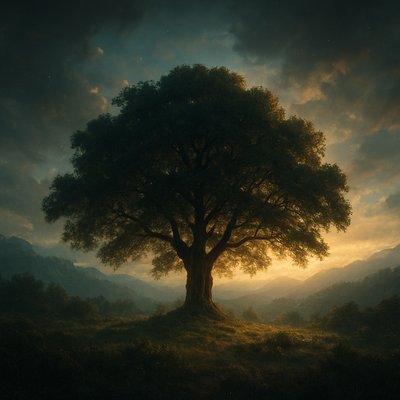
A serene and majestic watercolor painting, capturing the essence of a grand, towering evergreen tree (like the dominant one in the provided image) standing proudly in a sun-dappled, open forest glade. The tree's deep green needles are rendered with varying washes, showcasing its immense height and full, tiered branches that reach towards a partly cloudy, bright blue sky.

In the foreground and around the base of this glorious tree, two or three graceful mule deer are depicted. One might be grazing peacefully, another looking up towards the viewer with its large, expressive ears, and a fawn possibly tucked nearby. Their coats are rendered in soft, earthy watercolor tones of grey-brown, with delicate highlights and shading to suggest their gentle forms and distinctive white rumps and tails.

The surrounding landscape features a subtle ground cover of dry grasses and scattered undergrowth, characteristic of a high-desert or mountain forest floor, painted with soft, blended washes of ochre, sage green, and light brown. The sky above is a classic watercolor blend of soft blues and wispy white clouds. The overall mood is one of tranquil natural beauty, quiet majesty, and a harmonious coexistence of wildlife and ancient trees, rendered with the flowing, luminous quality of watercolor art
A woman dressed in Great Depression era fashion, standing in a dimly lit, humble setting. She wears a modest, long-sleeved dress made of durable, slightly faded cotton or rayon, with a mid-calf hemline. The dress is a muted color like dusty blue, faded green, or soft brown, possibly with a subtle, small floral or geometric pattern. Her hair is styled simply, perhaps in soft waves or a practical updo, and she wears sturdy, low-heeled lace-up shoes. Her posture is resilient, reflecting the strength of the era. The background is simple and sparse, hinting at the economic hardship, perhaps an old wooden wall or a faded curtain. The overall feeling is one of quiet determination and dignified hardship Use Art Deco architecture or Art Deco interior in the background, but describe the fashion as faded, worn, and humble. Juxtapose the sleek, modern geometry of the setting with the practical, mended, and heavy wool textures of the clothing.
Minimalist composition focusing on color relationships in the art style of Color Field Painting --v 6.1