A Man With A Surprised Look On His Face Is Surrounded By Soap Bubbles Art

A GUY NAMED JOE RAZZ , GREW UP IN EVERETT MASSACHUSETTS,THIS SKULLY CAP GOATEE WEARING TOUGH GUY HE WAS SURROUNDED BY OLD SCHOOL IRISH GANGSTERS, MOBSTERS, HE WAS SELLING DRUGS UNTIL HE GOT HOOKED AND IN ANGUISH CRIED OUT TO GOD ,THEN RECIEVED JESUS CHRIST ,NOW HE IS SAVED HEALED AND ON FIRE FOR THE GOOD, POWERFUL LIGHT ON HIM
portrait of a person with expressive eyes
animal standing in natural pose
serene landscape with mountains and water
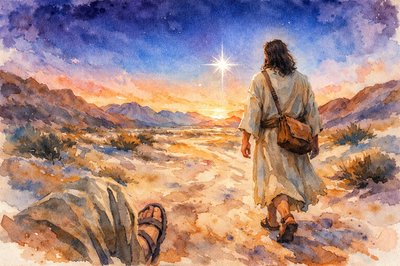
Personal POV scene. Me and Jesus in the desert on a cool morning at daybreak walking toward a bright star. Jesus is wearing old clothes and carrying a satchel. I’m wearing old clothes and sandals just like Him. The air is cool and crisp. The sky is bright blue on the horizon with deep purple fading into black at the upper atmosphere. The air is crisp and clear. It’s like the desert in California looking east toward Arizona. There are desert hills on the north and south sides and mountains in the distance.
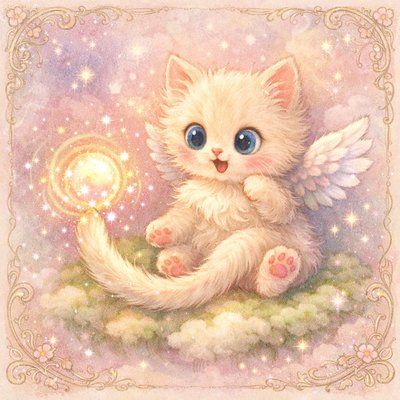
Whimsical Storybook Illustration Style, Soft Pastel Color Palette, Dreamy Atmosphere. A charming, heartwarming scene featuring a magical creature, rendered with gentle textures and colored pencil lines.

The Kitten: An impossibly fluffy, cream-colored kitten with enormous, round, sparkling blue eyes and tiny pink paws. It is sitting upright on a soft, mossy cloud, looking at its tail with a delighted, surprised expression.

The Wings: Sprouting from its back are two small, incredibly soft angel wings with white feathers that have a gentle, pearlescent sheen. They look slightly too big for its tiny body, giving it a clumsy sort of grace.

The Magic Tail (The Wand): The tail is long and expressive. Instead of a normal furry tip, the end of its tail is a swirling, glowing orb of concentrated magical energy—soft golds, rosy pinks, and powder blues. The kitten is swishing its tail forward just like a wizard waves a wand.
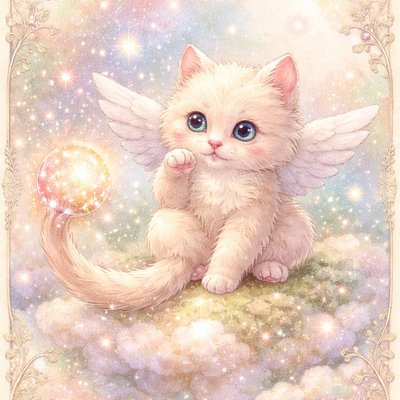
Whimsical Storybook Illustration Style, Soft Pastel Color Palette, Dreamy Atmosphere. A charming, heartwarming scene featuring a magical creature, rendered with gentle textures and colored pencil lines.

The Kitten: An impossibly fluffy, cream-colored kitten with enormous, round, sparkling blue eyes and tiny pink paws. It is sitting upright on a soft, mossy cloud, looking at its tail with a delighted, surprised expression.

The Wings: Sprouting from its back are two small, incredibly soft angel wings with white feathers that have a gentle, pearlescent sheen. They look slightly too big for its tiny body, giving it a clumsy sort of grace.

The Magic Tail (The Wand): The tail is long and expressive. Instead of a normal furry tip, the end of its tail is a swirling, glowing orb of concentrated magical energy—soft golds, rosy pinks, and powder blues. The kitten is swishing its tail forward just like a wizard waves a wand.
still life arrangement of fruits and flowers
house with front view
still life with everyday objects
Shojo Manga Sparkle Portrait Style Transfer Example
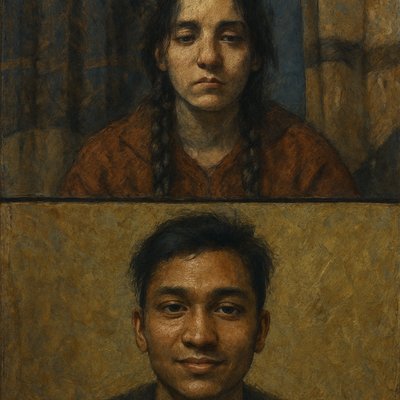
portrait of two people together
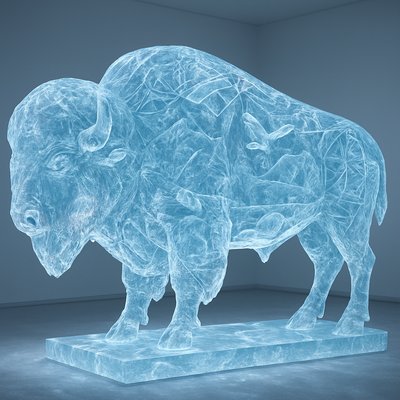
    A breathtaking, full-size artistic sculpture of a standing buffalo, rendered entirely in the style of intricate, luminous glass art, reminiscent of the painted buffalo installations found in West Yellowstone. The Buffalo is standing in the nature of Yellowstone National Park. The buffalo's form is composed of countless individual pieces of vibrant, multifaceted stained glass or fused glass, meticulously cut, arranged, and joined, creating a cohesive and majestic shape.

    Instead of traditional paint, the entire surface of this glass buffalo is adorned with various miniature, finely detailed scenes and patterns etched, painted, or embedded within the glass itself, or created by the unique coloration and texture of the glass pieces. These scenes could depict:

        Western landscapes: Yellowstone's geysers, mountain ranges, pine forests, rivers.

        Wildlife: Elk, bears, wolves, eagles (in glass).

        Native American art motifs: Geometric patterns, symbols, and figures (also rendered in glass).

        Historical moments: Subtle nods to early explorers or iconic figures (stylized in glass).

    The buffalo's interior is subtly illuminated, causing the entire sculpture to glow from within. Light catches every facet of the glass, creating a dazzling play of refracted colors and intricate shadows on the ground around it. The background is a clean, modern art gallery setting with soft, focused lighting, allowing the buffalo to be the sole, radiant centerpiece. The atmosphere is one of awe, wonder, and appreciation for artistic craftsmanship and the spirit of the American West, reimagined through a unique, luminous medium. The artistic style is hyper-realistic, emphasizing the detailed texture, transparency, and brilliant light play inherent in glass art."
A biblical scene of Moses anointing Aaron with oil, inspired by the Book of Exodus. Moses, an older man with a long white beard, is holding a golden goblet and pouring oil directly onto Aaron's uncovered head. Moses is not wearing glasses, and his hands do not touch Aaron's head. Aaron is a man in his 50s with a full beard, dressed in ornate priestly robes with a richly colored ephod and no head covering. The oil flows visibly onto Aaron's head, beard, and garments. The setting is a desert-like environment near the Tabernacle, with woven curtains in the background, illuminated by warm, divine light. The scene reflects a biblical atmosphere with historically accurate clothing and details.
Style: Ethereal Historical Fantasy Portrait. The mood is quiet, reverent, and deeply mystical. Soft, natural moonlight is the primary light source, creating gentle rim-lighting.

The Subject (Asonya): A woman of the ancient, antediluvian world, dressed with profound modesty. She is wrapped in multi-layered, heavy robes of woven wool dyed in deep indigo and charcoal grey that conceal her form. A textured veil covers her hair and frames her face. Her expression is contemplative and gentle, with eyes gazing upward.

The Moon Phase Connection: The current moon phase—a slender, glowing Waning Crescent—is intrinsically tied to her appearance.

    The Headpiece: A clasp made of pale, almost translucent moonstone in the exact shape of the crescent moon secures her veil. It seems to hold an internal, soft luminescence.

    The Projection: A faint, ethereal projection of the crescent moon phase is visible subtly glowing on the fabric of her veil over her forehead, as if starlight is clinging to her.

Action & Setting: She stands on an ancient, wind-worn stone platform used for observing the heavens. In her hands, she holds a simple, dark earthenware bowl filled with still water. The reflection of the actual crescent moon in the sky is perfectly captured in the water she holds.

Atmosphere: The background is a vast, clear night sky filled with countless stars. The air feels old and still.
wide landscape with natural scenery
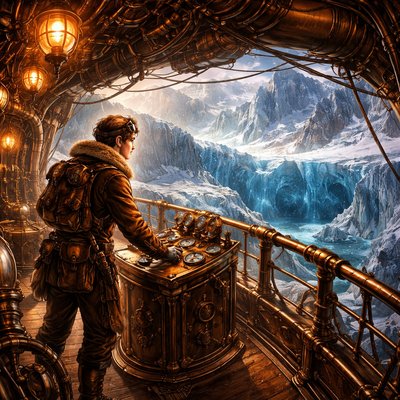
"A high-detail Steampunk illustration view from the open deck of the airship 'Falcon,' inspired by Tom Swift and the Caves of Ice. A young inventor in fur-lined leather explorer gear and brass goggles stands at a complex copper control pedestal studded with gauges and levers, looking out over the railing. Below and ahead, massive, jagged Arctic glaciers and deep blue ice caves reflect the warm glow of the ship's exterior mercury-vapor lamps and vacuum-tube engines. The airship deck is surrounded by polished brass fittings, coiling steam pipes, and gilded rigging. Victorian industrial aesthetic, cinematic lighting, contrast between warm mechanics and cold ice
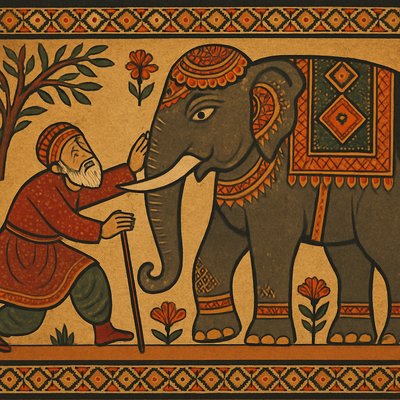
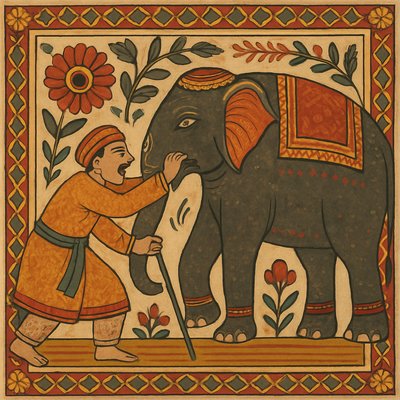
The first approached the elephant and happening to fall against his broad and study side at once began to bawl, God bless me but the elephant is very like a wall. Show a blind man falling against the side of the elephant with tusks.

Shojo Manga Sparkle Portrait Style Transfer Example
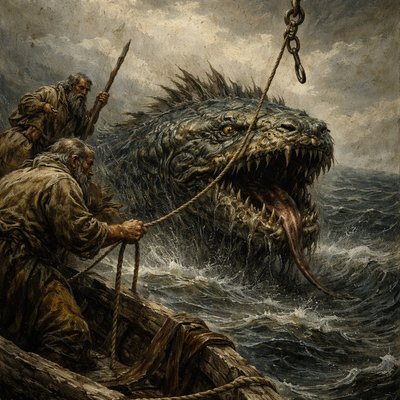
“Canst thou draw out leviathan with an hook? or his tongue with a cord which thou lettest down? Canst thou put an hook into his nose? or bore his jaw through with a thorn?” (Job 41:1-2, KJV)
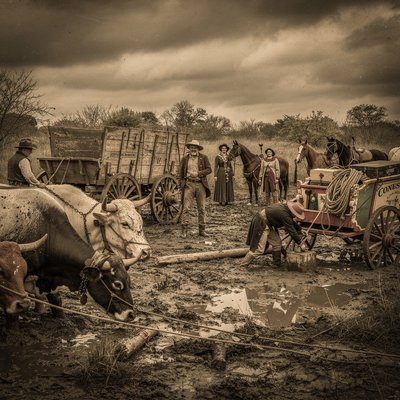
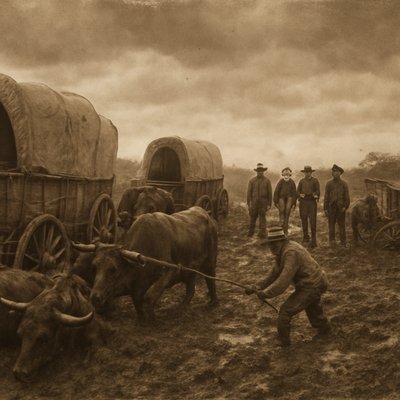
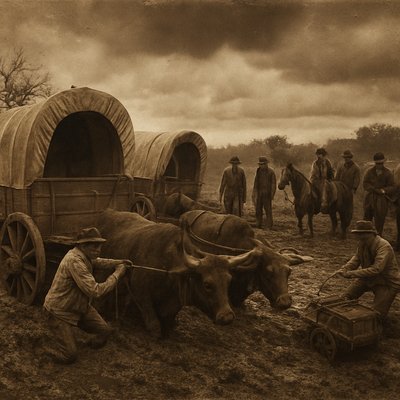
A highly realistic and historically accurate image set in the deep, waterlogged mud of the Texas Cross Timbers (Montague County) in 1840. The scene captures the frustrating moment when the Chihuahua Traders caravan is completely stuck. Foreground focus is on several heavy, wooden Conestoga freight wagons, mired up to their axles in dark, thick mud. Exhausted oxen are straining and distressed, their drivers in rough frontier attire attempting to free the wheels with ropes and levers. In the mid-ground, a small group of the American equestrian circus performers stands next to their distinctive, high-quality riding horses, which are visibly more refined than the typical pack animals. The performers are dressed in sturdy but distinct traveling clothes, looking ill-equipped and frustrated by the muddy conditions. One performer is carefully securing a colorful carriage or cart containing unique circus props, struggling to keep it from sinking. The overall mood is one of miserable delay and hardship. Cloudy, oppressive sky; detailed realism; wide-angle shot; dark, moody lighting.
a tree in nature
a painting of a man with long hair
The first approached the elephant and happening to fall against his broad and study side at once began to bawl, God bless me but the elephant is very like a wall. Show a blind man falling against the side of the elephant.
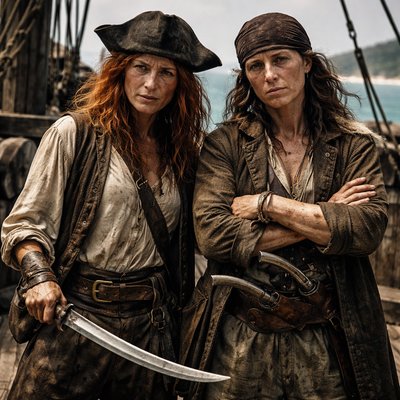
Gritty Historical Realism Style, Cinematic Film Photography, Natural Daylight. A powerful, candid medium shot of the infamous pirate duo, Anne Bonny and Mary Read, standing side-by-side on the weathered wooden deck of the sloop Revenge in the Caribbean Sea (circa 1720).

The Subjects: Both are dressed in practical, worn 18th-century male sailor's attire—loose canvas breeches, oversized linen shirts, heavy leather waistcoats, and bandanas—scruffy clothing that disguises their gender at a distance but reveals them as fiercely capable women upon closer inspection. Their faces are sun-weathered, dirty, and determined.

Specific Details: Anne Bonny (left) has fiery red hair escaping a dark bandana and a tricorn hat pushed back; she holds a drawn cutlass and has a defiant, volatile expression. Mary Read (right) looks sturdier, wearing a heavy wool coat, arms crossed over her chest with two flintlock pistols visible in her sash, looking steady and calculating.

The Setting: The background is a chaotic, working pirate ship deck with coils of tarred rope, rigging, barrels, and a cannon. Beyond the rail is the turquoise ocean and a hazy tropical coastline. The lighting is harsh, midday sun, with salt spray in the air. The mood is tense, rebellious, and authentic. Film grain texture.
The reverberations of sound in many waters shining with glory. No humans. only waters and brilliant light are to be expressed. But this is to be viewed as looking up from under the water.
A highly realistic and historically accurate image set in the deep, waterlogged mud of the Texas Cross Timbers (Montague County) in 1840. The scene captures the frustrating moment when the Chihuahua Traders caravan is completely stuck. Foreground focus is on several heavy, wooden Conestoga freight wagons, mired up to their axles in dark, thick mud. Exhausted oxen are straining and distressed, their drivers in rough frontier attire attempting to free the wheels with ropes and levers. In the mid-ground, a small group of the American equestrian circus performers stands next to their distinctive, high-quality riding horses, which are visibly more refined than the typical pack animals. The performers are dressed in sturdy but distinct traveling clothes, looking ill-equipped and frustrated by the muddy conditions. One performer is carefully securing a colorful carriage or cart containing unique circus props, struggling to keep it from sinking. The overall mood is one of miserable delay and hardship. Cloudy, oppressive sky; detailed realism; wide-angle shot; dark, moody lighting.
A highly realistic and historically accurate image set in the deep, waterlogged mud of the Texas Cross Timbers (Montague County) in 1840. The scene captures the frustrating moment when the Chihuahua Traders caravan is completely stuck.

Foreground focus is on several heavy, wooden Conestoga freight wagons, mired up to their axles in dark, thick mud. Exhausted oxen are straining and distressed, their drivers in rough frontier attire attempting to free the wheels with ropes and levers.

In the mid-ground, a small group of the American equestrian circus performers stands next to their distinctive, high-quality riding horses, which are visibly more refined than the typical pack animals. The performers are dressed in sturdy but distinct traveling clothes, looking ill-equipped and frustrated by the muddy conditions. One performer is carefully securing a colorful carriage or cart containing unique circus props, struggling to keep it from sinking. The overall mood is one of miserable delay and hardship. Cloudy, oppressive sky; detailed realism; wide-angle shot; dark, moody lighting.
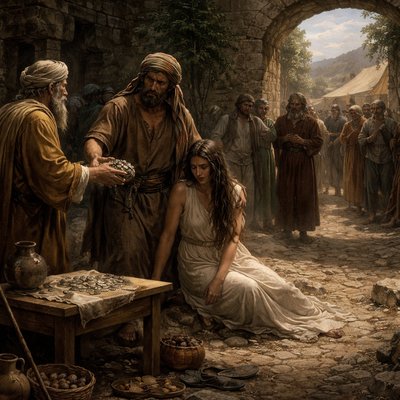
“If a man find a damsel that is a virgin, which is not betrothed, and lay hold on her, and lie with her, and they be found; Then the man that lay with her shall give unto the damsel's father fifty shekels of silver, and she shall be his wife; because he hath humbled her, he may not put her away all his days..” (Deuteronomy 22:28-29, KJV)
a tree in nature
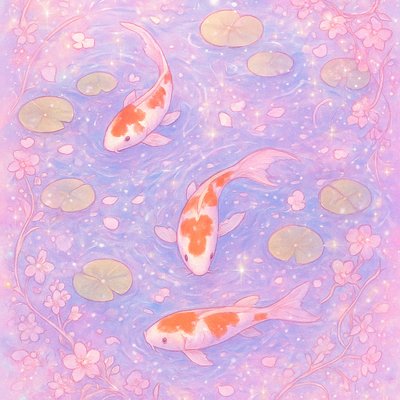
A koi pond seen from above, orange and white koi fish swimming among lily pads, clear water with subtle ripples, fallen cherry blossom petals floating on the surface, dappled sunlight
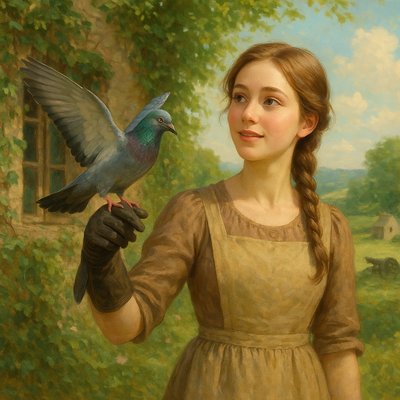
A beautiful young woman with fair skin, light brown hair styled in a braid, and rosy cheeks stands outdoors in front of a rustic stone and ivy-covered building. She is wearing a simple, practical light brown dress with an apron-style overlay, suggestive of a farm setting. Her right arm is extended, and she is wearing a dark leather glove on her hand, upon which a messenger pigeon has just landed. The pigeon is a classic racing pigeon type, with iridescent green and purple neck feathers, and it has its wings slightly spread as if in the act of landing or adjusting. A small message capsule or scroll is clearly visible attached to one of its legs. The woman looks slightly upwards and to the right with a soft, warm expression, her lips slightly parted, as if acknowledging the pigeon or looking towards the message. In the background, to the right, is a picturesque green landscape under a bright sky with scattered clouds, featuring rolling hills, a small, distant stone building, and what appears to be an old cannon or piece of artillery, hinting at a historical wartime context. The overall lighting is warm and natural, creating a serene yet significant atmosphere.
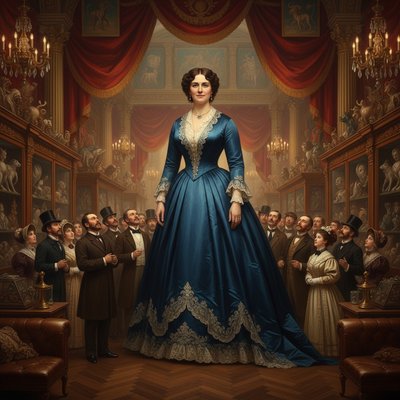
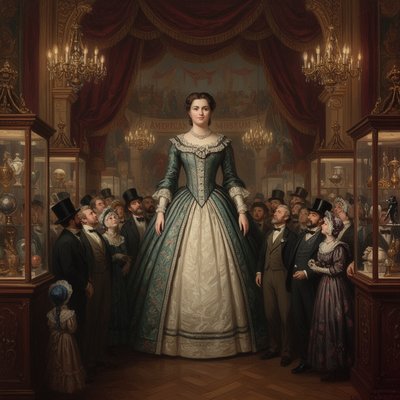
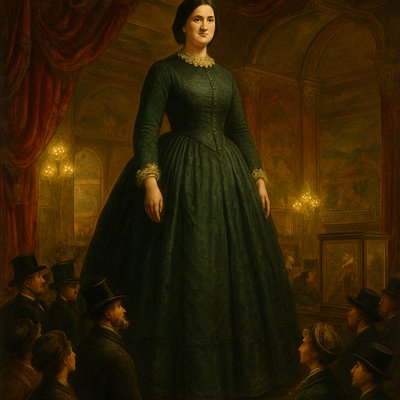
Victorian Oil Painting Art Style, Historical Digital Art Style, a rich and detailed full-body portrait of the famous giantess Anna Swan standing in the center of a lavish, gaslit exhibition hall at P.T. Barnum's American Museum in the 1860s. She is towering over the surrounding crowd of average-sized gentlemen in top hats and ladies in bonnets, whose heads only reach her waistline; they look up at her with expressions of awe and curiosity. Anna is dressed with immense dignity in a fashionable, expansive Victorian silk gown with a crinoline hoop skirt, tailored bodice, and lace trim. Her face is gentle, intelligent, and composed. The background is crowded with heavy red velvet drapery, gilded architectural details, curiosities in glass cases, and painted circus banners faintly visible. The lighting is warm, dramatic gaslight, creating deep shadows and highlighting the rich fabrics and the incredible scale of Anna Swan compared to her environment.
The reverberations of sound in many waters shining with glory. No humans. only waters and brilliant light are to be expressed. But this is to be viewed as looking up from under the water. The reverberations are above the viewer's perspective like Genesis 1:6-8
A highly realistic and historically accurate image set in the deep, waterlogged mud of the Texas Cross Timbers (Montague County) in 1840. The scene captures the frustrating moment when the Chihuahua Traders caravan is completely stuck.

Foreground focus is on several heavy, wooden Conestoga freight wagons, mired up to their axles in dark, thick mud. Exhausted oxen are straining and distressed, their drivers in rough frontier attire attempting to free the wheels with ropes and levers.

In the mid-ground, a small group of the American equestrian circus performers stands next to their distinctive, high-quality riding horses, which are visibly more refined than the typical pack animals. The performers are dressed in sturdy but distinct traveling clothes—perhaps featuring slightly tailored jackets or vests—rather than performance costumes, looking ill-equipped and frustrated by the muddy conditions. One performer is carefully securing a small, colorful carriage or cart containing unique circus props, struggling to keep it from sinking. The overall mood is one of miserable delay and hardship. Cloudy, oppressive sky; detailed realism; wide-angle shot; dark, moody lighting.
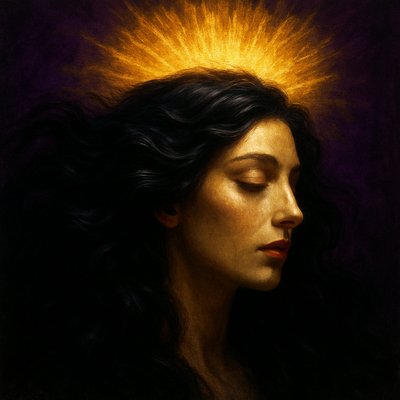
A dramatic, close-up, high-contrast portrait inspired by Song of Songs 5:11. The subject's head is crowned with dramatically wavy hair that is intensely, intensely black—like the glossy feathers of a raven. A radiant, ethereal golden light emanates from the crown of the head, casting a dramatic glow. This golden light is surrounded by a rich, powerful aura of royal deep purple and mysterious black shadow. The portrait should emphasize the texture and depth of the black hair, contrasting sharply with the bright gold and the saturated purple surrounding the subject. The style should be elegant, opulent, and symbolic, focusing purely on the aesthetic of divine beauty and royal power
a woman with a blue light on her face
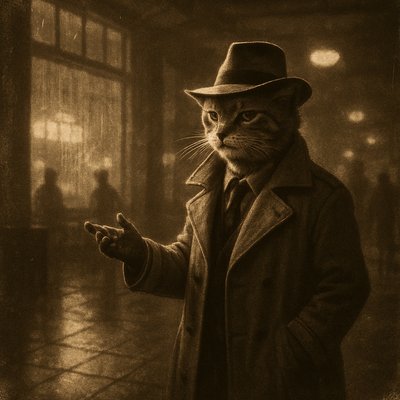
"Oliver, a human-sized, bipedal tabby cat with a trench coat and fedora, stands under the dim, atmospheric lighting of the original Grand Canyon Xanterra Lodge lobby. The scene is shot in classic film noir style, with strong contrasts between light and shadow, creating dramatic silhouettes and long, exaggerated shadows. Rain streaks down the large lobby windows, reflecting the neon glow from outside. He gestures with one paw towards an unseen check-in desk, his expression a mix of polite welcome and guarded cynicism. The texture of his fur is visible, adding to his rugged, lived-in appearance. Guests, depicted as blurred, indistinct figures, mill about in the background, their faces obscured by shadow or distance. The overall mood is mysterious, slightly melancholic, and undeniably stylish, capturing the essence of a bygone era."