“Doth The Eagle Mount Up At Thy Command, And Make Her Nest On High? She Dwelleth And Abideth On The Rock, Upon The Crag Of The Art

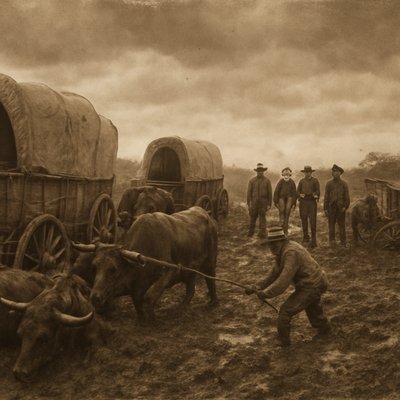
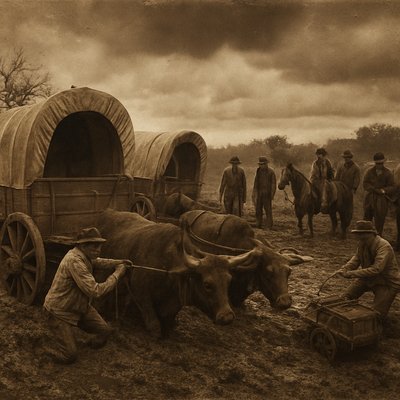
A highly realistic and historically accurate image set in the deep, waterlogged mud of the Texas Cross Timbers (Montague County) in 1840. The scene captures the frustrating moment when the Chihuahua Traders caravan is completely stuck. Foreground focus is on several heavy, wooden Conestoga freight wagons, mired up to their axles in dark, thick mud. Exhausted oxen are straining and distressed, their drivers in rough frontier attire attempting to free the wheels with ropes and levers. In the mid-ground, a small group of the American equestrian circus performers stands next to their distinctive, high-quality riding horses, which are visibly more refined than the typical pack animals. The performers are dressed in sturdy but distinct traveling clothes, looking ill-equipped and frustrated by the muddy conditions. One performer is carefully securing a colorful carriage or cart containing unique circus props, struggling to keep it from sinking. The overall mood is one of miserable delay and hardship. Cloudy, oppressive sky; detailed realism; wide-angle shot; dark, moody lighting.
A highly realistic and historically accurate image set in the deep, waterlogged mud of the Texas Cross Timbers (Montague County) in 1840. The scene captures the frustrating moment when the Chihuahua Traders caravan is completely stuck.

Foreground focus is on several heavy, wooden Conestoga freight wagons, mired up to their axles in dark, thick mud. Exhausted oxen are straining and distressed, their drivers in rough frontier attire attempting to free the wheels with ropes and levers.

In the mid-ground, a small group of the American equestrian circus performers stands next to their distinctive, high-quality riding horses, which are visibly more refined than the typical pack animals. The performers are dressed in sturdy but distinct traveling clothes, looking ill-equipped and frustrated by the muddy conditions. One performer is carefully securing a colorful carriage or cart containing unique circus props, struggling to keep it from sinking. The overall mood is one of miserable delay and hardship. Cloudy, oppressive sky; detailed realism; wide-angle shot; dark, moody lighting.
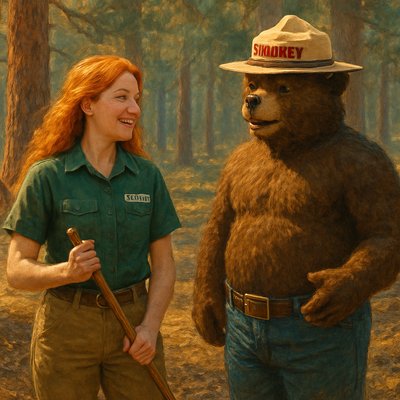
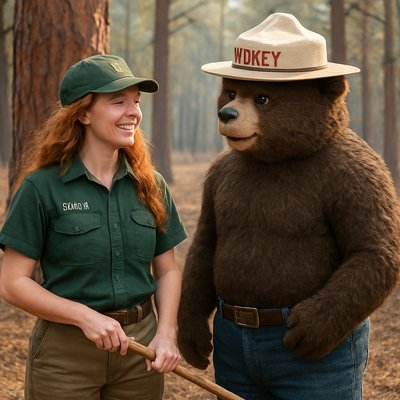
A highly detailed photograph of a cheerful female Camp Host with long, flowing red hair, wearing a forest green uniform shirt and khaki pants. She is standing in the San Juan National Forest and is holding a wooden rake. She is engaged in a friendly conversation with Smokey the Bear. The forest setting features large Ponderosa pine trees with orange bark and the ground is covered in a layer of pine needles and raked debris, illustrating fire prevention efforts. The lighting is soft, natural daylight filtering through the trees, giving a warm and encouraging tone. Focus on realistic texture for the uniform, hair, and pine needles.
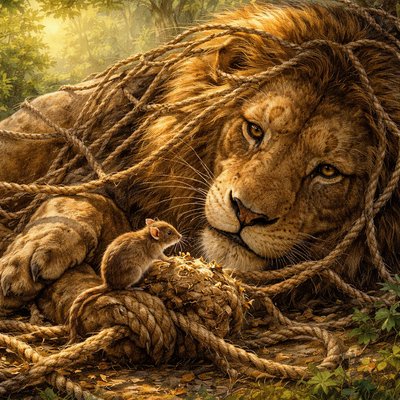
Classical Wildlife Illustration Style, Rich Textures, Warm Golden Hour Lighting. An intimate, detailed look at a dramatic rescue on a sun-dappled forest floor.

The Trapped Giant (The Lion): A massive, powerful male lion with a thick mane is hopelessly tangled in a complex hunter’s net made of thick, coarse hemp ropes. He is lying on his side, exhausted and defeated, his immense paws bound. His expression is one of surprising gentleness and relief as he looks down.

The Tiny Hero (The Mouse): The focal point is a tiny field mouse, rendered with exquisite detail, perched precariously on a thick knot of rope right next to the lion's massive face. The mouse is busily gnawing through a crucial strand of the thick netting with its sharp teeth. Shavings of hemp rope are visible.

The Atmosphere: Warm, late afternoon sunlight filters through the tree canopy, creating patches of bright light that highlight the dusty texture of the ropes, the individual hairs on the mouse, and the deep golden fur of the lion. The immense scale difference between the lion’s head and the mouse’s entire body is central to the composition.
a sign that says selfie adventure on it
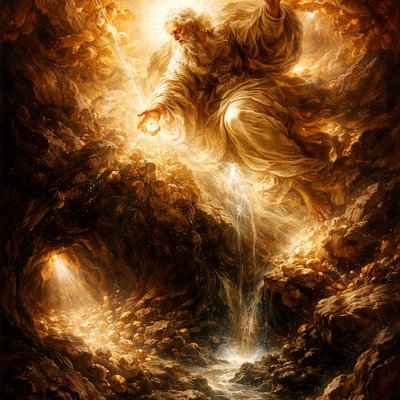
 He (God) setteth an end to darkness, and searcheth out all perfection: the stones of darkness, and the shadow of death. From Job 28:3
a painting of a circus tent with the number two on it
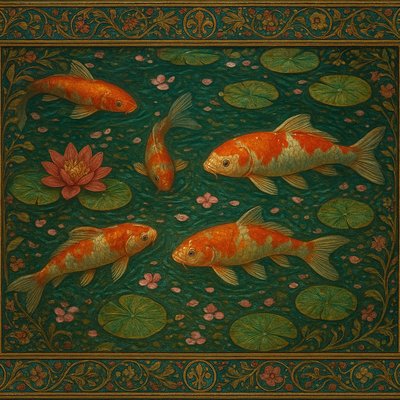
A koi pond seen from above, orange and white koi fish swimming among lily pads, clear water with subtle ripples, fallen cherry blossom petals floating on the surface, dappled sunlight
A detailed fantasy painting shows a sprawling gnome village built into the massive trunk and branches of an ancient tree at night. Numerous cozy wooden houses with blue-tiled roofs and glowing windows are nestled among the leaves, connected by intricate rope bridges, wooden walkways, and ladders. Gnomes in traditional red hats are visible on balconies and platforms. The primary mode of transport is large owls: a giant barn owl with a leather harness and basket filled with gnomes lands on a main platform, while another owl wearing a scarf perches on a lower bridge. Dozens of other owls are perched throughout the tree and in the background forest. A large, glowing full moon illuminates the scene, casting a magical light, with warm lanterns hanging everywhere. A gentle river flows at the base of the tree among forest flowers. The style is rich, textured, and whimsical
And be not drunk with wine, wherein is excess; but be filled with the Spirit; Speaking to yourselves in psalms and hymns and spiritual songs, singing and making melody in your heart to the Lord; Giving thanks always for all things unto God and the Father in the name of our Lord Jesus Christ; 
(Ephesians 5:18-20 KJV) Do not use words but only images to interpret the passage.
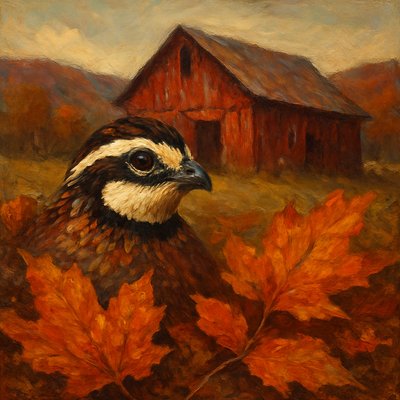
Oil Painting Art Style, a detailed male Northern Bobwhite Quail, its distinctive head markings and feather patterns clearly rendered with rich brushwork, peeking from behind a cluster of vivid, textured fall leaves on the ground. The quail's eyes are sharp and alert. Behind it, an old, weathered, rustic red barn is depicted with strong brushstrokes, showing its aged timber and flaking paint, under a slightly overcast, softly lit autumn sky. The setting is a quintessential Eastern farm in the mountains of Tennessee, with the surrounding hills hinted at in deep, autumnal tones. Focus on the tactile quality of the painted textures, the depth and richness of the autumn colors, and the enduring charm of the rural scene.
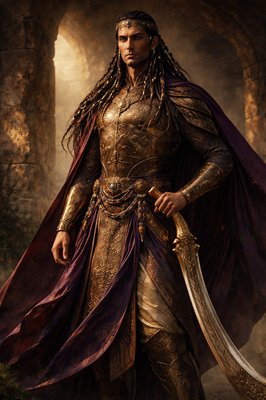
Style: A detailed, photorealistic character portrait in the style of high-fantasy historical cinema, focusing on texture, armor design, and facial structure.

The Subject: A full-body portrait of a single Gibeonite lord. He is a figure of imposing, "giant" stature, standing significantly taller than an average human (suggesting 7+ feet), but his proportions are lithe, graceful, and powerful rather than bulky or brutish.

Facial Features & Expression: He possesses a noble, almost ageless bearing reminiscent of an Elven lord, translated into ancient Near Eastern features. He has high, sculpted cheekbones, a strong aquiline nose, and intense, deep-set eyes that convey a calculating intelligence and ancient dignity. His expression is calm, watchful, and confident.

Hair & Adornment: His long, dark hair is elaborately and precisely braided, woven with hammered bronze rings and polished beads of carnelian and lapis lazuli.

Attire & Armor: He is dressed in attire that demonstrates advanced craftsmanship and sophistication. He wears a fitted breastplate of polished bronze, richly engraved with complex, swirling Canaanite motifs (stylized lions, gryphons, and geometric patterns). Beneath the armor, a tunic dyed deep Tyrian purple shows through.

Weapons: At his hip hangs a massive, curved khopesh sword, scaled to his immense height, with a hilt carved from hippopotamus ivory and inlaid with gold.

Pose & Lighting: He stands in a relaxed but formidable pose of authority, one hand resting on his sword hilt. The lighting is golden hour sunlight, catching the metallic sheen of the bronze armor and the intelligence in his eyes against a neutral, out-of-focus textured stone background.
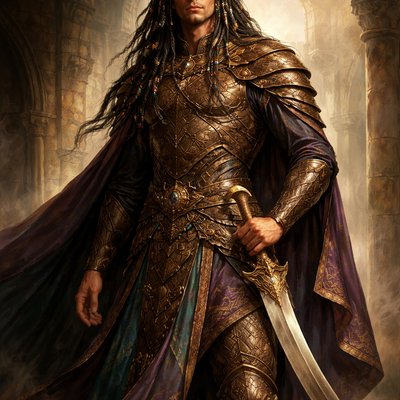
Style: A detailed, photorealistic character portrait in the style of high-fantasy historical cinema, focusing on texture, armor design, and facial structure.

The Subject: A full-body portrait of a single Gibeonite lord. He is a figure of imposing, "giant" stature, standing significantly taller than an average human (suggesting 7+ feet), but his proportions are lithe, graceful, and powerful rather than bulky or brutish.

Facial Features & Expression: He possesses a noble, almost ageless bearing reminiscent of an Elven lord, translated into ancient Near Eastern features. He has high, sculpted cheekbones, a strong aquiline nose, and intense, deep-set eyes that convey a calculating intelligence and ancient dignity. His expression is calm, watchful, and confident.

Hair & Adornment: His long, dark hair is elaborately and precisely braided, woven with hammered bronze rings and polished beads of carnelian and lapis lazuli.

Attire & Armor: He is dressed in attire that demonstrates advanced craftsmanship and sophistication. He wears a fitted breastplate of polished bronze, richly engraved with complex, swirling Canaanite motifs (stylized lions, gryphons, and geometric patterns). Beneath the armor, a tunic dyed deep Tyrian purple shows through.

Weapons: At his hip hangs a massive, curved khopesh sword, scaled to his immense height, with a hilt carved from hippopotamus ivory and inlaid with gold.

Pose & Lighting: He stands in a relaxed but formidable pose of authority, one hand resting on his sword hilt. The lighting is golden hour sunlight, catching the metallic sheen of the bronze armor and the intelligence in his eyes against a neutral, out-of-focus textured stone background.
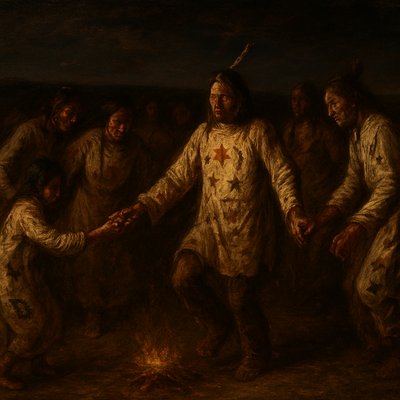
"A historically accurate depiction of a Ghost Dance, focusing on the late 19th-century context, specifically around 1890-1891. The scene shows Lakota (Sioux) or Northern Paiute people (specify one or include elements of both, but avoid anachronisms) participating in the ceremony.

Setting: A vast, open prairie or high desert landscape, under an expansive sky. The time of day could be dusk or night, with a prominent moon or stars, or a bright, clear day. Avoid overtly spiritual or ethereal elements like floating spirits unless explicitly requested for a later, more symbolic iteration. The focus should be on the earthly ceremony.

Participants: A circle of men, women, and children, hand-in-hand, moving in a slow, rhythmic shuffle or circular motion. Their faces show a mixture of devotion, hope, and determination. Some may have expressions of trance or deep concentration.

Attire:

    Ghost Dance Shirts/Dresses: Emphasize the unique Ghost Dance shirts and dresses, which were typically made of muslin or canvas. These garments should feature painted designs such as stars, crescents, birds (especially eagles or crows), buffalo, human figures, or crosses. The designs should appear hand-painted, not mass-produced.

    Hair and Adornments: Participants should have braided hair or wear it long. Some may wear feathers (e.g., eagle or hawk feathers) in their hair. Minimal traditional adornments, as the focus was often on the Ghost Dance shirt itself. Avoid overly elaborate or Hollywood-esque depictions of war bonnets unless relevant to a specific individual and context.

    Footwear: Moccasins or bare feet.

Action/Atmosphere:

    The dancers are moving in a counter-clockwise circle, with a central figure or a small group often leading.

    The overall mood is one of earnest prayer and communal spiritual effort. The dance should convey a sense of hope for renewal and the return of the old ways, rather than aggression or despair.

    There might be a central pole or small fire as a focal point, around which the dance takes place.

    Avoid any signs of direct conflict or violence; the Ghost Dance itself was a non-violent spiritual movement.

Specific Considerations for Accuracy:

    Wovoka's Influence: The teachings of Wovoka (the Northern Paiute prophet) emphasized peace, hard work, and the return of the buffalo and deceased ancestors. The scene should subtly reflect this hopeful, redemptive spirit.

    Regional Variations: If focusing on Lakota, consider their specific interpretations, which sometimes included more imagery related to their warrior traditions on the shirts, but still within the peaceful framework of the dance.
    Respectful Portrayal: Ensure the depiction is respectful and avoids any stereotypical or caricatured representations of Indigenous people. Focus on their human dignity and spiritual sincerity.
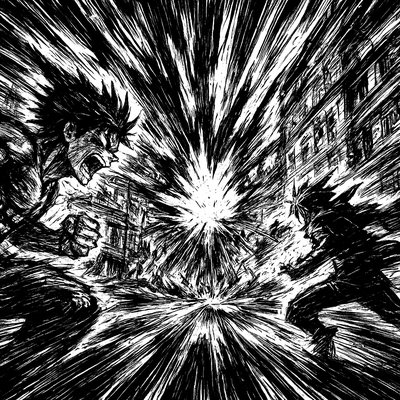
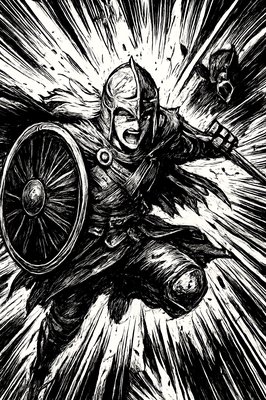
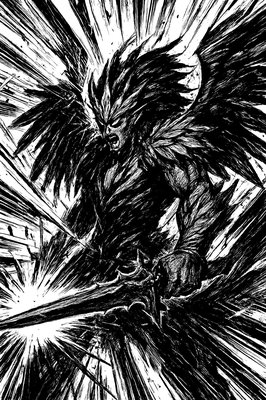
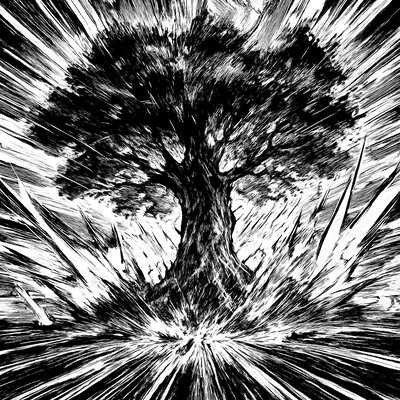
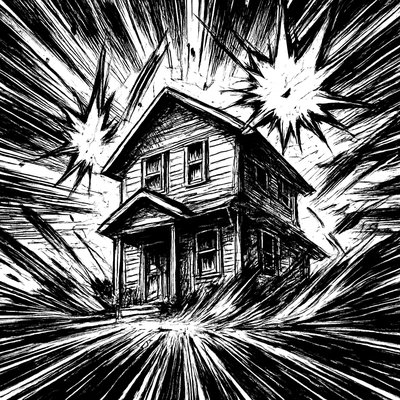
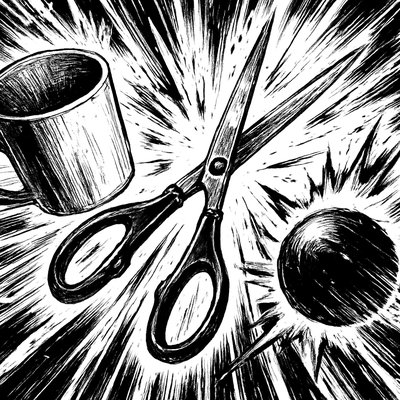
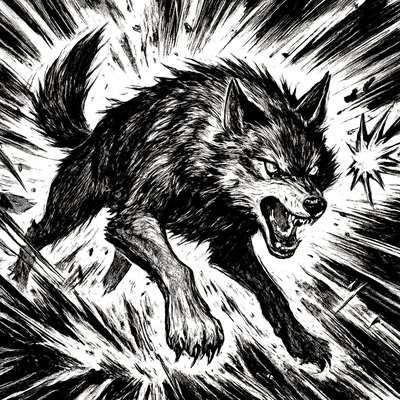
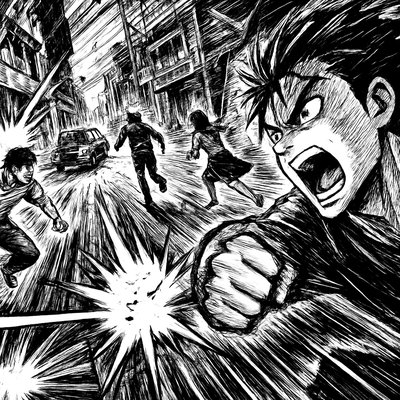
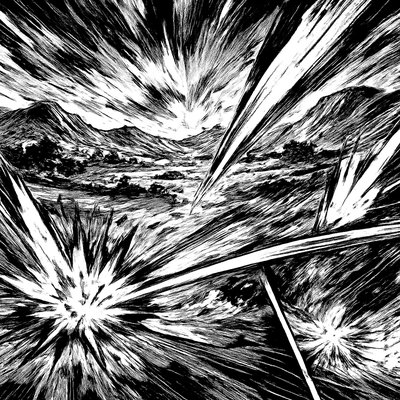
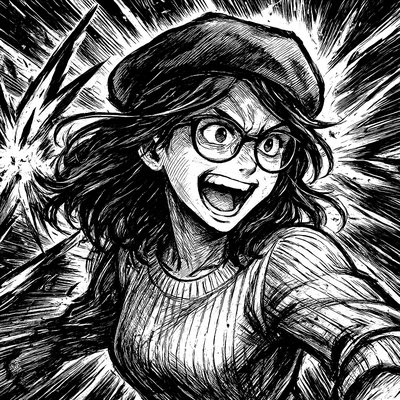
Shonen Battle Manga Art Style Style Transfer Example
a man dressed in armor holding a lantern
a demon with a sword in his hand
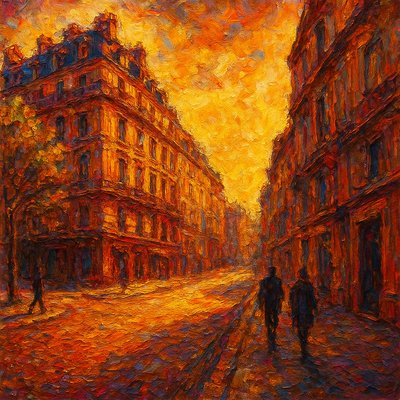
Oil Portrait Art Style Style Transfer Example
a tree in nature
house with front view
still life with everyday objects
animal standing in natural pose
urban street with city activity
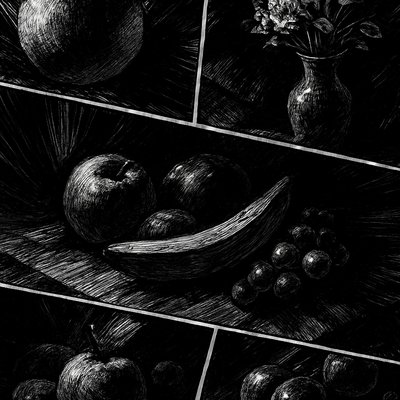
still life arrangement of fruits and flowers
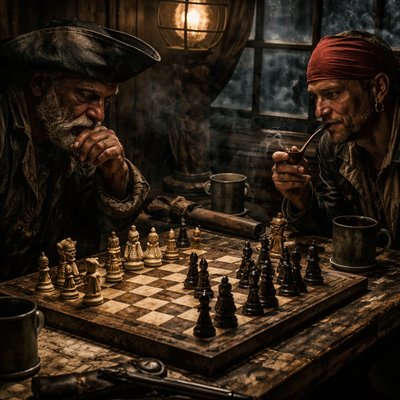
Cinematic Historical Photograph, Gritty Realism, Chiaroscuro Lighting. A tense, high-stakes chess match taking place between two seasoned pirates inside the cramped, dimly lit stern cabin of a rocking galleon at sea during the night.

The Players: On one side sits a grizzled, older Pirate Captain with a heavy grey beard and a scarred face, leaning over the board, his hand rubbing his chin in deep concentration. Opposite him is a younger, cunning Quartermaster with a gold tooth and a confident smirk, holding a clay pipe.

The Board & Pieces: Between them is a heavy wooden table stained with grog. The chessboard is carved directly into the tabletop, with squares made of inlaid mother-of-pearl and burned wood. They are playing with the custom pirate-themed chess set (previously designed): The Captain's side uses pieces carved from yellowed whalebone (King with tricorn, Ship Rooks), and the Quartermaster's side uses pieces cast from dark, tarnished iron. A bone "Knight" piece is currently threatening an iron "Queen."

The Atmosphere: The cabin is lit by a single, swaying oil lantern hanging overhead, casting long, moving shadows and illuminating the smoke in the air. Mugs of rum, a flintlock pistol, and rolled charts are cluttered around the board. Outside a stern window, a dark, stormy ocean is visible. The photo has a film grain texture.
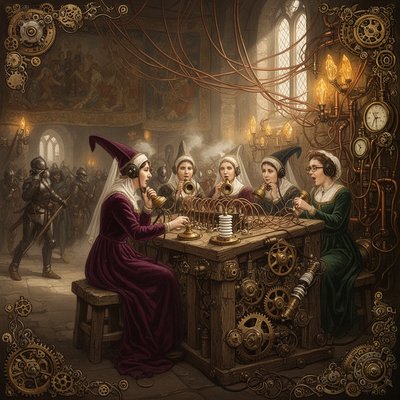
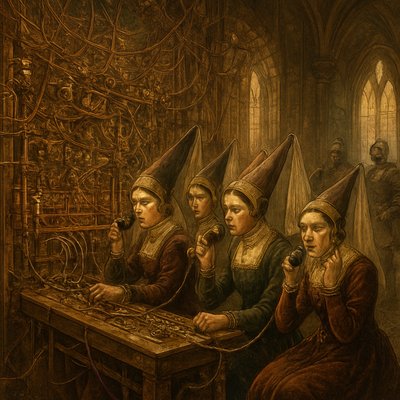
Steampunk Historical Fantasy, Satirical Illustration Style, Cinematic Lighting. A bizarre, anachronistic scene inside a drafty medieval castle great hall (Camelot). A group of noblewomen, dressed in elaborate 6th-century velvet gowns, wimples, and tall pointed hennin hats with veils, are seated on rough wooden stools. They are furiously working a massive, makeshift telephone switchboard operator station.
The Technology: The switchboard is constructed from rough-hewn oak timbers, gleaming brass gears, porcelain insulators, and hundreds of thick, chaotic copper wires that are strung haphazardly across ancient tapestries and stone walls, disappearing out narrow arrow-slit windows.

The Action: The ladies hold bulky, antique Victorian-era earpieces and large brass mouthpieces, plugging heavy cables with oversized jacks into the board with expressions of intense concentration and mild confusion. Knights in armor walk past in the background, looking bewildered. Sunlight streams through gothic windows, illuminating the dust and the clash of eras.
Steampunk Historical Fantasy, Satirical Illustration Style, Cinematic Lighting. A bizarre, anachronistic scene inside a drafty medieval castle great hall (Camelot). A group of noblewomen, dressed in elaborate 6th-century velvet gowns, wimples, and tall pointed hennin hats with veils, are seated on rough wooden stools. They are furiously working a massive, makeshift telephone switchboard operator station.

The Technology: The switchboard is constructed from rough-hewn oak timbers, gleaming brass gears, porcelain insulators, and hundreds of thick, chaotic copper wires that are strung haphazardly across ancient tapestries and stone walls, disappearing out narrow arrow-slit windows.

The Action: The ladies hold bulky, antique Victorian-era earpieces and large brass mouthpieces, plugging heavy cables with oversized jacks into the board with expressions of intense concentration and mild confusion. Knights in armor walk past in the background, looking bewildered. Sunlight streams through gothic windows, illuminating the dust and the clash of eras.
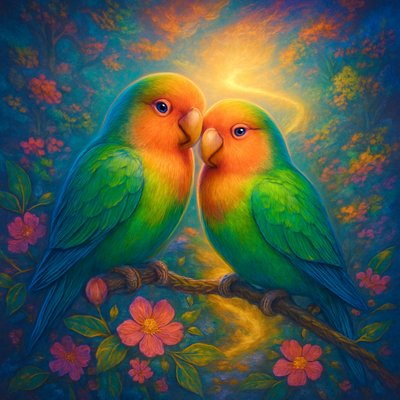
Digital Art Style, Romanticism Art Style, a profoundly joyful and beautifully vibrant painting inspired by Psalm 16:11, "You make known to me the path of life; you will fill me with joy in your presence, with eternal pleasures at your right hand." The scene features a pair of exquisitely detailed Peach-faced Lovebirds, with their iconic bright peach faces, vivid green bodies, and touches of blue on their rumps. They are perched affectionately close together on a blossoming branch, their expressions conveying deep contentment and joy. Behind them, a softly glowing, ethereal 'path' of light winds gently through a lush, vibrant, and abundant natural landscape, illuminated by a warm, radiant, divine light that bathes the entire scene. The environment is rich with blooming flowers and verdant foliage, suggesting a place of eternal pleasure and divine presence. Focus intently on the vibrant, luminous colors of the Lovebirds, their tender, joyful interaction, and the glowing, symbolic 'path of life' that permeates the harmonious and blissful atmosphere
A koi pond seen from above, orange and white koi fish swimming among lily pads, clear water with subtle ripples, fallen cherry blossom petals floating on the surface, dappled sunlight
A highly realistic and historically accurate image set in the deep, waterlogged mud of the Texas Cross Timbers (Montague County) in 1840. The scene captures the frustrating moment when the Chihuahua Traders caravan is completely stuck.

Foreground focus is on several heavy, wooden Conestoga freight wagons, mired up to their axles in dark, thick mud. Exhausted oxen are straining and distressed, their drivers in rough frontier attire attempting to free the wheels with ropes and levers.

In the mid-ground, a small group of the American equestrian circus performers stands next to their distinctive, high-quality riding horses, which are visibly more refined than the typical pack animals. The performers are dressed in sturdy but distinct traveling clothes—perhaps featuring slightly tailored jackets or vests—rather than performance costumes, looking ill-equipped and frustrated by the muddy conditions. One performer is carefully securing a small, colorful carriage or cart containing unique circus props, struggling to keep it from sinking. The overall mood is one of miserable delay and hardship. Cloudy, oppressive sky; detailed realism; wide-angle shot; dark, moody lighting.
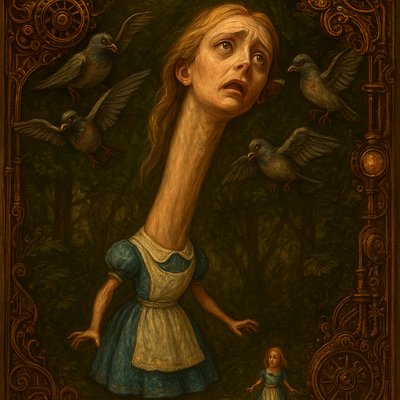
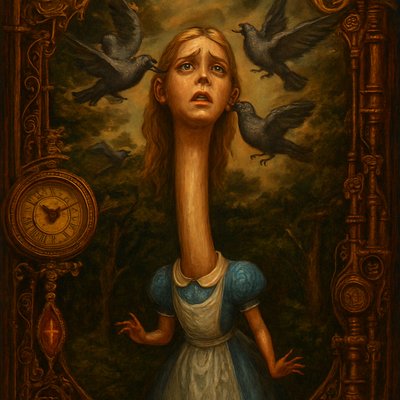
Alice, wearing her blue dress, looking distressed, with her neck stretched impossibly high, vanishing into the foliage above. Her head emerges far above the trees of the Wonderland forest. A flock of angry Pigeons fly around her immense face, one landing on her ear and pecking at it, mistakenly believing her to be a serpent trying to steal their eggs. Below, the tiny, disoriented body of Alice stands near the base of the massive neck. Whimsical, detailed oil painting, saturated colors, storybook illustration by John Tenniel crossed with Salvador Dali, high contrast lighting.
A dramatic, close-up, high-contrast portrait inspired by Song of Songs 5:11. The subject has dramatically wavy hair that is intensely, intensely black—like the glossy feathers of a raven. A radiant, ethereal golden light emanates from the crown of the head, surrounded by a rich, powerful aura of royal deep purple and mysterious black shadow. Opulent hyperrealistic portrait, Art Deco portraiture, cinematic lighting, dominant black and gold with deep purple accents, glossy raven black
A highly detailed photograph of a cheerful female Camp Host with long, flowing red hair, wearing a forest green uniform shirt and khaki pants. She is standing in the San Juan National Forest and is holding a wooden rake. She is engaged in a friendly conversation with Smokey the Bear. The forest setting features large Ponderosa pine trees with orange bark and the ground is covered in a layer of pine needles and raked debris, illustrating fire prevention efforts. The lighting is soft, natural daylight filtering through the trees, giving a warm and encouraging tone. Focus on realistic texture for the uniform, hair, and pine needles.
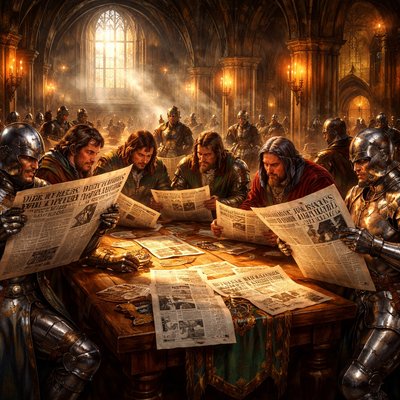
A grand medieval hall in King Arthur's Camelot transformed by modern invention: armored knights in shining full-plate mail and nobles in velvet robes gathered around a large wooden table, intently reading freshly printed newspapers with bold 19th-century headlines like 'Merlin's Latest Blunder Exposed!' and 'Eclipse Prediction: Yankee Wizard Triumphs Again', ink still glistening on the broadsheets, one knight holding the paper upside down in confusion while another points excitedly at an advertisement for bicycles, flickering torchlight and early electric bulbs casting warm dramatic glows on faces and paper, rich textures on crinkled newsprint, polished armor reflections, ornate tapestries and stone arches in background with subtle printing press visible through an open door belching faint steam, vibrant colors with deep crimson reds, golden yellows, and inky blacks, god rays streaming through high arched windows at golden hour, hyper-detailed photorealistic fantasy style, epic cinematic composition capturing satirical anachronism and wonder,
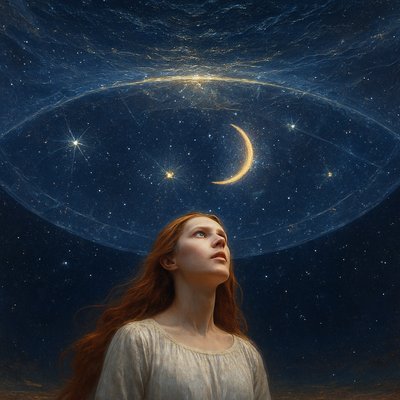
Photorealism Art Style, a breathtaking, upward-looking perspective from the ground, portraying ancient Jewish cosmology for Psalm 8:3. In the lower frame, a young woman with long, flowing red hair, dressed in simple, ethereal white heavenly attire, stands on subtle, ancient earth, gazing upwards with an expression of profound awe and wonder. Above her, the night sky transitions into a vast, layered structure of heavens. Clearly visible is a translucent, crystalline firmament (raqia), appearing as a colossal, shimmering barrier. Within this firmament, large, distinct stars and a glowing crescent moon are vividly captured, appearing as tangible, luminous objects "set into" its surface, radiating a soft, internal light. Beyond and above this firmament, immense, dark yet shimmering celestial waters are visibly contained, looking like a real, suspended ocean reflecting an unseen, brilliant divine light from the highest reaches. The overall scene is imbued with deep blues, celestial purples, and radiant golds from the embedded lights. Focus on the woman's reverent expression, the stunning depth of the layered heavens seen from below, the realistic texture of the firmament, and the tangible, luminous quality of the stars and moon within it, creating an image of overwhelming ancient wonder and divine majesty.
Alice, wearing her blue dress, looking distressed, with her neck stretched impossibly high, vanishing into the foliage above. Her head emerges far above the trees of the Wonderland forest. A flock of angry Pigeons fly around her immense face, one landing on her ear and pecking at it, mistakenly believing her to be a serpent trying to steal their eggs. Below, the tiny, disoriented body of Alice stands near the base of the massive neck. Whimsical, detailed oil painting, saturated colors, storybook illustration by John Tenniel crossed with Salvador Dali, high contrast lighting.
Oil Portrait Art Style Style Transfer Example
Shonen Battle Manga Art Style Style Transfer Example
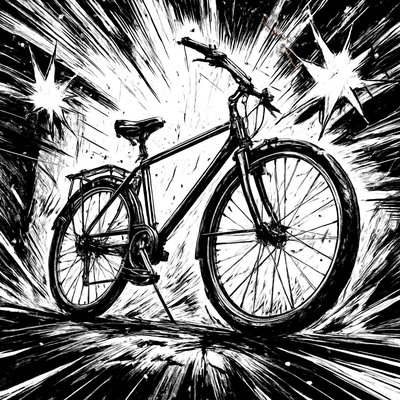
bicyle resting against a wall
wide landscape with natural scenery
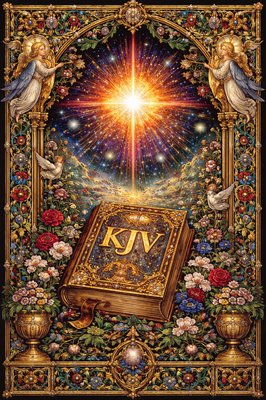
Not using maps or globes as symbols please create Kepler's Supernova and the Bible, "KJV" is the only word used