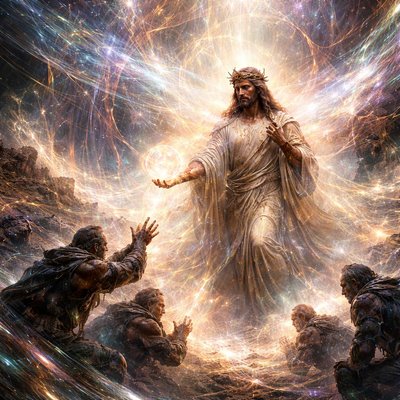
“But Ask Now The Beasts, If They May Speak To Thee; And The Birds Of The Air, If They May Declare To Thee. Tell The Earth, If It Art

Matthew 21:34 (KJV)
34 And when the time of the fruit drew near, he sent his servants to the husbandmen, that they might receive the fruits of it.
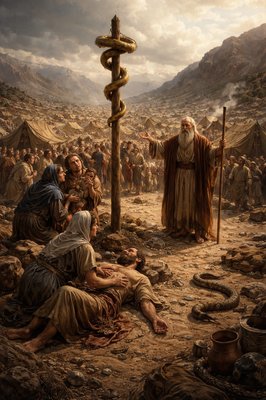
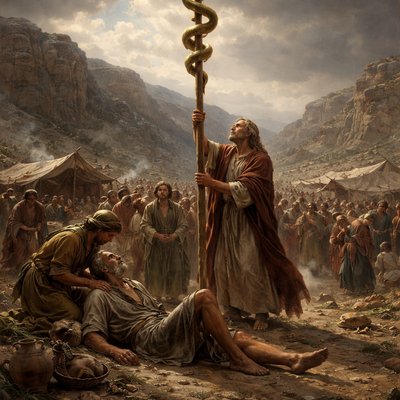
“And Moses made a serpent of brass, and put it upon a pole, and it came to pass, that if a serpent had bitten any man, when he beheld the serpent of brass, he lived.” (Numbers 21:9, KJV)
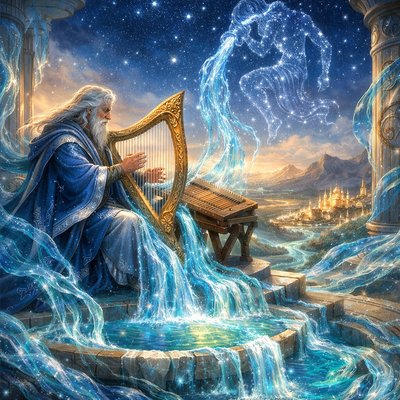
A wide-angle, epic and majestic fantasy-realism style illustration for ArtStyles, based on Psalm 92:3, capturing a grand, celestial-inspired musician at dawn. In a mystical, open-air temple balcony under a starry sky with the constellation Aquarius prominently visible as a shimmering water-bearer icon pouring water, a majestic figure with a flowing beard and blue and silver robes (symbolizing Aquarius and music) is seated. Before the figure are two elaborate instruments.
One is a unique, gilded and carved wooden harp with a distinct triangular frame, which is explicitly and clearly shown with exactly ten distinct, visible, and countable strings stretched taut. The strings are glistening with cool, deep blue and golden light as the musician plucks them. Nearby, a beautiful, multi-stringed wooden psaltery (a trapezoidal zither-like instrument) sits on a stand, also being played by the other hand.
As the musician plays, glowing streams of illuminated, cascading blue and indigo water, visualized as physical music, emanate directly from the vibrating strings of both the ten-string harp and the psaltery. This water-music does not fall as rain, but flows down and out in majestic, powerful, yet gentle streams, just like an outpour from an Aquarian vessel. The water-music pools into a crystal-clear basin below the instruments, and then cascades over a series of carved crystal steps, spreading out across the temple floor and into a valley, illustrating the sound going out. The "solemn sound" is visualized through the deep, rich colors of the flowing water and the light within it, and the steady, powerful, and calming nature of the flow. The atmosphere is solemn, peaceful, and epic. The surrounding architecture is ancient and detailed with astrological symbols of stars and flowing water. In the distant valley, a magnificent city and a winding river are touched by the flowing water-music. No text or labels are on screen. The lighting is early morning gold and blue. Detailed fabric textures and wood grain are visible.
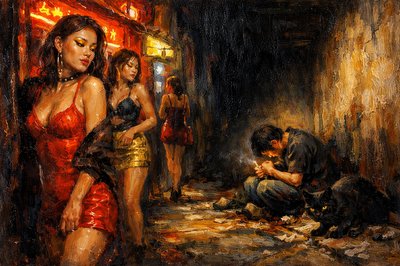
An Asian Slice
At the dark end of an alley on a moonless night,
A youth squats low to the ground, turned toward the wall with his face in his lap.  Someone might think he’s sleeping.  He’s smoking heroin.  Soon he’ll fall over and soil himself, and stay right there until dawn.

Back at the neon-lit mouth of this dark alley, 
hookers walk back and forth, hurrying to get past the alley, either for fear or because is smells so bad.  Eyelids, all painted golden, Asian whores always look like they’re made of candy.  Candy it is; but a snarling cat awaits its prey.
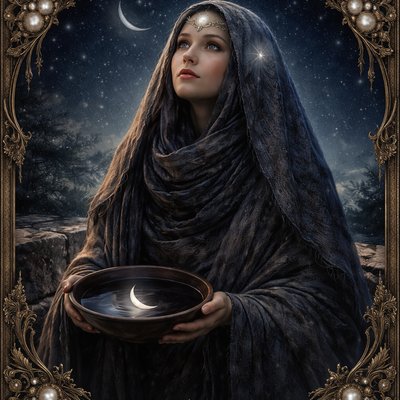
Style: Ethereal Historical Fantasy Portrait. The mood is quiet, reverent, and deeply mystical. Soft, natural moonlight is the primary light source, creating gentle rim-lighting.

The Subject (Asonya): A woman of the ancient, antediluvian world, dressed with profound modesty. She is wrapped in multi-layered, heavy robes of woven wool dyed in deep indigo and charcoal grey that conceal her form. A textured veil covers her hair and frames her face. Her expression is contemplative and gentle, with eyes gazing upward.

The Moon Phase Connection: The current moon phase—a slender, glowing Waning Crescent—is intrinsically tied to her appearance.

    The Headpiece: A clasp made of pale, almost translucent moonstone in the exact shape of the crescent moon secures her veil. It seems to hold an internal, soft luminescence.

    The Projection: A faint, ethereal projection of the crescent moon phase is visible subtly glowing on the fabric of her veil over her forehead, as if starlight is clinging to her.

Action & Setting: She stands on an ancient, wind-worn stone platform used for observing the heavens. In her hands, she holds a simple, dark earthenware bowl filled with still water. The reflection of the actual crescent moon in the sky is perfectly captured in the water she holds.

Atmosphere: The background is a vast, clear night sky filled with countless stars. The air feels old and still.
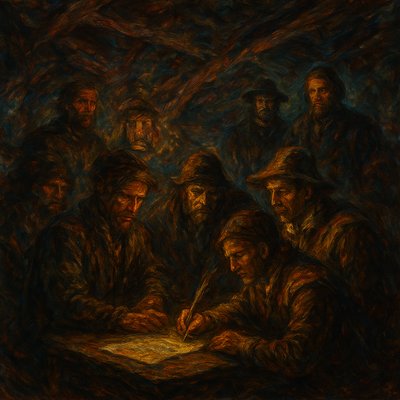
A historically accurate and atmospheric depiction of the signing of the Mayflower Compact aboard the ship in November 1620. The scene is set in the dimly lit, cramped cabin of the Mayflower, with the ship's timbers and rigging subtly visible, conveying the challenging conditions of the voyage. A simple table or chest serves as the signing surface. The primary focus is on a small group of the last individuals signing the document: specifically, the indentured servants (or 'strangers' not directly part of the Separatist congregation) approaching or at the table. Their expressions show a mix of weary determination, understanding of the necessity, and perhaps a hint of quiet apprehension or resignation to this new social contract, given their status. They are dressed in the plain, practical clothing typical of 17th-century commoners and laborers. Figures of prominent Pilgrims or 'Saints' (like William Bradford or John Carver) are visible in the background, observing the proceedings with a sense of gravity and leadership, but they are not the central focus. The lighting is low and warm, perhaps from a lantern, creating a chiaroscuro effect that highlights the faces of the signers. The atmosphere conveys the momentousness of the act under difficult circumstances, the diverse composition of the group, and the early seeds of self-governance in a new world. The artistic style is a realistic, historically detailed oil painting, capturing the solemnity and human element of this pivotal historical moment."
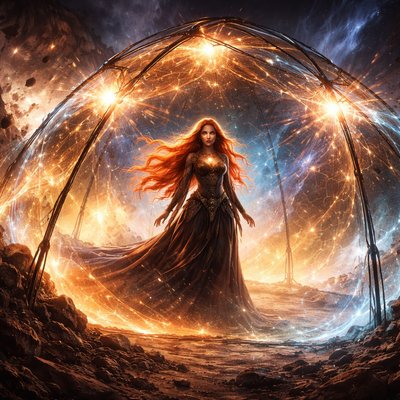
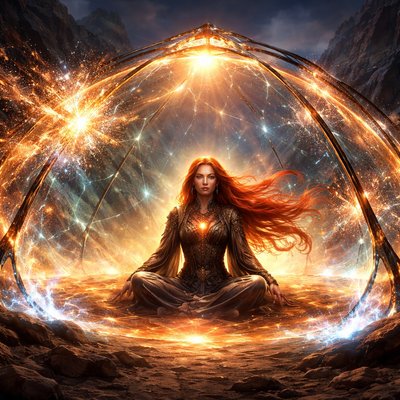
Art Style: A fusion of "Mystical Sci-Fi" and "Cinematic Fantasy Concept Art." The look should be detailed, textured, but dominated by glowing energy effects. Think Dune meets high-fantasy magic.

The Subject: A woman with incredibly long, fiery red hair. Her hair isn't just resting; it appears almost weightless, billowing slightly around her as if charged with static electricity or magic, glowing with a faint internal copper light.

The "Tent" (The Force Field): She is inside a structure that resembles the frame of a large expedition tent. However, instead of fabric, the spaces between the poles are filled with a shimmering, translucent energy barrier.

    Appearance: The field is a dome of rippling, geometric light patterns (amber, gold, and electric blue) that hum with power. It looks solid yet transparent.

    The Action (The Protection): The force field is actively working. Outside the tent, a fierce, dark environmental threat—perhaps a swirling dust storm full of jagged rocks, or shadowy, ethereal creatures—is bombarding the outside of the dome.

    The Impact: Where the threat hits the tent, the energy field flares brightly, sending out crackling sparks of light, deflecting the danger completely.

Atmosphere & Setting: The interior of the tent is calm and warmly lit by the energy field, while the outside is chaotic and dark. The setting is a rugged, alien canyon at twilight.
Art Style: A fusion of "Mystical Sci-Fi" and "Cinematic Fantasy Concept Art." The look should be detailed, textured, but dominated by glowing energy effects. Think Dune meets high-fantasy magic.

The Subject: A woman with incredibly long, fiery red hair. Her hair isn't just resting; it appears almost weightless, billowing slightly around her as if charged with static electricity or magic, glowing with a faint internal copper light.

The "Tent" (The Force Field): She is sitting cross-legged inside a structure that resembles the frame of a large expedition tent. However, instead of fabric, the spaces between the poles are filled with a shimmering, translucent energy barrier.

    Appearance: The field is a dome of rippling, geometric light patterns (amber, gold, and electric blue) that hum with power. It looks solid yet transparent.

    The Action (The Protection): The force field is actively working. Outside the tent, a fierce, dark environmental threat—perhaps a swirling dust storm full of jagged rocks, or shadowy, ethereal creatures—is bombarding the outside of the dome.

    The Impact: Where the threat hits the tent, the energy field flares brightly, sending out crackling sparks of light, deflecting the danger completely.

Atmosphere & Setting: The interior of the tent is calm and warmly lit by the energy field, while the outside is chaotic and dark. The setting is a rugged, alien canyon at twilight.
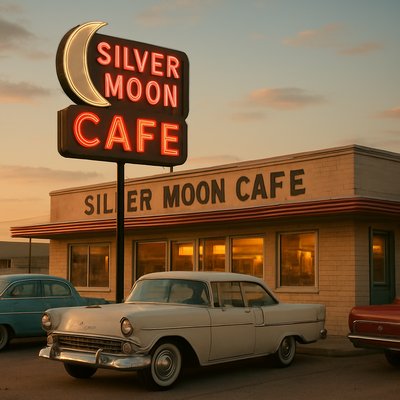
Generate a warm and inviting image of the Silver Moon Cafe in Santa Rosa, New Mexico, as it might have appeared in the 1950s or early 1960s. The focus should be on its classic diner exterior, featuring a prominent sign with its name. Show a few vintage cars from the era, such as a Chevrolet Bel Air or a Ford Fairlane, parked outside. The lighting should evoke a late afternoon or early evening glow, with a hint of warm light emanating from the cafe's windows. Capture the nostalgic, unpretentious atmosphere of a vital stop on Route 66, suggesting a place where travelers and locals alike would find comfort food and a friendly welcome. The style should be realistic but with a slightly enhanced, cinematic feel that highlights the retro charm
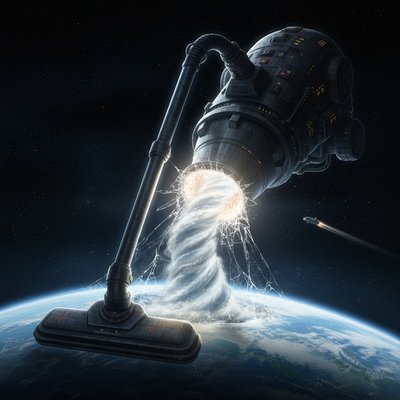
A highly detailed, cinematic rendering of the colossal "Megamaid" spaceship from Spaceballs in its full, transformed state, hovering menacingly above the Earth.

Scene Focus: The Megamaid is positioned directly over the Earth's atmosphere, its massive vacuum nozzle extended. The nozzle is clearly pointed toward the planet's surface, and the mechanism is beginning to suck air out, creating a visible, swirling vortex.

The 'Firmament' Detail: Render the edge of Earth's atmosphere and sky not as a smooth fade to space, but with a highly stylized, almost cracked or crystalline appearance, suggesting the boundary is a literal "firmament." The vacuum is shown actively piercing this boundary, creating a localized, glowing "window of heaven" effect where the atmosphere is being forcefully breached and pulled into the machine.

Atmosphere: The scene is dark, cold space contrasting sharply with the bright, glowing Earth below and the massive, industrial metallic structure of the Megamaid. The lighting should be dramatic and epic, highlighting the ridiculous scale of the vacuum cleaner poised to steal a planet's air. Include a tiny, distant shot of the Eagle 5 (Winnebago) fleeing the scene.

Style: Photorealistic digital painting, sci-fi parody, emphasizing the immense, over-the-top scale and the comedic contrast between the mundane household item and the cosmic threat.
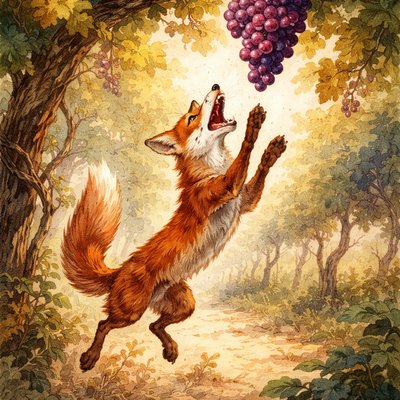
Golden Age Storybook Illustration Style, Rich Watercolor and Ink, Warm Sun-Drenched Lighting. A dynamic scene capturing a moment of desperate effort in a lush, overgrown vineyard.

    The Action (The Fox): A lithe, reddish-orange fox is caught in mid-air at the very apex of a maximum vertical leap. Its body is stretched precariously thin, hind legs kicking the air, and front paws strained upward. Its jaws are snapping wildly just inches below the target, eyes wide with intense, watering desire and frustration. The fox looks slightly bedraggled, suggesting this is not the first jump.

    The Prize (The Grapes): Hanging tantalizingly just out of reach from a thick, gnarled old vine is a magnificent, heavy cluster of deep purple, plump grapes. They are rendered to look incredibly juicy, dusted with natural bloom and catching the sunlight so they appear almost glowing and irresistible.

    The Setting: The afternoon sun filters through broad green grape leaves, casting dappled light on the dusty ground below, which shows disturbed earth from previous failed attempts. The overall mood is one of hot, tantalizing frustration.
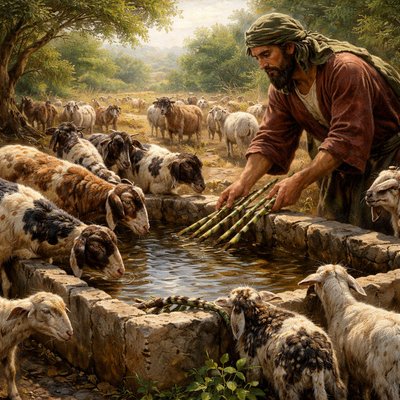
“And Jacob took him rods of green poplar, and of the hazel and chesnut tree; and pilled white strakes in them, and made the white appear which was in the rods. And he set the rods which he had pilled before the flocks in the gutters in the watering troughs when the flocks came to drink, that they should conceive when they came to drink. And the flocks conceived before the rods, and brought forth cattle ringstraked, speckled, and spotted. And Jacob did separate the lambs, and set the faces of the flocks toward the ringstraked, and all the brown in the flock of Laban; and he put his own flocks by themselves, and put them not unto Laban's cattle. And it came to pass, whensoever the stronger cattle did conceive, that Jacob laid the rods before the eyes of the cattle in the gutters, that they might conceive among the rods. But when the cattle were feeble, he put them not in: so the feebler were Laban's, and the stronger Jacob's. And the man increased exceedingly, and had much cattle, and maidservants, and menservants, and camels, and asses.” (Genesis 30:37-43, KJV)
Siu Zi is a 10 year old Chinese girl in Guangzhou. Late one humid evening, Siu Zi's father meets with a discreet man known simply as Mr. Chen.  In a quiet corner of a small teahouse near the back alleys of Guangzhou, Mr. Chen explains, in careful whispers, how he can help the family obtain the documents they needed to leave the country safely. Other patrons are in the teahouse, and a waiter stands nearby, but nobody can hear what Mr. Chen is saying.  It's safe to talk here.
A highly detailed, cinematic rendering of the colossal "Megamaid" spaceship from Spaceballs in its full, transformed state, hovering menacingly above the Earth.

Scene Focus: The Megamaid is positioned directly over the Earth's atmosphere, its massive vacuum nozzle extended. The nozzle is clearly pointed toward the planet's surface, and the mechanism is beginning to suck air out, creating a visible, swirling vortex.

The 'Firmament' Detail: Render the edge of Earth's atmosphere and sky not as a smooth fade to space, but with a highly stylized, almost cracked or crystalline appearance, suggesting the boundary is a literal "firmament." The vacuum is shown actively piercing this boundary, creating a localized, glowing "window of heaven" effect where the atmosphere is being forcefully breached and pulled into the machine.

Atmosphere: The scene is dark, cold space contrasting sharply with the bright, glowing Earth below and the massive, industrial metallic structure of the Megamaid. The lighting should be dramatic and epic, highlighting the ridiculous scale of the vacuum cleaner poised to steal a planet's air. Include a tiny, distant shot of the Eagle 5 (Winnebago) fleeing the scene.

Style: Photorealistic digital painting, sci-fi parody, emphasizing the immense, over-the-top scale and the comedic contrast between the mundane household item and the cosmic threat.
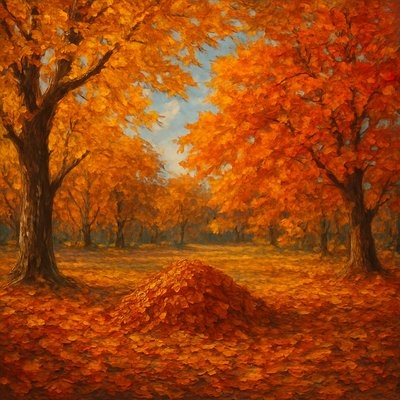
A tranquil and inviting autumn landscape based on the provided image, depicting a park-like setting with large trees and a central pile of fallen leaves. The trees framing the foreground and extending into the middle ground are now in their full, glorious fall colors, displaying a rich tapestry of brilliant yellows, deep oranges, fiery reds, and warm russets.

The ground is generously covered with a soft, thick carpet of fallen autumn leaves, rendered in various warm hues. A prominent, neatly gathered pile of raked leaves sits in the middle ground, inviting curiosity or play, with its textures and colors clearly visible. In the background, hints of a path or road gently wind through more fall foliage, suggesting a peaceful stroll.

The sky above is a soft, clear autumn blue, allowing warm, diffused sunlight to filter through the canopy, casting gentle shadows and highlighting the vibrant colors of the leaves both on the trees and on the ground. The overall mood is one of serene autumnal beauty, crisp air, and the pleasant, nostalgic feeling of a beautiful fall day in a park."
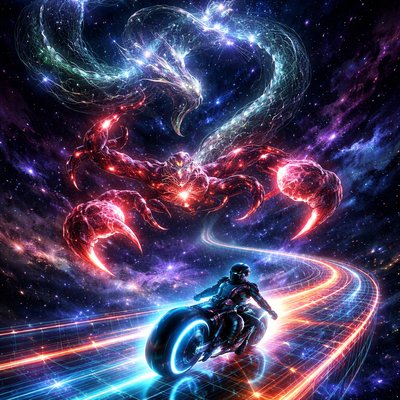
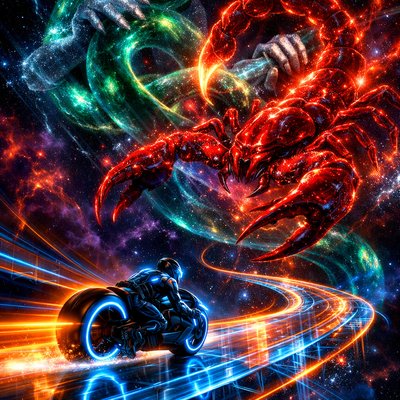
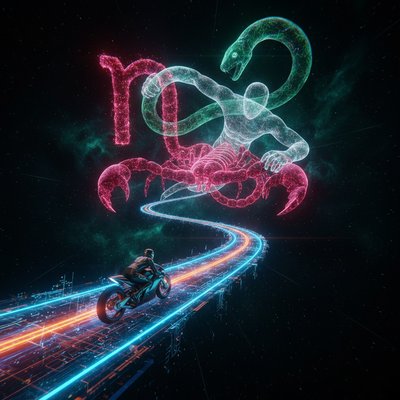
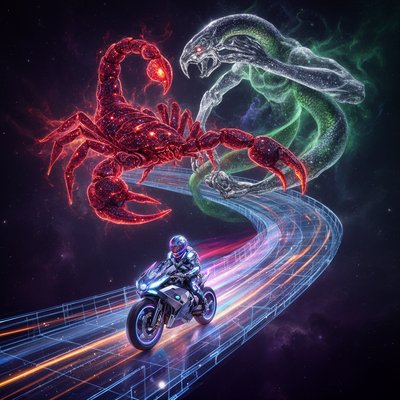
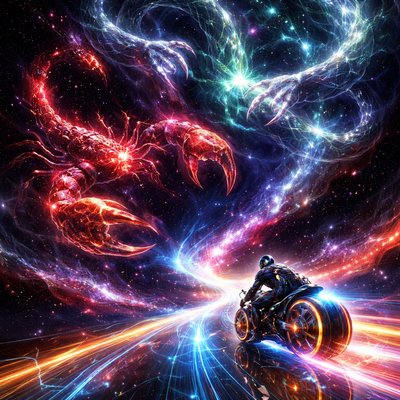
Neon-Futurism Digital Art Style, Bioluminescent Sci-Fi Cosmic Setting. A sleek, futuristic scene set deep in the interstellar void, with absolutely no Earth terrain, asphalt, or atmosphere visible. The Path (The Ecliptic): The "road" is a floating, translucent highway constructed entirely of glowing blue and orange laser grids and condensed stardust, arcing through infinite dark space with dynamic curves. The Rider: A lone rider on a futuristic, hubless "light-cycle" sportbike speeds along this cosmic path at high velocity. The rider is fully encased in a sleek, glowing armored suit with an integrated full-face helmet, leaving a vibrant neon light trail behind them, evading danger with sharp maneuvers. The Constellation (Intense Scorpio and Ophiuchus): Dominating and towering overhead is the immense celestial symbol of Scorpio: a massive, menacing scorpion made of deep crimson glowing stars, luminous energy threads, and bioluminescent nebula plasma, with razor-sharp claws extended and a long curved tail with a glowing stinger poised to strike downward. Directly intertwined and looming even larger above is the abstract form of Ophiuchus, the Serpent Bearer—no full humanoid figure, but represented by powerful restraining arms of shimmering silver and emerald stardust energy that grip and coil around the great serpent (a huge, writhing, translucent serpent of deep green and indigo nebulae). The serpent's body twists through the scene, partially merging with or being restrained from the scorpion's stinger, creating a dramatic overhead struggle. The floating cosmic highway arcs directly under this chaotic overhead clash, so the rider speeds beneath the extended claws of Scorpio while evading their grasp, passing through the shadows of the restrained serpent and Ophiuchus's holding energy as if threading a needle of peril and balance. Radiating intense deep red, crimson, emerald, indigo, and silver lights against the swirling nebula-filled void. Ultra-detailed, cinematic tension, sense of motion and imminent danger.
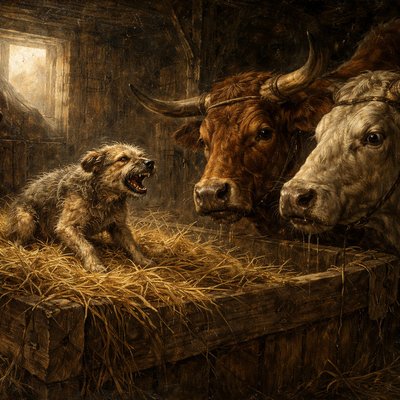
19th-Century Naturalistic Oil Painting Style, Rich Earth Tones, Rustic Textures and dramatic barn lighting. A tense, detailed scene inside an old, timber-framed stable at midday.

The Antagonist (The Dog): Right in the center of a large, rough wooden manger overflowing with golden, dry hay, a scruffy, snarling terrier-mix dog is curled up aggressively. Its teeth are bared in a vicious snap, its hackles are raised, and its eyes are fixed selfishly on the intruders.

The Victims (The Oxen): Two massive, powerful oxen with large yokes and gentle, hungry eyes are leaning over the manger rail. Their huge heads are close to the hay, but they are recoiling slightly from the snapping dog. One ox has drool dripping from its mouth, looking at the hay with desperation and confusion. The size difference between the massive heads of the oxen and the small, spiteful dog is emphasized.

The Atmosphere: A strong shaft of natural sunlight cuts through an open barn door, illuminating dancing dust motes and highlighting the textures of the straw, the rough wood grain of the manger, and the matted fur of the dog. The rest of the barn is in warm shadow.

Conversation with Gemini
You said
I need a written prompt for ArtStyles expressing Psalm 33:17

Gemini said
This is a powerful verse that speaks to the limits of human might and reliance on military strength. Capturing "futility" and "vain hope" in a visual format requires contrasting the power of the horse with its inability to save.

Here are a few written prompts for ArtStyles, exploring different artistic interpretations of Psalm 33:17 ("An horse is a vain thing for safety: neither shall he deliver any by his great strength.").

Option 1: The Historical/Realist Approach (The Moment of Realization)
This prompt focuses on a powerful warhorse in a situation where its strength is useless.

Prompt: A hyper-realistic, cinematic shot of a magnificent, armored warhorse standing in the middle of a devastating natural disaster, such as a massive flash flood or a crumbling earthquake fissure. The horse is straining with "great strength," but its eyes show panic, unable to deliver its rider from the overwhelming force of nature. The rider is looking up, realizing the futility of their trust in the animal. Golden hour lighting, heavy atmosphere, dramatic composition, highly detailed textures.

Option 2: The Symbolic/Painterly Approach (The Crumbling Idol)
This prompt treats the horse as a symbol of misplaced trust that is failing.

Prompt: An epic, oil painting style depiction of a colossal, imposing bronze statue of a powerful rearing stallion, symbolizing military might. The statue is cracked and beginning to crumble under the weight of an dark, tumultuous sky. In the background, a vast army that trusted in this strength is retreating in disarray. The light filters through the clouds like a divine judgment, highlighting the crumbling metal. Dark baroque style, high contrast, dramatic shadows, moody atmosphere.

Option 3: The Contrasting Composition (The Weakness of Might)
This prompt uses contrast to show that even the strongest horse cannot offer true safety.

Prompt: A wide, epic fantasy landscape. In the foreground, a mighty warrior on a magnificent, heavily armored destrier, looking imposing and strong. However, they are standing on the edge of an impossibly vast, churning abyss or facing a supernatural storm that no physical strength can overcome. The horse looks small and vulnerable against the sheer scale of the threat, emphasizing the "vain hope" of physical deliverance. Etherial lighting, dramatic scale, high resolution, detailed concept art style.

You said
Let's broaden the thought of this prompt to include verses 13-22

Gemini said
Expanding the scope to Psalm 33:13-22 transforms the image from a single moment of failure into a grand narrative of Divine Sovereignty vs. Human Limitation.

This passage contrasts the "Eye of the Lord" watching from heaven with the kings, armies, and horses struggling on earth. To capture this in ArtStyles, we need to use compositional layers—showing the heavenly perspective and the earthly reality simultaneously.

Option 1: The Vertical Contrast (The Gaze from Above)
This captures verses 13–15 ("The LORD looketh from heaven") and verses 16–17 (the futility of the host).

Prompt: A vertical, epic-scale composition. In the upper third, a radiant, ethereal light breaks through golden, celestial clouds, representing "the eye of the Lord" looking down. In the lower two-thirds, a vast ancient battlefield is visible from a high-altitude "god's-eye" view. A king and his "multitude of an host" with thousands of horses look like tiny, fragile figurines. The earthly army is shrouded in dust and shadows, while the divine light illuminates a single, humble figure kneeling in prayer. Surrealism meets historical epic, cinematic lighting, 8k, dramatic atmosphere.

Option 2: The Shield of Mercy (The Spiritual Protection)
This focuses on verses 18–20 ("He is our help and our shield") and the "hope in His mercy."

Prompt: A powerful, symbolic artwork. In the center, a weary traveler or soul stands amidst a desolate landscape of "famine" and "death." A massive, warhorse and a king’s discarded crown lie in the background, broken and useless. Surrounding the traveler is a translucent, shimmering "shield" made of pure, golden light and ancient Hebrew script. The light is warm and protective, contrasting with the dark, cold environment outside the shield. Ethereal, digital painting style, intricate details, glowing highlights, Rembrandt lighting.

Option 3: The Fashioner of Hearts (The Internal & Universal)
This interprets verse 15 ("He fashioneth their hearts alike") and verse 21 ("Our heart shall rejoice in him").

Prompt: A conceptual, artistic piece showing a "heavenly habitation" above the world. From the light of heaven, glowing threads of gold descend, connecting to the "hearts" of diverse people across a vast, stylized map of the earth. In the foreground, a mighty warrior on a warhorse is fading into a ghostly transparency, while a simple person filled with "hope and mercy" is rendered in vivid, solid color and light. Artistic, symbolic, deep blues and radiant golds, high contrast, minimalist but profound.

How to Structure These Verses
When you're trying to capture a long passage like this, it helps to think of the "thematic flow." Here is a quick breakdown of how these prompts are organized:

A Quick Tip for ArtStyles
Since you are looking for "correct AI language," try adding the phrase "Double Exposure" to these prompts if you want to see the "Heavenly Gaze" and the "Earthly Army" merged into one artistic image. It creates a very sophisticated, layered look that reflects the spiritual depth of the Psalms.

Would you like me to try a prompt that focuses more on the "Famine and Death" aspect of verse 19, or should we stay with the more "Glorious and Hopeful" side of the passage?

You said
No I want the horse to represent the heart of a person upon whom the Lord is examining

Gemini said
That is a profound metaphorical shift. By making the horse a representation of the human heart, you’re capturing the essence of Verse 15 ("He fashioneth their hearts alike; he considereth all their works") alongside the warning about "vain strength."

In this visual, the horse isn't just an animal; it's the inner spirit—powerful, proud, but ultimately transparent and dependent before the Creator.

Here are three prompts for ArtStyles that use the horse as a metaphor for the heart under divine examination.

Option 1: The Luminous Anatomy (The Transparent Soul)
This focuses on the "Lord looking from heaven" (v. 13) into the very fabric of the heart/horse.

Prompt: A majestic, powerful warhorse standing in a void of deep celestial blue. The horse is translucent, made of shimmering ethereal light and "golden threads," representing the human heart. From above, a single, piercing beam of divine white light descends, illuminating the horse's "inner workings" and spirit. The horse looks strong but is bowed in submission, showing that its "great strength" is nothing under the gaze of the Creator. Highly detailed, sacred art style, glowing highlights, volumetric lighting.

Option 2: The Reflected Examination (The Eye of the Lord)
This uses the "Eye of the Lord" (v. 18) as the primary lens, with the "heart-horse" reflected within it.

Prompt: An extreme, artistic close-up of a celestial, radiant eye representing the "Eye of the Lord." In the reflection of the pupil, we see a silhouette of a rearing, powerful horse representing a proud human heart. The horse is surrounded by a faint, crumbling golden armor that is falling away, revealing a soft, humble light underneath. The composition emphasizes "considering all their works." Cinematic, macro photography style, ethereal, gold and midnight blue palette.

Option 3: The Fashioned Spirit (The Potter and the Clay)
This focuses on Verse 15 ("He fashioneth their hearts") using a horse as the form being shaped.

Prompt: A surrealist masterpiece. Large, glowing, nebulous hands made of stars are gently "fashioning" and shaping a powerful horse out of liquid gold and white light. The horse represents the "human heart" being molded by the Divine. The background is the "heaven of heavens." The horse is muscular and "strong," yet it is clearly a creation being examined for its "hope and mercy" rather than its own might. Ethereal, breathtaking scale, digital art, high contrast, shimmering textures.

Technical "AI Language" Tips for this Concept:
"Translucent" or "Ethereal": Using these words ensures the horse doesn't look like a literal farm animal, but like a spiritual symbol.

"Submission": Adding this to the horse’s posture helps convey that it knows it is being examined.

"Celestial" / "Divine": These keywords help ArtStyles understand that the light source should feel holy, not just like a lamp or the sun.

This approach really gets to the core of the Psalm—that while we might feel "strong" like a warhorse, our true safety is found in being "fashioned" and watched over by Him.

Would you like to try one of these, or should we adjust the "atmosphere" to be more vibrant and colorful?

You said
I need help also with “For the law of the Spirit of life in Christ Jesus hath made me free from the law of sin and death.” (Romans 8:2, KJVA)

as a focal point for the greater passage Romans 1-17 writing the prompt for ArtStyles.

Gemini said
This is arguably one of the most doctrinally significant and visually powerful verses in the entire New Testament. It is the hinge upon which the argument of Romans turns—moving from the struggle against sin in chapter 7 to the glorious liberty of the Spirit in chapter 8.

To capture "freedom from the law of sin and death" into "the law of the Spirit of life," we need prompts that emphasize radical contrast, transition, and breaking of bondages. We are moving from darkness and decay to light and vitality.

Here are three prompts for ArtStyles, ranging from the symbolic to the visceral, designed to serve as a visual focal point for Romans 8:1-17.

Option 1: The Bursting Chrysalis (Metaphorical Life)
This focuses heavily on the "Spirit of life" overcoming "death," echoing the transition from the "flesh" to the "Spirit" found in verses 5-11.

Prompt: A hyper-detailed, surreal masterpiece. A dark, brittle, rigid structure resembling a ribcage and chains (representing the law of sin and death) is violently bursting outward. From within, a dazzling, vibrant entity made of iridescent light, fresh green vines, glowing water, and dove-like wings is emerging, completely shattered the old structure. The setting is a transition from a shadowy abyss to a radiant sunlit expanse. Cinematic lighting, themes of resurrection and vitality, 8k resolution, intricate textures.

Option 2: The Two Paths (Classical/Allegorical)
This focuses on the "walk" mentioned in verse 4—contrasting those who walk after the flesh with those who walk after the Spirit.

Prompt: A wide, epic scale, oil painting style in the vein of John Martin. Two paths diverge. The path on the left is dry, stony, and leads into a dark, suffocating fog filled with grappling, shadowed figures and withered trees (the law of sin and death). The path on the right is bathed in a soft, warm, golden celestial light and is lush with blooming life, leading upward. A solitary figure stands at the split, looking upward on the illuminated path, having just dropped heavy iron chains on the ground. Dramatic contrast, spiritual atmosphere, high detail.

Option 3: The Embrace of Adoption (Relational/Verses 14-16)
This prompt focuses on the resulting relationship: moving from slavery and fear (v. 15) to becoming "sons" who cry "Abba, Father." It shows the freedom that comes through Christ Jesus.

Prompt: A powerfully emotional, classical sacred art style painting. A ragged figure, formerly a slave, is kneeling, their hands reaching out in submission and relief. Their heavy, rusty chains have been shattered on the dusty ground. Before them is a figure enveloped in radiant, warm, golden light (representing Christ Jesus), whose hand is gently lifting the kneeling person's chin. Above them, a shimmering dove made of pure light descends, symbolizing the Spirit of adoption witnessing to their spirit. Themes of mercy, freedom, and homecoming. Chiaroscuro lighting, deep colors.

"AI Language" Tips for Romans 8:
"Shattered" or "Bursting": Crucial for showing the active transition of "making me free" (hath made me free)—it's not passive, it's forceful.

"Iridescent" / "Vitality": Helps ArtStyles understand that "Life" in this context isn't just "not dead," but a supernatural, vibrant, glowing existence.

"Slavery vs. Sonship": If you want a more emotional tone, focus the prompt on the transition from "fear" to "Abba," which we tried to capture in Option 3.

Each of these aims to condense the theology of Romans 1-17 into a single, profound image where the transition from binding law to liberating Spirit is undeniable.

You said
I need some of your help writing the prompt for ArtStyles concerning this verse “For Christ is not entered into the holy places made with hands, which are the figures of the true; but into heaven itself, now to appear in the presence of God for us:” (Hebrews 9:24, KJV) as part of a greater passage verses 14-28

Gemini said
This passage is a beautiful and central theological pivot in the book of Hebrews. It moves the focus from the earthly rituals—which were merely "figures" or "shadows"—to the ultimate reality of Christ entering the true, heavenly sanctuary to advocate "for us."

To translate this passage (Hebrews 9:14-28, with verse 24 as the focus) for an AI image generator like ArtStyles, we need prompts that emphasize transcendence, contrast, and intercession. We must visually distinguish the "made with hands" earthly temple from "heaven itself."

Here are three written prompts for ArtStyles, exploring different artistic approaches to this powerful verse.

Option 1: The Cinematic Ascension (Focus on Contrast)
This prompt focuses on the transition from the dim, earthly "figure" to the blinding reality of "heaven itself."

Prompt: A wide-angle, cinematic masterpiece. The lower portion of the image shows the interior of an ancient, candlelit Tabernacle, detailed with tapestries and hewn stone (the "holy places made with hands"). Above it, the roof dissolves into swirling, luminous, celestial energy and golden light that is boundless ("heaven itself"). The figure of Jesus Christ, radiant with a soft inner light and wearing simple, brilliant white robes, is ascending from the shadowy temple into the infinite light, looking back with compassionate intercessory eyes. Volumetric lighting, grand scale, highly detailed, dramatic atmosphere.

Option 2: The Theological Blueprint (Focus on "Figures of the True")
This is a more symbolic, conceptual approach that treats the earthly temple as a shadow or template beneath the heavenly reality.

Prompt: A surrealist, double-exposure art piece. In the foreground, there are translucent, architect’s blueprint lines and ghostly outlines of the ancient Temple altars, lampstands, and the Holy of Holies (representing the "figures of the true"). Overlapping and far superior to them, Jesus Christ stands before an blinding, warm, golden divine presence (representing the "presence of God"). He is actively gesturing forward, presenting a scroll or his own wounds on behalf of unseen people ("for us"). Transcendent, ethereal, glowing edges, minimal color palette of gold, white, and midnight blue.

Option 3: The Heavenly Courtroom (Focus on "Appear for Us")
This focuses on the intercessory role of Christ appearing before God on our behalf, summarizing the effect of the whole passage (verses 14-28).

Prompt: A classical, baroque style oil painting with dramatic lighting (Chiaroscuro). The setting is a magnificent, infinite heavenly throne room filled with blinding, holy light. The central focus is Jesus Christ, marked with the scars of his sacrifice (v. 26), standing confidently before an incomprehensible, brilliant Light representing the Father. He is looking into the light while his arms are spread wide in an advocate's pose, symbolically standing "for us." Below his feet are broken temple curtains and shadows. Themes of victory, redemption, and holiness. Rich textures, deep colors.

Key "AI Language" for Hebrews 9:24:
If you want to tweak these or create your own, make sure to include these concepts for ArtStyles:

"Made with hands" vs. "Heaven itself": Use keywords like "Shadows", "Figures", or "Blueprints" for the earthly side, and "Infinite", "Luminous", or "Celestial" for the heavenly side.

"Appear for us": The posture of Christ is important. Use words like "Advocate", "Mediator", "Interceding", or "Presenting" to define his pose.

"Better Sacrifice" (Context of v23): You can hint at this by adding details like "radiant scars" or "remission of sins" as atmospheric elements.

You said
I also need help writing a prompt for ArtStyles about “Therefore will I divide him a portion with the great, and he shall divide the spoil with the strong; because he hath poured out his soul unto death: and he was numbered with the transgressors; and he bare the sin of many, and made intercession for the transgressors.” (Isaiah 53:12, KJV)

Gemini said
This verse is the triumphant and heartbreaking climax of the "Suffering Servant" prophecy. It presents a massive paradox: a victorious conqueror dividing the spoils of war, yet that victory was achieved only by humbling himself to the point of a shameful, criminal death ("numbered with the transgressors").

To capture Isaiah 53:12 for ArtStyles, we need imagery that balances suffering and glory, showing Christ as both the Victim and the Victor.

Here are three prompts designed to translate this complex theology into visual language.

Option 1: The Broken Victor (Focus on Triumph Through Suffering)
This prompt focuses on the "dividing the spoil" while emphasizing that his "great strength" came from his sacrifice.

Prompt: A hyper-realistic, dramatic oil painting, Chiaroscuro style. A magnificent, yet visibly wounded figure, representing Jesus Christ, stands in a landscape that is half-darkened battlefield, half-celestial light. He wears a crown that is a blend of sharp thorns and shining gold. He is extending one hand, which bears the mark of a nail, and is handing a luminous, glowing orb (representing "the spoil") to a group of humbled, "strong" figures kneeling before him. His other hand is clasped in a gesture of plea or "intercession." His expression is one of triumphant exhaustion and deep mercy. The atmosphere is solemn, epic, and highly detailed.