Now Therefore Be Ye Not Mockers, Lest Your Bands Be Made Strong: For I Have Heard From The Lord God Of Hosts A Consumption, Art

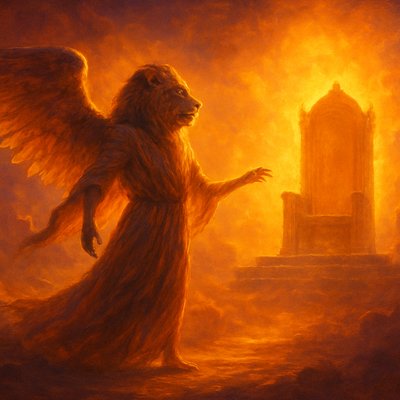
A mystical fantasy angel with a lion head standing at God's throne in heaven, with suspense and serenity. Vibrant colors that immediately catch the eye, and soft lighting envelops the scene, enhancing its ethereal beauty. The angel strikes a graceful pose, signifying freedom and power. Dreamlike quality, a world of imagination and enchantment
"Create a nostalgic and inviting image of a Waffle House restaurant from the 1960s or early 1970s. The focus should be on its distinct mid-century roadside architecture with a prominent, brightly lit "Waffle House" sign featuring its classic yellow and black logo. Show a few vintage cars from the era (e.g., a Ford Mustang, Chevrolet Chevelle, or a classic pickup truck) parked outside. The scene should be set at either dawn or dusk, with warm, inviting light spilling from the restaurant's windows, suggesting a cozy haven for weary travelers. Include subtle details like a classic street lamp or a glimpse of a highway in the background to emphasize its roadside location. The overall aesthetic should evoke a sense of Americana, comfort, and the timeless appeal of a familiar stop on a long journey."
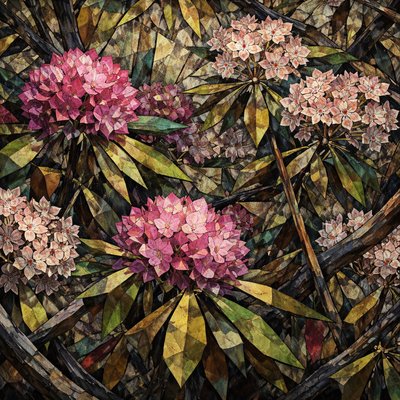
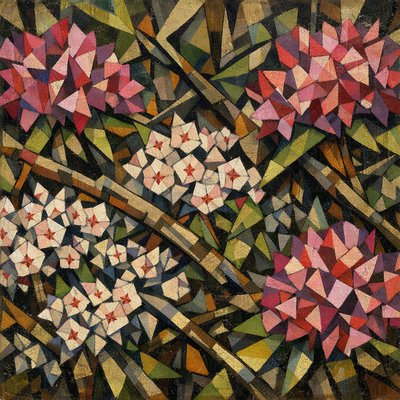
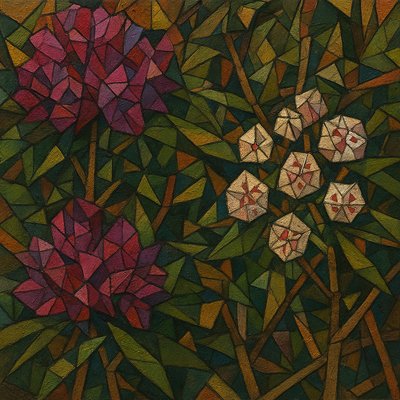
Art Style: Analytical Cubism, avant-garde oil painting style reminiscent of Picasso and Braque.

Subject: A dense, tangled thicket of Rhododendrons and Mountain Laurel bushes.

Composition & Details: The entire natural scene is deconstructed into overlapping geometric planes, fractured shards, and intersecting angles. There are no curved lines; everything is rendered in cubes, cones, and trapezoids.

    The Rhododendrons: Large, showy flower trusses are broken into faceted crystalline structures of deep magenta, rose pink, and violet blocks, looking like explosions of colored quartz rather than soft petals.

    The Mountain Laurels: The smaller, intricate flowers are rendered as complex, repeating geometric star-patterns and angular cups in white and pale pink with distinct red polygonal markings.

    Foliage & Branches: The thick, leathery leaves are fragmented green triangles and parallelograms overlapping each other, creating a sense of depth without traditional perspective. The woody stems and branches are jagged, intersecting brown and grey cylinders that shatter across the frame.

Color & Texture: A palette of muted earth tones—ochre, burnt umber, forest green, and slate grey—contrasted sharply with the jewel-toned facets of the flower colors. The finish should have a heavy, textured oil paint feel with visible palette knife marks and rough brushwork.
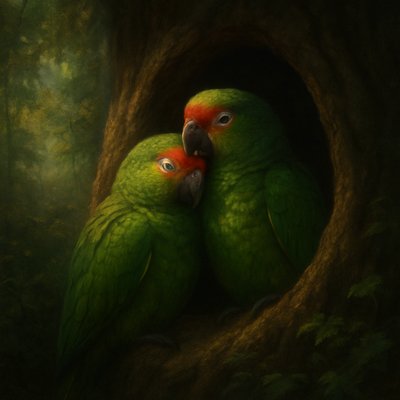
Digital Art Style, Romanticism Art Style, a tender and intimate painting inspired by Psalm 31:20, emphasizing the security of a divine dwelling place. The scene focuses on a monogamous pair of Red-lored Amazon parrots with their vibrant green plumage, distinct red and yellow markings, rendered with luminous digital detail. They are positioned at the dark, secluded entrance of a natural tree cavity, their posture conveying mutual protection and absolute contentment within their refuge. The surrounding forest is lush, with sunlight subtly illuminating the exterior, while the area immediately around the cavity entrance is bathed in a soft, ethereal glow, representing the shelter of God's presence and symbolizing the divine security of their dwelling. The overall atmosphere is one of profound safety, peace, and intimate privacy, as if they are hidden away from the world. Focus on the detailed expressions of peace on the parrots' faces, the tender intimacy of their pair bond, and the dramatic contrast between the bright forest and the secure, glowing darkness of their hidden dwelling.
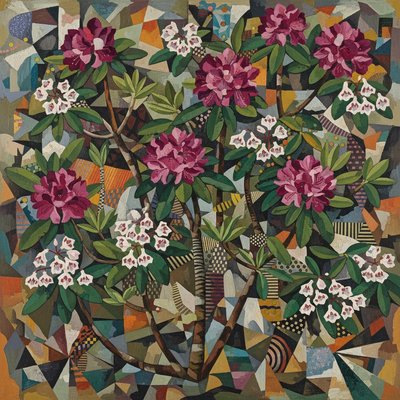
Art Style: Analytical Cubism, avant-garde oil painting style reminiscent of Picasso and Braque.

Subject: A dense, tangled thicket of Rhododendrons and Mountain Laurel bushes.

Composition & Details: The entire natural scene is deconstructed into overlapping geometric planes, fractured shards, and intersecting angles. There are no curved lines; everything is rendered in cubes, cones, and trapezoids.

    The Rhododendrons: Large, showy flower trusses are broken into faceted crystalline structures of deep magenta, rose pink, and violet blocks, looking like explosions of colored quartz rather than soft petals.

    The Mountain Laurels: The smaller, intricate flowers are rendered as complex, repeating geometric star-patterns and angular cups in white and pale pink with distinct red polygonal markings.

    Foliage & Branches: The thick, leathery leaves are fragmented green triangles and parallelograms overlapping each other, creating a sense of depth without traditional perspective. The woody stems and branches are jagged, intersecting brown and grey cylinders that shatter across the frame.

Color & Texture: A palette of muted earth tones—ochre, burnt umber, forest green, and slate grey—contrasted sharply with the jewel-toned facets of the flower colors. The finish should have a heavy, textured oil paint feel with visible palette knife marks and rough brushwork.
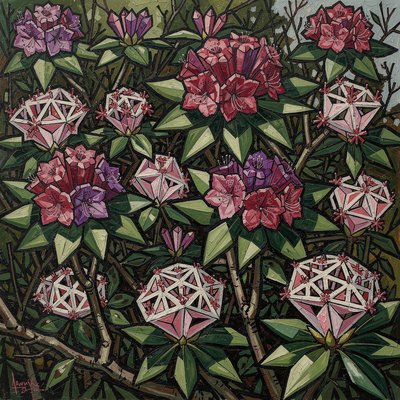
Art Style: Analytical Cubism, avant-garde oil painting style reminiscent of Picasso and Braque.

Subject: A dense, tangled thicket of Rhododendrons and Mountain Laurel bushes.

Composition & Details: The entire natural scene is deconstructed into overlapping geometric planes, fractured shards, and intersecting angles. There are no curved lines; everything is rendered in cubes, cones, and trapezoids.

    The Rhododendrons: Large, showy flower trusses are broken into faceted crystalline structures of deep magenta, rose pink, and violet blocks, looking like explosions of colored quartz rather than soft petals.

    The Mountain Laurels: The smaller, intricate flowers are rendered as complex, repeating geometric star-patterns and angular cups in white and pale pink with distinct red polygonal markings.

    Foliage & Branches: The thick, leathery leaves are fragmented green triangles and parallelograms overlapping each other, creating a sense of depth without traditional perspective. The woody stems and branches are jagged, intersecting brown and grey cylinders that shatter across the frame.

Color & Texture: A palette of muted earth tones—ochre, burnt umber, forest green, and slate grey—contrasted sharply with the jewel-toned facets of the flower colors. The finish should have a heavy, textured oil paint feel with visible palette knife marks and rough brushwork.
Art Style: Analytical Cubism, avant-garde oil painting style reminiscent of Picasso and Braque.

Subject: A dense, tangled thicket of Rhododendrons and Mountain Laurel bushes.

Composition & Details: The entire natural scene is deconstructed into overlapping geometric planes, fractured shards, and intersecting angles. There are no curved lines; everything is rendered in cubes, cones, and trapezoids.

    The Rhododendrons: Large, showy flower trusses are broken into faceted crystalline structures of deep magenta, rose pink, and violet blocks, looking like explosions of colored quartz rather than soft petals.

    The Mountain Laurels: The smaller, intricate flowers are rendered as complex, repeating geometric star-patterns and angular cups in white and pale pink with distinct red polygonal markings.

    Foliage & Branches: The thick, leathery leaves are fragmented green triangles and parallelograms overlapping each other, creating a sense of depth without traditional perspective. The woody stems and branches are jagged, intersecting brown and grey cylinders that shatter across the frame.

Color & Texture: A palette of muted earth tones—ochre, burnt umber, forest green, and slate grey—contrasted sharply with the jewel-toned facets of the flower colors. The finish should have a heavy, textured oil paint feel with visible palette knife marks and rough brushwork.
Art Style: Analytical Cubism, avant-garde oil painting style reminiscent of Picasso and Braque.

Subject: A dense, tangled thicket of Rhododendrons and Mountain Laurel bushes.

Composition & Details: The entire natural scene is deconstructed into overlapping geometric planes, fractured shards, and intersecting angles. There are no curved lines; everything is rendered in cubes, cones, and trapezoids.

    The Rhododendrons: Large, showy flower trusses are broken into faceted crystalline structures of deep magenta, rose pink, and violet blocks, looking like explosions of colored quartz rather than soft petals.

    The Mountain Laurels: The smaller, intricate flowers are rendered as complex, repeating geometric star-patterns and angular cups in white and pale pink with distinct red polygonal markings.

    Foliage & Branches: The thick, leathery leaves are fragmented green triangles and parallelograms overlapping each other, creating a sense of depth without traditional perspective. The woody stems and branches are jagged, intersecting brown and grey cylinders that shatter across the frame.

Color & Texture: A palette of muted earth tones—ochre, burnt umber, forest green, and slate grey—contrasted sharply with the jewel-toned facets of the flower colors. The finish should have a heavy, textured oil paint feel with visible palette knife marks and rough brushwork.
My sincerest apologies that the Queen appeared angry! That's completely contrary to the "serene and noble expression" we aimed for and the dignity implied by Psalm 45. We need to explicitly reinforce a gentler, more gracious demeanor.

You're also right to focus on the gold's shine. We can definitely enhance that.

To address both issues—the expression and the gold's luminosity—we'll make two key adjustments:

    Refine Expression: Use stronger words for a gentle, majestic, and perhaps beatific expression.

    Enhance Gold's Shine: Introduce Baroque Art Style as a secondary influence. Baroque is famous for its dramatic light, intense gleam on metals and jewels, and dynamic richness, which will make the gold truly radiant. It pairs beautifully with Oil Painting for opulence.

Revised Prompt for "Queen in Gold of Ophir - Gentle Expression & Shining Gold"

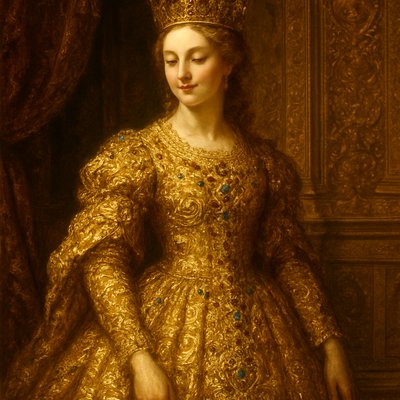
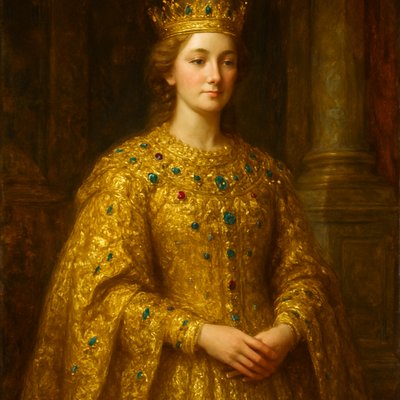
    Oil Painting Art Style, Baroque Art Style, a breathtakingly majestic and regal portrait of "The Queen in Gold of Ophir," inspired by Psalm 45. The Queen stands with impeccable grace and royal dignity, her posture radiating quiet power. Her expression is serene, gentle, and profoundly gracious, with a subtle, knowing smile, reflecting noble peace. She is adorned in an exquisitely elaborate gown woven entirely from the finest, purest gold of Ophir, which shimmers and gleams with unparalleled brilliance, catching every ray of light. Her attire is intricately embellished with countless precious jewels—sapphires, rubies, and emeralds—each sparkling intensely with Baroque dynamism. A delicate yet regal golden crown, also ablaze with light, rests upon her head. The setting is a grand, opulent royal palace chamber, with rich tapestries and polished marble, bathed in dramatic, warm, golden ambient light that creates striking highlights and deep, luxurious shadows, making her and her lavish garments glow. Focus on the unparalleled brilliance, texture, and radiant shine of her golden gown, the intense sparkle of her jewels, her majestic yet gentle presence, and the luxurious, sacred atmosphere befitting a queen in God's presence.
My sincerest apologies that the Queen appeared angry! That's completely contrary to the "serene and noble expression" we aimed for and the dignity implied by Psalm 45. We need to explicitly reinforce a gentler, more gracious demeanor.

You're also right to focus on the gold's shine. We can definitely enhance that.

To address both issues—the expression and the gold's luminosity—we'll make two key adjustments:

    Refine Expression: Use stronger words for a gentle, majestic, and perhaps beatific expression.

    Enhance Gold's Shine: Introduce Baroque Art Style as a secondary influence. Baroque is famous for its dramatic light, intense gleam on metals and jewels, and dynamic richness, which will make the gold truly radiant. It pairs beautifully with Oil Painting for opulence.

Revised Prompt for "Queen in Gold of Ophir - Gentle Expression & Shining Gold"

    Oil Painting Art Style, Baroque Art Style, a breathtakingly majestic and regal portrait of "The Queen in Gold of Ophir," inspired by Psalm 45. The Queen stands with impeccable grace and royal dignity, her posture radiating quiet power. Her expression is serene, gentle, and profoundly gracious, with a subtle, knowing smile, reflecting noble peace. She is adorned in an exquisitely elaborate gown woven entirely from the finest, purest gold of Ophir, which shimmers and gleams with unparalleled brilliance, catching every ray of light. Her attire is intricately embellished with countless precious jewels—sapphires, rubies, and emeralds—each sparkling intensely with Baroque dynamism. A delicate yet regal golden crown, also ablaze with light, rests upon her head. The setting is a grand, opulent royal palace chamber, with rich tapestries and polished marble, bathed in dramatic, warm, golden ambient light that creates striking highlights and deep, luxurious shadows, making her and her lavish garments glow. Focus on the unparalleled brilliance, texture, and radiant shine of her golden gown, the intense sparkle of her jewels, her majestic yet gentle presence, and the luxurious, sacred atmosphere befitting a queen in God's presence.
Cinematic Historical Photograph, Gritty Realism, Chiaroscuro Lighting. A tense, high-stakes chess match taking place between two seasoned pirates inside the cramped, dimly lit stern cabin of a rocking galleon at sea during the night.

The Players: On one side sits a grizzled, older Pirate Captain with a heavy grey beard and a scarred face, leaning over the board, his hand rubbing his chin in deep concentration. Opposite him is a younger, cunning Quartermaster with a gold tooth and a confident smirk, holding a clay pipe.

The Board & Pieces: Between them is a heavy wooden table stained with grog. The chessboard is carved directly into the tabletop, with squares made of inlaid mother-of-pearl and burned wood. They are playing with the custom pirate-themed chess set (previously designed): The Captain's side uses pieces carved from yellowed whalebone (King with tricorn, Ship Rooks), and the Quartermaster's side uses pieces cast from dark, tarnished iron. A bone "Knight" piece is currently threatening an iron "Queen."

The Atmosphere: The cabin is lit by a single, swaying oil lantern hanging overhead, casting long, moving shadows and illuminating the smoke in the air. Mugs of rum, a flintlock pistol, and rolled charts are cluttered around the board. Outside a stern window, a dark, stormy ocean is visible. The photo has a film grain texture.